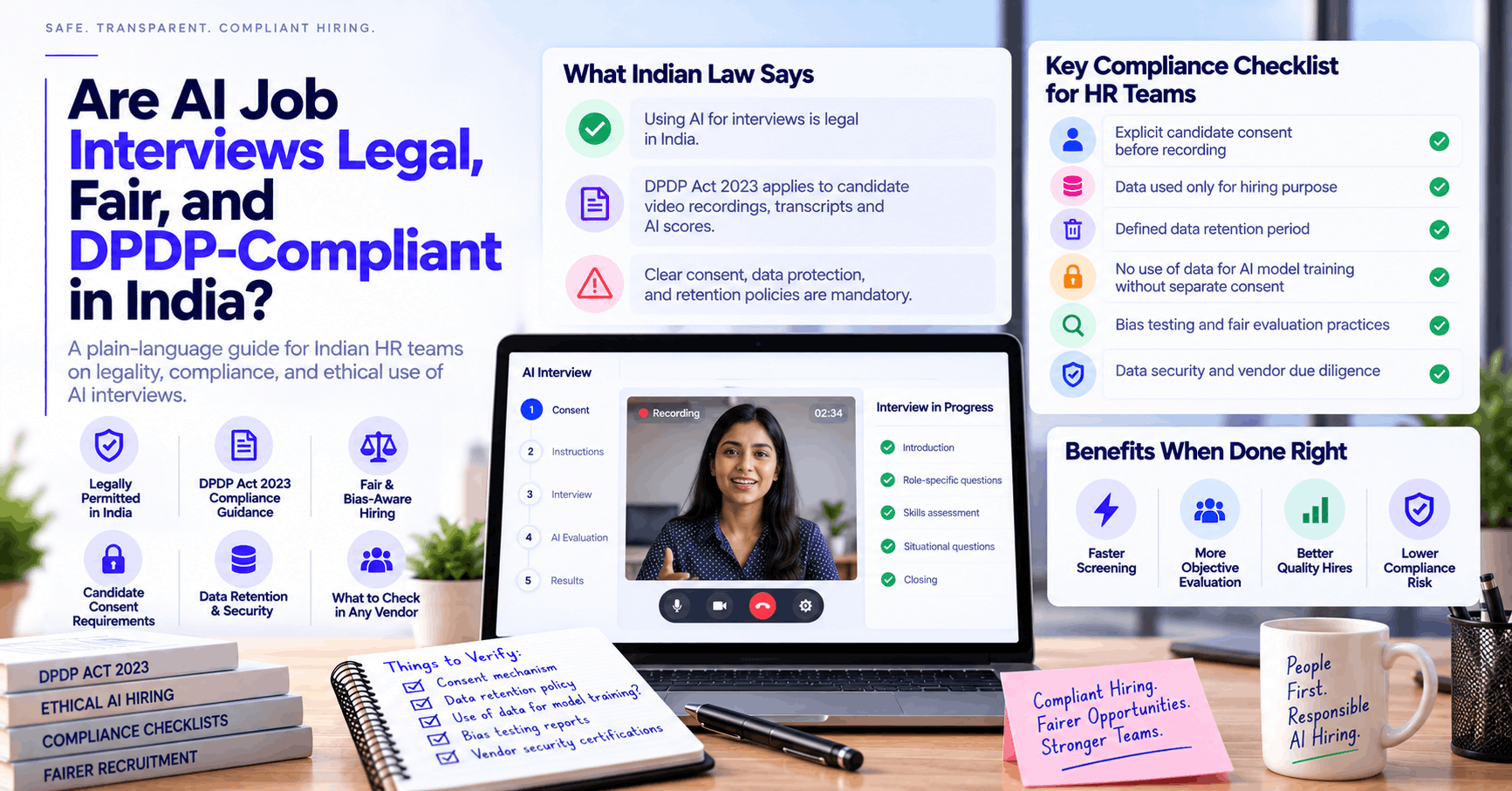
AI job interviews are legal in India — there is no law that prohibits automated candidate screening or AI-scored video interviews. What the law does regulate, increasingly specifically, is how candidate data is collected, stored, and used. India's Digital Personal Data Protection (DPDP) Act 2023 applies directly to candidate video recordings, interview transcripts, and AI-generated assessment scores. An AI interview tool that runs on a vendor's servers without a clear data processing agreement, without candidate consent for recording, and without defined data retention limits creates real legal exposure. RecruitKar's proctored AI video interview software is built with DPDP-aligned data architecture — this post explains what that means in practice, and what every HR team should verify before deploying any AI interview tool.
The legal question: is using AI for interviews actually permitted?
India currently has no specific legislation that prohibits the use of AI in hiring decisions. There is no Indian equivalent to New York City's Local Law 144 (which mandates bias audits for automated employment tools) or the EU AI Act's high-risk classification for AI systems used in employment screening.
What does exist, and what is directly relevant, is the DPDP Act 2023 — India's first comprehensive data protection legislation, which came into effect in 2023 and whose rules under the Act are expected to be notified progressively. The Act applies broadly to digital personal data — and candidate video recordings, voice recordings, interview transcripts, and AI-generated assessment scores are unambiguously personal data under its framework.
So to answer the question precisely: using AI to screen, score, or evaluate candidates is legal in India. Using it in a way that violates candidate data rights under the DPDP Act is not.
What the DPDP Act 2023 requires for recruitment specifically
The DPDP Act establishes several obligations that apply directly to how organisations use AI interview tools. Here are the provisions most relevant to HR teams.
Consent — and what it has to mean
The DPDP Act requires that personal data be processed with the "free, specific, informed, unambiguous, and unconditional consent" of the data principal (the candidate). In the context of an AI interview, this means:
- The candidate must be told, before the interview begins, that their video and audio are being recorded
- The candidate must be told that the recording will be processed by an AI system and that an AI-generated score will inform (or in some implementations, determine) shortlisting decisions
- The candidate must actively consent to this — not just by proceeding past a terms-and-conditions page they may not have read, but through an affirmative acknowledgment that the interview is recorded and AI-evaluated
- The consent must be specific to the purpose: consent to "video interview" doesn't automatically extend to consent to "AI scoring of verbal content for competency evaluation"
Implied consent — the assumption that a candidate who showed up for the interview consented to everything done with their recording — is not sufficient under the DPDP Act's standard.
Practical implication: The interview platform must include an explicit consent screen before recording begins. The consent language must accurately describe what will be done with the recording. This should be verifiable and logged.
Data minimisation and purpose limitation
The DPDP Act requires that only data necessary for the stated purpose be collected, and that it not be used for purposes other than those consented to. For an AI interview:
- Video and audio recordings should only be stored and processed to the extent necessary for the evaluation purpose
- The recording should not be used for any other purpose — training a new AI model, research, sharing with third parties — without separate, specific consent
- If a candidate is not hired, the recording should not be retained indefinitely "just in case" — there should be a defined retention policy
Practical implication: Check whether your AI interview vendor's contract specifies that candidate recordings are used to train or improve their AI model. If it does, this is a use beyond the candidate's interview evaluation — and it requires either separate consent or removal from the contract.
Data retention limits
The DPDP Act does not specify a single retention period for employment data, but it establishes a principle of purpose limitation — data should not be retained beyond the period necessary for the purpose it was collected for. For interview recordings, this points toward:
- A defined retention period stated to the candidate at consent
- Deletion of recordings after that period (or after hire/rejection, plus a reasonable review period)
- A documented process for deletion rather than indefinite archiving
Practical implication: Ask your AI interview vendor: what is the default retention period for candidate recordings? Can it be configured to match your company's policy? Who bears responsibility for deletion at the end of the retention period?
Data principal rights
Under the DPDP Act, candidates have rights over their own data — including the right to access what data has been collected about them and to request correction or erasure. This creates an obligation for organisations to be able to respond to such requests.
Practical implication: If a candidate asks "what data do you have about my interview and how was it used," you need to be able to answer. This requires that your AI interview vendor provides a clear record of what data was collected, how it was processed, and what the outputs were.
Data localisation and cross-border transfers
The DPDP Act includes provisions on cross-border data transfers — personal data of Indian residents may not be transferred to certain countries without appropriate safeguards. For organisations using AI interview tools hosted outside India, particularly in the US or Europe:
Practical implication: Ask where candidate recordings are stored and processed. If a vendor's servers are outside India, ask whether the vendor has a Data Processing Agreement (DPA) that addresses cross-border transfer requirements under the DPDP Act.
The fairness question: does AI interviewing introduce new forms of bias?
Legality and fairness are related but not identical questions. An AI interview tool can be legal under DPDP and still produce biased outcomes that disadvantage certain candidate groups.
The real bias risks in AI interviewing
Accent and language bias in transcription: Speech-to-text transcription systems that were trained primarily on American or British English pronunciation produce systematically more errors on Indian-accented English and regional-language speech. If the AI is scoring a transcription rather than raw audio, errors in transcription produce errors in scoring — and those errors cluster by accent, which correlates with regional and linguistic background.
Communication style versus competency: AI systems that score aspects of communication style — pace, vocabulary complexity, confidence markers — may systematically reward the communication patterns of candidates from higher-socioeconomic backgrounds, better-resourced educational environments, or specific cultural contexts. This can produce discriminatory outcomes even when no protected characteristic is explicitly considered.
Training data reflecting historical outcomes: Some AI interview scoring models are trained on historical interview data — comparing how candidates answered questions to outcomes like "was hired" or "performed well." If historical hiring outcomes were biased (certain profiles being hired at higher rates for reasons unrelated to job performance), the model learns to replicate those biases.
What mitigates these risks in practice
Structured, competency-based rubrics: Scoring that evaluates whether an answer demonstrates a specific, job-relevant competency — rather than evaluating overall impression or communication style — is considerably more defensible than holistic scoring. The rubric becomes the object of scrutiny rather than an opaque model output.
Human review of AI scores: AI scoring that informs a human decision rather than replacing it creates an accountability layer that catches systematic errors before they become systematic exclusion. The human reviewer can override a score that seems anomalous.
Multilingual support with validated accuracy: A platform that supports regional Indian languages isn't just a convenience feature for candidates — it's a fairness feature that prevents accent and language from functioning as a proxy for competency. RecruitKar's AI video interviews support 12 Indian languages, with proctoring and structured scoring applied consistently across all of them.
Transparency in scoring rationale: A scoring system that shows which criteria were met strongly, which were weak, and which were missing — rather than a single opaque score — allows recruiters to identify and question assessments that don't match their own reading of a candidate's qualifications.
What to ask any AI interview vendor before deploying
This checklist applies to any platform you're evaluating — including RecruitKar. These are the questions that distinguish a vendor who has thought seriously about DPDP compliance and fairness from one who has applied a privacy policy as a legal checkbox.
On consent and transparency:
- Does your platform include an explicit consent screen before recording begins?
- Is the consent language specific about AI scoring, or does it only mention recording?
- Can we customise the consent language to match our company's specific use of the tool?
- Is consent logged and auditable?
On data storage and retention:
- Where are candidate recordings stored (country and cloud provider)?
- What is the default retention period?
- Can retention periods be configured to comply with our data policy?
- Are candidate recordings used to train or improve your AI model? If so, is this disclosed to candidates?
On data subject rights:
- Can you provide a record of all data collected for a specific candidate upon request?
- Is there a process for candidate data erasure requests?
On bias and fairness:
- Has your AI scoring been tested for differential outcomes across accent, gender, and age groups?
- What transcription accuracy has been validated for Indian English accents and regional languages?
- Does scoring evaluate job-relevant competencies specifically, or holistic impressions?
On contracts and liability:
- Is there a Data Processing Agreement available that addresses DPDP Act requirements?
- Who bears data controller responsibility — the employer or the vendor?
How RecruitKar approaches DPDP compliance
Full technical and legal detail is in RecruitKar's DPDP compliance & privacy standards documentation. The architecture principles most relevant for compliance-focused buyers:
- Explicit, logged candidate consent before any recording begins, with consent language that accurately describes AI evaluation
- Configurable data retention periods — organisations set their own retention policy rather than accepting a vendor default
- Candidate recordings are not used for model training without separate, explicit consent
- Data residency options available for Indian data localisation requirements
- A Data Processing Agreement available for enterprise customers that addresses DPDP obligations on the vendor-processor side
On the fairness side, RecruitKar's scoring is rubric-based against configurable job-specific criteria — not holistic impression scoring. The rubric is set by the hiring team before the interview begins and applied consistently to every candidate. Scoring rationale is visible at the criterion level, not just as a single output score. And multilingual support across 12 Indian languages addresses the accent and language fairness risk directly. See how these combine in practice on the objective hiring rubrics page.
The bottom line on legality and compliance
AI interviews are legal in India. The compliance requirements that do apply — under the DPDP Act 2023 — are about how candidate data is handled, not about whether AI can be used. Meeting those requirements is achievable with the right vendor architecture and the right internal processes.
The risk is not in using AI interviews. The risk is in deploying them without verifying the data handling architecture, without providing candidates with adequate consent and disclosure, and without choosing a scoring approach that evaluates job-relevant competencies rather than proxy characteristics that correlate with protected demographics.
A compliance-focused HR team asking the right questions of a vendor — including the checklist above — will find that responsible AI interview tools can address most DPDP obligations directly. The ones that can't answer these questions clearly are the ones to be cautious about.
Frequently asked questions
Is there a specific Indian law that bans or restricts AI in hiring decisions? No specific law in India currently bans AI-assisted hiring decisions. The DPDP Act 2023 regulates how personal data (including candidate recordings and assessment data) is collected, processed, and stored. India's Equal Remuneration Act and related employment legislation prohibit discrimination on specific protected grounds, but don't address AI specifically. This legal landscape is evolving — regulatory attention on AI in hiring is increasing globally and India is expected to follow — which is why building DPDP-compliant practices now is preferable to retrofitting them after a more specific regulation arrives.
Does the DPDP Act apply to foreign companies hiring candidates in India? Yes, if those companies are collecting, processing, or storing personal data of Indian residents — including through an AI interview platform — the DPDP Act applies to them. The Act's obligations follow the data principal (the Indian candidate), not just the geographic location of the company collecting the data.
What is the maximum penalty for DPDP Act violations? The DPDP Act 2023 provides for financial penalties of up to ₹250 crore for significant data protection violations. The penalty framework is graduated by severity, and penalties for specific categories of non-compliance (failure to implement reasonable security safeguards, failure to notify data breaches) are separately specified. The rules under the Act — which will specify procedural details — are expected to be notified progressively.
Should we get candidate consent before or during the interview? Before, unambiguously. The consent screen should appear before any recording begins — not after the candidate has already started speaking. Consent obtained after recording has begun cannot retroactively validate that recording under the DPDP Act's requirement for prior consent.
Can a rejected candidate request their AI interview score? Under the DPDP Act, a data principal has the right to access personal data that has been processed about them. An AI-generated interview score, associated with a specific candidate, is personal data. Whether organisations are required to provide the specific numeric score or only to confirm that data was processed is a question that will likely be clarified through rules and enforcement guidance. The practical approach is to have a process for responding to such requests before they arrive, rather than after.
Learn more about RecruitKar's DPDP-ready architecture and ethical AI standards. See how consent, data retention, and rubric-based scoring are implemented — proctored AI video interview software built for Indian compliance requirements.