"What's our cost-per-hire?" is one of those questions that sounds simple until someone actually tries to answer it precisely. Does it include the recruiter's salary, or just direct spend like job board fees? What about the time hiring managers spend interviewing — does that count? A signing bonus? The answer, done properly, is more nuanced than most teams initially assume, and getting it wrong in either direction — undercounting or overcounting — makes the number nearly useless for the decisions it's meant to inform.
This post walks through the standard formula, what should and shouldn't be included, common mistakes, and — more importantly — what to actually do with the number once you have it.
The standard formula
The most widely used, industry-standard formula for cost-per-hire is:
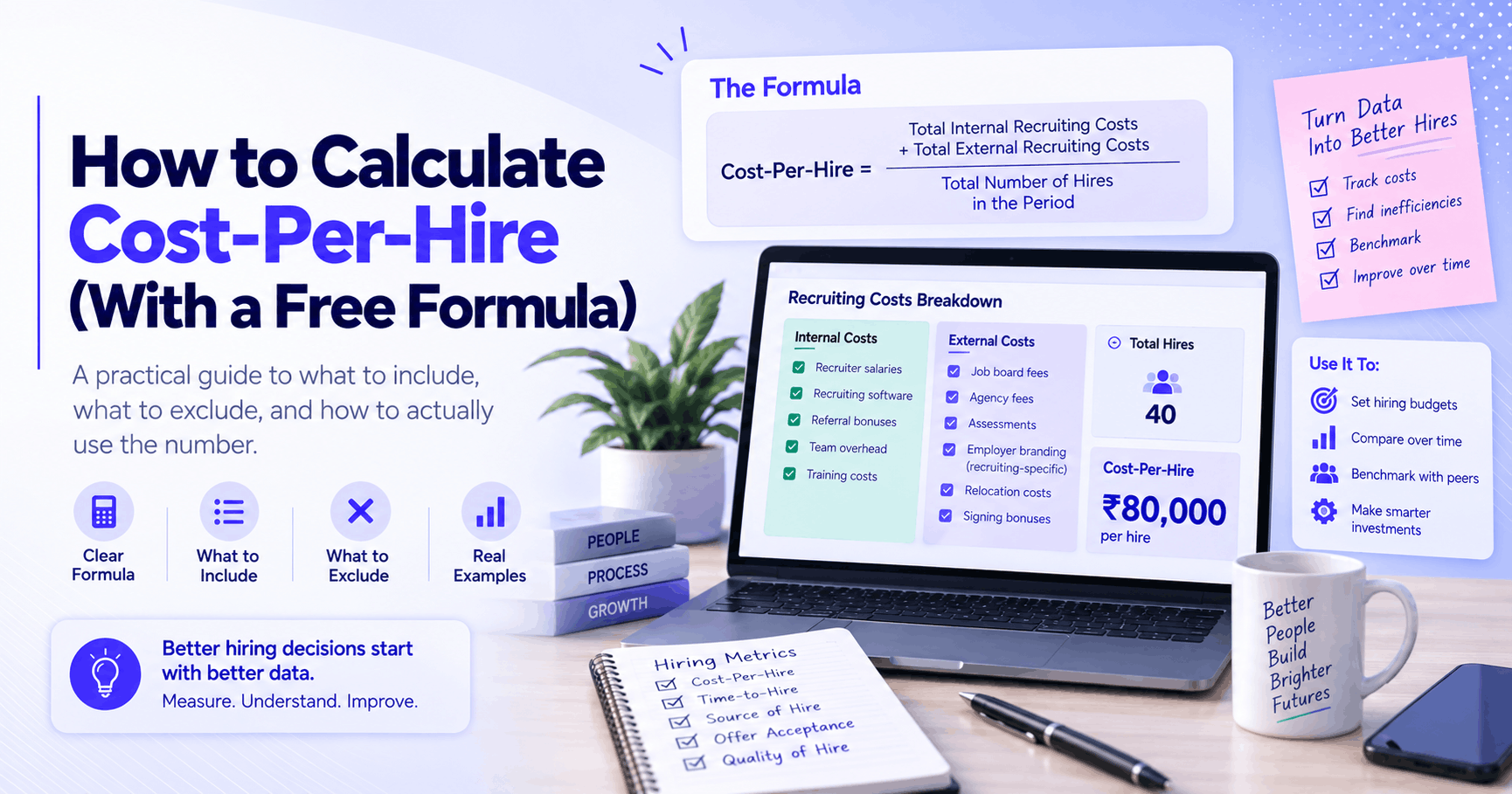
Cost-per-hire = (Total internal recruiting costs + Total external recruiting costs) ÷ Total number of hires in the period
This formula, formalized jointly by SHRM and ANSI (the American National Standards Institute) as a recruiting metrics standard, is worth using specifically because it enables consistent comparison — both against your own historical numbers over time, and against external benchmarks that use the same definition.
What counts as internal costs
- Recruiter and sourcer salaries and benefits, prorated to the time actually spent on recruiting activities (relevant if recruiters also handle other responsibilities).
- Internal recruiting team overhead — the proportional share of office space, equipment, and administrative support attributable to the recruiting function.
- Referral bonuses paid to employees for successful hires through the referral program.
- Recruiting technology costs — ATS, sourcing tools, assessment platforms, and other recruiting software, prorated across the hiring volume the tools support.
- Relevant training costs for recruiters and hiring managers directly related to hiring skills (interview training, for example).
What counts as external costs
- Job board and posting fees — LinkedIn, Naukri, Indeed, and similar platforms.
- Agency or staffing firm fees, if external recruiters were used for any portion of the hires being measured.
- Advertising and employer branding spend directly tied to recruiting (career fair costs, recruiting-specific social media spend).
- Background check and assessment costs per candidate.
- Relocation costs, where applicable and where the company covers this directly.
- Signing bonuses, in some but not all formulations — this is one of the areas where practice varies, so it's worth being explicit and consistent about your own inclusion criteria (more on this below).
What's commonly excluded, and why
- Hiring manager time spent interviewing is technically a real cost (their time has value), but it's excluded from the standard SHRM/ANSI formula specifically because it's difficult to measure consistently and varies enormously by role and company. Some organizations track this separately as a supplementary metric, but it's not part of the standard cost-per-hire calculation.
- Onboarding costs are generally treated as a separate metric (cost of onboarding, distinct from cost of hiring), since onboarding continues well past the point a hire is technically "made," and mixing the two makes both numbers less precise.
- General employer branding spend not tied to a specific recruiting effort (broad company marketing that happens to also build employer reputation) is typically excluded, since attributing it specifically to recruiting outcomes is difficult to do accurately.
- Compensation of the hired employee itself is not a recruiting cost — it's a separate operating expense, and including it would conflate two entirely different budget categories.
A worked example
Suppose a company made 40 hires in a quarter. Internal costs for that quarter: two full-time recruiters at a combined ₹18 lakh in prorated quarterly salary and benefits, plus ₹2 lakh in recruiting software costs, plus ₹1 lakh in referral bonuses paid out — totaling ₹21 lakh in internal costs. External costs: ₹4 lakh in job board fees, ₹6 lakh in agency fees for a portion of harder-to-fill roles, and ₹1 lakh in assessment tool costs — totaling ₹11 lakh in external costs.
Total recruiting cost: ₹21 lakh + ₹11 lakh = ₹32 lakh Cost-per-hire: ₹32 lakh ÷ 40 hires = ₹80,000 per hire
This single blended number is useful as a headline metric, but it's worth immediately noting its limitation: it averages across very different role types.
Why a single blended number can be misleading
A single company-wide cost-per-hire figure obscures more than it reveals if hiring spans meaningfully different role types. A ₹80,000 average might represent a mix of ₹15,000 entry-level hires and ₹300,000 senior technical hires — a number that doesn't accurately describe either category, and that could shift significantly quarter to quarter just based on hiring mix, without any actual change in recruiting efficiency.
A better practice: segment cost-per-hire by role level, department, or hiring channel. Calculating it separately for entry-level versus senior roles, or for roles filled primarily through job boards versus agencies versus internal sourcing, produces numbers that are actually comparable and actionable, rather than one blended figure that changes based on hiring mix as much as actual efficiency.
What to actually do with the number
- Track it over time, segmented consistently, to spot trends. A rising cost-per-hire for a consistent role category, over consecutive quarters, is worth investigating — is it reflecting genuinely higher market competition for that role type, or is it a sign of inefficiency creeping into the process (more reliance on expensive agencies, longer time-to-hire driving up internal cost allocation)?
- Compare cost-per-hire across different sourcing channels for the same role type. If agency-sourced hires for a given role consistently cost significantly more than hires sourced directly, that's a concrete data point for evaluating whether to shift more sourcing effort toward the cheaper channel, weighed against any differences in candidate quality or time-to-hire between the two.
- Use it alongside quality metrics, never in isolation. The cheapest possible cost-per-hire is trivial to achieve by cutting corners — skipping structured interviews, rushing decisions, reducing screening rigor. Cost-per-hire only tells a useful story when paired with quality-of-hire indicators (retention at 6 and 12 months, hiring manager satisfaction, performance ratings) — a lower cost-per-hire that comes with meaningfully worse retention isn't actually an efficiency win.
- Use it to build a business case for tooling or process investment. If a specific tool or process change (better sourcing technology, an in-house team versus continued reliance on agencies) can be shown to meaningfully reduce cost-per-hire for a given role category, while maintaining or improving quality metrics, that's a concrete, defensible case for the investment — more persuasive to leadership than a general claim of "this will make hiring better."
Common mistakes to avoid
- Including inconsistent cost categories from period to period. If signing bonuses were included in Q1's calculation but excluded in Q2's, the resulting trend line is measuring a definitional change, not an actual shift in recruiting cost or efficiency — pick a consistent methodology and stick with it.
- Comparing your number directly against a generic industry benchmark without checking methodology alignment. Published benchmarks vary in exactly what they include and exclude — a benchmark that excludes referral bonuses while your calculation includes them will produce a misleading comparison, even if both numbers are individually accurate.
- Treating cost-per-hire as the only metric that matters. As noted above, cost-per-hire without quality-of-hire context can incentivize exactly the wrong behavior — rushing decisions or cutting corners to hit a lower number, at the expense of hiring quality that costs far more down the line through turnover or poor performance.
- Forgetting to prorate shared costs accurately. A recruiter who spends 60% of their time on recruiting and 40% on other HR functions shouldn't have 100% of their salary counted toward cost-per-hire — under- or over-allocating shared costs like this distorts the number more than most teams initially realize.
Cost-per-hire in the Indian market specifically
A few India-specific considerations worth factoring in when calculating and benchmarking this metric locally. Job board costs in India vary considerably by platform and posting tier — a basic Naukri or Indeed posting costs meaningfully less than a premium placement or a dedicated agency search, and companies hiring at real volume often negotiate bulk or subscription pricing that changes the per-posting math compared to one-off usage. Agency and staffing fees in India are also typically structured differently than in some Western markets — often as a percentage of the hired candidate's annual compensation rather than a flat fee, which means cost-per-hire for senior roles sourced through agencies can scale up meaningfully faster than for equivalent junior roles. And because compensation benchmarks vary enormously by city tier and industry within India, comparing your own cost-per-hire against a generic "India average" benchmark published by an international HR research firm is often less useful than building an internal benchmark specific to your own role types, locations, and hiring channels over time.
Building a simple tracking template
For teams without existing recruiting analytics infrastructure, a straightforward spreadsheet tracking the following, updated quarterly, is enough to get meaningful signal without needing sophisticated tooling: total internal cost (prorated recruiter time, tooling, referral bonuses) and total external cost (job boards, agencies, assessments) for the period, broken out by role category rather than blended into one company-wide number; total hires in that period, by the same role categories; the resulting cost-per-hire per category; and a corresponding quality indicator (6-month retention rate, or hiring manager satisfaction score, tracked alongside) for the same hires. Reviewing this quarterly, looking specifically at trends within each role category rather than the blended total, surfaces most of the actionable signal this metric can offer without requiring dedicated recruiting-analytics software.
How process efficiency connects to cost-per-hire
A meaningful share of recruiting cost is time-driven rather than purely spend-driven — a longer, less efficient process consumes more prorated recruiter salary time per hire, even before counting any additional job-board or agency fees incurred while a role stays open longer than necessary. This is one of the more direct, measurable links between process efficiency (reducing time-to-hire, cutting scheduling friction, consolidating fragmented sourcing and outreach into one connected pipeline) and the cost-per-hire number itself — faster, less friction-heavy hiring doesn't just feel better operationally, it shows up concretely in the internal-cost side of this calculation.
The bottom line
Cost-per-hire is a genuinely useful metric, but only when calculated consistently, segmented meaningfully by role type rather than blended into one misleading average, and interpreted alongside quality-of-hire indicators rather than in isolation. Used well, it's a concrete way to identify where recruiting spend is actually going, compare channels and approaches on real data rather than assumption, and build a defensible case for process or tooling investment — used carelessly, it's just as easy to optimize the number in ways that quietly damage hiring quality instead.