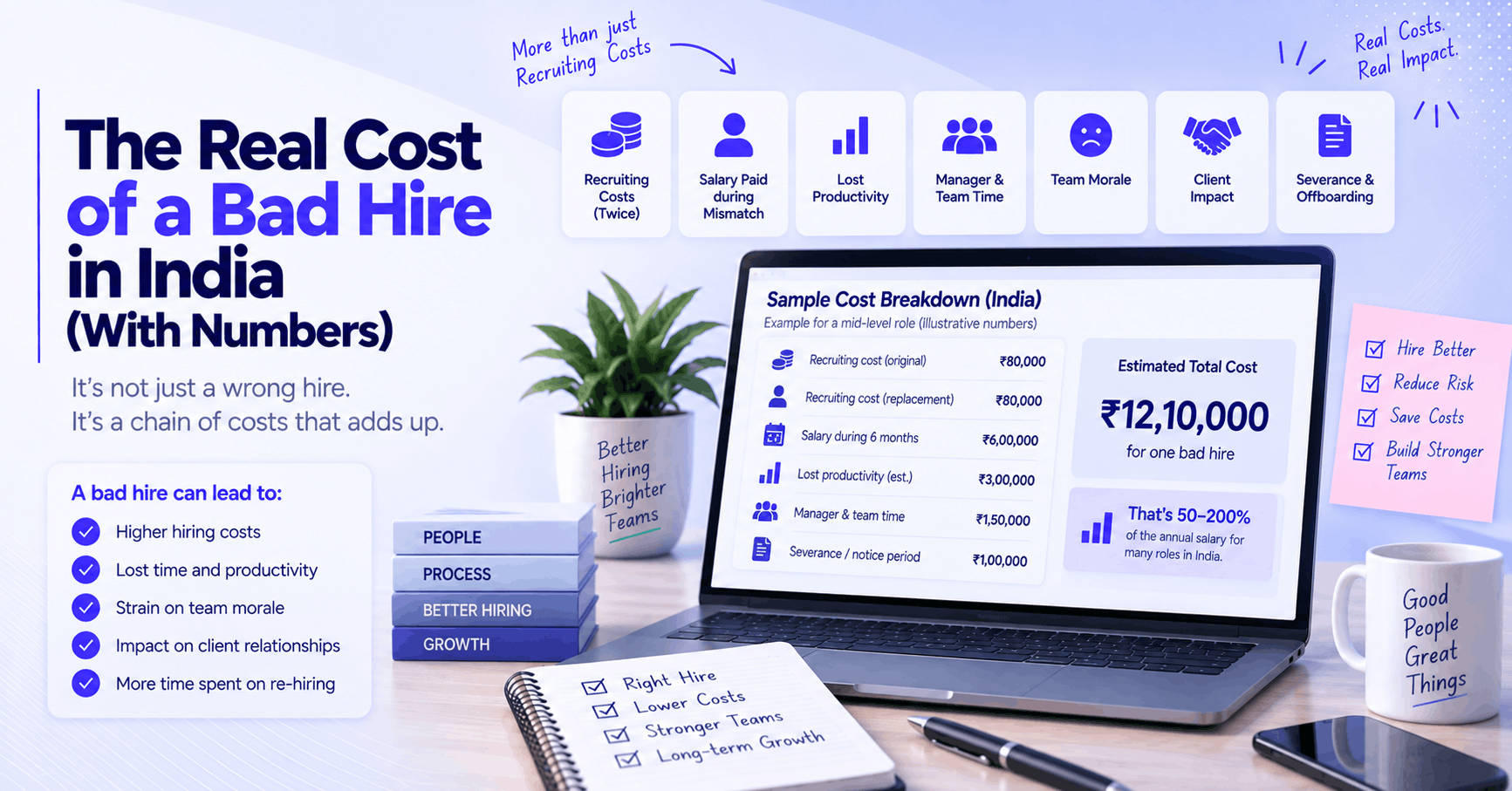
"We'll figure it out once they're in the role" quietly costs companies far more than most hiring teams realize. A bad hire isn't just an awkward performance conversation months later — it's a compounding cost that touches recruiting spend, team productivity, manager time, and sometimes client relationships, long before anyone calculates what it actually added up to.
This post breaks down where the cost of a bad hire actually comes from, offers a practical way to estimate it for your organization, and — more usefully — looks at what the data suggests about where bad hires most commonly originate, since that's what's actually actionable.
What counts as a "bad hire," precisely
Before the cost breakdown, it's worth being precise about the term, as it covers a few genuinely different scenarios:
- Underperformance relative to role expectations despite reasonable onboarding and support.
- Poor cultural or team fit, creating friction disproportionate to the individual's output.
- Voluntary exit within a short window (often defined as under a year, sometimes under six months), which frequently — though not always — reflects a mismatch that should have been caught earlier in the process.
All three scenarios share a common thread: the hiring process didn't accurately predict how this person would actually perform or fit once in the role.
Where the cost actually comes from
Direct recruiting cost, spent twice
The most obvious cost: the original cost-per-hire for the role that didn't work out, plus the full cost of re-recruiting for the same position — sourcing, screening, interviewing, and onboarding all over again. If a role's cost-per-hire was, say, ₹80,000, a bad hire doesn't just waste that figure — it typically means paying it again for the replacement, effectively doubling direct recruiting spend for a single headcount.
Compensation paid during the mismatch period
Salary, benefits, and any other compensation paid to the underperforming or mismatched employee during their tenure represents real spend that produced comparatively little of the value the role was hired to deliver. This is often the largest single line item in a full cost accounting, particularly for more senior or highly compensated roles.
Lost productivity and output
Beyond direct compensation, a bad hire frequently produces meaningfully less output or lower-quality work than a genuinely strong hire would have in the same period. Depending on the role, this may also require rework from colleagues or managers to correct mistakes, adding harder-to-quantify lost productivity across the team, not just the individual.
Manager and team time
Underperformance rarely resolves itself without intervention. Managers spend disproportionate time on performance coaching, additional oversight, and difficult conversations with a struggling or mismatched hire — time diverted from other priorities and team members who might otherwise benefit from that attention.
Team morale and cohesion effects
A poor fit — particularly one affecting team dynamics or requiring colleagues to compensate for performance gaps — has real, if harder-to-quantify, effects on team morale and cohesion. These can in turn contribute to broader team disengagement or even prompt other team members to consider leaving if the situation persists unresolved.
Client or customer impact, for client-facing roles
For roles with direct client or customer interaction, a bad hire can damage external relationships in ways that are genuinely difficult to reverse. A client who had a poor experience with an underperforming account manager, for instance, may carry that impression well past the point the individual employee issue is actually resolved.
Severance, notice period, and offboarding costs
Depending on how the situation is resolved — whether through termination, mutual separation, or the employee's own departure — there are often direct costs associated with notice periods, any severance arrangements, and the administrative overhead of offboarding, layered on top of everything above.
A practical way to estimate this for your own organization
A reasonably useful, if necessarily approximate, estimate can be built from a few inputs:
- Doubled recruiting cost: 2 × your cost-per-hire for the relevant role category (covering both the original hire and the replacement search).
- Compensation during the mismatch period: Monthly compensation × number of months before the mismatch was identified and addressed (commonly somewhere between 3–9 months in practice, though this varies significantly by role and how quickly performance issues are typically caught).
- Estimated productivity loss: A rough estimate — some organizations use a fraction of the role's compensation (commonly cited estimates range from 30% to as high as 150% of annual salary in various industry studies, though these figures vary enormously by methodology and shouldn't be treated as precise) as a proxy for lost productivity and rework, applied across the mismatch period rather than a full year.
- Manager time cost: An estimated number of hours per week spent on additional coaching or oversight, multiplied by the manager's effective hourly cost, summed across the mismatch period.
Adding these together produces a directional estimate — not a precise figure, since some inputs (productivity loss, morale effects) are inherently difficult to measure precisely, but specific enough to be genuinely useful for internal decision-making, particularly when comparing the estimated cost of a bad hire against the cost of process improvements designed to prevent them.
A worked example
Consider a mid-level marketing role in India with an annual compensation of ₹9 lakh (roughly ₹75,000/month), where a mismatch is identified and addressed after 5 months:
- Doubled recruiting cost (assuming ₹60,000 cost-per-hire for this role category): ₹1,20,000
- Compensation during the mismatch period: ₹75,000 × 5 = ₹3,75,000
- Estimated productivity loss (using a conservative 30% of the compensation paid during the mismatch period as a rough proxy): ₹1,12,500
- Estimated manager time cost (assuming roughly 3 hours/week of additional coaching time over 5 months, at an estimated manager effective cost of ₹1,500/hour): ₹90,000
Rough total estimate: approximately ₹6,97,500 — nearly nine times the original monthly compensation for the role, and well above what many teams intuitively assume a single mismatched hire actually costs when they haven't calculated it directly.
This example deliberately excludes harder-to-quantify factors like team morale effects or client impact, which means it likely understates the true cost in many real situations rather than overstating it.
What the data suggests about where bad hires most commonly originate
Rather than treating bad hires as simply unpredictable bad luck, it's worth looking at where mismatches most commonly trace back to, since that's what's actually preventable:
- Unstructured, inconsistent interviews. As covered in research on structured versus unstructured interviewing, unstructured interviews are a meaningfully weaker predictor of actual job performance. Many bad hires trace back to a process that relied heavily on gut feel or interviewer chemistry rather than structured, evidence-based evaluation of job-relevant competencies.
- Rushed decisions under hiring pressure. Roles filled under significant time pressure — an urgent backfill, a growth-driven scramble — are disproportionately represented in post-hoc analyses of hiring mistakes, since time pressure tends to compress or skip steps (reference checks, additional interview rounds) that exist specifically to catch mismatches before an offer goes out.
- Overvaluing credentials or pedigree over demonstrated skill. A candidate with an impressive résumé on paper doesn't automatically translate into strong on-the-job performance — mismatches are common when screening leans heavily on credentials rather than direct evidence of the actual skills the role requires.
- Skipped or superficial reference checks. Reference checks are sometimes treated as a formality rather than a genuine diligence step, and skipping or rushing them removes one of the more direct sources of information about how a candidate has actually performed in similar situations previously.
- Misalignment on role expectations from the start. Sometimes a "bad hire" isn't actually a capability mismatch — it's a case where the role itself was unclear or where expectations communicated during hiring didn't match the reality of the job, setting up a mismatch that had little to do with the candidate's actual ability.
What this means for how much process investment is justified
Given the scale of cost involved — often several multiples of a role's monthly compensation, even by conservative estimates — investments in reducing hiring mismatches (structured interviews, more rigorous screening, genuine reference checks, reducing rushed hiring under pressure) tend to pay for themselves fairly quickly if they meaningfully reduce even a modest share of bad hires. This is a useful framing for justifying process investment internally: rather than treating hiring-quality improvements as a soft, hard-to-quantify benefit, the cost-of-a-bad-hire calculation gives a concrete number to weigh against the cost of the process improvement itself.
Tools and process changes that support more consistent, evidence-based hiring decisions — structured pipelines that track interview feedback and scoring consistently, sourcing and screening that prioritize actual demonstrated skill over credential-matching alone — are worth evaluating explicitly against this cost baseline, rather than purely on their impact on hiring speed or volume, since hiring quality and hiring efficiency are often treated as separate concerns when they're actually closely connected through exactly this kind of cost math.
The bottom line
The cost of a bad hire is considerably larger than the intuitive, "well, we'll just have to hire again" framing most teams default to — once direct recruiting cost, compensation paid during the mismatch, lost productivity, and manager time are actually added up, the total frequently runs to several times a role's monthly compensation, even before accounting for harder-to-quantify effects on team morale or client relationships. This isn't a reason for hiring paralysis — it's a reason to treat process rigor at the point of hiring (structured interviews, genuine reference checks, resisting the pressure to rush under time constraints) as a direct, quantifiable investment against a real, calculable downside, rather than an abstract best practice worth pursuing only when convenient.