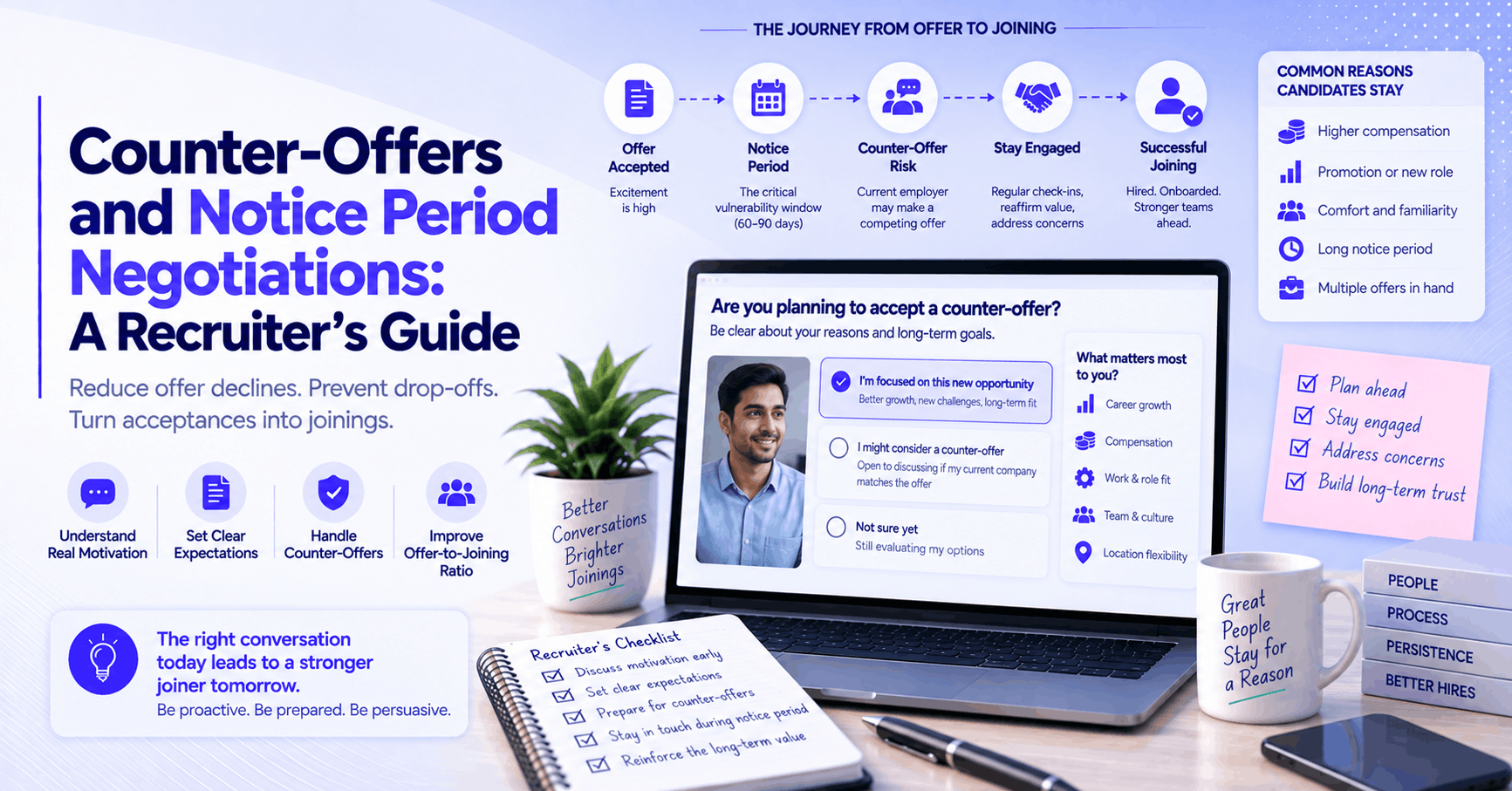
Few things are more frustrating in recruiting than a candidate accepting an offer, then not showing up on their start date. Weeks of sourcing, screening, and interviewing — plus the hiring manager's time and a role that's now still open — undone by a decision made in a conversation you weren't part of.
In India specifically, this problem has a particular shape. Notice periods commonly run 60 to 90 days, sometimes longer for senior roles — an extended window during which a candidate remains embedded in their current company, fully available for a counter-offer conversation, and increasingly subject to second thoughts as the initial excitement of a new opportunity fades. That gap between offer acceptance and actual joining is where a meaningful share of hiring effort quietly evaporates, and it's an under-discussed problem relative to how much it actually costs teams.
This post covers why this happens, what genuinely reduces the risk, and how to handle counter-offer situations when they do arise.
Why the offer-to-joining gap is such a problem in India
Long notice periods create an extended vulnerability window. A 90-day notice period means three months during which a candidate stays in their current environment, maintains existing relationships, and has ample time for both a counter-offer conversation and simple second-guessing. In markets with two-week or one-month notice standards, this window is dramatically shorter and the risk correspondingly lower.
Counter-offers are common and often substantial. When an employer learns a valued employee is leaving, particularly in competitive skill categories, a counter-offer with meaningful compensation increase or a promotion is a frequent response — and it's delivered by people who already have an established relationship with the candidate, which carries real persuasive weight against a new employer the candidate has only interacted with through a hiring process.
Multiple offers in flight are common in competitive skill markets. A strong candidate in a sought-after skill category may be weighing several opportunities simultaneously, and acceptance of one offer doesn't necessarily end their consideration of others still in progress.
Emotional inertia favors staying. Leaving a job involves real disruption — new team, new manager, unfamiliar environment, loss of accumulated relationships and standing. As the initial enthusiasm about a new opportunity fades over a long notice period, the comfort of familiarity often becomes more persuasive than it was at the moment of accepting the offer.
What actually reduces the risk, starting long before the offer stage
The most effective interventions happen well before an offer letter goes out — by the time a counter-offer conversation is happening, a lot of the outcome has already been determined by how the process was run.
1. Understand genuine motivation early, not just interest
A candidate who's leaving primarily for compensation is considerably more vulnerable to a counter-offer than one leaving for reasons a current employer can't easily fix — lack of growth path, poor management relationship, wanting fundamentally different work, or a change in life circumstances. Asking directly and specifically, early in the process, about what's actually driving the job search (rather than accepting a generic "looking for growth") gives real signal about counter-offer risk, and lets you address the actual motivation throughout the process rather than competing purely on compensation.
2. Discuss the counter-offer possibility explicitly, before it happens
This feels awkward but consistently helps: raising the topic directly before an offer is extended — "if you resign, there's a reasonable chance your current employer will make a counter-offer; have you thought about how you'd respond?" — prompts the candidate to think it through in advance, when they're clear-headed about why they wanted to leave, rather than in the emotionally charged moment when a counter-offer actually lands.
3. Make sure compensation is genuinely competitive, not marginally better
An offer that's only slightly above a candidate's current compensation is easy for a current employer to beat. An offer that's genuinely competitive for the role and market — and that the candidate perceives as fair rather than as a negotiation starting point — is considerably more defensible against a reactive counter-offer.
4. Set compensation expectations early to avoid late-stage surprises
Discussing compensation range early in the process, rather than leaving it to the final stage, prevents a scenario where a candidate invests weeks in a process and then receives an offer meaningfully below expectations — which not only risks an immediate decline but leaves them more receptive to whatever their current employer proposes instead.
5. Build a genuine relationship with the candidate, not just a transactional process
A candidate who feels a real connection to the hiring manager, the team, and the specific work they'd be doing is harder to pull back than one whose entire relationship with the new employer consists of a few structured interviews and an offer letter. This is one of the more underrated benefits of running a thoughtful, communicative hiring process rather than a purely mechanical one.
Managing the notice period itself
This is where most of the actual risk lives, and where most teams do the least.
Stay genuinely engaged throughout, not just at the start and end
A candidate who accepts an offer and then hears nothing for two months until a day-before-joining logistics email is considerably more likely to drift, reconsider, or accept a counter-offer than one who's been meaningfully engaged throughout. Regular, genuine check-ins — not just administrative paperwork requests — keep the new opportunity emotionally present rather than becoming an abstract future event while their current job remains the daily reality.
Use channels the candidate actually checks, and keep it human
Engagement during notice period works best when it feels genuine rather than procedural. Periodic informal check-ins through a channel candidates actually respond on — for candidates in India, WhatsApp is often far more effective than email for this kind of light, ongoing contact — tend to sustain connection better than formal, infrequent email correspondence.
Involve the future manager and team, not just the recruiter
Connecting a candidate with their future manager and potential teammates during the notice period — a casual call, an invitation to a team event, or simply direct informal contact — builds the relational connection that makes leaving the offer considerably harder emotionally than if their only relationship is with a recruiter they'll never work with again.
Share genuinely useful context about the role and team
Sending relevant materials — team updates, information about projects they'll be working on, context about the company's direction — keeps a candidate mentally engaged with the new role and reinforces that they made the right decision, rather than leaving a two-month void where doubt can accumulate unchallenged.
Track notice-period candidates as an active pipeline stage
A common process gap: once an offer is accepted, the candidate effectively disappears from active tracking until their start date. Treating the notice period as an explicit, tracked pipeline stage — with defined check-in points rather than ad hoc contact — makes sustained engagement a deliberate process rather than something that depends on an individual recruiter remembering to follow up amid other priorities.
Measuring your offer-to-joining ratio
Most teams track time-to-hire and cost-per-hire but don't track this specific metric, which is often the more actionable one in a long-notice-period market. Offer-to-joining ratio is simply the percentage of extended and accepted offers that actually result in someone starting work — a team with a 70% ratio is losing nearly a third of its successfully closed offers somewhere between acceptance and day one, which represents an enormous amount of wasted recruiting effort that typically goes unmeasured and therefore unaddressed.
Worth tracking alongside it: at what point in the notice period drop-offs most commonly occur (early, mid, or close to the start date), and the stated reason where a candidate is willing to share it. Teams that track this often find patterns that suggest specific fixes — a cluster of drop-offs in the final few weeks, for instance, might point to insufficient engagement late in the notice period, while early drop-offs might suggest compensation or motivation issues that should have been surfaced before an offer went out at all.
A practical notice-period engagement cadence
Rather than leaving engagement to individual discretion, a defined cadence helps ensure it actually happens consistently. A reasonable structure for a 90-day notice period might look like: an immediate post-acceptance welcome and clear articulation of what happens next, including a rough timeline; a check-in within the first week or two, ideally including some direct contact with the future manager rather than only the recruiter; periodic informal contact roughly every two to three weeks thereafter — genuinely light and human rather than procedural, sharing relevant team or company updates; a more substantive touchpoint around the midpoint, potentially including an informal team introduction or invitation to a relevant team event; and a final stretch of more frequent contact in the last two to three weeks, covering practical onboarding logistics alongside continued relationship-building.
The specific cadence matters less than having one at all — the failure mode most teams fall into isn't choosing the wrong frequency, it's having no defined process and therefore defaulting to near-total silence until the week before a start date.
When a counter-offer actually happens
If a candidate tells you they've received a counter-offer, a few things genuinely help:
Respond promptly, but don't panic-escalate. Immediately matching or exceeding a counter-offer on compensation alone often doesn't resolve the underlying question, and can start a bidding war you'll lose or win expensively. Take the conversation seriously, but start by understanding rather than immediately countering.
Return to their original stated motivation. If the candidate originally said they were leaving because of limited growth opportunity or a difficult management situation, the honest question is whether a compensation increase actually addresses that — often it doesn't, and helping the candidate think this through clearly, without pressure, is more genuinely useful than simply outbidding.
Be honest about what you can and can't do. If matching the counter-offer isn't possible or wouldn't be equitable relative to your existing team's compensation, saying so directly — while reinforcing the genuine reasons the role is a good opportunity — is better than vague hedging that erodes trust either way.
Accept that some candidates will stay, and handle it gracefully. A candidate who accepts a counter-offer isn't necessarily lost permanently — handling that outcome professionally, without pressure or resentment, keeps the door open for a future conversation, which matters more than it might seem given how often counter-offer acceptances lead to a renewed job search within a year.
What not to do
Don't pressure or create artificial urgency. Aggressive tactics — exploding offer deadlines, guilt-based appeals, or pressure during the notice period — tend to backfire, and even when they work short-term, often produce a hire who starts with a negative impression of the company.
Don't disparage their current employer or the counter-offer. Arguments that "counter-offers never work out" or criticism of their current company can come across as manipulative rather than helpful, and candidates generally recognize it as a sales tactic rather than genuine advice.
Don't disappear during the notice period and then reappear only at the end. As covered above, this is one of the most common and most avoidable contributors to offer-stage drop-off.
Don't treat an offer acceptance as the end of the recruiting process. It's genuinely the middle of it, particularly in a market where 60–90 day notice periods are standard.
The bottom line
The offer-to-joining gap in Indian recruiting is a genuine, costly problem, and it's one that's substantially influenced by decisions made well before an offer letter goes out — understanding a candidate's real motivation, making a genuinely competitive rather than marginally better offer, and treating the notice period as an active engagement stage rather than administrative dead time. Counter-offers will still happen, and some candidates will accept them regardless of how well a process was run. But the difference between a team that treats offer acceptance as the finish line and one that treats it as the start of a critical two-to-three-month engagement period shows up directly in how many accepted offers actually turn into people showing up on day one.