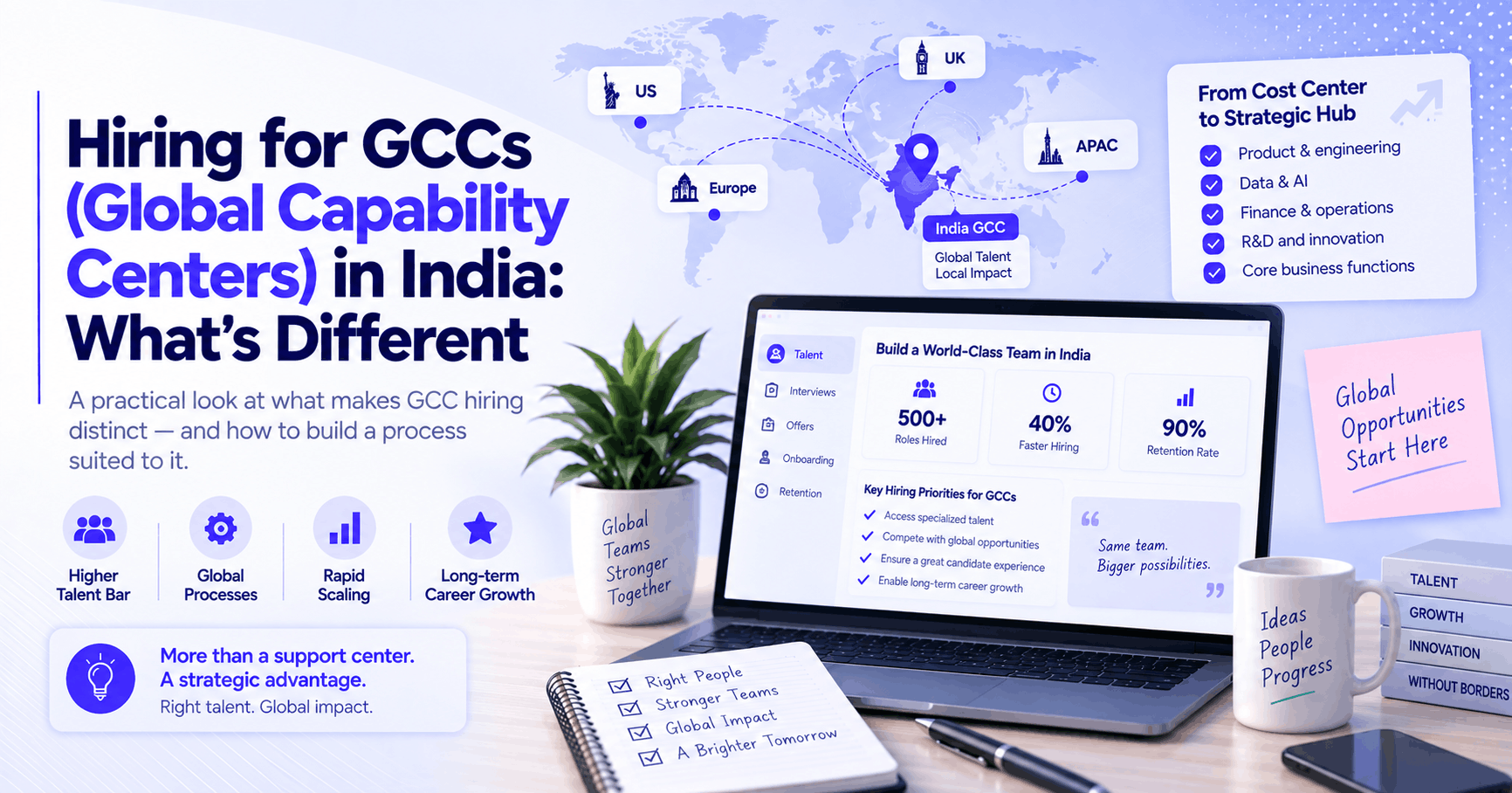
Global Capability Centers — often still called GCCs, and previously known more commonly as "captive centers" or "offshore development centers" — have shifted from a cost-arbitrage strategy to something closer to a core part of how large global companies operate. India has become one of the largest hubs for this model, with GCCs increasingly handling genuinely strategic work — product engineering, data science, finance operations, R&D — rather than the more commoditized back-office functions the term once implied.
This shift changes what hiring for a GCC actually requires. A center built to run strategic, high-value work needs a fundamentally different hiring approach than one built purely for cost-efficient support functions, and a lot of companies setting up or scaling a GCC in India are still operating with hiring practices designed for the older model. This post covers what's genuinely different about GCC hiring, and how to build a process suited to what GCCs have actually become.
What a GCC actually is, and how the model has changed
A Global Capability Center is an in-house, wholly-owned facility a global company sets up in another country — commonly India — to handle specific business functions directly, rather than through a third-party vendor or outsourcing partner. The key distinction from traditional outsourcing is ownership and integration: a GCC is part of the parent company itself, not an external service provider, which means employees are full members of the global organization, not vendor staff.
The functions housed in GCCs have expanded considerably over the past decade. Where early GCCs (often called "captives" at the time) focused heavily on IT support, back-office processing, and cost-driven functions, current GCCs increasingly own genuinely strategic work: core product engineering, AI/ML research, financial planning and analysis, cybersecurity, and increasingly, functions close to the parent company's core competitive advantage rather than peripheral support.
This shift matters enormously for hiring, because it changes the talent bar. A GCC handling strategic product engineering needs to compete for the same caliber of talent as the parent company's headquarters, not simply find cost-efficient staff for standardized processes — and the hiring approach needs to reflect that.
What's genuinely different about GCC hiring
The talent bar is often higher and more specialized than traditional India hiring
Because GCCs increasingly own strategic, not just supportive, functions, roles frequently require deep technical specialization, sometimes in genuinely scarce skill areas (specific AI/ML expertise, advanced data engineering, niche financial modeling) where the available talent pool, even in India's large market, is considerably smaller than for more standardized roles.
Candidates are evaluating the center against global career opportunities, not just local ones
A strong candidate considering a GCC role is frequently also weighing offers from Indian product companies, other GCCs, and sometimes opportunities abroad. This means employer branding, career growth narrative, and compensation competitiveness all need to be benchmarked against a broader, more competitive set than a typical local hiring process might assume.
Integration with a global parent organization adds process complexity
Hiring decisions, compensation bands, and sometimes even specific role requirements often need to align with global parent-company standards and approval chains, which can introduce coordination overhead beyond what a typical India-only hiring process involves — particularly for senior roles where global stakeholder sign-off is common.
Rapid scaling is common, and volume can be substantial
Many GCCs scale quickly once established, sometimes hiring hundreds of roles across a compressed timeline as a center builds out its initial capability — this brings in a lot of the same high-volume hiring challenges covered elsewhere, but layered on top of a higher talent bar than typical high-volume hiring, which is a genuinely harder combination to execute well.
Retention and career-pathing matter more than in a typical vendor relationship
Since GCC employees are full members of the parent organization, career growth, internal mobility, and long-term retention considerations are more central to hiring strategy than they would be in a transactional staffing or outsourcing relationship — hiring managers need to think about multi-year career trajectories, not just filling an immediate role requirement.
Why the India GCC market specifically is worth understanding right now
India's GCC sector has moved from a niche offshore strategy to one of the more significant drivers of professional hiring in the country, with the number of centers and the scope of work they own both expanding considerably in recent years. This isn't a marginal trend — it represents a meaningful share of new white-collar job creation, particularly in technology, finance, and increasingly R&D-adjacent functions, and it's reshaping talent competition in India's major hiring markets in ways that any company hiring in the same cities or skill categories needs to be aware of, whether or not they're building a GCC themselves.
For companies not operating a GCC, this matters too: GCCs are increasingly bidding for the same senior technical and specialized talent that product companies and domestic enterprises are also trying to hire, which has real implications for compensation benchmarking and offer competitiveness across the broader Indian hiring market, not just within the GCC sector itself.
Common mistakes companies make when setting up GCC hiring
Treating the GCC hiring brief the same as a vendor-staffing request. Some companies, especially in the early stages of establishing a center, default to specifications and compensation targets more suited to outsourced staffing than to hiring genuinely strategic, full-time talent — this mismatch tends to become apparent quickly once the center struggles to attract candidates at the caliber its actual mandate requires.
Underestimating how competitive metro-city sourcing has become. Bangalore, Hyderabad, and Pune in particular have a dense concentration of GCCs, product companies, and domestic enterprises all competing for overlapping talent pools — a sourcing strategy that assumes abundant supply in these cities, without accounting for how contested that supply actually is for specialized roles, tends to underperform against realistic hiring timelines.
Assuming global job architecture translates directly without local adaptation. Role titles, leveling structures, and compensation bands designed for the parent company's home market don't always map cleanly onto how the Indian talent market perceives seniority or compensates for specific skills — a rigid, unadapted global framework can create friction both in attracting candidates and in setting realistic internal expectations about hiring timelines and success rates.
Neglecting employer brand investment specific to the GCC's actual mandate. If a company's broader public brand or past reputation is still associated with an older, purely cost-driven captive-center model, that perception needs active, deliberate correction through employer branding — candidates researching the opportunity will often carry outdated assumptions unless the center's genuine strategic mandate and career narrative are communicated clearly and specifically, not left to be inferred.
Practical considerations for building a GCC hiring process
Benchmark compensation against the right comparison set
GCC compensation needs to be competitive against Indian product companies and other established GCCs in the relevant function and city, not benchmarked purely against traditional outsourcing or vendor-staffing rates, which tend to run considerably lower. Getting this benchmark wrong — treating GCC hiring like traditional offshore staffing — is one of the more common reasons newer GCCs struggle to attract the caliber of talent their strategic mandate actually requires.
Build a genuine employer brand narrative, not just a job posting
Since strong candidates are weighing a GCC role against product-company and other competitive opportunities, the pitch needs to go beyond "join our India center" — it needs to articulate what genuinely strategic, high-visibility work looks like within the center, what career paths exist (including potential mobility to other parts of the global organization), and how the center's mandate has evolved beyond the outdated "cost center" perception some candidates may still associate with the GCC model.
Plan sourcing for both volume and specialization simultaneously
A GCC scaling quickly often needs both high-volume hiring for more standardized roles and highly specialized hiring for scarce technical skills, often concurrently. This calls for a sourcing approach flexible enough to handle both — AI-assisted candidate discovery that matches against actual described experience can help surface specialized candidates a keyword-based search might miss, while the same underlying pipeline needs to handle high-volume screening and scheduling efficiently for more standardized roles happening in parallel.
Account for city-tier strategy in sourcing
Many GCCs are increasingly expanding beyond traditional metro hubs (Bangalore, Hyderabad, Pune) into Tier-2 cities, both to access a wider talent pool and to manage cost. This affects sourcing strategy directly — candidate pools, compensation expectations, and even communication preferences can differ meaningfully by city tier, and a sourcing approach built purely around metro-city norms may underperform in these expanding locations.
Coordinate hiring approval processes explicitly with the global parent
If compensation bands, headcount approvals, or specific role sign-offs require coordination with a global parent organization, mapping this process explicitly — and setting realistic candidate-facing timelines that account for it — prevents the kind of offer-stage delay that can lose strong candidates to faster-moving competitors, a risk covered in more detail in guidance on reducing time-to-hire generally.
Invest genuinely in onboarding and early integration
Given the retention and career-pathing stakes involved in GCC hiring specifically, a rushed or generic onboarding process — treating a strategic hire the way a transactional vendor placement might be onboarded — undermines a lot of the investment made in attracting strong talent in the first place. Deliberate integration into the global organization's culture, tools, and career-development structures matters more here than in more transactional hiring contexts.
Where GCC hiring intersects with high-volume hiring, and where it diverges
It's worth being precise about this, since GCC hiring can look deceptively similar to standard high-volume hiring from the outside, given the scale many centers hire at during a growth phase. The volume-management practices — standardizing what can be standardized, batching interviews, automating scheduling and communication — genuinely apply here too, and much of the general high-volume hiring guidance is directly relevant.
Where GCC hiring diverges is in the talent bar and evaluation depth required for the more specialized, strategic roles a GCC increasingly houses — these roles need the rigor of a senior, highly selective hiring process (structured interviews with real technical depth, competitive offer positioning, genuine career narrative) even while the center as a whole may be scaling at high-volume speed. Treating every GCC role with the same standardized, high-volume playbook risks under-evaluating the genuinely strategic hires that increasingly define what a modern GCC actually is.
A realistic hiring approach for a scaling GCC
A center in active growth might reasonably split its hiring motion into two parallel tracks: a high-volume track for more standardized, execution-focused roles, using structured, consistent screening and interview processes similar to other high-volume hiring contexts, with batched interviews and automated scheduling and communication to manage throughput efficiently. Alongside this, a more selective track for specialized, strategic roles — senior engineering, specialized data science, leadership positions — would warrant deeper, more individualized evaluation, competitive compensation benchmarked against product-company and top-tier GCC standards, and a genuine, specific career narrative rather than a generic pitch.
Multi-channel outreach, sequenced across email and other channels given how competitive sourcing for specialized talent in India's GCC-heavy metro and expanding Tier-2 markets has become, supports both tracks — though the depth of evaluation and the offer-positioning strategy needs to differ meaningfully between them.
The bottom line
GCCs in India have evolved well past the cost-arbitrage model many hiring processes were originally built around, and hiring for a modern GCC increasingly means competing for genuinely strategic talent against product companies and other established centers, not simply filling standardized roles at competitive cost. Getting this right means benchmarking compensation and employer brand against the right comparison set, building sourcing flexible enough to handle both high-volume and highly specialized hiring concurrently, and being honest internally about which roles need a selective, senior-hire-caliber process even while the center scales quickly around them.