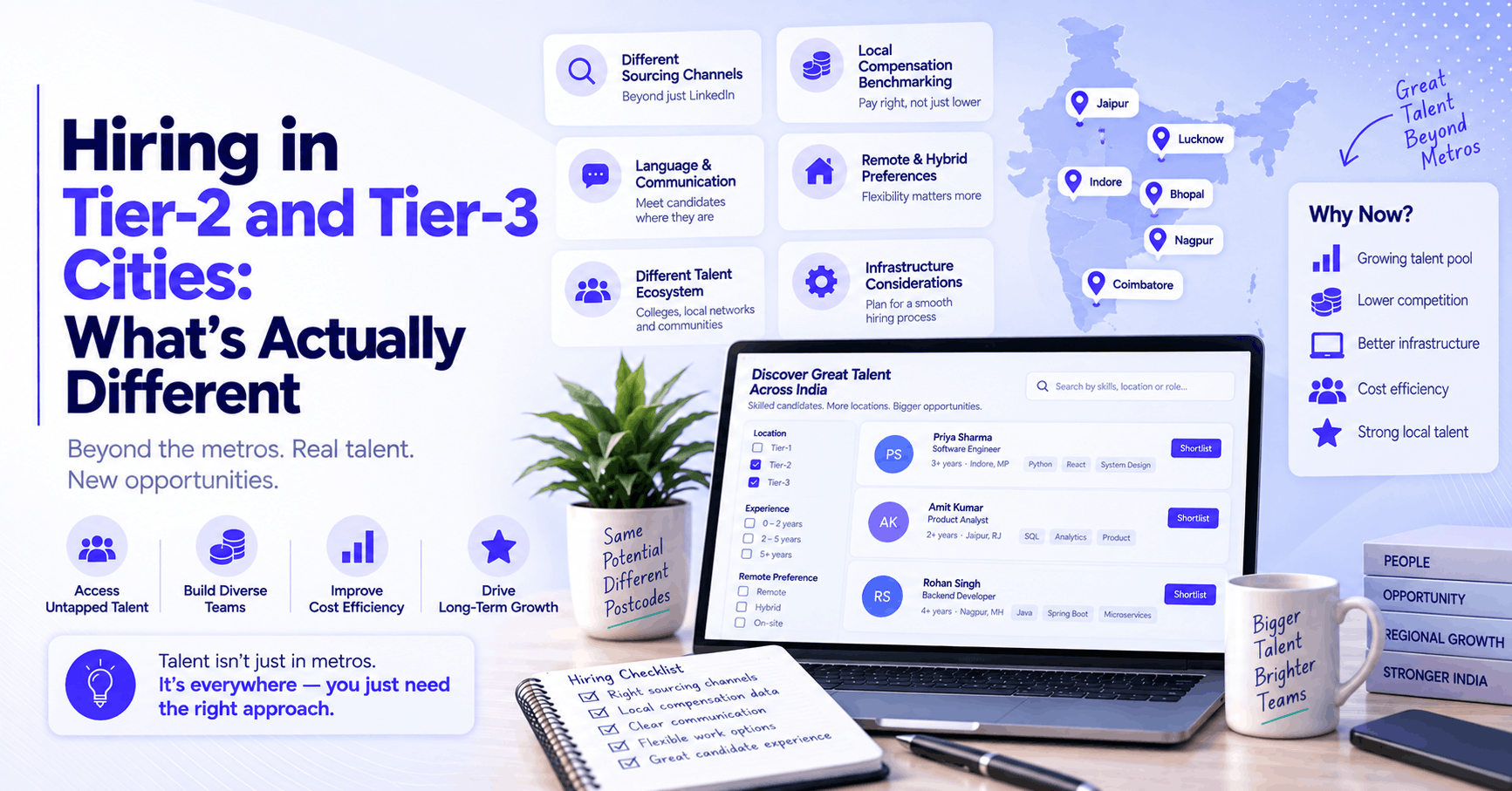
For a long time, hiring in India effectively meant hiring in a handful of metro cities — Bangalore, Mumbai, Delhi NCR, Hyderabad, Pune, Chennai — with everywhere else treated as a secondary market at best. That pattern has been shifting meaningfully, driven by a mix of rising talent costs and intense competition in saturated metro markets, improved digital infrastructure making remote and hybrid work genuinely viable in smaller cities, and a large, increasingly skilled talent pool in Tier-2 and Tier-3 cities that metro-centric hiring strategies have historically underutilized.
This post covers what genuinely changes when hiring outside the traditional metro hubs — sourcing, compensation, communication, and process — and practical guidance for doing it well rather than treating it as a simple copy of metro hiring at a lower cost.
Why this shift is happening now
Metro talent markets are increasingly saturated and expensive, particularly for common role categories where GCCs, product companies, and domestic enterprises are all competing for overlapping candidate pools in the same handful of cities, driving up both compensation expectations and time-to-hire.
Digital infrastructure has closed much of the practical gap. Reliable internet connectivity, widespread smartphone penetration, and normalized remote and hybrid work arrangements mean a genuinely strong candidate in a Tier-2 city is no longer structurally excluded from most knowledge-work roles the way they might have been a decade ago.
A large, often underutilized talent pool exists outside metros. Tier-2 and Tier-3 cities host a substantial and growing pool of educated, skilled candidates — including graduates from regional engineering and management institutions, and professionals who've deliberately chosen to remain closer to home rather than relocate to a metro — that metro-centric sourcing strategies routinely miss entirely.
Cost efficiency, done thoughtfully, remains a real advantage, though it's worth being careful about treating this as the primary or sole motivation — an approach that positions Tier-2/3 hiring purely as a cost play, without genuine investment in sourcing quality and candidate experience, tends to underperform relative to one that treats it as accessing a genuinely strong, underutilized talent pool.
What actually changes when hiring outside metro cities
Sourcing channels and candidate discovery patterns differ
Candidates in Tier-2 and Tier-3 cities may be less consistently active on platforms like LinkedIn, which skew toward metro and internationally-oriented professional networks, and more reachable through other channels — regional job boards, local college placement offices, and word-of-mouth or referral networks within specific regional communities. A sourcing strategy built purely around LinkedIn search risks systematically underrepresenting exactly the talent pool this hiring approach is meant to access.
Compensation benchmarking needs a genuinely local reference point
Applying metro compensation bands wholesale to Tier-2/3 hiring often overpays relative to local market rates, while applying an arbitrarily discounted band without real local benchmarking risks underpaying relative to what strong candidates in that specific market can reasonably expect, particularly as compensation expectations in growing Tier-2 hubs rise over time. Genuine local benchmarking — rather than a flat percentage discount off metro rates — produces more accurate, defensible compensation decisions.
Communication norms and language preferences vary more than in metro hiring
Outside the more internationally-oriented metro talent pools, comfort with English versus a regional language or Hindi can vary considerably, and this has direct implications for how job postings are written, how outreach is conducted, and how interviews should be structured — a topic covered in more depth in guidance on multilingual hiring generally, but particularly relevant here since Tier-2/3 sourcing is exactly where this consideration matters most.
Candidate expectations around remote/hybrid arrangements differ
Many strong candidates in Tier-2 and Tier-3 cities are specifically motivated by the ability to work in meaningful roles without relocating to a metro — this means remote or hybrid arrangement clarity, and genuine flexibility where the role allows it, is often a more significant factor in candidate decision-making here than in metro hiring, where in-office expectations are more commonly an accepted norm.
Infrastructure and logistics considerations for in-person elements
Where in-person interviews, assessment centers, or onboarding events are part of the process, Tier-2/3 hiring requires more deliberate logistics planning — travel considerations, scheduling around local transport and connectivity realities, and potentially structuring more of the process to be genuinely remote-friendly rather than assuming metro-level in-person convenience.
Practical steps for building a Tier-2/3 hiring approach
Diversify sourcing beyond metro-centric defaults
Alongside broader platforms, consider building direct relationships with regional educational institutions, engaging with local professional communities and groups, and using AI-assisted candidate discovery that matches against actual described skills and experience rather than relying solely on keyword search patterns that tend to favor more metro-typical resume phrasing and terminology.
Build genuine local compensation benchmarks
Rather than applying a blanket discount to metro compensation bands, invest in understanding actual local market rates for the specific roles and cities being targeted — this might mean consulting region-specific salary survey data, or tracking actual offer-acceptance patterns over time as a growing internal benchmark specific to each target city.
Adapt outreach and communication to local preferences
Where a meaningful share of the target candidate pool is more comfortable in a regional language or Hindi than in English, adapting outreach messaging accordingly — including through channels like WhatsApp, which tends to see strong engagement across all city tiers in India, not just metros — can meaningfully improve response and engagement rates compared to defaulting to English-only, metro-styled outreach.
Be genuinely clear and flexible about work arrangement
Since remote or hybrid flexibility is often a primary motivator for Tier-2/3 candidates specifically, being explicit and honest about what's actually offered — rather than vague language that gets clarified only late in the process — helps candidates self-select accurately and reduces late-stage drop-off from a mismatch on this specific expectation.
Structure interviews and assessments for remote delivery where appropriate
If much of the hiring process will happen remotely given geographic distribution, investing in a genuinely good remote interview experience — reliable video tools, clear scheduling, multilingual support where relevant — matters more here than it might for a metro-based process where in-person options are more readily available as a fallback.
Plan onboarding with geographic distribution in mind
If new hires won't be physically co-located with existing teams or won't relocate to a metro office, onboarding needs deliberate design for remote integration — clear early expectations, structured check-ins, and genuine effort to build connection with the broader team despite physical distance, since the usual informal, in-office onboarding dynamics won't happen organically the way they might for a co-located hire.
The current scale of this shift
It's worth grounding this in the actual scope of the trend rather than treating it as a marginal or speculative shift. A growing share of new hiring by large IT services firms, GCCs, and increasingly product companies has been directed toward Tier-2 cities in recent years, with several cities — Jaipur, Coimbatore, Indore, Bhubaneswar, Kochi, Lucknow, and others — establishing genuine, sustained talent hubs rather than one-off satellite offices. This isn't purely opportunistic cost-arbitrage on the part of companies; it also reflects a real shift in candidate preference, with many skilled professionals — particularly those with family ties to a specific region, or those prioritizing cost of living and quality of life — actively choosing to build careers without relocating to a metro, provided genuinely strong opportunities exist locally or remotely. Companies that recognize this as a durable structural shift, rather than a temporary or purely tactical cost-saving measure, tend to build more sustained, higher-quality talent pipelines in these markets than those treating it as an occasional overflow strategy.
Choosing which Tier-2/3 cities to prioritize
Not every Tier-2 or Tier-3 city offers the same talent profile, and a deliberate city-selection process tends to produce better outcomes than an ad hoc or purely opportunistic approach. Useful factors to weigh include the presence of strong regional educational institutions producing graduates in relevant fields, existing digital and physical infrastructure quality, the presence of other companies already hiring successfully in that market (a signal of both talent availability and market maturity), and genuine local cost-of-living and compensation dynamics rather than assumptions carried over from a different city. Starting with one or two carefully chosen cities, building genuine sourcing relationships and local market understanding there, and expanding deliberately based on what's actually working tends to produce better long-term results than spreading initial hiring efforts too thinly across many locations simultaneously without building real depth in any of them.
A realistic timeline for building Tier-2/3 hiring capability
Companies new to hiring outside metro markets should expect a genuine ramp-up period rather than assuming immediate parity with established metro sourcing capability. Early hires in a new Tier-2/3 market often take longer to source and close than equivalent metro roles, simply because the sourcing channels, local compensation benchmarks, and employer brand awareness in that specific market haven't yet been built. This typically improves meaningfully after the first several successful hires — both because sourcing relationships and local market knowledge compound over time, and because early hires themselves often become a source of referrals and local credibility that makes subsequent hiring in the same market progressively easier. Setting realistic internal expectations about this ramp-up period, rather than judging the strategy's success purely on early-stage hiring speed, prevents a promising long-term approach from being abandoned prematurely based on initial friction that's largely a function of newness rather than a flaw in the underlying strategy.
A short checklist before expanding into a new city
Have you identified genuinely relevant regional educational institutions or professional communities to build sourcing relationships with, beyond generic platform search?
Is compensation benchmarked against real local market data, rather than a flat discount off metro bands?
Are job postings and outreach adapted for language preferences likely to matter in this specific market?
Is the work arrangement (remote, hybrid, in-office) clearly and honestly communicated upfront, given how central this often is to candidate decision-making outside metros?
Is onboarding designed with geographic distribution genuinely in mind, rather than assuming in-office norms will apply by default?
What to watch out for
Treating Tier-2/3 hiring purely as arbitrage. An approach motivated solely by cost savings, without genuine investment in sourcing quality, fair compensation, and a real career growth narrative, tends to produce weaker retention and a less engaged talent pool than an approach that treats this as genuinely accessing strong, underutilized talent rather than simply finding cheaper labor.
Underinvesting in connectivity and infrastructure support where genuinely needed. While digital infrastructure has improved substantially, it's not uniform across every Tier-2/3 location — being realistic about where genuine gaps might still exist, and providing reasonable support (equipment, connectivity stipends where relevant) rather than assuming metro-level infrastructure exists everywhere, prevents avoidable friction for otherwise strong hires.
Assuming one uniform approach works across all Tier-2/3 cities. Cities vary considerably from each other — a growing tech hub like Jaipur or Coimbatore has a different talent profile and market dynamic than a smaller, less digitally-connected town, and treating "Tier-2/3" as one undifferentiated category risks applying the wrong approach to a specific location's actual conditions.
Neglecting career growth pathways for geographically distributed hires. If Tier-2/3 hires perceive fewer visible growth or promotion opportunities compared to metro-based colleagues, this can undermine retention over time — being deliberate about equitable career pathing, regardless of location, matters for sustaining this hiring strategy long-term rather than treating it as a one-time sourcing tactic.
The bottom line
Hiring in Tier-2 and Tier-3 cities isn't simply metro hiring at a discount — it requires genuinely different sourcing channels, honest local compensation benchmarking, communication adapted to different language preferences, and deliberate remote-friendly process design, done well specifically because it opens access to a large, often underutilized talent pool rather than because it's a shortcut to lower cost. Companies that treat it with the same rigor and genuine investment as metro hiring — rather than as a purely cost-driven afterthought — tend to build stronger, more sustainable talent pipelines in these markets than those chasing savings without a matching commitment to doing it properly.