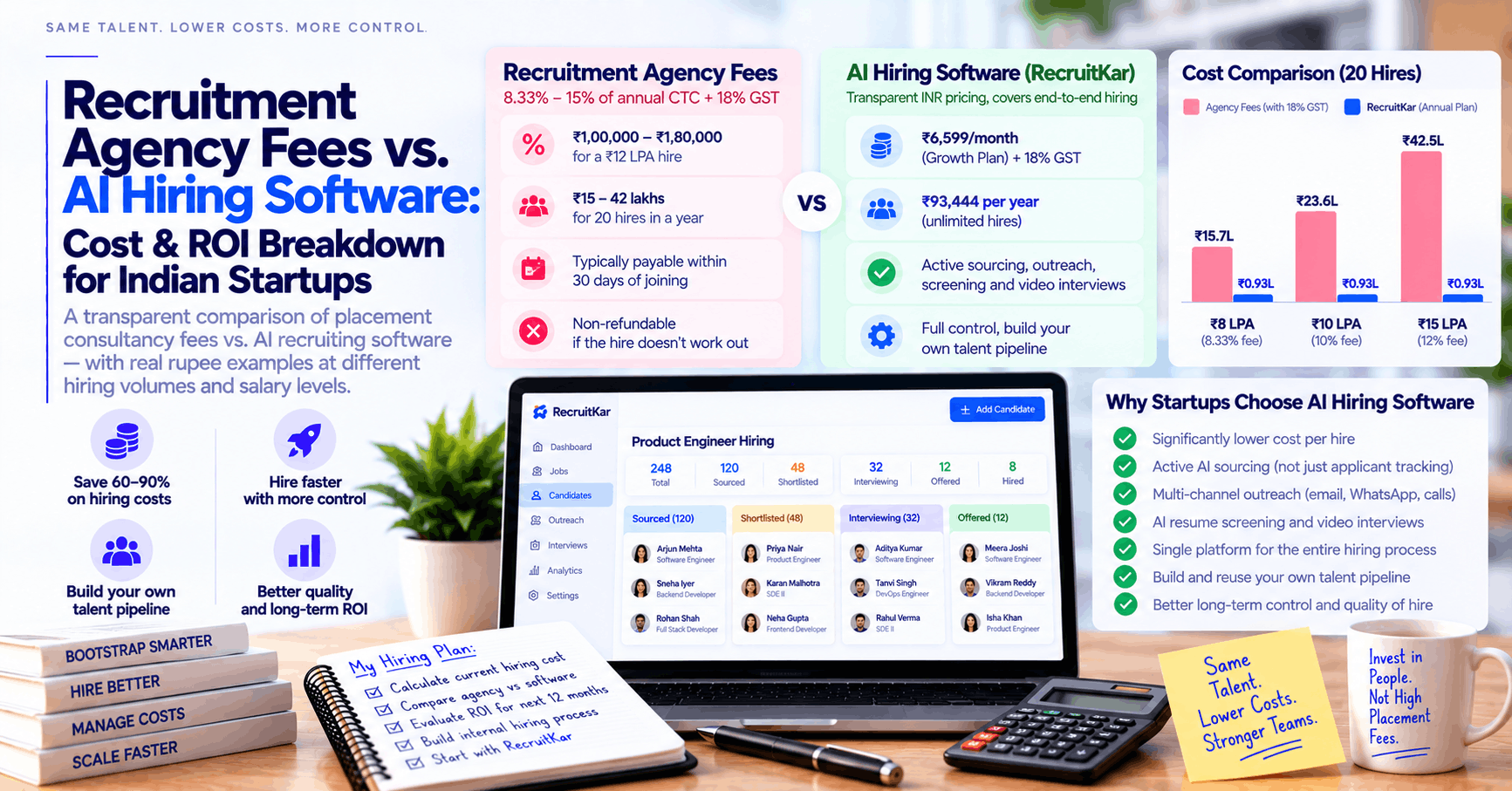
Placement consultancies in India charge 8.33% to 15% of a candidate's annual CTC as a placement fee — typically due within 30 days of joining and non-refundable if the hire doesn't work out. On a ₹12 LPA engineering hire, that's ₹1,00,000 to ₹1,80,000 per placement. On 20 hires at that level in a year, that's ₹20–36 lakhs in agency fees alone. RecruitKar's startup recruiting platform replaces that spend with a transparent INR credit model — the Growth plan at ₹6,599/month covers active AI sourcing, outreach, screening, and video interviews for every role. This post breaks down exactly when agency fees are justified, when they're not, and how to calculate your own cost comparison before the next hire.
How placement consultancy fees actually work in India
Understanding the cost comparison requires being precise about what Indian placement consultancies charge and how, because the structure varies meaningfully by consultant type and role level.
Standard fee structure
Permanent placement fee: 8.33% to 15% of the candidate's annual CTC (Cost to Company), due on joining or within 30 days of the candidate's start date. For mid-market roles (₹6–20 LPA), 8.33% to 12% is most common. For specialist or senior roles (₹20 LPA+), 12% to 15% is standard; for C-suite search, 15% to 25% of first-year CTC is not uncommon.
Replacement guarantee: Most consultancies offer a 30–90 day replacement guarantee — if the placed candidate leaves within that window, the consultancy will attempt to find a replacement at no additional fee. What this doesn't cover: the cost of the lost productivity during the gap, the recruiter time spent re-onboarding, and the replacement search taking additional weeks.
Retained search: For senior roles where the consultancy is given exclusivity on the search in exchange for an upfront retainer (typically 30–40% of the total fee), the remaining fee is due at various milestones. Retained search is standard for CXO hiring and uncommon for roles below ₹30–40 LPA.
Staffing/contract placement: For contractual or temp placements, the fee structure is typically a markup on the candidate's daily or monthly rate — usually 15–25% — ongoing for the duration of the engagement rather than a one-time placement fee.
What's hidden in the fee
The sticker percentage understates the real cost in a few ways:
GST: Placement fees attract 18% GST on top of the percentage fee. A ₹1,00,000 placement fee is actually ₹1,18,000 after GST.
Non-refundable if hire fails: The replacement guarantee covers re-sourcing a replacement, not refunding the original fee. If the replacement is also unsuccessful or the role changes, the guarantee has limited practical value.
Time cost of managing the agency relationship: Briefing the consultancy, reviewing candidates they send (many of whom are not well-matched), giving feedback on multiple rounds, and managing the offer negotiation through an intermediary all consume recruiter and founder time that isn't captured in the fee percentage.
The worked example: 20 hires in a year at two salary levels
To make this concrete: a Series A startup hiring 20 people in Year 2 — a mix of engineering, product, sales, and operations roles.
Scenario A: all 20 hires through placement consultancies
Average CTC: ₹10 LPA (mid-market mix), average fee rate: 10% and 18% GST puts each hire at ₹10,00,000 × 10% × 1.18 = ₹1,18,000, or ₹23,60,000 across 20 hires.
Average CTC: ₹15 LPA (slightly more senior mix) at an average fee rate of 12%: each hire is ₹15,00,000 × 12% × 1.18 = ₹2,12,400, or ₹42,48,000 across 20 hires.
Average CTC: ₹8 LPA (operations-heavy mix) at an average fee rate of 8.33%: each hire is ₹8,00,000 × 8.33% × 1.18 = ₹78,684, or ₹15,73,680 across 20 hires.
So the range for 20 hires through consultancies runs from roughly ₹15 lakhs to ₹42 lakhs, depending heavily on average CTC and fee rate negotiated.
Scenario B: in-house hiring with AI recruiting software
RecruitKar Growth plan: ₹6,599/month + 18% GST = ₹7,787/month, which is ₹93,444 annually.
In-house recruiter (or founder time equivalent): A dedicated in-house recruiter at ₹8–12 LPA is ₹67,000–₹1,00,000/month all-in. However, for a startup without a full-time recruiter, the relevant cost is the founder or operations head's time allocation — typically 25–40% of one senior person's working week during a hiring sprint, which at a ₹24 LPA founder cost works out to approximately ₹50,000–₹80,000/month during active hiring.
Job board costs: Naukri posting credits, LinkedIn premium (optional), Indeed posting — typically ₹15,000–₹30,000/month during active sourcing.
Total in-house cost for 20 hires over 12 months:
- Software: ₹93,444/year
- Job boards: ₹2,40,000/year (₹20,000/month average)
- Recruiter time (founder or TA): ₹6,00,000–₹9,60,000/year
Total: ₹9,33,444–₹12,93,444/year
Compare against ₹15–42 lakhs in agency fees: the in-house model with AI software costs 30–70% less depending on the hiring mix, and the gap grows significantly as CTC levels and hire count increase.
When agency fees are genuinely justified
The comparison above makes in-house look straightforwardly better — but that's only true when the in-house capability can actually deliver the same candidates. There are specific circumstances where agency fees are justified and the cost comparison is less clear-cut.
Senior and C-suite roles
For a VP Engineering, CFO, or Chief Product Officer at ₹40–80 LPA, the search requires a genuine network and the ability to reach passive candidates who aren't applying to job boards. A good executive search firm earns its 15–20% fee by accessing a candidate pool that an in-house sourcer without existing relationships can't easily reach. The cost is high; so is the value — getting this hire wrong costs far more than the placement fee.
Highly specialised technical roles with thin talent pools
A DevOps engineer with specific Kubernetes and AWS expertise in a niche domain, or a data scientist with rare industry-specific modelling experience — when the candidate pool in India is genuinely small (a few hundred people with the relevant background), a consultancy with pre-existing relationships in that community can find candidates faster than a cold AI-assisted search on Naukri.
Urgent, time-sensitive replacement hires
When a key employee gives notice and the role needs to be filled in 4–6 weeks, the time cost of building a candidate pipeline from scratch may exceed the agency placement fee. A consultancy with active candidates in a ready pool can move faster than a full sourcing-to-screening process for genuinely urgent roles.
Roles that require confidentiality
Replacing a sitting employee who hasn't yet been told they're being replaced, or searching for a successor to a founder who hasn't announced a transition — these require a confidential search that an agency can conduct under its own name, without alerting the current market that a specific company is looking.
When agency fees are not justified
This is the larger category for most Indian startups, and the one where the cost gap is most significant.
Mid-market roles with deep inbound applicant pools
For a senior product manager role at ₹18–22 LPA at a funded startup in Bengaluru, Naukri Resdex returns hundreds of relevant profiles and LinkedIn sourcing is straightforward. A consultancy charges 10–12% of CTC for finding a candidate in a pool any competent in-house sourcer can access. The value-add doesn't justify the fee.
High-volume hiring for standardised roles
Customer support, sales development, QA engineers, operations associates — roles where the skills are broadly available and the volume is meaningful. Paying a placement fee on 10 customer support hires at ₹6 LPA each costs ₹6,25,000+ in agency fees for a candidate pool that AI-assisted sourcing from Naukri can address at a fraction of that cost.
Roles where the job boards work well
For roles where candidates are actively looking and well-represented on Naukri, LinkedIn, and Indeed, a consultancy is a middleman adding a fee to a sourcing process that doesn't need intermediation. The 7 candidate sourcing methods built into a modern AI recruiting platform reach the same databases the consultancy uses — without the markup.
When you're hiring frequently enough to justify a process
If a startup is hiring 15+ people per year, the fixed investment in building an in-house process and tooling amortises quickly across hires. The per-hire cost of in-house hiring falls as volume increases; agency fees stay constant as a percentage regardless of volume.
The hybrid approach most Series A companies actually use
Very few high-growth Indian startups use a pure-agency or pure-in-house model. The practical approach that works at the Series A stage:
In-house (with AI recruiting software) for:
- All mid-market roles (₹6–20 LPA)
- High-volume roles (support, operations, sales)
- Roles where Naukri and LinkedIn sourcing is productive
- Re-hires and referral-sourced candidates
Agency (specialist or retained) for:
- CXO and VP-level roles
- Highly specialised technical searches where the talent pool is thin
- Urgent replacement hires where time-to-fill is critical
- Roles requiring confidentiality
This split typically produces a blended cost-per-hire of ₹50,000–₹1,00,000 per hire (including the in-house infrastructure cost and the occasional agency fee for senior roles) compared to ₹1,00,000–₹2,00,000+ per hire for an all-agency approach — without sacrificing the speed or quality of senior hires where agency expertise genuinely adds value.
Building the cost comparison for your own situation
To calculate your own agency fee vs. in-house comparison:
Step 1: Identify your hiring plan for the next 12 months. How many hires, at what approximate CTC levels, split between role types (senior specialist vs. mid-market vs. volume)?
Step 2: Estimate what each hire would cost through an agency. Multiply each hire's expected CTC × the likely fee rate (8.33–12% for most mid-market roles) × 1.18 for GST. Sum across all planned hires.
Step 3: Estimate the in-house cost. Software subscription (₹93,444/year for RecruitKar Growth, or see full pricing) + job board spend + recruiter time allocation (founder or TA hours × effective hourly cost).
Step 4: Identify which roles genuinely benefit from agency sourcing. Apply the criteria from the section above — senior/specialist/urgent — and budget agency fees only for those specific roles.
Step 5: Calculate the difference. The gap between the full-agency scenario and the hybrid scenario is your annual saving from bringing mid-market hiring in-house. For most Series A startups hiring 15–25 people per year, this gap runs ₹8–20 lakhs annually.
What changes operationally when you bring hiring in-house
The cost saving is real. What comes with it:
You need a recruiter or someone who owns recruiting. In-house hiring without dedicated bandwidth produces slow hiring that costs more in time than it saves in fees. For a startup hiring 15+ people per year, a dedicated TA person or a senior operations hire with recruiting as a core responsibility is the operational unlock that makes the economics work.
You need a process. Agency relationships impose external accountability — the consultancy is motivated to close the role. In-house recruiting without a structured pipeline, clear SLAs, and tracking tends to drift. An ATS with stage tracking and clear ownership of next steps replaces this accountability structure internally.
The first few hires take longer. Building sourcing pipelines, establishing job board presence, and developing a candidate outreach rhythm takes time. Month 1 and 2 of in-house hiring are typically slower than equivalent agency placements; Month 3 onwards, the process compounds and becomes faster as the pipeline and brand build.
Frequently asked questions
What is the standard placement consultancy fee in India for tech roles? 8.33% to 12% of annual CTC for most mid-market tech roles (₹6–25 LPA). For senior engineering leadership (₹25–50 LPA), 12–15% is more common. For CXO-level tech searches, 15–20% is standard. All fees attract 18% GST on top of the percentage. Fees are negotiable, particularly for volume arrangements — if you're placing 10+ hires through the same consultancy in a year, negotiate a volume rate of 7–9% before the engagement begins.
Are agency placement fees tax-deductible for startups? Yes — placement fees paid to recruitment consultancies are a business expense and deductible for income tax purposes in India. Ensure you collect GST-compliant invoices from the consultancy (with their GSTIN) for your own ITC claims.
What happens if a consultancy-placed candidate leaves within 3 months? Most consultancies offer a replacement guarantee of 30–90 days. The replacement guarantee typically covers re-sourcing a replacement candidate at no additional fee — not a refund of the original placement fee. Read the guarantee terms carefully; some are limited to a single replacement attempt, and some exclude cases where the candidate leaves for reasons the consultancy considers outside their control (role change, salary dispute, etc.).
Can a startup use both a consultancy and an in-house process simultaneously? Yes, and this is common for high-volume hiring sprints where the in-house team can't cover all open roles simultaneously. The risk is that candidates sourced by both channels end up in the same pipeline, leading to confusion about ownership and fee liability. Define clearly at the outset which roles are exclusive to the agency, which are exclusive to in-house, and which are open to both — with a clear rule on who owns the placement if the same candidate is found by both.
How long does it take to build an in-house recruiting capability from scratch? For a startup that previously relied entirely on consultancies, the first 60–90 days of in-house hiring involve building the process (ATS setup, JD templates, sourcing channels, interview structure) as well as filling active roles. Most founding teams find that their first 3–4 in-house hires take meaningfully longer than equivalent agency placements; from Month 4 onwards, the process is established and speed is comparable — with dramatically lower per-hire cost. The break-even point on the time investment is typically 5–8 hires into the in-house model.
Calculate your agency fee savings by bringing hiring in-house with RecruitKar. AI sourcing, multi-channel outreach, and AI video screening — all on a transparent INR credit model, no per-placement fees. Startup recruiting platform built for teams hiring their first 50 people.