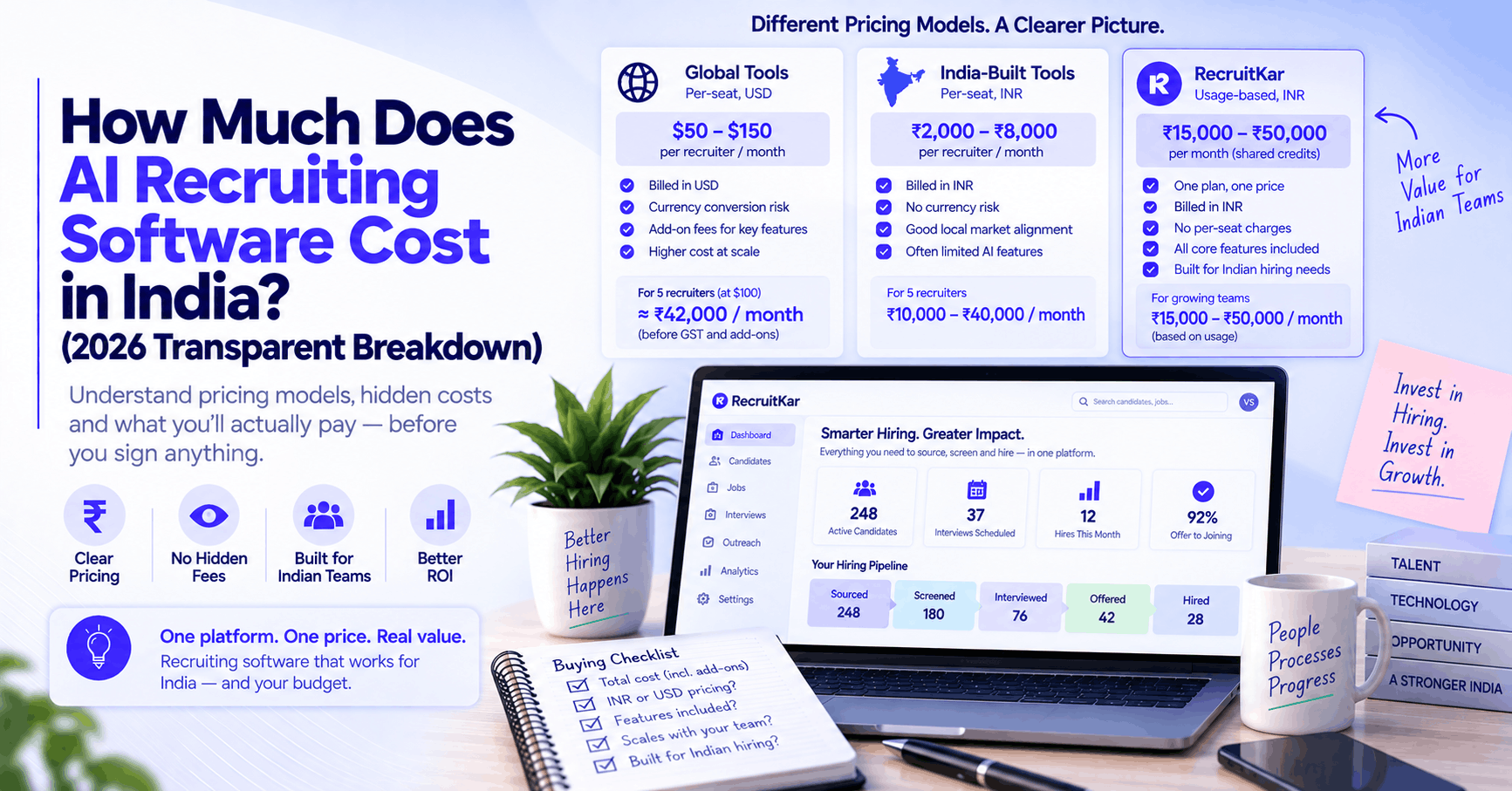
AI recruiting software in India ranges from ₹0 (basic ATS with manual sourcing) to ₹50,000+ per month, depending on team size, feature depth, and — critically — whether the vendor prices in USD per seat or in INR against actual usage. Most global platforms charge $50–$150 per recruiter per seat per month, billed in USD, which means Indian teams absorb currency risk on top of the sticker price. RecruitKar operates on a transparent shared INR monthly credit pool — one plan, one currency, no per-seat taxes — which changes the cost calculation meaningfully for most Indian hiring teams.
If you're comparing tools and trying to figure out what you'd actually pay, this breakdown covers every major pricing model, what the real landed cost looks like for Indian teams, and how to build an apples-to-apples comparison before you sign anything.
Why "pricing" is harder to compare than it should be
Recruiting software pricing is deliberately opaque in a lot of cases. Vendors know that a $99/seat/month price looks small when you're thinking about one recruiter, and considerably less small when you apply it to a team of eight and convert to INR at ₹84 per dollar. Add module fees for sourcing, video interviews, or WhatsApp integration that aren't included in the base plan, and the actual monthly spend can be two to three times what the headline price implied.
The three things that make a genuine cost comparison hard:
USD pricing with INR salaries. A SaaS tool priced at $100/seat/month costs a US company roughly the same as it costs an Indian company — in dollar terms. As a percentage of an Indian recruiter's monthly salary, it's a meaningfully different number. Indian teams are effectively subsidizing the pricing model of platforms built for Western markets.
Per-seat versus per-usage pricing behaving very differently at scale. A per-seat model charges you whether a seat is fully utilized or not. A usage-based model only charges for actual activity — sourcing, screening, interviews conducted. For teams with variable hiring volume, or smaller teams where one recruiter handles everything, these models produce very different bills in practice.
What's included at the base price versus what's a paid add-on. Some platforms charge the base plan and then separately invoice for AI sourcing, video interviews, WhatsApp integration, and background verification — each a meaningful addition. Others include the full stack in one number. Comparing two base-plan prices without knowing what's included in each produces a meaningless comparison.
The main pricing models in the market
Per-seat, USD-denominated (most global platforms)
The dominant model for tools built primarily for Western markets — Greenhouse, Lever, Ashby, HireVue, LinkedIn Recruiter, and many others. A per-seat fee, typically in the $50–$150/month range per recruiter, billed monthly or annually in USD.
What this means for an Indian team of 5 recruiters:
- At $100/seat/month: $500/month = approximately ₹42,000/month at current exchange rates, before GST, before any add-on modules.
- At $150/seat/month for a mid-tier plan: $750/month = approximately ₹63,000/month.
Neither figure is outrageous for a company that has the budget — but they become harder to justify when the tool was designed around hiring workflows that don't fully account for India's specific context: notice periods, Naukri/Indeed sourcing, WhatsApp outreach, regional-language candidates, and INR compensation structures.
Per-seat, INR-denominated (India-built tools)
Zoho Recruit and a handful of other India-origin tools price in INR on per-seat or per-recruiter models. This removes the currency risk and typically comes with better Indian market alignment.
- Typical range: ₹2,000–₹8,000 per recruiter per month depending on tier and features included.
- What this means for a team of 5: ₹10,000–₹40,000/month, in INR, with no currency conversion volatility.
The trade-off is usually feature depth relative to newer AI-native tools — India-priced tools in this segment tend to be more ATS-and-job-posting focused, with lighter AI sourcing and screening functionality than the more recent generation of AI-first platforms.
Credit or usage-based, INR-denominated
The model RecruitKar uses: a shared monthly credit pool in INR, with credits consumed across sourcing, screening, outreach, and interviews based on actual activity rather than a fixed per-seat fee. The team shares one pool rather than having per-head licenses.
What this means in practice:
- Starter: ₹1,749/month for 500 credits — efficient for 3–8 hires/month.
- Growth: ₹6,599/month for 2,000 credits — efficient for 15–30 hires/month.
- Pro: ₹15,499/month for 5,000 credits — efficient for 40–80 hires/month.
- Enterprise: ₹28,999/month for 10,000 credits — for high-volume or agency use.
Credits cover the entire sourcing-to-interview workflow:
- AI candidate discovery: 1 credit/profile
- Resume scoring: 0.5 credits
- Email outreach: 1 credit/message
- WhatsApp messages: 1 credit
- AI voice screening calls: 2 credits/connected minute
- AI video interviews: 4 credits/minute, capped at 60 per interview
Human interview scheduling via Google/Outlook integration into Meet, Zoom, or Teams is included at no credit cost. Additional credits can be topped up at ₹4/credit rather than forcing an upgrade to the next tier for a temporarily higher-volume month.
The key structural difference from per-seat: a team of 3 recruiters sharing a Growth plan costs the same as a team of 8 recruiters sharing the same plan. You pay for hiring activity, not headcount.
Enterprise/custom pricing (large platforms, HRMSs with recruiting modules)
Darwinbox, Keka, and larger HRMSs typically price recruiting as a module within a broader HRMS contract, negotiated per implementation. These contracts are usually annual, with per-employee or per-transaction pricing that varies substantially by deal size and negotiation.
- Meaningful for: companies already committed to one of these platforms for payroll/HRMS who want to add recruiting without managing a separate vendor.
- Not ideal for: companies that primarily need a strong recruiting tool and don't need the broader HRMS, since the recruiting module in an HRMS is often less capable than a dedicated recruiting platform, while the combined cost can be substantially higher than standalone recruiting software.
What you're actually paying for, feature by feature
Before comparing sticker prices, it helps to know what a full AI recruiting workflow requires and which platforms include it in the base plan versus as an add-on:
- Job posting & applications: included in most basic ATSs
- Resume storage & search: included in most basic ATSs
- Basic pipeline/kanban: included in most basic ATSs
- AI candidate matching/discovery: rarely included; common add-on
- AI resume scoring: rarely included; common add-on
- Email outreach sequences: sometimes included; often separate
- WhatsApp integration: almost never included; always separate if available
- AI voice screening: almost never included; specialist tool
- AI video interviews: almost never included; specialist tool
- Interview scheduling automation: sometimes included; often separate
- Naukri/Indeed Chrome extension: rarely included; India-specific feature
A platform with a lower base-plan price that charges separately for five items in the add-on column can easily exceed a platform with a higher base price that includes them all. Build the full-feature comparison before comparing numbers.
The agency fee alternative — what you're replacing
For context, Indian recruitment consultancies and staffing agencies typically charge 8.33% to 15% of a candidate's annual CTC as a placement fee. On a ₹10 LPA hire, that's ₹83,300 to ₹1,50,000 per placement — a single hire.
A Growth plan at ₹6,599/month, used to source and fill 10 hires per month, works out to ₹660 per hire in software cost — roughly 100 to 200 times cheaper than a single agency placement fee at the same compensation level, assuming reasonably efficient in-house sourcing.
This comparison has limits: agencies bring sourcing expertise, a warm candidate network, and speed that an under-resourced in-house team may not be able to match. But as a framing for what software spend actually represents relative to the alternative, it's worth keeping in mind when evaluating whether a ₹15,000/month tool is "expensive."
What hidden costs look like in practice
- Implementation and onboarding fees. Enterprise platforms frequently charge a one-time setup fee — sometimes ₹25,000–₹1,50,000+ — not included in the monthly subscription price. Ask explicitly.
- Training costs. Some platforms require paid training for administrators and end users beyond basic onboarding. Others include it. Clarify what's covered.
- Integration fees. Connecting to your HRMS, payroll system, or background verification provider may cost extra depending on whether the integration is native or requires middleware.
- Data migration. If you're moving from an existing ATS, migrating candidate history may involve a professional services fee. Ask before you commit to leaving your current system.
- GST. SaaS subscriptions in India are subject to 18% GST. A tool priced at ₹6,599/month is ₹7,787/month with GST. USD-denominated plans for India-based subscribers may also trigger GST on the import of services — check with your finance team.
- Annual commitment discount vs. monthly flexibility. Many platforms offer 15–20% off for annual billing. This is often worth taking if you're confident in the tool — but make sure you're confident before you commit, since exit mid-contract is typically possible only with significant forfeiture.
Building a real comparison
Before you shortlist vendors, fill in this table for each:
- Base monthly price (INR, after GST)
- Per-seat or usage-based?
- AI sourcing included?
- WhatsApp outreach included?
- AI video interviews included?
- Job board Chrome extension?
- Implementation/onboarding fee?
- Annual commitment required?
- Currency
- Effective cost per hire at your volume
The last row — effective cost per hire at your actual expected monthly hiring volume — is the number that matters for budget conversations. A tool that's nominally cheaper per month but costs more per hire (because it covers less of the workflow and requires other tools alongside it) isn't actually cheaper.
Frequently asked questions
What is the average cost of ATS software in India per month?
For India-built or India-priced tools, expect ₹2,000–₹40,000/month depending on team size and feature tier. USD-denominated global platforms translated to INR typically run ₹25,000–₹1,00,000+/month for a team of 3–5 recruiters with a reasonably full feature set. The range is wide because "ATS" covers everything from basic candidate tracking to full AI sourcing, screening, and interview platforms — make sure you're comparing equivalent feature sets.
Is per-seat or credit-based pricing better for Indian recruiting teams?
Per-seat pricing is more predictable if your team size is stable and fully utilizes each seat. Credit-based pricing works better for teams with variable hiring volume, or smaller teams where one or two recruiters handle the entire workflow — you're not paying for unused capacity during slow months or under-utilized seats. RecruitKar uses a shared INR credit pool specifically because Indian hiring volume is often seasonal and role-type dependent.
Do Indian startups really need AI recruiting software, or is a basic ATS enough?
A basic ATS (pipeline tracking, resume storage, job posting) is enough if you're hiring fewer than five to eight people per quarter and sourcing is primarily inbound. If you're actively sourcing, running outreach, or screening at any real volume, the manual effort of doing those things without automation quickly becomes the bottleneck — at which point the software pays for itself in recruiter time saved, even before counting placement-fee savings.
What's included in RecruitKar's pricing vs. what costs extra?
The monthly credit plan covers AI sourcing, resume scoring, email outreach, WhatsApp outreach, AI voice calls, and AI video interviews — all drawing from the same shared credit pool. Human interview scheduling via Google/Outlook integration into Meet, Zoom, or Teams is included at no extra credit cost. See the full pricing breakdown here.
How does RecruitKar compare to Zoho Recruit on price?
Zoho Recruit's India pricing runs from roughly ₹1,250/recruiter/month (Standard) to ₹2,500/recruiter/month (Enterprise) in INR — solid per-seat pricing for an established ATS. RecruitKar's credit model is typically more cost-efficient for teams running active AI sourcing, outreach, and video interviews, since those features either aren't available in Zoho Recruit's standard tiers or require add-ons. The full comparison lives on the best AI recruiting software in India page and on the why growing teams choose RecruitKar page.
Want to calculate your actual number? RecruitKar's pricing is fully transparent — see every plan tier, credit allocation, and per-feature cost on the pricing page without a sales call.