Ask five recruiters what "AI in hiring" actually means, and you'll get five different answers. To one person, it's a chatbot that answers candidate FAQs. To another, it's a resume parser that ranks applicants. To someone else, it's the reason their inbox is suddenly full of AI-generated cover letters that all sound identical.
All of them are right, which is part of the problem. "AI recruitment" isn't one tool — it's a collection of very different technologies bolted onto different stages of the hiring funnel, adopted at wildly different speeds by different companies. Some of it genuinely saves recruiters hours a week. Some of it is still clumsy, biased, or over-hyped. Most hiring teams are somewhere in the middle: using a few AI tools seriously, kicking the tires on a few more, and ignoring the rest.
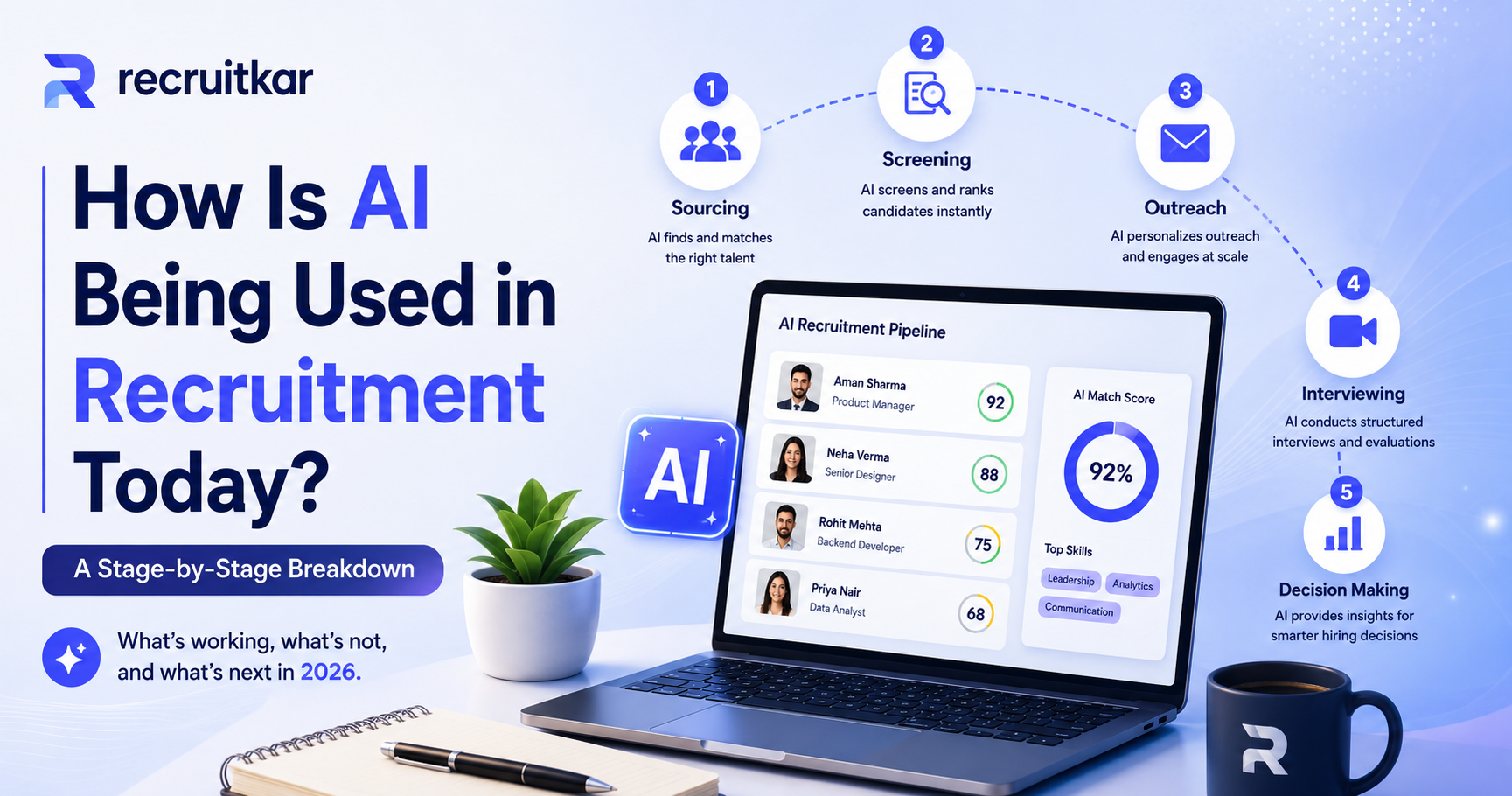
This post breaks down what AI is actually doing at each stage of recruitment today — sourcing, screening, outreach, interviewing, and decision-making — with real numbers, not vendor hype. It also covers where AI still struggles, because that matters just as much if you're deciding what to adopt.
The Short Version
Before the detail, here's the map. AI has meaningfully changed four stages of hiring so far:
- Sourcing — matching candidates to roles by skills and context, not just keywords
- Screening — scoring and ranking resumes/applications against a role automatically
- Outreach and engagement — personalizing messages at scale and answering candidate questions instantly
- Interviewing — running structured, recorded, or voice-based interviews without a human present for the first pass
A fifth area — predictive analytics for quality-of-hire and retention — is growing but still immature for most companies. We'll cover all five, plus what to watch out for.
1. Sourcing: From Keyword Search to Context-Aware Matching
Ten years ago, "sourcing with technology" meant Boolean strings on LinkedIn or a job board's keyword filter. That approach has a well-documented blind spot: it only finds candidates who happen to describe themselves using the exact words in your job description. A candidate who spent three years doing project coordination inside a support role might never show up in a search for "project manager," even if they'd be a strong fit.
Modern AI sourcing tools work differently. Instead of matching strings, they build a contextual profile of a candidate's experience — what they actually did, not just what job titles they held — and compare that against the requirements of a role. This is the difference between "search" and "match," and it's the single biggest shift in sourcing technology over the past few years.
In practice, this shows up as:
- AI candidate discovery — you drop in a job description, and the system searches across public profiles and existing databases to surface people who fit, ranked by relevance. Recruitkar's Discover with AI tool is one example of this approach, alongside similar features from Eightfold, HireEZ, and others.
- Resume-to-role scoring at upload — bulk resume uploads get scored against a specific role instead of just being stored and searched later.
- Cross-platform imports — pulling candidates from job boards, LinkedIn, or referral links directly into a single, de-duplicated pipeline instead of managing five separate candidate lists.
The efficiency gains here are real and measurable. Recruiters using AI-assisted search tools have reported reviewing far fewer irrelevant profiles per hire, and cutting hours off the sourcing phase of each role. Separately, industry surveys have found that recruiters still spend a disproportionate share of their week — often more than a full workday — on manual sourcing and administrative tasks that AI tools are specifically designed to compress.
The catch: context-aware matching is only as good as the data it's trained on and the rubric it's scoring against. A poorly written job description, or a system that hasn't been told what "good" looks like for your specific team, will still produce a mediocre shortlist — just faster than before.
2. Screening: Scoring Instead of Scanning
Manual resume screening is famously slow and inconsistent — two recruiters looking at the same stack of resumes will often shortlist different people, influenced by fatigue, order effects, or unconscious bias about names, colleges, or employment gaps.
AI screening tools aim to standardize this by applying the same scoring criteria to every candidate: skills match, experience relevance, and increasingly, softer signals extracted from how someone describes their work. Some platforms allow recruiters to build custom screening rubrics — weighting specific skills or experience types higher for a given role — so the scoring reflects what actually matters for that job, not a generic template.
This is genuinely useful for high-volume roles, where a recruiter might otherwise be looking at hundreds of applications for a single posting. It's less clearly useful — and worth being cautious about — for senior or highly specialized roles, where nuance and judgment matter more than pattern-matching.
It's also worth being honest about the risk here: AI screening tools can encode and scale existing bias if they're trained on historical hiring data that already reflects unequal outcomes. This isn't a hypothetical concern — it's why regulators have started paying close attention. New York City's Local Law 144 requires bias audits for automated employment decision tools, and the EU AI Act classifies hiring-related AI systems as "high-risk," with compliance obligations that regulators have continued to refine into 2026 and 2027. If you're evaluating a screening tool, ask the vendor directly how they test for and mitigate bias — a credible tool should have a clear answer.
3. Outreach and Engagement: Personalization at a Scale Humans Can't Match
Cold outreach in recruiting has a rough track record — generic templated messages get ignored, and most candidates can tell within a sentence whether a message was written for them specifically or blasted to five hundred people.
AI has changed this in three ways:
- Personalized messaging at scale. Instead of one template sent to everyone, AI tools can generate individualized outreach that references a candidate's actual experience, while still letting a recruiter send dozens of messages in the time it used to take to write three. LinkedIn has reported meaningfully higher acceptance rates on AI-assisted outreach compared to generic templates.
- Multi-channel reach. Email response rates have been declining for years, particularly for passive candidates who aren't actively job-hunting — and LinkedIn's own data suggests passive candidates make up roughly 70% of the workforce at any given time. That's pushed recruiters toward channels candidates actually check. In India specifically, WhatsApp has become a serious recruiting channel rather than a novelty — response rates on WhatsApp outreach tend to run well ahead of cold email, simply because it's where people are already paying attention. Tools like Recruitkar's WhatsApp outreach and AI voice calling exist specifically because email-only outreach has stopped being sufficient on its own.
- Instant, always-on responses. Chatbots and AI voice agents now handle a lot of the repetitive back-and-forth that used to eat recruiter time — answering "what's the salary range," "is this remote," or "can I reschedule" without a human needing to be online. This matters more than it sounds: candidates lose interest fast, and a same-day response to a question can be the difference between staying in the process and quietly dropping out.
4. Interviewing: AI as a First-Pass Filter, Not a Final Decision-Maker
This is the stage where AI adoption is newest, and where skepticism is most warranted — and most useful.
AI video interviews let candidates record responses to a fixed or adaptive set of questions on their own schedule, which get scored and transcribed automatically. For high-volume roles — campus hiring, retail, BPO — this solves a real logistical problem: you simply cannot manually interview a thousand applicants for fifty roles. Multilingual support is a meaningful addition for markets like India, where a single-language interview format quietly excludes strong candidates who are more comfortable in another language. Recruitkar's AI video interview feature, for instance, supports 11+ languages with proctoring and auto-scored transcripts, which is a fairly standard feature set for this category now.
The fairness question is legitimate and worth asking directly: are AI-scored interviews actually fair? The honest answer is "it depends heavily on implementation." A system that scores based on structured, job-relevant criteria and gives recruiters visibility into why a score was given is a meaningfully different product from a black-box system that outputs a number with no explanation. Candidates increasingly expect transparency here — recent industry surveys put candidate demand for AI-use disclosure at around 79%, and that expectation is only getting stronger as regulation catches up.
The practical, and increasingly common, approach is treating AI interviews as a first-pass filter, not a hiring decision. AI narrows a large pool down to a manageable shortlist; a human still makes the final call, usually through a live conversation. Most platforms — Recruitkar included — pair AI video screening with free human interview scheduling (via Google/Outlook calendars into Meet, Zoom, or Teams) specifically so teams aren't forced to choose one mode over the other.
5. Predictive Analytics: The Least Mature, Most Talked-About Layer
The most ambitious AI applications in hiring try to predict things that haven't happened yet — which candidates are likely to succeed in a role, which are likely to accept an offer, which are likely to stay past a year. Some vendors report meaningful gains here: organizations using predictive analytics in hiring have reported better hiring outcomes and lower regrettable turnover compared to those relying on traditional screening alone.
Treat these numbers with healthy skepticism. Predictive hiring models are only as reliable as the historical data and outcome definitions they're built on, and "success" is notoriously hard to define consistently across roles and managers. This is the layer of AI recruiting technology most likely to overpromise — useful as a directional signal, risky as the sole basis for a decision.
Where AI in Recruitment Still Falls Short
To keep this balanced, a few honest limitations worth naming:
- It amplifies whatever data it's trained on — including bias, if that bias exists in historical hiring patterns.
- It struggles with nuance and nontraditional backgrounds — a candidate who changed careers, took a gap for caregiving, or built skills outside a formal job title can be undervalued by systems trained mostly on conventional resumes.
- Candidates are increasingly wary of it — transparency isn't optional anymore; expect candidates to ask directly whether AI is involved in a decision that affects them.
- Regulation is tightening, not loosening — between NYC's Local Law 144 and the EU AI Act's high-risk classification for hiring tools, "we didn't know we needed to audit this" is becoming a weaker defense every year.
How to Actually Start Using AI in Your Hiring Process
If you're evaluating where to begin, a reasonable, low-risk sequence looks like this:
- Start with sourcing and outreach, not final decisions. These are the stages where AI assistance is most mature and lowest-risk — a bad match just gets filtered out downstream, rather than becoming a bad hire.
- Keep a human reviewing the top of the funnel occasionally, even once screening is automated, to sanity-check that the scoring logic reflects what you'd actually value.
- Ask vendors directly about bias testing and transparency before adopting a screening or interview tool — not as a compliance checkbox, but because it affects candidate trust and hiring quality.
- Use AI interviews as a filter, not a verdict. Pair them with a human conversation before extending an offer.
- Consolidate where you can. A lot of the friction in AI-assisted hiring comes from stitching together five separate point solutions that don't share data — sourcing in one tool, screening in another, interviews in a third. Platforms like Recruitkar that keep sourcing, outreach, and interviews feeding one ATS pipeline exist specifically to reduce that fragmentation, though a single spreadsheet and disciplined process can get a small team surprisingly far too.
The Bottom Line
AI hasn't replaced recruiters — what it's actually done is compress the parts of the job that were always mechanical, so more time is left for the parts that genuinely need human judgment.
The teams getting real value from AI right now aren't the ones who've automated everything — they're the ones who've been deliberate about which three or four stages actually benefit from it, and left the rest to people.
If you're mapping out where AI fits into your own hiring process, it's worth auditing your current funnel stage by stage — sourcing, screening, outreach, interviewing — and asking honestly where the bottleneck actually is before adding a tool to fix it.