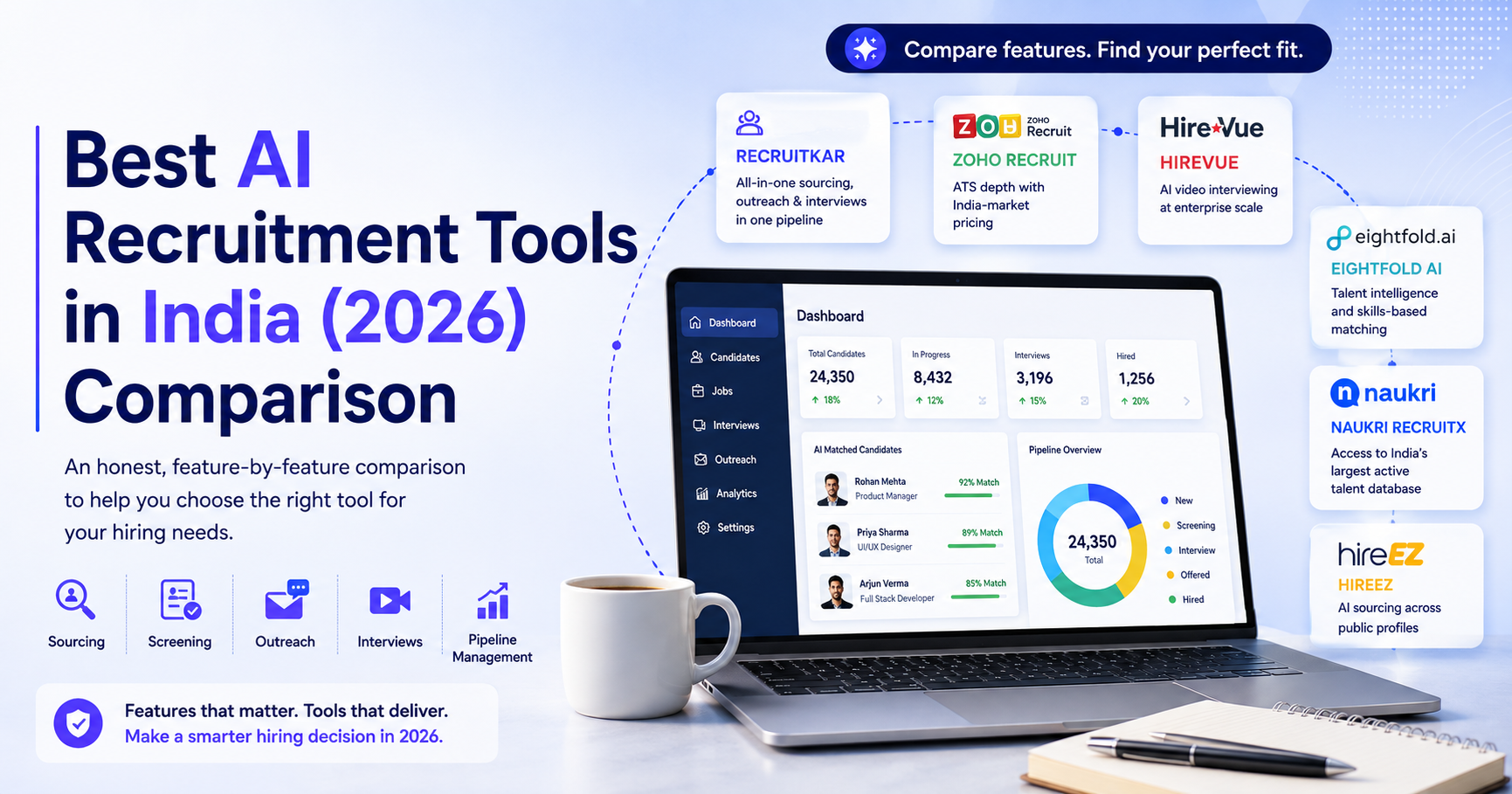
Shopping for AI recruitment software has a problem: almost every "best tools" list online is published by one of the vendors on it, and unsurprisingly, that vendor always comes out on top. That doesn't help you actually pick the right tool for your team.
This comparison takes a different approach. Instead of ranking tools 1-through-10, it groups them by what they're actually good at and who they genuinely fit — because "best" depends entirely on your hiring volume, your budget, and which part of your process is actually broken. Recruitkar is included here, and we've tried to be specific about who it's a strong fit for rather than pretending it's the right answer for every team, because it isn't.
What "AI recruitment software" actually covers
Before comparing tools, it helps to know what you're comparing. Most platforms in this space cover some combination of:
- Sourcing — finding and matching candidates to a role, from your own database, job boards, or public profiles.
- Screening — scoring or ranking applicants against a role automatically.
- Outreach — email, WhatsApp, SMS, or voice-based candidate contact, often personalized or automated.
- Interviewing — AI-scored video interviews, or scheduling automation for human interviews.
- ATS / pipeline management — the system of record that tracks every candidate through every stage.
Very few tools do all five well. Most are strong in two or three areas and average in the rest — which is exactly why it's worth knowing what you actually need before comparing feature lists.
Quick comparison
Below is a quick snapshot of how the tools compare. Pricing changes often, and enterprise tools rarely publish it, so treat everything here as directional — always confirm current pricing directly with each vendor before deciding.
- Recruitkar — Strongest at sourcing + outreach + AI interviews in one pipeline. Best for Indian SMB/mid-market teams wanting one consolidated tool. Starting price approx ₹1,749/mo.
- Zoho Recruit — Strongest at ATS depth + India-market pricing. Best for agencies and in-house teams already in the Zoho ecosystem. Pricing: free tier; paid plans scale by recruiter seats.
- HireVue — Strongest at AI video interviewing at enterprise scale. Best for large enterprises with high-volume, structured interview needs. Pricing: custom/enterprise pricing.
- Eightfold AI — Strongest at talent intelligence and skills-based matching. Best for large enterprises with complex internal mobility + external hiring. Pricing: custom/enterprise pricing.
- Naukri RecruitX / Naukri's recruiter tools — Strongest at deep access to India's largest active candidate database. Best for teams that rely heavily on Naukri as a primary sourcing channel. Pricing: add-on to Naukri job posting plans.
- HireEZ — Strongest at AI sourcing across public profiles. Best for sourcing-heavy teams, especially tech recruiting. Pricing: custom, typically seat-based.
Tool-by-tool breakdown
Recruitkar
What it does well: Recruitkar's pitch is consolidation — sourcing, outreach, and interviewing feeding into one pipeline, rather than a recruiter juggling four separate logins. Its AI candidate discovery matches candidates to a role by context rather than keyword search, and it pulls from multiple sources — resume uploads, job boards, LinkedIn, CSV imports, and even other job postings you've already worked — into a single deduplicated pipeline.
On outreach, it supports email, WhatsApp, and AI voice calling in 11+ languages, which matters more than it might sound for teams hiring across Indian cities and language regions. On interviews, it offers both AI video interviews (multilingual, proctored, auto-scored) and free human interview scheduling through Google/Outlook into Meet, Zoom, or Teams — so teams aren't forced to pick one mode exclusively.
Where it's a genuinely strong fit: Small-to-mid-sized Indian companies, staffing agencies, and RPOs that want sourcing, outreach, and interviews under one roof without paying enterprise-tool pricing or stitching together multiple point solutions. The credit-based pricing model (pay for what you use, rather than a flat per-seat fee) tends to suit teams with variable hiring volume better than a fixed monthly seat cost.
Where it's probably not the right fit: Very large enterprises with complex internal-mobility needs, multi-country compliance requirements, or deep HRIS integration requirements may outgrow it — that's squarely where Eightfold or HireVue's enterprise tiers are built to operate. You can see its full pricing structure and how the ATS pipeline ties everything together to judge fit for yourself.
Zoho Recruit
What it does well: Zoho Recruit has been in the Indian market long enough to have genuinely mature ATS functionality — custom pipelines, detailed reporting, and solid integration with the rest of the Zoho suite (Zoho People, Zoho CRM) if you're already using those products. It offers both an in-house recruiting mode and a staffing-agency mode with client/vendor management, which is a genuinely useful distinction most competitors don't bother making.
Best for: Teams already embedded in the Zoho ecosystem, or agencies that specifically need client-facing reporting and vendor management built into the ATS itself.
Worth knowing: Its AI features (resume parsing, candidate matching) are solid but generally considered less sophisticated than tools built AI-first from the ground up — it's an ATS with AI added on, rather than an AI platform that happens to include an ATS.
HireVue
What it does well: HireVue is one of the most established names in AI video interviewing globally, with deep experience handling extremely high interview volumes (think tens of thousands of candidates for graduate programs) and structured, competency-based interview scoring.
Best for: Large enterprises with genuinely high-volume, standardized hiring needs — think campus recruiting at scale, or large BPO/retail hiring — where interview consistency across thousands of candidates matters more than flexibility.
Worth knowing: It's built and priced for enterprise scale. Smaller teams often find it more tool than they need, both in complexity and cost, and it's primarily an interviewing tool rather than a full sourcing-to-hire platform.
Eightfold AI
What it does well: Eightfold's core strength is what it calls "talent intelligence" — building a deep, skills-based understanding of both candidates and your existing workforce, then using that to match people to roles, including internal mobility (moving existing employees into new roles), not just external hiring.
Best for: Large enterprises that care as much about internal talent mobility and workforce planning as they do about external recruiting — this is a genuinely different (and broader) use case than most tools on this list.
Worth knowing: This breadth comes with enterprise complexity and pricing. It's not really built for a 20-person hiring team trying to fill ten roles a quarter.
Naukri's recruiter tools
What it does well: Naukri.com remains one of the largest active job-seeker databases in India, and its recruiter-facing tools give direct, deep access to that pool — which is hard for any AI-sourcing tool to fully replicate if candidates simply aren't active elsewhere.
Best for: Teams whose primary sourcing channel is already Naukri and want tighter integration with that specific database, particularly for high-volume, India-only hiring.
Worth knowing: It's a sourcing channel first, not a full recruiting platform — most teams pair it with a separate ATS or interview tool rather than relying on it end-to-end.
HireEZ
What it does well: HireEZ (formerly Hiretual) is built specifically around AI sourcing — pulling candidate data from a wide range of public profiles and professional networks, with strong Boolean-to-AI search translation for recruiters used to traditional sourcing techniques.
Best for: Sourcing-heavy teams, particularly in tech recruiting, where finding passive candidates who aren't actively applying is the main bottleneck.
Worth knowing: Its strength is sourcing specifically — outreach, screening, and interviewing capabilities are lighter than platforms built around a full pipeline, so many teams use it alongside a separate ATS.
Common pricing traps to watch for
Comparing sticker prices across these tools is misleading unless you understand how each pricing model actually behaves as your hiring volume changes:
- Seat-based pricing — charging per recruiter login can get expensive fast if you have a small team handling a lot of requisitions, since cost scales with headcount, not hiring volume. It works in your favor if you have many recruiters each handling relatively few roles.
- Credit or usage-based pricing — charging per candidate sourced, message sent, or interview conducted scales with actual activity, which tends to suit teams with seasonal or unpredictable hiring volume — you're not paying for a seat that sits idle in a slow month. The tradeoff is less pricing predictability if volume spikes unexpectedly.
- Enterprise/custom pricing — common with HireVue and Eightfold, usually means annual contracts, minimum commitments, and pricing negotiated case-by-case — reasonable for a large enterprise with a procurement team, often impractical for a 15-person hiring team wanting to start small.
- Hidden add-on costs — worth asking about explicitly. Some platforms bundle sourcing and screening into a base plan but charge extra for interview scheduling, WhatsApp/SMS outreach, or additional integrations. Get a full list of what's included versus billed separately before comparing two platforms' base prices directly.
None of these models is objectively better — the right one depends on how predictable your hiring volume is and how your team is structured.
A few common questions
Is there a genuinely free AI recruitment tool in India?
A few platforms on this list offer some kind of free tier or trial, but "free" usually means limited — a capped number of candidates, roles, or credits per month. Zoho Recruit, for instance, has a free tier with seat limits. Recruitkar's entry-level Starter plan is low-cost rather than free, but is built for exactly this kind of small-volume testing. Treat any free tier or entry plan as a way to test real matching quality on a live role, not as a permanent solution once you're hiring at any real volume.
Which of these tools is best for a small business or startup hiring its first few roles?
For a small team without a dedicated recruiter, the priority is usually ease of setup and low upfront cost over enterprise-grade depth — Recruitkar's entry-level Starter plan and Zoho Recruit's free tier are both built for this, whereas HireVue and Eightfold are generally not accessible at this scale.
Do I need a separate ATS if I use an AI sourcing or interviewing tool?
It depends on whether the tool includes pipeline management. HireEZ and Naukri's recruiter tools are primarily sourcing channels and are commonly paired with a separate ATS. Recruitkar and Zoho Recruit both include a built-in pipeline, which is worth factoring in if you're trying to avoid running two disconnected systems.
How much does AI actually improve hiring outcomes, versus just hiring speed?
Speed and volume gains are the easiest to measure and the most commonly advertised. Quality-of-hire improvements are real but harder to prove in the short term — they usually only become visible after tracking a cohort of AI-assisted hires against a comparable group over 6–12 months. Be appropriately skeptical of any vendor claiming precise quality-of-hire percentages without explaining how they measured it.
How to actually decide
Feature lists all start to look similar after the fifth comparison table. A more useful way to choose is to identify where your process is actually breaking, and pick based on that:
- If your bottleneck is finding enough qualified candidates → prioritize sourcing strength (Recruitkar, HireEZ, Naukri's tools).
- If your bottleneck is interview volume or consistency at enterprise scale → prioritize interviewing tools built for scale (HireVue).
- If your bottleneck is fragmented tools and manual handoffs between sourcing, outreach, and interviews → prioritize a consolidated pipeline (Recruitkar, Zoho Recruit).
- If you're solving for internal mobility and workforce planning, not just external hiring → look at Eightfold specifically; most tools on this list don't compete here.
- If budget and pricing predictability matter more than a specific feature → compare pricing models directly, since seat-based, credit-based, and enterprise-custom pricing behave very differently as your hiring volume changes month to month.
A few questions worth asking any vendor before signing, regardless of which tool you're leaning toward:
- How is AI screening bias tested and audited?
- What happens to candidate data if we cancel — is it exportable?
- Is pricing seat-based, credit-based, or usage-based, and how does that change as hiring volume goes up or down?
- Does the free trial or free tier reflect real usage, or is it too limited to actually evaluate the product?
- What's included at no extra cost — some platforms charge extra for basic features like interview scheduling that others include free.
Trying before you commit
Most of the tools above offer either a free tier or a trial period, and it's worth actually using one on a live open role rather than a demo dataset — demos are built to look good, and real candidate data reveals a lot more about a tool's genuine matching quality. Recruitkar's low-cost Starter plan is one option if you want to test sourcing, outreach, and the ATS pipeline against a real role before committing to a higher tier — you can compare that experience directly against a trial of any of the other tools listed here and judge for yourself which one actually solves your specific bottleneck.
The bottom line
There isn't a single "best" AI recruitment tool in India in 2026 — there's a best tool for your specific hiring volume, team size, and the particular stage of your process that's currently costing you the most time.
The honest answer to "which one should I buy" is almost always "the one that fixes your actual bottleneck," not the one at the top of someone else's list.