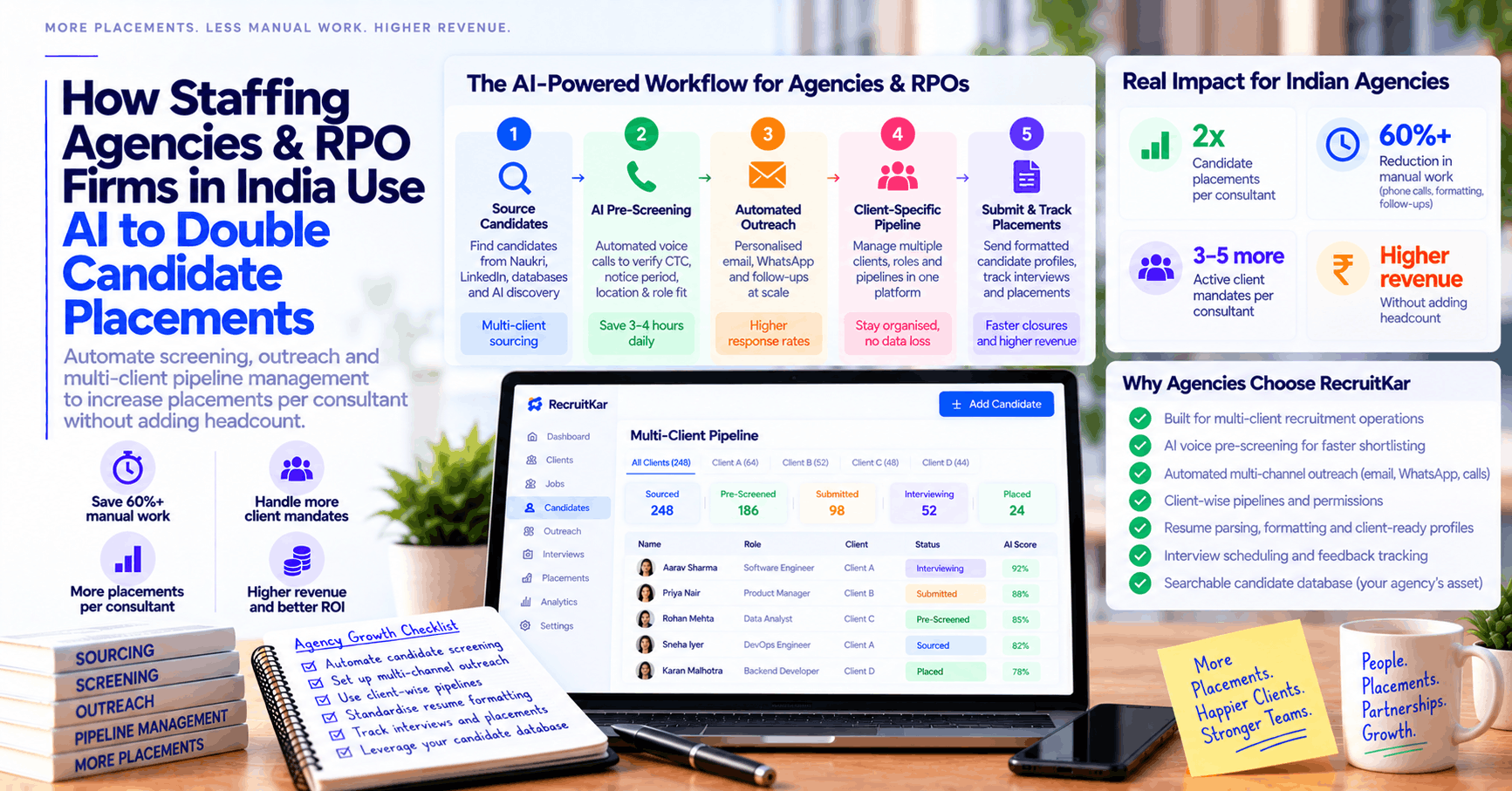
The average Indian recruitment consultant handles 8–12 open requirements simultaneously. Without automation, roughly 60% of their week disappears into manual tasks that generate no placements: phone screening candidates to verify basics already on their resume, copy-pasting candidate profiles between Naukri and client-facing Word documents, chasing hiring managers for interview feedback across WhatsApp threads. RecruitKar's AI software for staffing agencies is built specifically for multi-client recruiting operations — automating pre-screening calls, outreach sequences, and pipeline tracking across multiple client mandates in one system. This post covers exactly how high-performing Indian agencies are using AI to increase placements per consultant, with specific workflow examples for both contingency and RPO models.
The agency recruiting challenge that's different from in-house
Before the playbook: it's worth being precise about what makes agency and RPO recruiting structurally different from in-house hiring, because general-purpose ATS tools built for in-house teams solve the wrong problems for agencies.
Multiple clients, multiple pipelines, one consultant. An in-house recruiter works one pipeline for one organisation. An agency consultant simultaneously manages requirements from 5–15 different clients, each with different role specifications, different process expectations, different communication preferences, and different urgency levels. The cognitive overhead of context-switching across all of these — without a system that keeps each client's pipeline genuinely separate — is where most agency productivity is lost.
Revenue comes from placements, not from process. An in-house recruiter's output is measured by quality of hire and time-to-fill. An agency consultant's output is measured by placements — closed mandates that generate revenue. Every hour spent on tasks that don't directly advance a candidate toward placement is lost revenue, not just lost time. The automation ROI calculation for an agency is therefore more direct than for in-house hiring: if AI pre-screening saves a consultant 3 hours per day and they use that time to manage 3 additional active mandates, the revenue impact is measurable within a quarter.
The candidate database is the agency's core asset. An agency's historical candidate pool — built over years of placements across multiple clients and roles — is what differentiates a well-established consultancy from a new entrant. If that database lives in Naukri saved searches, a consultant's personal Excel files, and WhatsApp contacts that walk out the door when they leave, the asset walks out with them. Centralising it in a searchable, queryable system that's owned by the agency rather than individuals is a strategic priority, not just an operational convenience.
The 5 manual tasks where most agency time is wasted
Understanding where AI saves time requires being specific about which tasks consume it.
1. Phone screening to verify basics (3–4 hours/day per consultant)
Before a candidate can be presented to a client, a consultant verifies: current CTC and expected CTC, notice period, location flexibility, whether they're actively interviewing elsewhere, and basic role fit. This information is often partly in the candidate's resume — but not completely, and not in a format that allows quick comparison across 30 candidates.
A consultant with 15 open mandates receiving 20–30 new applications per mandate per week cannot manually call-screen every candidate without that becoming the entire job. In practice, manual screening means either reviewing only a fraction of candidates (missing strong profiles) or delegating it to junior consultants whose quality of screening is inconsistent.
2. Resume reformatting for client submission (30–45 minutes per candidate)
Most Indian agencies present candidates to clients not in the raw resume format but in a standardised client-facing profile — reformatted to the agency's template, removing the candidate's contact details, adding the consultant's commentary, and structuring it consistently. For a consultant submitting 5–8 candidates to a client, this is 3–6 hours of manual reformatting per mandate.
3. Follow-up for interview feedback (1–2 hours/day)
After a client interviews a shortlisted candidate, the consultant needs to collect feedback promptly — both to communicate with the candidate and to keep the process moving. In practice, this means chasing hiring managers who haven't responded, through WhatsApp threads that have no visibility to anyone else in the agency, with no documented record of what feedback was given when.
4. Candidate status updates across WhatsApp (1–2 hours/day)
Candidates being presented for multiple mandates simultaneously expect updates on their status. Manually messaging each candidate across multiple WhatsApp conversations — without any tracking of who was told what, when, by which consultant — produces both inconsistency and duplication.
5. Searching historical candidate database for new mandates (1–2 hours per new mandate)
When a new mandate arrives, an experienced consultant's first instinct is to check whether a strong candidate from a previous placement is now available or open to a move. Without a searchable, centralised database, this means going through personal notes, old emails, and Naukri saved searches — a process that takes hours and produces incomplete results.
How AI changes each of these tasks
AI voice pre-screening eliminates phone-screening overhead
Instead of a consultant manually calling 30 candidates per mandate, an AI voice agent dials the candidate list automatically, conducts a structured 3–5 minute qualifying conversation (CTC, notice period, location, role interest), and logs the results directly in the pipeline.
The consultant reviews outcomes in 20–30 minutes — which candidates are qualified and interested, which have blockers (CTC too high, wrong location, not open to the sector), which didn't connect and need a retry — rather than spending 4 hours making calls. For a consultant managing 12 active mandates with an average of 25 new candidates per mandate per week, this compresses what was a 10-hour per week task into approximately 2 hours of outcome review.
The AI voice call is transparent — it identifies itself as an automated pre-screening call on behalf of [Agency] for [Client Role] — and in India's professional candidate market, candidates are increasingly familiar with this format, particularly for mid-market roles. For senior mandates where the first conversation is itself a signal, a human consultant call remains the right approach.
Automated multi-channel outreach replaces manual follow-up
For candidates being approached for new mandates — sourced from the agency's existing database, Naukri, or LinkedIn — a sequenced outreach campaign (email → WhatsApp → brief voice touch) runs automatically rather than requiring a consultant to manually message each candidate.
The outreach sequence is configured per mandate and tracks responses across all channels. A candidate who replied positively to the WhatsApp but not the email shows up as "interested — WhatsApp reply" in the pipeline, rather than being missed because the consultant only checked their email that morning.
Centralised multi-client pipeline eliminates context-switching overhead
RecruitKar for recruitment agencies maintains a separate pipeline per client mandate, visible in a unified dashboard. A consultant opening the system sees: all active mandates across all clients, current pipeline stage for each candidate across all mandates, which mandates have candidates stalled waiting for client feedback, and which new candidates have entered the pipeline in the last 24 hours.
The same candidate can be tracked across multiple mandates simultaneously — appearing in the pipeline for two different client roles — with status tracked independently per mandate without data duplication.
Candidate reuse across mandates surfaces historical database value
When a new mandate arrives, the system searches the agency's historical candidate pool — every candidate ever sourced, interviewed, or placed — and ranks existing candidates against the new mandate's requirements. A consultant who placed a strong data analyst 18 months ago can find and contact that candidate for a new data mandate in minutes, rather than discovering them through a fresh Naukri search weeks later.
This is the compounding value that AI candidate matching adds over time for agencies: each placement and each sourcing effort adds to a searchable asset that returns value on future mandates. Agencies that don't centralise and systematically reuse their candidate database are effectively starting from zero on each new mandate.
The RPO model: how AI automation changes the economics
RPO (Recruitment Process Outsourcing) firms face a version of the same challenges — managing large volumes of sourcing, screening, and pipeline management on behalf of a client organisation — but at a scale and integration depth that creates additional specific challenges.
The volume challenge: RPO firms typically manage significantly higher hiring volumes per account than contingency agencies per mandate. An RPO contract for a 500-person company might involve 80–100 hires per year across 15–20 simultaneous role types. Managing this at quality without AI-assisted screening and outreach requires recruiter-to-opening ratios that are economically difficult to sustain.
The client reporting challenge: RPO clients expect visibility into pipeline status, source quality, time-to-fill by role type, and interview-to-offer conversion rates. Producing this reporting manually from fragmented systems (one tool for sourcing, another for ATS, another for outreach) consumes hours per week that add to the RPO operation's cost structure.
The brand immersion challenge: RPO consultants work under the client's brand — candidates interact with them as employees of the client organisation, not as an external RPO provider. The tooling and communication must reflect the client's employer brand and process standards, not the RPO firm's own.
RPO hiring automation on RecruitKar addresses these through: configurable per-client pipelines that can be branded to the client's employer identity, built-in source tracking and conversion analytics for client reporting, and AI-assisted screening that maintains consistent quality across high-volume roles without proportional increases in recruiter headcount.
A worked example: contingency agency, 5 consultants, 60 active mandates
The before state:
- 5 consultants, each managing 10–14 active mandates
- 3–4 hours/day per consultant on phone pre-screening
- 1–2 hours/day per consultant on candidate status updates (WhatsApp)
- Candidate database: Naukri saved searches + personal Excel files + individual WhatsApp contacts
- Client feedback: tracked in personal notebooks and WhatsApp threads
- Average placements per consultant per month: 3–4
The after state (with AI automation):
- AI voice pre-screening handles initial candidate qualification across all mandates; each consultant spends 30–45 minutes reviewing outcomes daily instead of 3–4 hours on calls
- Multi-channel outreach sequences (email + WhatsApp) run automatically per mandate; consultants review replies rather than sending messages manually
- Centralised pipeline across all clients and mandates; each consultant has a unified view of all active candidates, all client feedback, and all pending actions
- Candidate database is searchable across all historical placements; reuse rate on new mandates increases from near-zero (relying on memory) to 15–20% of mandates filled from historical pool
- Average placements per consultant per month: 6–7
The doubling of placement rate comes primarily from reclaimed time — not from AI making better hiring decisions, but from AI handling the mechanical tasks that were consuming 40–50% of each consultant's productive day.
What to look for when evaluating AI tools for your agency
Multi-client pipeline architecture: Does the system maintain genuinely separate client pipelines — with configurable access controls so a consultant only sees the client mandates they're responsible for — or is it a single pipeline with a "client" tag that doesn't provide real separation?
Candidate deduplication across mandates: When the same candidate appears in searches for three different mandates, does the system recognise them as one person or create three separate records? Deduplication is table-stakes for an agency tool but handled poorly by general-purpose ATS platforms.
Candidate ownership and database export: Who owns the candidate data if you switch platforms? Can you export your full historical candidate database — including sourcing notes, placement history, and contact details — cleanly? This is the most critical due-diligence question and the one most agencies ask too late.
Integration with Naukri, LinkedIn, and Indian job boards: The primary sourcing channels for Indian agencies need to connect directly to the platform. A tool that requires manual data entry from Naukri search results is not an efficiency improvement over the current state.
Client-facing reporting built in: Does the platform generate the pipeline and conversion reports clients expect, or does this require a separate manual process? For RPO firms especially, built-in reporting is a core requirement, not a nice-to-have.
Frequently asked questions
Will AI voice screening work for senior mandates (₹30+ LPA)? For senior mandates, the first conversation is itself a signal — how a candidate presents, how they ask questions, how they respond to information about the role. AI voice pre-screening is most appropriate for mid-market mandates (₹8–25 LPA) where the qualifying questions are straightforward and the human conversation adds more value at the interview stage than the pre-screen. For senior mandates, AI voice can still handle the initial availability and interest check, but the substantive first conversation should be a human consultant call.
How do we handle client confidentiality for mandates where the client doesn't want their identity disclosed? This is a standard requirement in retained search and some contingency mandates. The system should support creating mandates with a client reference name rather than the actual company name — all candidate-facing outreach and pipeline references use the reference name, not the disclosed client identity. Candidates learn the client identity only when they've been shortlisted and formally submitted.
What's the realistic timeline to see placement rate improvement after adopting AI tools? Most agencies see measurable improvement in consultant capacity (hours freed from manual screening) within the first month of adoption. Placement rate improvement typically lags by 6–8 weeks — the freed time needs to be directed into additional mandate management and sourcing activity, and new mandates take time to convert to placements. Agencies that actively redirect freed consultant time into additional mandates see placement rate improvements of 40–70% within a quarter; those that don't actively redirect the time see efficiency gains but limited revenue impact.
Does AI-assisted sourcing and screening reduce the quality of candidates presented to clients? Done well, it improves it. AI screening that filters on relevant qualification criteria — role-specific experience, CTC alignment, notice period fit — produces a shortlist that's more consistently relevant than manual screening at volume, where quality degrades as review fatigue sets in. The risk is a poorly designed screening rubric that filters on the wrong criteria — which is why the rubric configuration should be validated per mandate type rather than applied generically.
Can smaller agencies (2–5 consultants) benefit from AI tools, or is it only for larger operations? Smaller agencies often see the highest proportional benefit, because the consultant-to-mandate ratio is typically more stressed — a 3-consultant agency managing 30 mandates has less buffer for manual inefficiency than a 20-consultant firm. The ROI calculation is also faster: a 3-consultant agency where each consultant's placement rate increases from 3 to 5 per month generates a meaningful revenue increase against a monthly software cost in the low thousands of rupees. The setup overhead is the same regardless of agency size; the proportional impact is often larger for smaller agencies.
Scale your agency placements without adding headcount. Manage multiple client pipelines, automate pre-screening calls, and deliver pre-vetted shortlists to clients — all from RecruitKar's multi-client recruiting platform. AI software for staffing agencies — purpose-built for Indian recruitment consultancies and RPO firms.