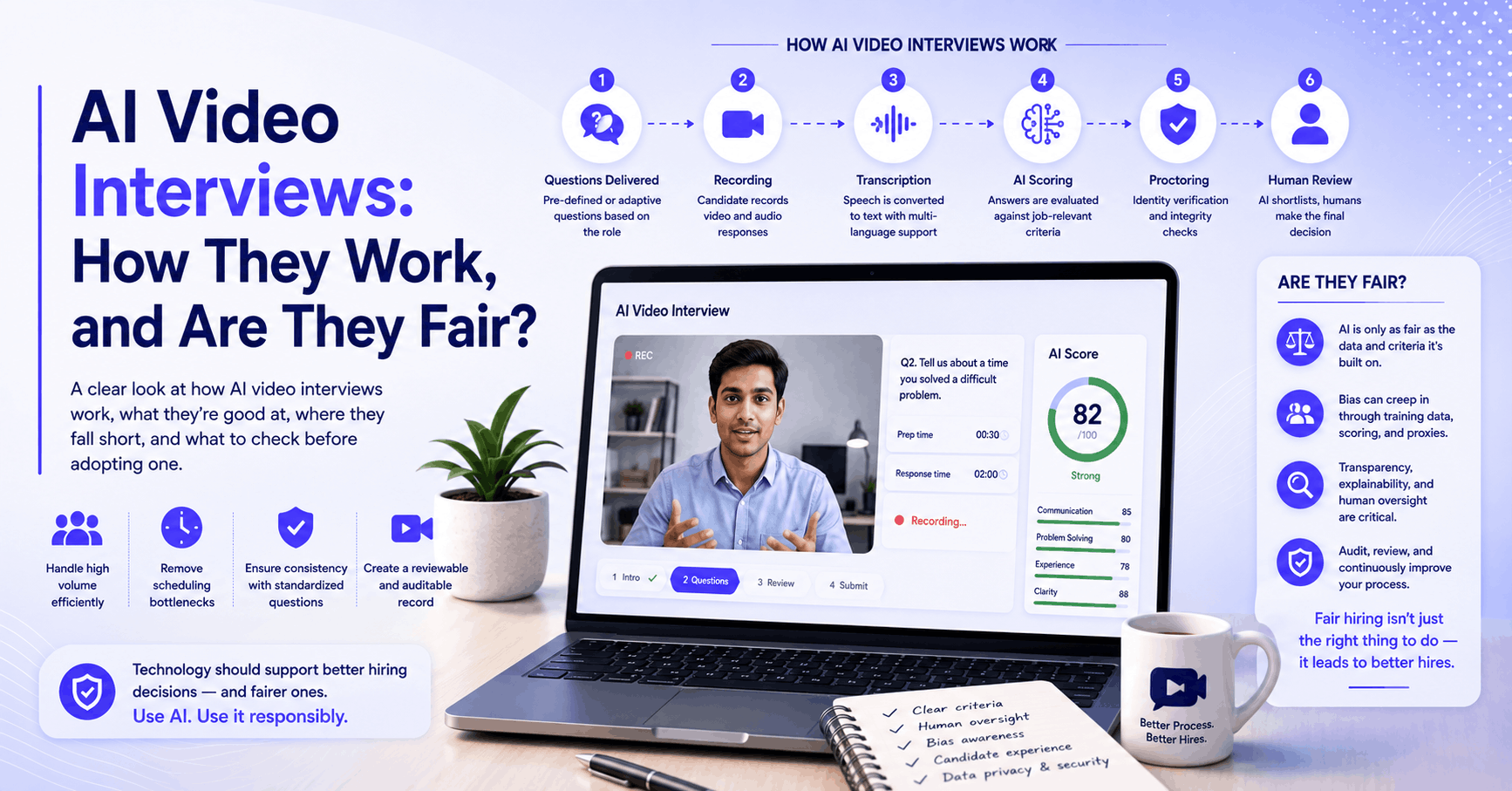
If you've applied for a job recently and been asked to record yourself answering questions on your laptop, alone, with no interviewer on the other end — you've done an AI video interview. For a lot of candidates, the experience is unsettling the first time: talking to a webcam instead of a person feels strange, and it's natural to wonder what's actually happening with that recording afterward.
For recruiters, the appeal is straightforward: a single job posting for a graduate program or a high-volume retail role can attract thousands of applicants, and there simply aren't enough hours to personally interview all of them. AI video interviews exist to solve that specific logistics problem. Whether they solve it fairly is a genuinely more complicated question, and one worth taking seriously rather than glossing over — both because it's what candidates are asking, and because regulators are starting to ask it too.
This post covers how AI video interviews actually work, what they're good at, where they fall short, and what to check before adopting one — for hiring teams considering it and candidates trying to understand what they're walking into.
What an AI video interview actually is
There are two related but distinct formats that both get called "AI video interviews," and it's worth separating them:
- One-way (asynchronous) video interviews. A candidate is given a set of questions — sometimes fixed, sometimes adaptive based on previous answers — and records responses on their own schedule, without a live interviewer present. This is the format most people mean when they say "AI interview."
- AI-assisted live interviews. A human interviewer conducts a normal video call, but the session is recorded, transcribed, and analyzed afterward — for consistency checks, note-taking, or to flag topics that weren't covered. This format keeps a human in the room throughout; the AI's role is closer to an assistant than an evaluator.
Most of the fairness debate centers on the first format, since that's where AI is doing evaluative work without a human present in the moment.
How the technology actually works
Question delivery. The system presents a set of questions — often role-specific and pre-approved by the hiring team — sometimes with a fixed time limit to answer, sometimes with a short prep window beforehand.
Recording and transcription. The candidate's video and audio response gets recorded and transcribed to text. Transcription accuracy matters more than it might seem — errors here can distort what's actually being evaluated, and multilingual support becomes genuinely important in markets like India, where a candidate answering fluently in a language other than English shouldn't be penalized for it. Platforms with proper multilingual support — Recruitkar's AI video interviews, for example, support 11+ languages — exist specifically to avoid quietly filtering out strong candidates on language alone.
Scoring. This is where implementations vary the most, and where the fairness question actually lives. Some systems score based on structured, job-relevant criteria — did the answer address the specific competency being asked about, how complete was the response, does it reflect relevant experience. Others analyze tone, word choice, or other signals in ways that are far less transparent and far more prone to encoding bias.
Proctoring. For roles or contexts where identity verification and integrity matter, the system may check that the person answering matches the applicant, flag environment irregularities, or verify the response wasn't pre-recorded or fed by someone else.
Human review. In most well-designed implementations, the AI-generated score narrows a large pool down to a shortlist, but a human — usually a recruiter — makes the actual decision about who advances, informed by the AI score and often the recording itself, not just a number.
What AI video interviews are genuinely good at
Handling volume that would otherwise be logistically impossible. For a role attracting thousands of applicants, there is no realistic alternative that involves a human interviewing every candidate live. The honest choice usually isn't "AI interview vs. live interview for everyone" — it's "AI interview vs. an even blunter filter," like resume keyword screening alone, or first-come-first-served processing.
Removing scheduling as a bottleneck. Candidates can complete the interview whenever suits them, without coordinating a live slot across time zones or work schedules — genuinely useful for candidates currently employed elsewhere who can't easily take a call during work hours.
Applying the same questions consistently. Every candidate gets asked the same thing, in the same way, which reduces one source of inconsistency compared to live interviewers who might unconsciously go easier on some candidates or ask meaningfully different follow-up questions to others.
Creating a reviewable record. Unlike a live interview where the only record is an interviewer's notes (or memory), a recorded response can be reviewed by a second person, referenced later, or checked if a decision is questioned.
The fairness question, taken seriously
This is the part worth not glossing over. "Are AI interviews fair?" doesn't have a single yes-or-no answer — it depends heavily on implementation, and there are specific, legitimate concerns worth naming directly.
Bias in training data. If a scoring model was built using historical interview data, and that historical data reflects biased outcomes (certain accents, backgrounds, or communication styles being favored or penalized in the past), the model can learn and repeat that pattern at scale — which is a materially different problem than one biased human interviewer, because it applies consistently across every candidate rather than being isolated to one person's judgment.
Communication style versus competency. Some scoring approaches risk conflating confident, fluent, culturally "expected" communication style with actual competence — which can disadvantage candidates who are highly qualified but less polished on camera, non-native speakers, neurodivergent candidates, or candidates from different cultural communication norms.
Lack of transparency. A candidate (and often the recruiter reviewing the score) frequently doesn't know exactly why a particular score was given. Systems that provide structured, explainable scoring — tied to specific, visible criteria rather than an opaque single number — are meaningfully more defensible than black-box scoring, both ethically and, increasingly, legally.
Candidate discomfort and trust. Independent of whether the scoring is actually biased, a lot of candidates simply distrust being evaluated by an algorithm they can't see or question — and that discomfort is itself a legitimate signal companies should take seriously, not dismiss. Recent industry research on candidate attitudes has found a strong majority of candidates want to know when AI is being used to evaluate them — this isn't a fringe preference anymore, it's close to a baseline expectation.
Accessibility. Candidates with certain disabilities, unreliable internet access, or limited access to a quiet, private space to record a video may be structurally disadvantaged by a one-way video format in ways a live phone or in-person interview wouldn't create.
None of this means AI video interviews are inherently unfair — it means "fair" depends entirely on specific implementation choices, and it's worth being able to answer these questions with specifics rather than reassurances.
What "doing it well" actually looks like
If you're evaluating or already using AI video interviews, here's what separates a defensible implementation from a risky one:
Score against structured, job-relevant criteria — and make those criteria visible. A system scoring "communication skills relevant to this specific customer-service role" based on visible, defined criteria is a fundamentally different (and more defensible) product than one outputting an unexplained overall score.
Keep a human in the final decision. Use the AI score to narrow a large pool to a manageable shortlist, not as the sole basis for a rejection. This is both an ethical safeguard and, increasingly, close to a legal requirement — automated employment decision tools are facing growing scrutiny, including mandated bias audits in some jurisdictions and high-risk classification under emerging AI regulation elsewhere.
Test for bias, and be able to show your work. Ask (or if you're the vendor, be ready to answer) how the scoring model has been tested across different demographic groups, accents, and communication styles — and what happens when disparities are found.
Offer alternatives where reasonable. For candidates who request it, or for roles where accessibility concerns are more likely, offering a live interview or an alternative format instead of forcing everyone through the same asynchronous video format is a meaningful fairness safeguard.
Be upfront with candidates. Tell candidates clearly that AI is involved in the process, roughly how it's used, and who ultimately makes the decision. This isn't just good ethics — it directly addresses the trust gap that's the single most consistent candidate complaint about this format.
What this means if you're a candidate preparing for one
A few practical, honest notes for anyone facing an AI video interview rather than trying to "beat" the algorithm:
- Answer the actual question asked, directly, before adding context. Structured scoring tends to reward clearly addressing the specific competency being asked about, not a meandering answer that eventually gets there.
- Treat it like a real interview, not a formality. The lack of a live interviewer can tempt people to under-prepare; the recording is still being evaluated with the same weight as a live conversation in most processes.
- Check your setup beforehand. Good lighting, a quiet space, and a stable connection matter more than they should, precisely because transcription and evaluation quality can be affected by poor audio.
- It's reasonable to ask questions about the process. If a company doesn't clearly explain how the interview is scored or reviewed, it's a fair thing to ask about directly — a transparent employer generally won't mind being asked.
Common questions worth answering directly
Can a candidate ask not to be evaluated by AI? In many implementations, yes — offering a live-interview alternative for candidates who request it is both a reasonable accommodation and increasingly expected practice, especially for candidates with disabilities or connectivity constraints that make an asynchronous video format genuinely difficult.
Does refusing an AI interview hurt a candidate's chances? It shouldn't, in a well-designed process, but it's a fair question for a candidate to ask a recruiter directly before assuming either way — practices vary meaningfully between companies.
Is the video recording kept, and for how long? This varies by vendor and company policy, but it's a reasonable question for a candidate to ask, and a reasonable one for a hiring team to have a clear, written answer to — vague answers here tend to erode trust fast.
Can a low AI score be appealed or reviewed by a human? In a defensible implementation, yes — the AI score should inform a human's decision, not replace it, which means there's always a human who can be asked to explain or reconsider a result.
When an AI video interview isn't the right tool
To keep this balanced: not every role benefits from this format. Senior, highly specialized, or leadership roles usually benefit far more from a live conversation, where nuance, real-time follow-up questions, and rapport genuinely matter to the hiring decision. AI video interviews are best suited to high-volume, more standardized roles — campus hiring, entry-level positions, structured customer-facing roles — where consistency across a large candidate pool matters more than deep, individualized exploration of a single candidate's experience. Most platforms, including Recruitkar, pair AI video screening with free human interview scheduling for exactly this reason — so a team can use each format where it actually fits, rather than forcing every role through the same process.
The bottom line
AI video interviews solve a real, specific problem — evaluating candidates at a volume no human interviewer could realistically handle — and they do it more consistently than an overwhelmed recruiter squeezing in back-to-back live calls. But 'consistent' isn't automatically the same as 'fair,' and the honest answer to whether these tools are fair is: it depends entirely on whether scoring is transparent, tested for bias, and treated as a first-pass filter rather than a final verdict.
But 'consistent' isn't automatically the same as 'fair,' and the honest answer to whether these tools are fair is: it depends entirely on whether scoring is transparent, tested for bias, and treated as a first-pass filter rather than a final verdict.
Any team adopting this technology owes candidates a clear answer to how it's being used — and any candidate facing one is right to expect that answer.