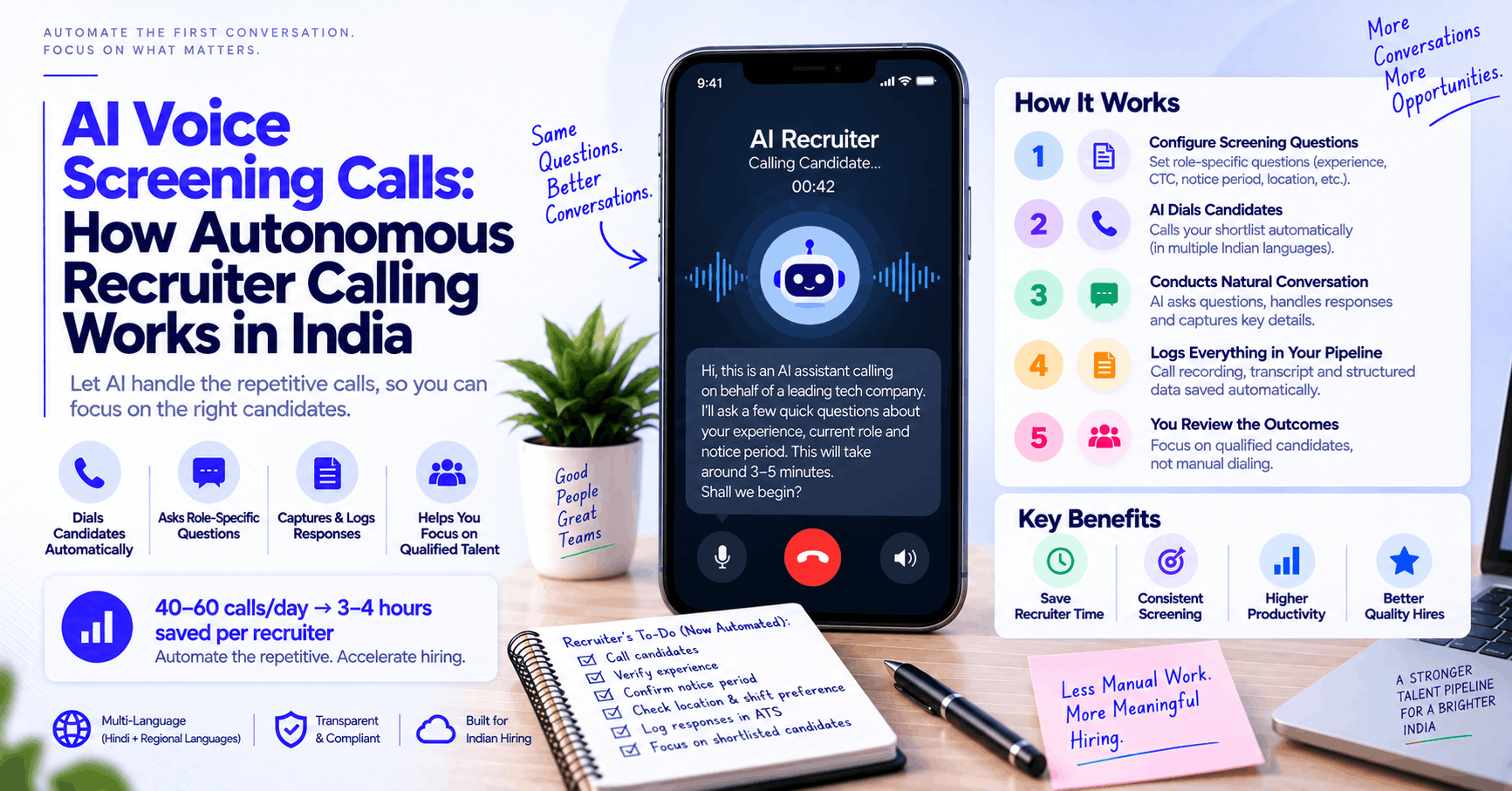
The average recruiter in a high-volume hiring role manually dials 40–60 candidates per day to verify basic qualifications — current role, experience, notice period, expected CTC, location. That's 3–4 hours of dialling for information that takes 5 minutes to act on. RecruitKar's automated AI voice screening calls replace that manual dialling entirely: an AI voice agent dials out to every candidate on a shortlist, conducts a structured 3–5 minute screening conversation in the candidate's chosen language, and logs the call recording, transcript, and key qualification details directly into the pipeline. Recruiters review outcomes, not calls.
This post explains exactly how autonomous voice screening works, where it fits in a hiring workflow versus other screening methods, and what to check before adopting any voice AI tool for recruiting.
The problem it solves, specifically
Manual phone pre-screening is one of the highest-volume, lowest-judgment tasks in the hiring process. The goal of a first screening call is almost always the same:
Is the candidate's experience level genuinely what the resume suggests?
What is their current CTC and expected CTC?
What is their notice period?
Are they open to the location, work mode (remote/hybrid/in-office), and shift if applicable?
Are they actively interviewing elsewhere, and what's their timeline?
None of these questions require a seasoned recruiter to answer — they require a structured conversation with a human-sounding voice that asks the questions consistently, captures the responses accurately, and moves to the next call when done. Manual dialling by a recruiter costs recruiter time, introduces inconsistency (different recruiters ask questions differently, some forget to ask something, some disproportionately progress candidates they found easy to talk to), and doesn't scale cleanly when a job posting attracts 500 applicants over a weekend.
AI voice screening replaces the mechanical part of this — not the judgment about whether to advance a candidate, which remains with the recruiter, but the data-gathering conversation that has to happen at scale before that judgment is worth exercising.
How AI voice screening actually works, step by step
Step 1: The screening script is configured for the role
Before the first call goes out, a recruiter or hiring manager configures the screening questions specific to the role — expected CTC range, notice period cutoff, required qualifications, location acceptance, shift requirements if relevant. These become the structured questions the AI asks, in the defined sequence.
More sophisticated implementations allow for conditional branching — if a candidate says their notice period is 90 days when the role requires joining in 30, the call can note this as a potential blocker and log it accordingly, rather than proceeding as though all answers are equivalent.
Step 2: The AI dials out to the candidate list
The system dials candidates automatically from the shortlisted pool — either all at once or in staggered batches to avoid overwhelming a small recruiter team with simultaneous results. Candidates receive the call from a business number; the voice agent introduces itself as calling on behalf of [Company] about a [Role] opportunity.
Most well-built systems are transparent that this is an AI-initiated call — candidates are informed upfront that they're speaking with an automated screening system and that the results will be reviewed by a human recruiter. This transparency has become increasingly important as candidates have become more aware of AI involvement in hiring processes, and it also reduces the conversational awkwardness that comes when a candidate isn't sure whether they're speaking with a human.
Step 3: The structured conversation happens
The AI conducts the conversation — asking the configured screening questions, handling common responses, and adapting to basic conversational inputs. Natural-sounding voice AI in Hindi and regional Indian languages matters specifically here: a candidate who is more comfortable in Hindi than English is more likely to complete the screening and give accurate answers when the call happens in their preferred language, rather than abandoning it mid-way because the AI's English is clear but their comfort with responding in English under pressure is lower.
For standard screening questions (CTC, notice period, location), accuracy is high because the questions are direct and the expected response formats are limited. More open-ended questions (describe your experience with X) produce more variable transcription and scoring quality, which is why AI voice screening works best for structured data-gathering rather than competency evaluation — that's what the subsequent video or human interview is for.
Step 4: Outcomes are logged automatically
Call recordings, transcripts, and structured qualification data (CTC stated, notice period, location confirmed, etc.) are logged directly against the candidate's record in the pipeline. Recruiters access a consolidated view of all screening outcomes — qualified candidates flagged for next steps, candidates with blockers (notice period too long, CTC expectation mismatch, wrong location) automatically tagged, candidates who didn't answer or asked to be called back queued for a retry.
In RecruitKar, these outcomes land in the visual ATS pipeline alongside the candidate's resume and any previous outreach history — so a recruiter reviewing screening results sees everything in one place, rather than cross-referencing a call log, a spreadsheet, and a resume database separately.
Step 5: Human review and next-step decisions
The recruiter reviews the shortlist of candidates who cleared basic screening criteria, listens to any calls where the transcript flags ambiguity, and decides who advances to the next round. The actual advancement decision — who gets an interview — remains a human call, made with better information than cold resume review alone provides.
Where AI voice screening fits in a hiring workflow
Best for: high-volume, structured qualification
Volume hiring for roles where the basic qualifications are straightforward and verifiable — BPO, customer support, retail, field sales, manufacturing floor supervisors, entry-to-mid-level tech roles — is where voice screening adds the most value. When a posting generates 200–500 applicants over 48 hours, manual dialling to qualify all of them is genuinely unworkable in a normal recruiter workday. Voice screening handles the full volume without a bottleneck.
Also effective for: passive candidate reactivation
A database of candidates who applied six months ago for a similar role, or who were shortlisted but not placed — these are often strong candidates who are re-contactable at low cost. AI voice screening can dial through a database of 500 past candidates to check availability, interest, and current situation far faster than a recruiter manually re-contacting each one, and without the social awkwardness of calling someone who may or may not remember the previous interaction.
Less suited for: senior or highly specialised roles
For roles where the screening conversation itself is a meaningful signal — where how a candidate describes their experience matters, not just whether they have it — a human-conducted screening call or an asynchronous video interview produces more useful information than a structured voice qualification check. Voice screening is a data-gathering tool; it doesn't replace the evaluative component of a first conversation with a senior candidate.
Paired with: AI video interviews for the next stage
A common, effective sequence for volume hiring: AI voice screening call for all applicants (basic qualification check), AI video interview for candidates who pass voice screening (competency-based structured evaluation), human interviews for the shortlisted candidates who clear video screening. This compresses what would otherwise be a three-week manual process into three to five working days, with recruiter time concentrated at the shortlist-review and human-interview stages where judgment actually matters.
What to check when evaluating any voice screening tool
Language quality in Indian English and regional languages
The most important technical specification, and the one most often glossed over in vendor demos. A voice AI that sounds natural and handles varied responses in American English may produce a jarring, stilted experience in Hindi or Telugu — which, as described above, directly affects screening completion rates for the candidate populations where AI voice screening is most valuable. Ask specifically: in which languages has the voice agent been trained and tested, and can you hear a demo call in each language you plan to use, not just the default English version.
Accuracy of structured data extraction
After the call, how reliably does the system extract structured data from the conversation? CTC stated as "around 8 lakhs" or "between 7 and 9" needs to be parsed and stored correctly for the pipeline to be useful. Notice period stated as "I'm currently serving notice, joining in three weeks" needs to be interpreted correctly. Testing this against realistic, varied candidate responses — not a scripted demo — reveals real accuracy quickly.
Transparency with candidates
The call should identify itself as automated. Beyond basic ethics, this reduces mid-call confusion and drop-off from candidates who realise partway through that something is unusual and hang up. It also reduces the backlash risk of a candidate discovering they were screened by an AI without being informed — a risk that's increasingly relevant as awareness of AI in hiring grows and expectations around disclosure harden.
Integration with your pipeline
A voice screening tool that delivers results as an audio file and a PDF summary, disconnected from your ATS, creates a data reconciliation task that partially offsets the time savings. A tool integrated with your pipeline — where results land directly against each candidate's record — is what produces a net time reduction rather than trading one manual task for another.
RecruitKar voice screening vs. standalone voice bots
There are standalone voice bot tools in the Indian market (Babblebots being one of the more commonly compared alternatives) that focus specifically on the calling functionality. The primary difference when evaluating RecruitKar against a standalone caller:
Standalone voice bots do the call and deliver results — recording, transcript, key data. The recruiter then manually transfers shortlisted candidates into their ATS or tracking system, triggers outreach separately, and manages the interview scheduling step in yet another tool.
RecruitKar's approach keeps the entire workflow in one pipeline: voice screening results, resume and sourcing data, email and WhatsApp outreach history, interview scheduling, and the visual hiring pipeline all sit in the same system. A candidate who passes voice screening can have an interview invitation triggered immediately, from the same platform, without the recruiter re-entering data or switching tools. The RecruitKar vs Babblebots comparison covers the feature-by-feature differences in detail for teams evaluating both.
Real workflow: high-volume campus hiring drive
To make this concrete: a company running a campus hiring drive for 80 engineering graduates across 12 colleges. 1,400 applications arrive over five days.
Without AI voice screening: A team of three recruiters manually calls candidates to confirm graduation year, CGPA, preferred location, and joining availability. At 8 minutes per connected call, and assuming a 60% connect rate, reaching all 1,400 candidates takes approximately 187 recruiter-hours — nearly five full working weeks for one recruiter.
With AI voice screening: The 1,400 candidates are dialled automatically starting 6 hours after the drive closes. 840 answer (60% connect rate); screening completes in about 14 hours of continuous dialling. Results are in the pipeline the following morning. Recruiters spend 3–4 hours reviewing outcomes and advancing 120 candidates to video interviews. Total recruiter time at this stage: less than half a working day.
The 120 video interviews are completed asynchronously by candidates over the next two days; recruiters review the shortlist and invite 25 to human panel interviews. The entire process from application close to final human interview panel takes 8 working days rather than 5–6 weeks.
Frequently asked questions
Do candidates know they're talking to an AI? In a well-implemented system, yes — and this should be the norm, not an afterthought. RecruitKar's voice agent introduces itself as an automated screening system calling on behalf of [Company] at the start of every call. Beyond ethics, this transparency reduces mid-call drop-off from candidates who become confused about whether they're speaking with a human, and it aligns with the direction regulatory expectations are moving in India and globally.
What happens if a candidate doesn't answer? The system automatically queues a callback attempt, typically at a different time of day to account for candidates who may be in a meeting or commuting. After a configured number of attempts without a connection, the candidate is flagged as "did not connect" in the pipeline, and a recruiter can decide whether to follow up by WhatsApp or email, or to close the candidate out of the current pipeline.
Can AI voice screening handle accents and varied speech patterns? Quality varies significantly by system. The specific Indian English accent variations (and the range of Hindi dialects, Tamil speech patterns, and other regional language variations) are a genuine technical challenge that not all voice AI systems handle equally well. Testing a real demo call with a candidate who speaks the way your actual candidate population speaks — not a demo prepared to showcase the best-case performance — is the most reliable way to evaluate this.
What's the typical completion rate for AI voice screening calls? Connect rates (calls answered) typically run 50–70% for cold screening calls to candidates who applied recently, depending on time of day, day of week, and how recently the application was submitted. Of candidates who answer and are told this is an AI screening call, completion rates (finishing the full screening conversation) are typically 70–85% for well-designed, brief screening flows (under 5 minutes). Longer or more complex screening conversations see meaningfully lower completion rates.
Is AI voice screening appropriate for senior roles? Generally not as a standalone first-round filter, for the reasons described above — the evaluative dimension of a senior candidate conversation requires human judgment that structured AI data-gathering isn't designed to replace. For senior roles, a human-conducted phone screen or a video interview tends to produce more useful signal at comparable or lower volume (since senior requisitions typically generate fewer applicants than volume roles). AI voice screening is most defensible, and most valuable, for genuinely high-volume roles where the alternative is either an unworkable manual dialling load or a much rougher filter (resume-only screening) that misses important qualification signals entirely.
Automate your phone pre-screening: Let RecruitKar Voice dial your candidate list, collect qualification data in their language, and land results directly in your pipeline — so you spend your time on shortlists, not on hold. Automated AI voice screening calls — set up your first campaign in under 10 minutes.