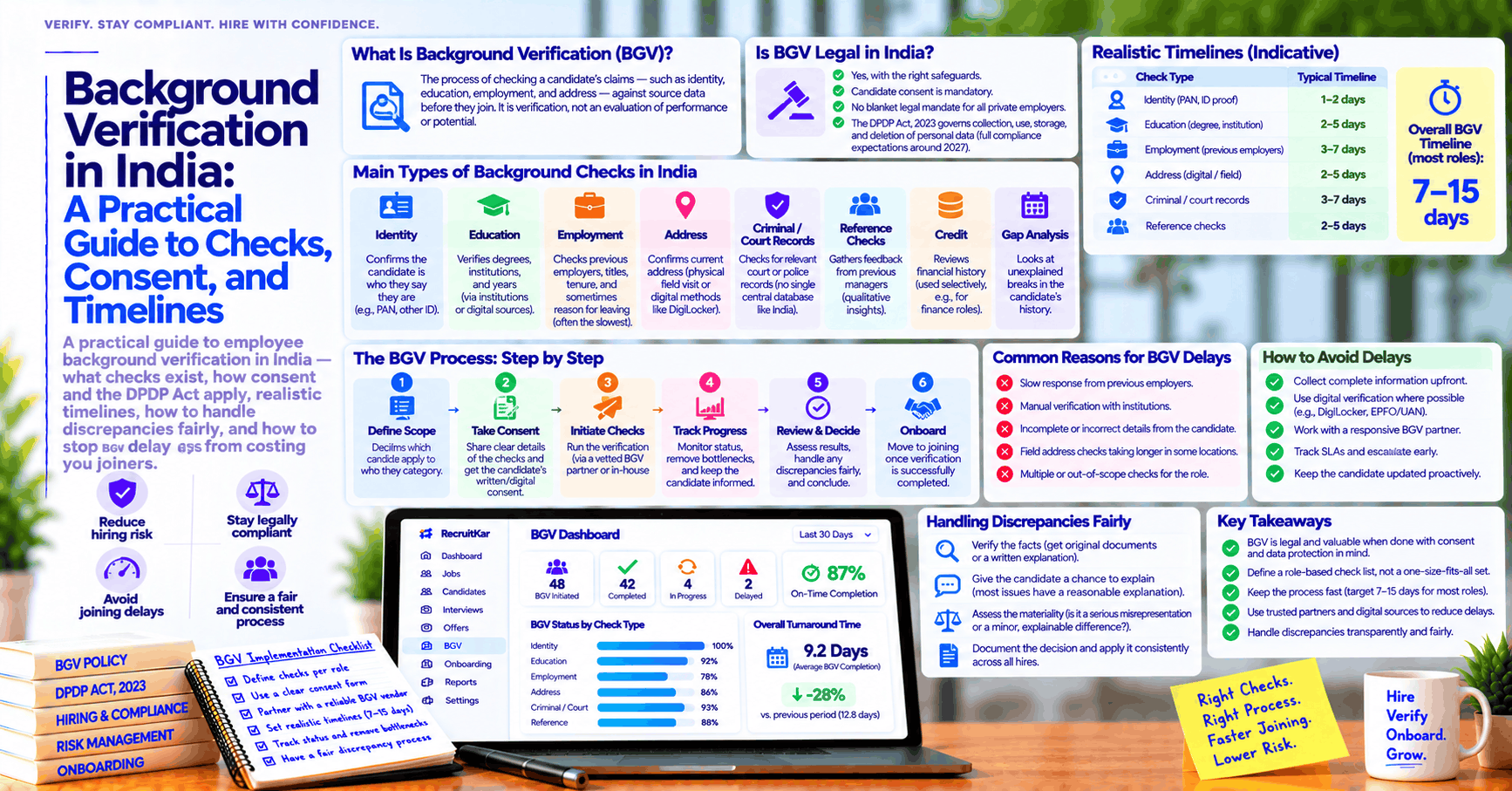
Background verification (BGV) is the process of checking what a candidate has told you, such as their identity, education, employment history, address, and sometimes court or criminal records, against source data before they join. It is legal in India as long as you handle consent and personal data properly, and no single law makes it mandatory for every private employer. In practice, the biggest problem is rarely the checks themselves. It is delay: verification that drags on while a candidate sits through a 60 to 90 day notice period is one of the quieter causes of offer-to-joining drop-off. RecruitKar's visual ATS pipeline is where you can track each hire's offer, verification status, and joining date in one place, so BGV does not disappear into email threads. This guide covers the checks, the consent and data-protection requirements, realistic timelines, and how to keep the process fast and fair.
This is general information, not legal advice. Data-protection rules in India are being phased in, and sector-specific requirements vary. Have counsel or your compliance team confirm what applies to you, especially around consent wording and sensitive records.
What background verification is, and what it is not
BGV is verification, not evaluation. It confirms that claims on a resume or application match what issuing authorities, institutions, and previous employers hold. It does not tell you whether someone will perform well, fit your team, or have the judgement the role needs. That is what structured interviews and reference conversations are for.
Used well, BGV does three things:
- It catches fabricated or inflated credentials before they become your problem.
- It reduces specific risks for sensitive roles, such as those handling money, data, or vulnerable people.
- It creates a documented, consistent standard so screening is not arbitrary.
Used badly, it becomes a slow, intrusive step that delays joiners and treats every candidate as a suspect.
Is background verification legal in India?
Yes, with conditions. The points that matter:
- Consent is the floor. Candidates should be told what checks will be done, why, and how their data will be used, and should agree before you start.
- There is no blanket legal mandate for all private employers to conduct BGV. Some regulated sectors, such as financial services, may carry their own expectations, so check sector rules.
- The DPDP Act, 2023 governs the data. Collecting, storing, sharing, and deleting candidate personal data, including identity documents, education and employment records, and any criminal-record information, falls under it. The Act's rules are being phased in, with vendors and commentators pointing to full compliance expectations around 2027. Verify the current position with counsel rather than assuming.
- Identity documents need care. Collect only what you actually need, protect it, and take advice on rules specific to identity numbers such as Aadhaar before building them into your process.
The main types of checks
| Check | What it verifies | Notes |
|---|---|---|
| Identity | Candidate is who they say they are | Typically PAN and other government ID; handle ID data carefully |
| Education | Degrees, institutions, years, sometimes certificates | Often involves contacting universities or using digital sources; speed varies by institution |
| Employment | Previous employers, titles, tenure, sometimes reason for leaving | Usually the slowest and most variable, since it depends on previous employers responding; EPFO/UAN data is sometimes used as a supporting source |
| Address | Candidate lives where they say | May be physical (a field visit) or digital (for example, via DigiLocker-linked documents), and digital methods have not fully replaced fieldwork |
| Criminal / court records | Any relevant court or police records | India has no single centralised criminal database, so this typically combines court-record searches with police verification |
| Reference checks | How previous managers describe the candidate | Qualitative; see our guide on running reference checks |
| Credit | Financial history | Used selectively, usually for finance roles, and needs a clear justification |
| Gap analysis | Unexplained breaks in history | A prompt for a conversation, not an accusation |
Match the scope to the role. A standard package for a general office role differs from the deeper checks appropriate for a senior finance hire. Running the maximum set for every role adds cost, delay, and data risk without adding value.
The process, step by step
1. Decide the scope per role family, in advance
Write down which checks apply to which categories of role. Do this once, apply it consistently, and avoid deciding case by case, which invites unfairness and inconsistency.
2. Put BGV in the offer letter
State that the offer is conditional on satisfactory verification, which checks may be run, and what documents the candidate will need to provide. This sets expectations before the offer is accepted rather than surprising the candidate afterwards.
3. Get clear, written, informed consent
The consent should say which checks will be performed, who will perform them, why the data is needed, how long it will be kept, and how the candidate can raise questions or exercise their rights. Do not bury it in a long form.
4. Collect documents early and completely
Ask for documents in one request, with a checklist, rather than trickling requests over days. Missing documents are one of the commonest sources of avoidable delay.
5. Initiate verification
Run it in-house or through a verification vendor. Start as soon as the offer is accepted, not after the candidate has joined.
6. Track progress by check, not just overall
Know which checks are complete, which are waiting on a third party, and who is chasing what. "BGV in progress" is not specific enough to act on.
7. Review the report and handle any discrepancy fairly
See the section below. This is the step where process fairness matters most.
8. Record the outcome and manage the data
Document the decision, store the report securely, restrict access, and delete it on schedule according to your retention policy.
How long does BGV take?
Verification vendors commonly cite a typical end-to-end range of roughly one to three weeks, with digital checks such as identity and some education checks completing faster, and employment, address, and criminal checks taking longer. Treat any figure as indicative, because the real timeline depends on:
- How quickly the candidate supplies complete documents
- How responsive previous employers and institutions are
- Whether address checks are physical or digital
- How many employers and addresses need to be verified
- Your vendor's turnaround and any backlog
The employment check is usually the long pole. A previous employer's HR team that responds slowly can hold up the whole report.
Why delays hurt more in India
India's notice periods, commonly 60 to 90 days for professional roles, create a long gap between offer acceptance and joining. That gap is the window in which candidates receive counter-offers and reconsider. A slow BGV process makes it worse in two ways:
- It adds uncertainty. A candidate who has resigned but has heard nothing about whether verification is complete, or what is outstanding, worries.
- It can push the joining date. A candidate who has served notice and is ready to join but cannot be cleared creates an awkward gap with real consequences for them.
How to prevent it:
- Start BGV the day the offer is accepted, and run it in parallel with the notice period rather than saving it for the end.
- Tell candidates what to expect and what you need from them, with a checklist and realistic timelines.
- Request documents upfront in a single message.
- Chase previous employers' HR early, and ask the candidate to give their former HR a heads-up.
- Decide your policy on joining before clearance. Some companies allow joining while non-critical checks are pending, with a clear condition that employment is subject to the outcome. Others require clearance first. Set the rule for each role family in advance and apply it consistently.
- Keep the candidate engaged throughout, since regular, genuine contact reduces the chance they drift away during the wait.
Handling discrepancies fairly
Not every difference between a resume and a report is fraud. Treat discrepancies in tiers:
Minor or explainable: a slightly different job title, a date off by a few weeks, a company that changed its name, a degree awarded in a different year. Ask the candidate for clarification and documentation, and accept reasonable explanations.
Material: a degree that cannot be verified, a claimed employer with no record, a significant tenure inflation. Give the candidate a fair chance to respond with evidence before deciding.
Serious: forged documents or a relevant criminal record. These need a documented decision, and legal advice before acting.
Principles for fairness:
- Give the candidate an opportunity to explain before any adverse decision.
- Use a consistent standard. Apply the same threshold to every candidate in the same role category.
- Do not act on unverified or partial information. A vendor report saying "unable to verify" is not the same as "false."
- Document the reasoning for every adverse decision.
- Take legal advice before withdrawing an offer, particularly after the candidate has resigned from their previous job in reliance on yours. Our guide to rejection and offer-withdrawal communication covers the human side of that conversation.
DPDP and consent: a working checklist
- [ ] Candidates are told, in plain language, which checks will be run and why
- [ ] Consent is obtained before any check starts and is recorded
- [ ] Only the data needed for the stated checks is collected
- [ ] Your verification vendor is under a written agreement covering data handling, security, and deletion
- [ ] Access to reports is limited to those who need it
- [ ] A retention period is defined, and data is deleted when it expires
- [ ] There is a process for candidates to ask what data you hold and to request correction
- [ ] You know where verification data is stored and whether it leaves India
- [ ] Sensitive records, such as criminal-record data, get extra safeguards
If your vendor claims to be "DPDP compliant," ask what that means specifically: how consent is captured, where data is stored, and how deletion works.
In-house or outsourced?
Outsourcing to a verification vendor is the norm for most companies, because vendors have established channels to institutions, courts, and employers, and can run checks in parallel. Choose on turnaround, coverage for the check types you need, transparency of status, data-protection practices, and how they handle disputes and re-checks.
Doing some checks in-house can work for low volume or simple checks, such as a quick reference call, but does not scale well to employment, address, or criminal checks.
Either way, own the process design. The vendor performs checks; you decide scope, standards, and how discrepancies are handled.
Tracking BGV in your hiring pipeline
RecruitKar does not perform background checks and is not a verification vendor. Where it helps is the tracking: after the offer, a candidate moves through offer accepted, documents received, verification in progress, cleared, and joined. Having those stages visible in your visual ATS pipeline, with dates and owners, makes it obvious which candidates are stuck and where, instead of relying on someone's memory of an email thread.
Keep candidates engaged during the wait with timely messages through email or WhatsApp, such as reminders for missing documents and short status updates.
Common mistakes
Starting BGV after joining or late in the notice period. This turns a manageable step into a last-minute scramble.
Running the same maximum check set for every role. It wastes time and collects more data than needed.
Vague consent. A line buried in a form does not meet the standard of informed consent.
Treating "unable to verify" as "failed." A verification gap is a prompt for follow-up, not a verdict.
No policy on joining before clearance. Ad hoc decisions are inconsistent and invite disputes.
Keeping reports indefinitely. Unneeded sensitive data is a liability.
Frequently asked questions
Is background verification mandatory in India? There is no single law that makes it mandatory for all private employers. Some regulated sectors may have their own requirements, and clients, especially in financial services and IT services, often require it contractually. Where you do it, you must handle consent and personal data lawfully.
Can I run a background check without the candidate's consent? You should not. Written, informed consent is the baseline, and the DPDP Act makes lawful handling of personal data a core obligation. Beyond the legal point, doing checks without telling candidates damages trust.
How long should I keep a candidate's BGV report? Only as long as needed for the purpose, and you should define the period in advance. Many companies keep reports for the duration of employment plus a defined period for records and potential disputes, and delete reports for candidates who are not hired much sooner. Confirm retention periods with your counsel.
What if a previous employer refuses to verify employment? It is common for employers to be slow or to confirm only limited details. Fall back on alternative evidence, such as relieving letters, payslips, offer letters, or EPFO/UAN records where appropriate, and use a reference conversation to fill the gap. Do not treat a non-responsive former employer as evidence of fraud.
Should I run BGV before or after the offer? Most companies make a conditional offer first and run BGV in the notice period, which keeps the process parallel rather than sequential. For roles with specific legal or safety requirements, you may need to complete certain checks earlier. The key is telling candidates clearly what the offer is conditional on.
Keep every hire's verification status visible. Track offer, document collection, verification, and joining in one visual ATS pipeline, and keep candidates informed through the notice period with automated email and WhatsApp updates.