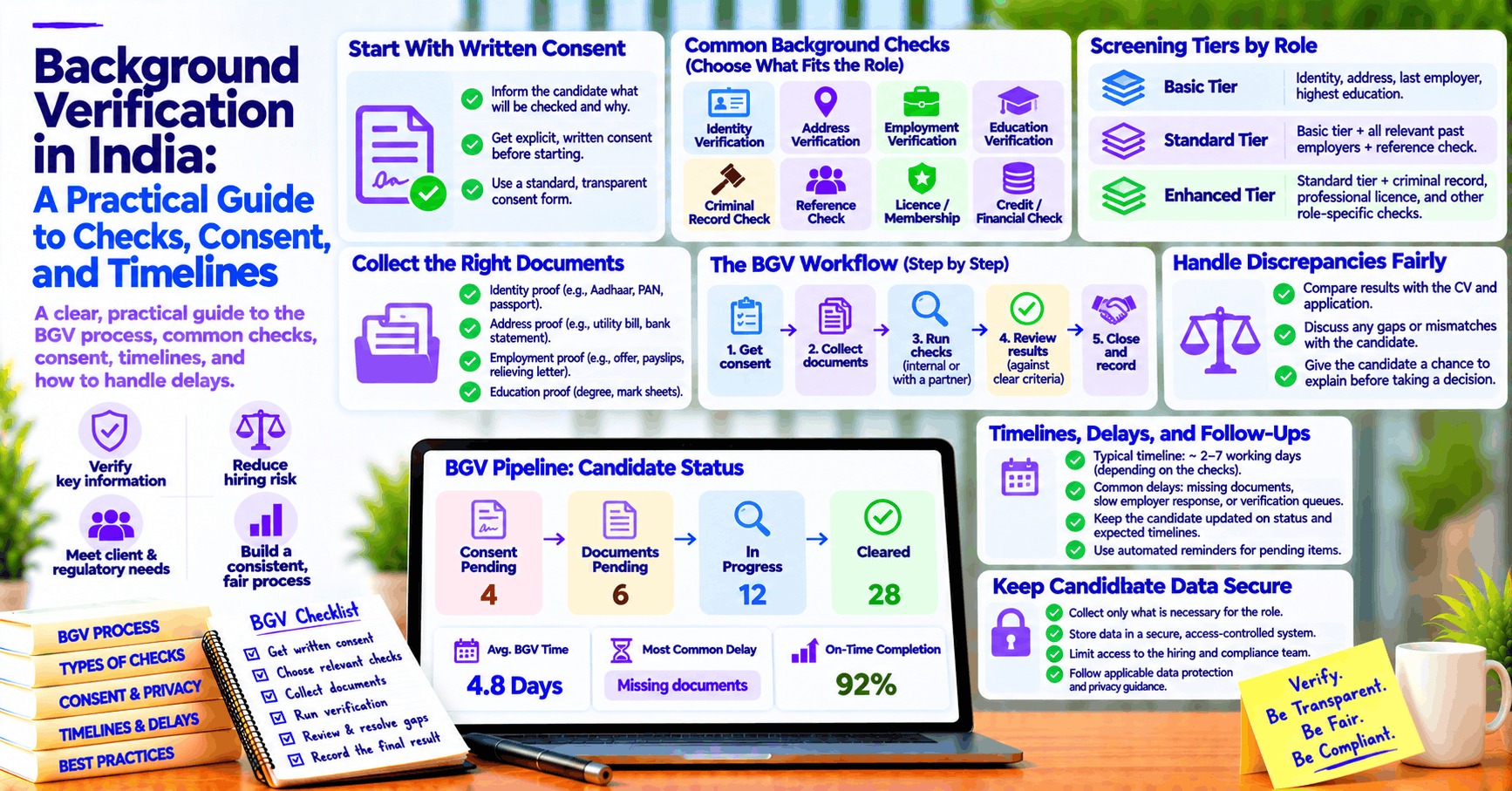
The background verification process in India usually runs in five steps: get the candidate's written consent, decide which checks the role needs, collect documents, run the checks through your team or a verification partner, and review results against clear criteria before the candidate joins. Most delays come from missing documents and slow responses from past employers, not from the checks themselves. Tracking each check against the candidate's record in the RecruitKar ATS pipeline keeps everyone aware of what is pending. This guide covers the common checks, consent, timelines, and how to handle delays.
What Background Verification Is (and Is Not)
Background verification, often shortened to BGV, is the process of confirming that the information a candidate has shared is accurate and that nothing relevant to the role has been left out. Companies also call it pre-employment screening or an employee background check.
It is different from a reference check. A reference check is a conversation with people who worked with the candidate to understand performance and working style. Background verification is a records-based confirmation of facts such as identity, past employment, and education. The two complement each other, and neither replaces the other.
It is also not a way to judge someone's character on rumour or personal opinion. A well-run process confirms job-relevant facts, treats candidates fairly, and uses clear criteria to decide what a finding means.
Why Companies Run Background Checks
Accuracy. To confirm that the CV is truthful, including titles, dates, and qualifications.
Risk reduction. To lower the chance of hiring someone for a role involving money, customer data, vulnerable people, or safety responsibilities when there is a relevant concern.
Client and regulatory expectations. Some clients, industries, and regulated roles expect or require specific checks.
Consistency. A standard process applied the same way to everyone is fairer than ad hoc checks.
The depth of verification should match the risk of the role. A senior finance role or a position with access to sensitive data calls for more than a basic entry-level role does.
Common Background Checks in India
Below are the checks most commonly used. You do not need all of them for every role. Choose the ones that are relevant and proportionate.
Identity verification. Confirms that the person is who they say they are, usually by checking government-issued identity documents. Follow the rules on how identity numbers may be collected, shown, and stored, and take legal advice on this point.
Address verification. Confirms the candidate's current or permanent address, either through documents or a physical or digital check. It matters more for some roles, such as field work, than others.
Employment verification. Confirms past employment details such as company name, dates of employment, designation, and sometimes reason for leaving, by contacting previous employers or reviewing documents such as relieving letters and payslips.
Education verification. Confirms degrees, certificates, and institutions, usually by checking with the university or board or through documents.
Criminal record check. Searches for relevant records, typically through available court or police-related sources. Availability and scope vary, and a result needs careful, fair interpretation.
Reference check. A conversation with professional referees about work and conduct. Our guide on how to run reference checks that tell you something covers this in detail.
Professional licence or membership check. Confirms registrations required for the role, such as for certain finance, legal, healthcare, or technical positions.
Credit or financial history check. Sometimes used for roles with financial responsibilities. It should be limited to roles where it is clearly relevant and done with proper consent and legal review.
Database and sanctions screening. Checks against lists maintained for regulatory or risk purposes, used mainly in regulated sectors.
Gap and tenure review. An internal review of career gaps and job tenure. Ask about them with curiosity, since gaps can have many valid reasons.
Other checks. Some employers use drug and medical screening, or review of public professional profiles, for specific roles. These raise greater privacy and fairness questions and should be used cautiously and only with legal guidance.
Matching the Checks to the Role
A simple way to set this up is to create tiers by role type and apply the same tier to everyone in that group.
Basic tier: identity, address, last employer, and highest education. Often suits entry-level or high-volume roles.
Standard tier: the basic checks plus all relevant past employers, plus a reference check. Suits most professional roles.
Enhanced tier: standard checks plus criminal record, professional licences, and any regulated or sector-specific checks. Suits roles with access to money, sensitive data, vulnerable people, or safety responsibilities.
Document your tiers and the reasons behind them. This helps you stay consistent, and it helps you explain to candidates why a check is being done.
Consent: Where the Process Starts
No check should begin before the candidate has been told what will be verified and has agreed in writing.
A good consent process includes:
Clear notice. Explain which checks you will run, why, who will perform them, and what information will be shared with third parties such as a verification partner or past employers.
Written, specific consent. Use a consent form that is easy to understand and separate from other documents, not buried inside a long contract.
Only what is needed. Collect only the information and documents required for the checks, and no more.
Secure handling. Keep documents and results in a secure place with limited access.
Retention limits. Decide how long you will keep records and delete them when they are no longer needed.
A way for candidates to ask questions. Give a named contact for queries and for requests to correct inaccurate information.
India's data protection law places obligations on organisations that process personal data, including around notice, consent, purpose, and security. The rules and their implementation continue to develop, so have your counsel review your consent language and data handling. A short note on this appears at the end of the article.
Step-by-Step Background Verification Process
Step 1: Define the checks and criteria
Decide, before you start, which checks apply to which role and what findings would matter. Examples: a mismatch in dates, a fake degree, or a serious criminal record directly relevant to the job. Write these criteria down so that decisions are consistent.
Step 2: Tell the candidate early
Mention background verification at the first or second conversation, and again in the offer. Explain which documents they will need and roughly how long it takes. Candidates who know in advance usually respond faster.
Step 3: Make the offer conditional
State in writing that the offer depends on satisfactory completion of background verification. This protects both sides and sets expectations. Have HR or counsel confirm the wording.
Step 4: Collect consent and documents
Send a consent form and a clear checklist of documents. Typical items include identity proof, address proof, education certificates, previous employment letters, relieving letters, and payslips. Make it easy to upload from a phone, since many candidates do not have access to a computer. Sending the checklist by email with a short follow-up on WhatsApp often speeds up collection.
Step 5: Run the checks
You can run checks through your own HR team or through a verification partner. Whichever you choose, confirm who is responsible for what, how long they take, and how data is secured. If you use a partner, ask how they store and delete data, and check the contract.
Step 6: Track status and follow up
Assign a single owner for each candidate's verification. Check progress regularly, chase pending items, and update the candidate. Visible tracking in your pipeline avoids the common problem of a check sitting untouched while the joining date approaches.
Step 7: Review results fairly
When results arrive, compare them against your criteria. Not every discrepancy is a problem. A date that differs by a few weeks, a company renamed after a merger, or a degree from a university that changed its name may have simple explanations.
Step 8: Give the candidate a chance to respond
If you find something that might affect the decision, tell the candidate and give them a fair chance to explain or correct it before deciding. Mistakes in records do happen.
Step 9: Decide, document, and close
Record the outcome and the reasoning. Store results securely, restrict access, and delete or archive as per your retention policy.
How Long Does Background Verification Take?
There is no single timeline, and you should be wary of anyone who promises a fixed number for every case. How long verification takes depends on several things:
Which checks you run. Identity checks are often quick, while employment, education, and court-record checks can take longer.
How quickly the candidate provides documents and consent. This is a very common cause of delay.
How quickly past employers and institutions respond. Some respond fast, others take time, and some are hard to reach.
Number of past employers. More employers mean more checks to complete.
Location and records access. Some records are slower to access in certain places.
Whether the verification partner works in parallel. Running checks at the same time, instead of one after another, saves time.
Your own internal responsiveness. Slow reviews and approvals add days.
Ask your verification partner for their typical turnaround by check type and plan around it, rather than assuming a single number. Build the expected duration into your offer and joining timeline.
Why Verification Delays Happen and How to Reduce Them
The search term "BGV delay offer joining" reflects a real frustration: the candidate has resigned, the joining date is close, and verification is not finished. Common causes and fixes:
Incomplete or poor-quality documents. Give a clear checklist, with examples of acceptable documents, at the offer stage.
Candidate slow to respond. Explain the consequences of delay and use friendly, regular reminders. Phone calls through RecruitKar voice outreach can help when messages go unanswered.
Past employers who do not reply. Start early, contact multiple points of contact, and accept reasonable alternative documents such as relieving letters, payslips, or experience letters when a former employer is unresponsive.
Checks run one after the other. Run them in parallel wherever possible.
Starting too late. Start verification as soon as the candidate accepts the offer, or before if your policy allows and the candidate has consented.
Unclear ownership. Name one person responsible for each verification, and review pending cases weekly.
No agreed approach for joining before completion. Decide in advance what happens if checks are not complete by the joining date. Some companies allow joining with conditions, such as completion within a set period, for lower-risk roles, and require full completion before joining for high-risk ones. Whatever your approach, state it clearly in the offer and apply it consistently.
Candidates who go quiet. Keep warm contact during the notice period. If you are managing several joiners at once, interview scheduling and a shared pipeline keep upcoming steps visible.
Handling Discrepancies Fairly
Finding a mismatch does not automatically mean dishonesty. Handle discrepancies in a consistent and fair way.
Check for simple explanations. Typos, name changes, company mergers, and renamed institutions are common.
Separate minor from serious. A small date variance is different from a fabricated degree.
Ask the candidate. Explain what you found and ask for clarification or documents.
Apply your criteria consistently. Treat similar cases similarly, regardless of who the candidate is.
Consider relevance to the role. Whether a finding matters depends on the job. Consider the nature of the issue, how long ago it occurred, and how it relates to the role.
Involve HR or legal for serious cases. Particularly where you are thinking of withdrawing an offer or ending employment.
Document your reasoning. Clear records support fairness and protect everyone if there is a later dispute.
Using a Verification Partner: What to Ask
Many companies work with a specialist verification provider. Before selecting one, ask questions such as:
Which checks do you cover, and how do you perform each?
How do you collect consent and handle candidate data?
Where is data stored, who can access it, and when is it deleted?
What are your typical turnaround times by check type?
How do you handle discrepancies and candidate disputes?
What reporting and status updates will we get?
What are the responsibilities and liabilities in the contract?
Keep claims about speed and accuracy in perspective, and verify them with references or a trial before committing. Have your counsel review the agreement.
Keeping Verification Efficient Inside Your Hiring Workflow
Background verification works best when it is one visible stage in your hiring process and not an afterthought.
Add verification as a defined stage in your pipeline, with statuses such as consent pending, documents pending, in progress, and cleared.
Send consistent messages to candidates using templates for consent requests, document checklists, and reminders.
Assign owners and set reminder dates ahead of joining.
Review pending verifications weekly.
Keep candidates informed so they are not left guessing.
If your team wants to keep outreach, scheduling, and pipeline tracking in one place, see how RecruitKar supports recruiting teams. Smaller companies setting up their first process can start with RecruitKar's startup solution.
A Note on Consent, Data Protection, and Compliance
This article is for general information and is not legal advice. Background verification involves sensitive personal data, and it can raise data protection, privacy, anti-discrimination, and employment law issues. India's data protection law and its rules are developing, and requirements may differ by industry and by state. Before finalising your process, have qualified legal counsel review your consent forms, the checks you run for each role, how you collect and store identity documents and other personal data, your retention periods, your agreements with verification partners, and how you handle adverse findings.
Frequently Asked Questions
1. What is the background verification process in India?
It typically involves getting the candidate's written consent, deciding which checks apply to the role, collecting documents, running checks such as identity, address, employment, and education, and reviewing the results against clear criteria. Results are then recorded, and the candidate is given a fair chance to respond to any discrepancy. Many companies make offers conditional on satisfactory verification.
2. How long does background verification take?
There is no fixed duration. It depends on the checks you run, how quickly the candidate shares documents, how quickly past employers and institutions respond, and how many employers need to be contacted. Ask your verification partner about typical turnaround by check type, start early, and run checks in parallel to reduce delays.
3. What documents are needed for a background check?
Common documents include identity proof, address proof, education certificates, previous employment letters, relieving letters, and payslips. The exact list depends on which checks the role needs. Share a clear checklist with the candidate early, and collect only what is needed for the checks you will actually run.
4. Can a candidate join before background verification is complete?
It depends on your policy and the risk of the role. Some companies allow joining with verification pending for lower-risk roles, usually with a condition that it must be completed within a set period. For high-risk roles, many require completion before joining. Whatever you choose, state it clearly in the offer letter and apply it consistently.
5. What should I do if background verification finds a discrepancy?
Check for simple explanations first, such as name changes, typing errors, or company mergers. Separate minor mismatches from serious ones, tell the candidate what you found, and give them a fair chance to respond. Decide using your documented criteria, and involve HR or legal advisors before withdrawing an offer or ending employment.
Final Thoughts
A good background verification process is clear, proportionate, and fair. Decide which checks each role needs, obtain written consent, ask for documents early, run checks in parallel, track every case in one place, and give candidates a chance to respond to findings. Most delays can be prevented by starting early and communicating well.
If you want your pipeline, outreach, and interview scheduling working together so verification never becomes the last-minute bottleneck, explore RecruitKar and see how it fits your hiring workflow.