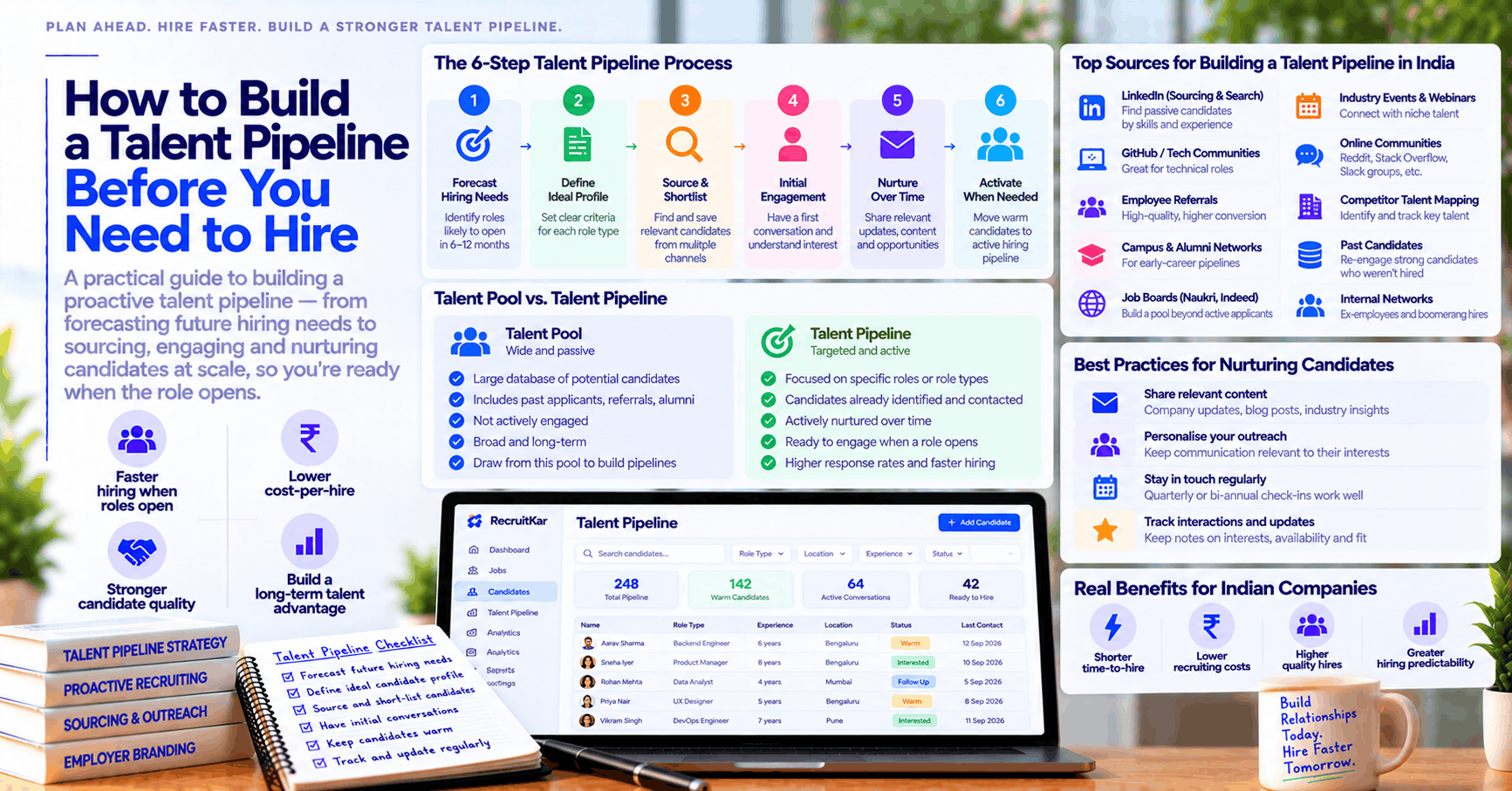
A talent pipeline is a pool of qualified candidates you've already identified, contacted, and kept warm — so when a role opens, your first call is to someone who already knows your company, not to a Naukri search that starts from zero. Companies that hire reactively — opening a role, posting, sourcing, and screening from scratch every time — consistently pay more per hire, take longer to fill, and lose strong candidates to companies that were already in conversation with them. Building a talent pipeline means doing the sourcing work in advance, when you're not under pressure. RecruitKar's AI candidate discovery lets you search, save, and contact candidates before a role is formally open — so your pipeline is warm when the requisition arrives.
The difference between a talent pool and a talent pipeline
These terms are frequently used interchangeably, and the distinction matters for how you build and manage each.
A talent pool is a broad database of people who might be relevant to future hiring — past applicants, sourced candidates who weren't hired, people who've engaged with your employer brand, alumni, and referrals. It's wide and largely passive — people are in it, but they haven't been specifically cultivated.
A talent pipeline is more specific — a set of candidates who have been identified for a particular role type, contacted at least once, and are being actively (if infrequently) kept warm with the expectation of a future conversation. A pipeline for "senior backend engineers in Bangalore" might contain 30 people you've had initial conversations with over the past 6 months, who know your company exists and has expressed at least mild interest.
The pipeline is built from the pool. The pool is broad and passive; the pipeline is targeted and active. Both are valuable, and good pipeline building requires managing both layers — the pool you draw from when you need to build a new pipeline, and the pipeline itself for roles you know are coming.
Why reactive hiring is expensive
The fully reactive model — post a role, source, screen, hire — has several structural costs that proactive pipeline building avoids:
It takes longer. Starting sourcing from zero when a role is opened means the first qualified candidate reaches the interview stage weeks after the role was filled proactively by a competitor who was already in conversation.
It competes at the worst time. When a role is urgently open, everyone knows you're hiring. Counter-offers are more likely because the candidate knows they have leverage. Speed pressure produces compromised decisions.
It's more expensive per hire. Agency fees are highest when roles are urgent. Job board spend is concentrated in short sprints. Recruiter time is disproportionately allocated to the mechanical work of building a pipeline that could have been built at a lower cost over several months.
It produces weaker shortlists. A pipeline built over months through deliberate sourcing and initial conversations produces a shortlist of candidates who know something about the company and have at least mild interest. A pipeline built in 3 weeks under pressure produces whoever was available and willing to respond to a cold message — a different and typically weaker candidate pool.
Step 1: Identify your predictable future hiring needs
Pipeline building starts with forecasting — knowing which roles you're likely to hire for over the next 6–12 months before the requisition is formally approved. This doesn't require precision; it requires reasonable foresight.
Sources of forecast signal:
- The business plan: if revenue is projected to grow 60% next year, what functions need to scale to support that growth?
- Existing team structure: which roles are likely to see internal promotions (creating backfills), upcoming retirements, or planned expansion?
- Historical patterns: which roles do you hire for repeatedly, and at what approximate frequency?
- Manager conversations: hiring managers who are planning for growth often know 3–6 months in advance which kind of hires they'll need; a structured TA planning conversation with them produces this information before it arrives as an urgent requisition.
You don't need to pipeline for every future hire — concentrate effort on roles that are hard to fill quickly (senior specialist roles, scarce technical profiles), roles you hire for repeatedly (a company that hires engineers every quarter benefits from a standing engineering pipeline), and roles where urgency is most costly (leadership positions where a gap causes organisational disruption).
Step 2: Define the ideal profile before sourcing
Before sourcing for a pipeline, define what a strong candidate for this role type actually looks like — not at the level of a formal job description, but with enough specificity to guide sourcing and make initial conversations meaningful.
For a "senior backend engineers, Bangalore" pipeline:
- Experience range: 5–10 years
- Technical indicators: production-grade experience with specific technologies relevant to your stack
- Company background: experience at product companies (not only services firms) preferred, for candidates likely to be engaged by the work
- Signals to look for: GitHub activity, contributions to relevant open-source projects, technical blog posts, talks at community events
- What the eventual role will likely involve: what kind of problems will they work on, what's the team like, what makes your company an interesting place for an engineer of this calibre
This profile guides both who to add to the pipeline and what to say in the initial outreach — which is where most pipeline-building efforts fail.
Step 3: Source consistently, not in bursts
Pipeline building requires a different sourcing cadence than reactive hiring. Instead of sourcing intensively for 2–3 weeks when a role opens, you source at a lower, consistent pace across time — 5–10 new candidate additions per week for a target pipeline role type, rather than 50 in a week when the requisition lands.
Where to source for pipelines:
Past applicants and silver medallists: Your own historical candidate database is the highest-ROI first stop. Candidates who were strong but weren't hired in a previous round — because the timing wasn't right, the role went to someone else, or a different opening was a better fit — are warm candidates who already know your company. A searchable ATS pipeline with historical candidate records makes this search fast; a folder of old email threads doesn't.
AI-matched discovery: A JD or profile brief fed into an AI discovery tool produces a ranked list of candidates from across databases and public profiles. Run this monthly per target role type rather than only when a role opens. RecruitKar's AI candidate discovery lets you build this as a standing search — import candidates to a pipeline, reach out, and mark responses — before any formal requisition exists.
GitHub and community sourcing: For technical roles, a monthly 45-minute session reviewing recent GitHub activity, conference speaker lists, and community forum contributions produces 5–10 high-signal candidates to add to the technical pipeline.
Referrals asked proactively: Most referral programs activate only when a role is open ("do you know anyone for this specific position?"). A proactive referral ask — "we're always looking for great backend engineers — who's the best one you know?" — produces referrals that go into the pipeline without needing a specific open role as a trigger.
Step 4: Make initial contact before you have a role to fill
The initial pipeline outreach message is fundamentally different from a job-specific outreach. You don't have a specific role to offer — you're introducing your company to someone you'd like to have in conversation when you do.
What works:
"Hi [Name], I came across your work on [specific project/GitHub repo/conference talk] and wanted to reach out. We're building [brief company description] and I'm always looking to meet people with your kind of background — not for a specific opening right now, but because we hire engineers like you periodically and I'd rather have had a conversation first than come to you cold when we do have something specific. Would you be open to a 15-minute call sometime in the next few weeks?"
What to avoid:
- Being vague about why you're reaching out — "I wanted to connect" with no context reads as a mass InMail
- Pitching a role that doesn't exist yet — promising a specific opening you don't have is a fast way to destroy trust
- Following up aggressively — a pipeline relationship is low-pressure by definition; a candidate who doesn't reply to an initial message is fine to follow up once and then leave in the pool for a future round
Response rate expectation: Pipeline outreach typically produces lower response rates than role-specific outreach (the candidate has less reason to engage if there's no immediate opportunity). 15–25% for well-personalised pipeline outreach is realistic; 5–10% for generic bulk outreach.
Step 5: Stay in touch at low frequency and high value
The point of a pipeline is that candidates remember your company when a real opportunity arises. Staying in touch in a way that's genuinely useful — rather than periodic "just checking in" messages that candidates learn to ignore — keeps the relationship warm without the pressure of constant engagement.
Low-effort, high-value touchpoints:
- Sharing a relevant article, company announcement, or product update once a quarter — not as a newsletter blast, but as a personal message ("saw this and thought of your work on X")
- A brief note when you've seen their work somewhere — a GitHub contribution, a conference talk, a post they published
- A check-in when you have a real update — "we're starting to think about hiring for this role type, wanted to flag it before we formally open it"
Aim for 2–3 touches per year per pipeline candidate for warm maintenance. More than that without a specific reason crosses into spam. Less than once a year risks the candidate forgetting the initial conversation entirely.
Step 6: Convert pipeline to active candidate when the role opens
When a role formally opens that matches candidates in your pipeline, the outreach is fundamentally different from a cold approach:
"Hi [Name], I mentioned we hire [role type] periodically when we spoke back in [month]. We've just opened a [specific role] — [one sentence on what it involves]. Given what you told me about your interest in [area they mentioned], I think this could be a strong fit. Would you be open to a conversation this week?"
This works because: the candidate knows who you are, you've referenced a previous conversation, and the outreach is specific rather than generic. Response rates to warm pipeline outreach consistently run 2–3x higher than equivalent cold outreach, which is the core ROI of the pipeline model.
Managing pipeline candidates in your ATS
Pipeline candidates — people you've sourced and contacted before a role is open — need to live somewhere organised, or the investment in building the pipeline is lost when a recruiter leaves, a role finally opens, or the ATS is cleaned up.
In RecruitKar, pipeline candidates can be added to a holding stage before a formal role exists — tagged by role type, source, and last-contact date — and moved to an active requisition pipeline when the role opens. The outreach history (emails sent, replies received, WhatsApp exchanges) is logged against the candidate record automatically, so the recruiter who eventually works the active role has the full context of every previous interaction, not just a name in a spreadsheet.
The practical workflow: discover → add to pipeline stage → send initial outreach via email or WhatsApp sequence → log response → set a follow-up reminder for 3 months → convert to active candidate when role opens.
Frequently asked questions
How large should a talent pipeline be for a specific role type? A working pipeline for a frequently-hired role type (senior engineers, for instance) should contain 20–40 warm candidates at any given time — enough that when a role opens, the first 5–10 outreach messages are to people who know your company, not to cold sourced profiles. A pipeline below 10 is too thin to provide meaningful reactive benefit; above 50 per role type becomes difficult to maintain with genuine warmth rather than just contact-database volume.
How do we keep pipeline candidates warm without a dedicated employer brand content program? You don't need a content program — you need occasional, genuine, personal contact. A recruiter who sends one specific, relevant message to each pipeline candidate every 3 months (referencing something real about their work or a genuine company update) maintains warmth without a marketing budget. The quality of touchpoints matters far more than the frequency.
What's the best channel for pipeline outreach in India — email or WhatsApp? Both, sequenced. Email for the initial, slightly more formal first contact. WhatsApp for follow-up and for the ongoing light-touch maintenance messages — a WhatsApp message from a recruiter they've spoken to before reads as personal and immediate rather than a marketing email. The multi-channel approach produces better overall engagement than either channel alone for maintaining warm relationships over time.
How do we handle candidates in the pipeline who take another job? Update their record with the new company and role — this is useful data, not a loss. A candidate who joined a new company is still a potential future pipeline candidate in 18–24 months (when they may be open again). Keeping their record current means you can reach out at an appropriate future point rather than treating them as permanently unavailable.
Can pipeline building work for a small company with one HR person? Yes — but scope it realistically. A single HR generalist at a 30-person company hiring 8–10 people per year can maintain a pipeline of 30–50 candidates across 3–4 role types with 2–3 hours per month of pipeline maintenance activity. The key is not trying to maintain a pipeline for every conceivable future hire, but concentrating on the 2–3 role types that are hardest to fill quickly and most costly when they're open.
Build your talent pipeline before the requisition arrives. Search, save, and reach out to candidates by role type before a role is formally open — AI candidate discovery and multi-channel outreach sequences keep your pipeline warm automatically.