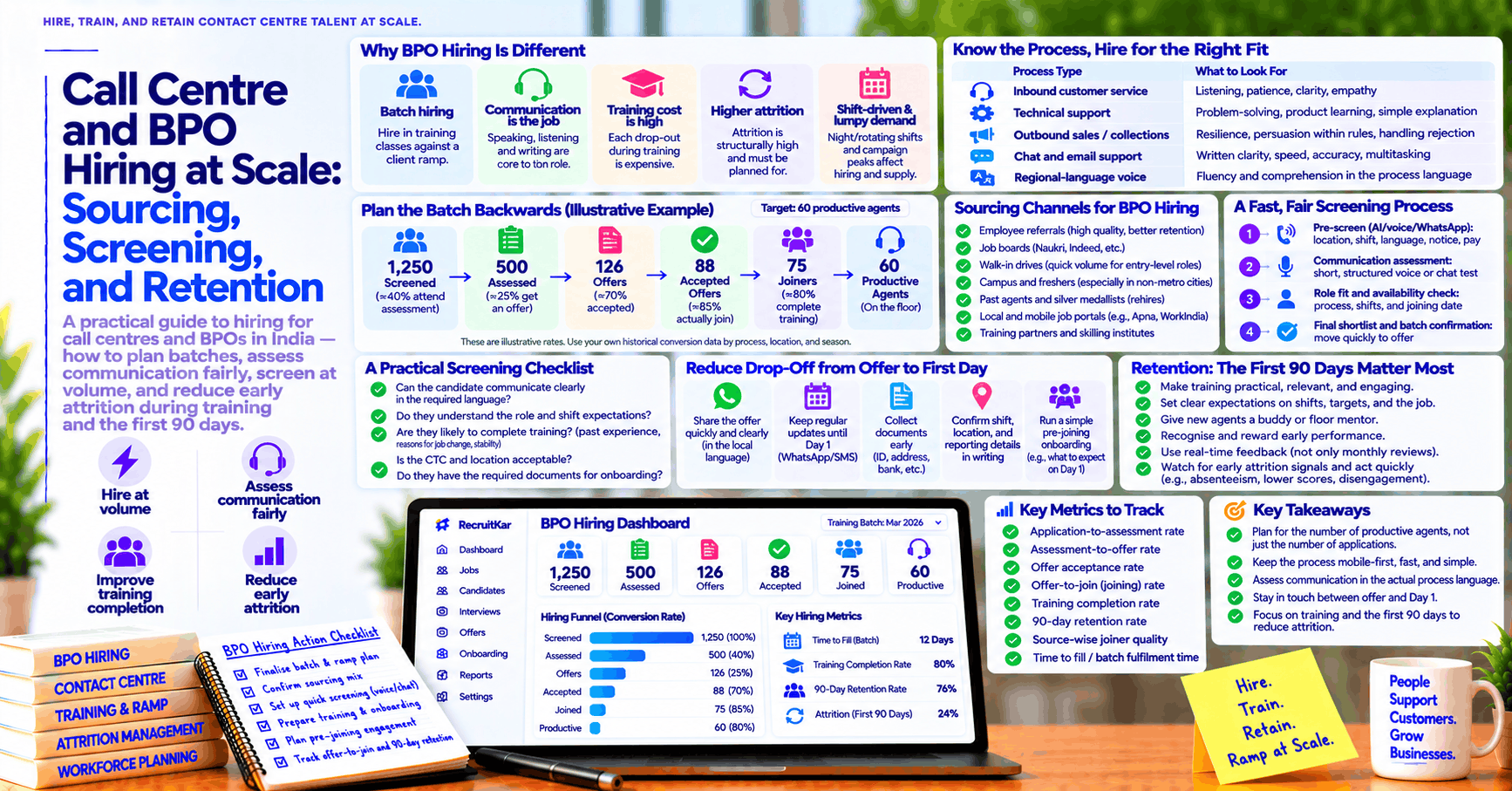
BPO hiring is a batch problem. You hire in training classes against a client's ramp schedule, and the number that matters is not applicants or offers but how many people complete training and are still on the floor three months later. That changes how you plan (backwards from the productive agents you need), how you screen (communication in the process language, assessed fairly), and where you focus retention (training, the first 90 days, and team leaders). RecruitKar's automated AI voice screening calls handle the repetitive first conversation, verifying location, shift availability, language, notice period, and expected pay, and logging the answers, so recruiters spend their time on candidates who clear the basics. This guide covers how contact-centre hiring differs from other high-volume hiring, how to plan batches, how to assess communication, how to screen quickly, and how to hold on to the people you hire.
Our separate guide on frontline and blue-collar hiring covers phone-first application design and sourcing for non-desk roles. This post focuses on what is specific to contact centres.
Why BPO hiring is different from other high-volume hiring
You hire in batches, not continuously. New agents start together in a training class against a client's ramp plan. Missing a start date can mean missing a client commitment.
Communication is the product. For voice and chat processes, how a person speaks, listens, and writes is the job itself, so assessing it well is central, not a side check.
Training is a sunk cost. You pay people to train before they produce anything. Each person who leaves during training or soon after is expensive, which is why early attrition matters more here than almost anywhere.
Attrition is structurally high. It is among the highest of any sector. That is not a reason to accept it, but it means retention and replacement planning have to be built into the hiring model.
Shifts shape everything. Night shifts, rotating rosters, weekend work, and commute and safety concerns drive both who applies and who stays.
Demand is lumpy. Client wins, seasonal peaks, and campaigns create bursts of demand that stretch normal recruiting capacity.
Know which process you are hiring for
"Call centre agent" covers very different jobs, and the screening should match.
Inbound customer service (voice): Listening, patience, clarity, empathy, following a process.
Technical support: Problem-solving, learning product knowledge, explaining simply.
Outbound sales or collections: Resilience, persuasion within rules, handling rejection.
Chat and email support: Written clarity, speed, accuracy, multitasking.
Regional-language voice: Fluency and comprehension in the process language.
Write the actual requirements for each process before screening. Applying one generic "good communication" standard to all of them wastes good candidates and lets in poor fits.
Plan the batch backwards
Start from the number you need on the floor and work back through your own conversion rates.
Illustrative example (replace with your own data): Suppose a client ramp needs 60 productive agents.
If about 80 percent of those who join complete training, you need roughly 75 joiners.
If about 85 percent of accepted offers actually join, you need roughly 88 accepted offers.
If about 70 percent of offers are accepted, you need roughly 126 offers.
If about 25 percent of assessed candidates get an offer, you need roughly 500 assessed.
If about 40 percent of screened candidates attend an assessment, you need about 1,250 screened.
The percentages above are made up to show the method. Your own history will differ, and the figures can change by process, city, and season. What matters is building the funnel from your data, not borrowing someone else's, and recalculating each cycle. Teams that skip this step usually discover the shortfall a week before the class starts.
Sourcing for contact centres
Employee referrals are often one of the strongest sources in BPOs, because agents know people who would fit and can describe the job honestly. Use a clear referral process, and pay the bonus after the referred person has completed training and stayed a defined period, so it rewards retention, not just joining. A shareable apply link lets agents forward roles on WhatsApp, with referred candidates tagged automatically.
Job boards such as Naukri and Indeed, plus local and mobile job portals, remain core for volume.
Walk-in drives work well for entry-level voice roles when screening is simple.
Freshers and campus are a major source for entry-level processes, especially in non-metro locations.
Past agents and silver medallists. Former employees who left on good terms, and candidates who nearly made it earlier, are warm and already understand the work. A searchable candidate database makes re-engagement fast.
Smaller cities. Many contact centres draw strong talent from Tier-2 and Tier-3 cities, including for work-from-home or hybrid processes where the role allows.
Track joiners and 90-day retention by source, not just applications. A source that sends many applicants who leave in training is costly.
Screening at volume without losing signal
A lean flow for entry-level processes might be:
Application and automated first contact. A short mobile application, followed by an automated call or WhatsApp message within hours.
Basic qualification. Location, shift availability, language(s), experience, expected pay, and earliest joining date. Automated voice screening can run this for every applicant in the candidate's language and log the results.
Communication assessment. In the process language, scored on a rubric (see below).
Process-relevant aptitude check. Typing speed, comprehension, a short role-play or call simulation, depending on the process.
Ops or team-leader conversation and offer.
Aim for as few steps and as little elapsed time as the role allows, since good candidates accept other offers quickly. Keep a human in the decision about who is hired. Automated screening should narrow and prioritise, not make final decisions on its own.
Assess communication fairly
This is where BPO hiring most often goes wrong, in both directions.
What to assess:
Clarity: can the customer understand what is being said?
Comprehension and listening: does the candidate understand a question or complaint and respond to it?
Empathy and tone: appropriate to the process
Following a script or process while adapting naturally
Written accuracy for chat and email roles
What not to reward or penalise:
Accent. Clear speech is the standard, not a particular accent. Using "neutral accent" as a proxy filters on regional and class background without measuring whether customers can understand the agent.
Fluency in a language the process does not use. English fluency should not be a filter for a Hindi or regional-language process, and vice versa.
Confidence or polish as a stand-in for ability.
How to do it well:
Use a written rubric with defined levels for each criterion, and calibrate assessors against sample calls with operations leaders so scores mean the same thing.
Assess in the language of the process. Multilingual AI video interviews let candidates record short responses in the relevant language, which assessors can review consistently. Check that the system's transcription is validated on the accents and languages in your candidate pool, since errors can distort scoring.
Keep a human reviewing borderline cases.
Check for disparities. Compare assessment pass rates across candidate groups, and investigate anything that looks unexplained.
Give candidates a realistic preview
Many early exits are mismatches, not weak performance. Candidates who expected something different leave in the first weeks.
Describe shifts honestly, including nights, rotations, and weekend work.
Explain targets and metrics that agents will be measured on.
Be clear on pay, including how incentives work and what typical earnings look like in practice, not only the best case.
Let candidates hear real calls or try a short simulation so they see what the work involves.
Discuss commute and transport realistically.
A candidate who understands the job and still accepts is more likely to stay. A candidate who would have left will sometimes self-select out early, which is cheaper than losing them after training.
Fill the batch reliably
Reduce offer-to-joining drop-off. Shorten the gap between offer and class start where possible, confirm attendance by message the day before, share the practical details for the first day, and stay in touch in between.
Over-invite carefully. Where history shows a predictable show-up rate, plan for it, but treat that as a patch, not a solution, since the underlying causes of no-shows still need fixing.
Document collection. Ask for identity and onboarding documents early, so paperwork does not delay the start.
Keep a bench. Candidates who cleared assessment but missed a batch can be offered the next start date rather than lost.
Training, nesting, and the first 90 days
For many BPOs the highest-risk period is training and the weeks after the agent first takes live calls.
Make training engaging and honest. Trainers who explain why each rule exists, use real examples, and give regular feedback keep trainees more committed.
Support the transition to the floor. A structured nesting period, with a buddy or mentor and a team leader who checks in, makes the first live weeks less daunting.
Check in at set points. A short check-in at day 3, day 7, day 30, and day 90, by WhatsApp or in person, catches problems early.
Watch early signals. Attendance, schedule adherence, and early quality scores often show who is struggling before they resign.
Act on team-leader patterns. Attrition often concentrates under particular team leaders. Track retention by team, and coach or reassign accordingly.
Retention levers that matter
Predictable rosters. Frequent last-minute shift changes are a common reason for leaving.
Clear, accurate incentive structures that agents can understand and trust.
Team-leader quality, including coaching ability, not just target delivery.
A visible career path from agent to senior agent, subject expert, quality analyst, or team leader.
Transport and safety for night shifts, which is also a compliance matter in many states.
Reasonable breaks and wellbeing support in a demanding role.
Recognition that is specific and timely.
Exit-interview data gathered and acted on, not filed.
Compliance basics
Check the details with your compliance team, as rules vary by state:
Night-shift rules, including safety and transport requirements for women employees where state rules apply
Working hours, overtime, and leave under the applicable state and labour-code provisions
PF, ESI, and wage compliance
Call recording and customer data: consent, security, and retention for customer data under data-protection law, plus candidate data handled in your own hiring
Fair assessment: keep records of how communication was scored so decisions can be explained
Metrics worth tracking
Applicant-to-screen and screen-to-assessment conversion: funnel health.
Assessment show-up and pass rates: sourcing and screening quality.
Offer-acceptance rate: competitiveness of the offer.
Offer-to-joining rate: candidate commitment and drop-off.
Training completion rate: quality of fit and training.
30, 60, and 90-day attrition: early retention.
Attrition by source and by team leader: where to fix.
Cost per productive agent: the real cost measure. Use cost per productive agent, not cost per hire. A cheap hire who leaves in training is expensive.
Common mistakes
Planning from applicants forward instead of from needed agents backward. It leaves batches short.
One generic communication standard for every process. It mismatches skills and roles.
Using accent as a proxy for quality. It filters unfairly without improving customer outcomes.
Over-selling the job. It brings in people who leave within weeks.
Ignoring team-leader effects. Attrition problems often sit with specific managers.
Treating training as separate from hiring. Selection and training completion are linked, so improve them together.
Frequently asked questions
How do I reduce attrition in a call centre? Fix it in stages: set honest expectations at hiring, run a well-supported training and nesting period, check in at set points, keep rosters predictable, and invest in team-leader quality. Track attrition by source, team, and tenure band to see where it concentrates, rather than treating it as one company-wide number.
What is a good way to assess communication skills at scale? Use a written rubric, assess in the language of the process, and calibrate assessors against sample calls with operations leaders. Automated voice or video responses can help you collect consistent samples at volume, with humans reviewing borderline cases and checking for unexplained differences across candidate groups.
Is accent a legitimate hiring criterion? Clarity is. A particular accent is not. Customers need to understand the agent, which is a measurable clarity standard. Filtering on accent tends to disadvantage candidates for reasons unrelated to how well customers are served.
How many candidates do I need to fill one training batch? It depends on your own conversion rates at each stage. Work backwards from the productive agents needed, through training completion, joining, offer acceptance, assessment, and screening, using your own recent data. The figures differ by process, city, and season, so recalculate each cycle.
Can automated screening replace recruiters in BPO hiring? It can take over the repetitive first conversation and logging, so recruiters spend time on candidates who clear the basics. Decisions about who is assessed further, who receives an offer, and how borderline cases are handled should stay with people.
Fill your next training batch with fewer wasted calls. Use RecruitKar's automated AI voice screening for the first conversation, multilingual AI video interviews for communication samples, a shareable apply link for referrals and drives, and a visual ATS pipeline to track every candidate from application to day 90.