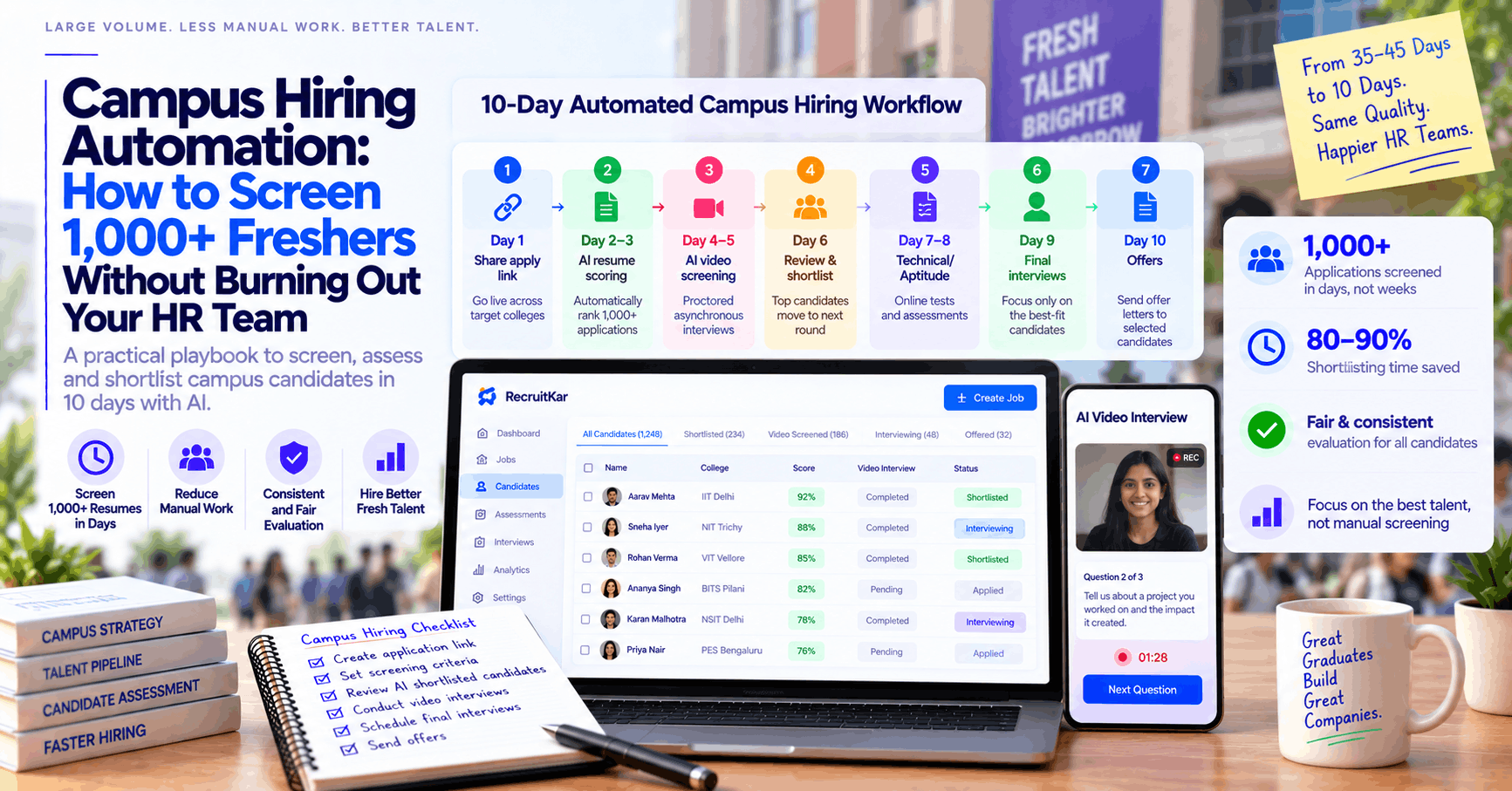
A campus hiring drive for 80 graduate joiners typically generates 800–1,500 applications in the first 48 hours. Without automation, shortlisting those 1,500 applications for a meaningful first round takes a team of three recruiters roughly 10–14 working days — with quality degrading significantly by Day 5 as fatigue affects review consistency. Campus recruitment automation compresses that timeline to 3 working days: a public application link goes live across target colleges, incoming resumes are automatically scored against the role rubric, and shortlisted candidates complete a proctored AI video screen asynchronously before a single human interview is scheduled. This playbook covers the exact setup, timeline, and decision points.
Why campus hiring breaks conventional recruiting processes
Campus recruitment is structurally different from lateral hiring in ways that most recruiting tools aren't designed for:
Volume arrives all at once, not gradually. A lateral role posted on Naukri receives applications spread over 2–4 weeks. A campus drive announced at a tier-1 engineering college generates 40–60% of total applications within the first 24–48 hours of the announcement. The pipeline doesn't build — it floods.
The candidate pool is largely undifferentiated on paper. Most freshers from the same batch and institution have nearly identical resumes: same degree, same internship season, same projects, roughly similar CGPA ranges. Traditional resume screening becomes an exercise in reading between the lines of nearly identical documents — and human judgment applied to identical inputs at volume produces inconsistent outputs.
The hiring window is fixed and non-negotiable. Campus recruitment seasons operate on college-mandated placement calendar windows. A company that misses the placement season window at a target institution has lost access to that entire batch — there's no "we'll get back to it next month." The timeline is external, not internal.
Multiple institutions must be managed simultaneously. A company targeting 15 colleges doesn't run 15 sequential drives — they run 15 overlapping drives, each at different stages, with different coordinators and different candidate pools, all converging on the same onboarding calendar.
The primary differentiator is speed and organisation.
Strong candidates receive multiple PPO and offer letters during placement season. A company that takes 6 weeks to make an offer after a campus presentation has lost the candidates it wanted to a company that moved in 2 weeks.
The standard manual campus hiring process — and where it breaks
For reference, here is how most Indian companies approach campus hiring manually:
- Campus presentation + registration forms circulated (Day 1–2)
- Resume collection by email or Google Form (Day 2–5)
- Resume screening by HR team (Day 5–14)
- Shortlist published to college placement cell (Day 14–16)
- Aptitude/technical test organised at college (Day 18–22)
- Group discussions or technical rounds (Day 22–28)
- HR interview (Day 28–34)
- Offer letter (Day 35–45)
Total timeline: 35–45 days from presentation to offer. In that window, the strongest candidates — who typically receive 3–5 offers across placement season — have often accepted elsewhere by Day 25.
The specific failure points:
- Days 5–14: Manual resume screening of 1,000+ applications is where most HR teams reach exhaustion, inconsistency sets in, and borderline candidates get inconsistent treatment depending on which reviewer happens to pick up their application
- Days 18–22: Organising an on-campus test requires coordinating with the placement cell, booking facilities, and travelling to campus — overhead that multiplies across 15 institutions
- Days 35–45: By the time offers go out, the candidates a company wanted most have often already accepted competing offers made 2–3 weeks earlier
The automated campus hiring workflow: 10 days to offer
Here is what the same process looks like with automation handling the volume-intensive stages:
Day 1: Shareable application link goes live
Rather than collecting resumes by email or Google Form and importing them manually, a shareable job application link is created in RecruitKar and shared with the college placement cell, posted on the college notice board, and circulated via WhatsApp to interested students. The link is mobile-friendly and requires no account creation — students submit their resume and basic details in under 3 minutes.
As applications come in, they populate the pipeline automatically — no manual import, no data entry, no inbox management. A recruiter can watch the application count climb in real time from the pipeline dashboard.
What this replaces: emailed resume attachments, Google Forms with manual data extraction, WhatsApp-forwarded CVs that require chasing.
Day 2: AI resume scoring runs automatically
As applications arrive, each resume is parsed and scored against the role rubric — which the recruiting team configured before the drive opened. The rubric for a fresher engineering role might weight: relevant internship or project experience (40%), technical skills alignment (30%), academic performance (20%), and co-curricular signal (10%).
By the end of Day 2, 1,000 applications are ranked — not sorted chronologically, not sorted by CGPA alone, but ranked by actual fit with the specific role's requirements. A recruiter opens the pipeline to see a ranked list: the top 250 candidates automatically flagged for the next round, the middle 500 in a borderline category for optional spot-check, and the bottom 250 filtered out with a documented reason.
What this replaces: 10–14 days of manual resume review by 3 recruiters, with significant inconsistency in the lower half of the review stack.
Day 3: Shortlisted candidates receive AI video interview invites
The top 250 candidates receive an automated message — via WhatsApp and email simultaneously — with a link to complete a proctored AI video interview. The interview is asynchronous and browser-based: candidates complete it on their own schedule within a 48-hour window, from their phone or laptop, without downloading an app or scheduling a time slot with a recruiter.
The interview contains 3 structured questions:
- A background question: "Walk us through the project you're most proud of from your course or internship. What was your specific contribution and what was the outcome?"
- A behavioural question: "Tell us about a time you had to learn something new quickly for a deadline. What was the situation and how did you approach it?"
- A motivation question: "What specifically interests you about working in [domain] at [Company], and what do you hope to build in your first 2 years?"
Each question has a 90-second to 2-minute time limit. Total candidate time: 12–15 minutes. Total asynchronous — no recruiter time required for delivery.
Day 5: AI video screening results reviewed
By Day 5, most of the 250 candidates who received the interview link have completed it (completion rates for well-designed browser-based async video screens in campus hiring typically run 70–80%). The pipeline shows each candidate with their AI video score alongside their resume score.
A recruiting team of two reviews the video shortlist — not all 200+ completed videos, but the ranked top 60 based on combined score. Reviewing 60 videos at 1.5x speed with a rubric takes approximately 4–5 hours. The shortlist of 40 candidates for human panel interviews is confirmed by end of Day 5.
What this replaces: an on-campus aptitude test (facility booking, travel, coordination overhead), group discussions (additional recruiter time), and the first HR interview round (which is replaced by the video screen for initial evaluation).
Day 6–8: Human panel interviews (virtual or on-campus)
40 candidates, 30-minute panel interviews each, two interview panels running in parallel. Proctored AI video interviews provide the recruiting team's initial structured evaluation; human panels go deeper on technical competency and judgment.
Scheduling is handled via calendar-integrated scheduling links sent to shortlisted candidates — each candidate selects from available slots, triggering automatic calendar holds and meeting links without recruiter involvement in the coordination.
Day 9: Debrief and selection
Panel feedback, logged directly against each candidate's record during or immediately after interviews, is aggregated for a 2-hour decision session. Final selection of 20–25 candidates for offers.
Day 10: Offers extended
Verbal offers extended by WhatsApp and phone. Formal offer letters sent by email. Total timeline from application open to offer: 10 days.
Managing multi-college drives simultaneously
The same workflow runs in parallel across multiple institutions — each college gets its own shareable application link (so applications are organised by institution by default), its own application window (staggered so the screening team isn't reviewing 5,000 applications simultaneously), and its own shortlist published back to the college placement cell.
The recruiting team manages a single pipeline view showing all institutions in aggregate — filterable by college, by application score, by video interview completion status, and by shortlist stage. A campus recruiter who previously managed 15 college drives across 15 separate spreadsheets and email chains now manages them in one dashboard.
This also enables cross-college ranking: if the drive across 5 colleges is intended to produce 80 hires and the demand varies, the top candidates across all institutions can be ranked together rather than allocating a fixed number per college regardless of relative quality.
Setting up the scoring rubric for freshers
The biggest risk in automated campus screening is using a rubric built for lateral hiring. Freshers don't have 3 years of work experience — a rubric that weights work history heavily will systematically under-score the entire campus pool. Fresher-appropriate criteria:
Academic performance (20%): CGPA or percentage, with context. A 7.5 CGPA from a tier-1 institution and an 8.8 CGPA from a tier-3 institution require different interpretation — the rubric should account for institutional context, not just the raw number.
Technical project quality (35%): What they built during coursework, internships, and personal projects. The rubric should reward specificity (clear description of what they did, what technologies they used, what the outcome was) over generic claims ("built a web application").
Internship or work experience (25%): Where they interned, what they did, and how they describe their contribution. An internship at a well-known company is a signal; a well-described internship at a lesser-known company doing genuinely interesting work can score higher.
Domain alignment and motivation (20%): Do they demonstrate genuine interest in the domain, or are they applying to every company in the placement drive indiscriminately? Specificity of interest is a meaningful signal for retention, not just performance.
The compliance and fairness layer in campus hiring
Campus hiring automation at scale creates compliance obligations that manual, small-batch hiring doesn't raise:
Consistent criteria: When AI scoring is used across 1,000+ candidates, the rubric must be defined, documented, and consistently applied. Post-drive audits that compare shortlist demographics against applicant pool demographics are a meaningful governance step — not because AI scoring is inherently biased, but because it amplifies whatever biases the rubric contains at scale.
Transparency with candidates: Under India's DPDP Act 2023, candidates should know that AI is used in the screening process and have access to basic information about how their data was processed. Campus drives that include this disclosure in the application link terms of use are ahead of what most companies currently do.
Defined retention for campus application data: A campus application pool of 5,000 resumes from candidates who weren't hired is personal data with retention obligations. Defining upfront how long that data is retained and implementing deletion at the end of the retention period is both good practice and increasingly a compliance necessity.
Frequently asked questions
How many colleges can one recruiter manage simultaneously with this workflow? With the automated workflow described above — centralised pipeline, per-college application links, automated scoring and video screening — a single campus recruiter can manage 15–20 simultaneous college drives during the placement season, compared to 5–7 managed manually. The limiting factors are panel interview capacity (human panel slots are the fixed constraint) and offer-approval bandwidth, not sourcing or screening.
Do students complete async video interviews on mobile? Yes, and browser-based video interviews designed for mobile completion are essential for campus drives in India, where a meaningful share of students use smartphones as their primary computing device. Desktop-only or app-required video interview tools see significantly lower completion rates among freshers — particularly from non-metro colleges where laptop ownership is lower. A completion rate of 70–80% for well-designed mobile browser-based async video is achievable; app-required alternatives typically see 40–55% completion in the same population.
How should we handle CGPA cutoffs — should we use them? Blunt CGPA cutoffs (rejecting all candidates below 7.5, for example) are a common but blunt instrument that misses candidates who performed modestly academically but have strong projects, internships, or other signals of genuine capability. The better approach is including CGPA as a weighted factor in the overall score rather than as a binary filter — a candidate with 6.8 CGPA and genuinely impressive internship and project experience should be accessible to the screening process. If your organisation has a specific compliance or policy reason for a CGPA floor, document and apply it consistently rather than informally.
What happens to candidates who don't complete the video interview in the 48-hour window? Most platforms allow configuring an automatic follow-up reminder at the 24-hour mark. Candidates who still haven't completed at the 48-hour deadline receive a message confirming they've missed the window and are no longer in the current round. Some companies extend the window by 24 hours for candidates who message to explain a genuine difficulty — a small, case-by-case decision that the recruiter makes manually rather than building into the automation.
How do we manage offer letter logistics across 80 joiners from 15 colleges? Offer letter generation at volume benefits from templated offer letter generation with mail merge functionality, which most ATS platforms support. The critical campus-specific addition is tracking each joiner's college placement cell requirements — some placement cells require offers in a specific format, or require co-signing by the placement officer, or have specific conditions on the joiner's joining date relative to their graduation. Mapping these requirements per institution before the drive closes and building them into the offer letter template for each college saves significant back-and-forth at the offer stage.
Streamline bulk campus screening with RecruitKar. Public application links, automated AI resume scoring, and browser-based proctored video screens — all in one pipeline designed for drives of 500–5,000 applicants. Campus recruitment automation — set up your next drive in under a day.