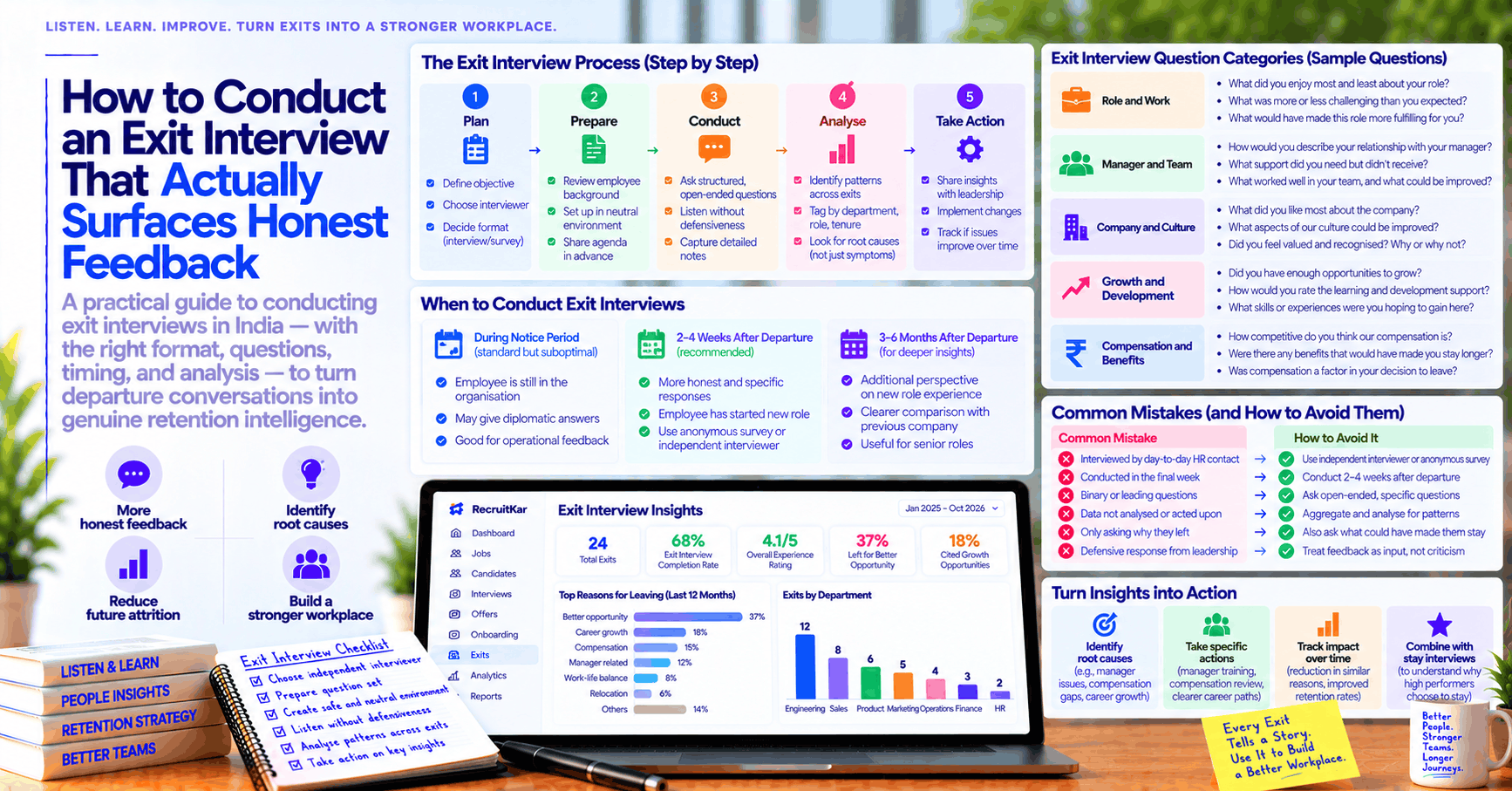
Most exit interviews in Indian companies produce the same data: "personal reasons," "better opportunity," "growth." These answers are almost always true and almost always useless — they confirm that the person is leaving without explaining why they chose to leave now, what specifically drove the decision, or what the company could have done differently. The problem isn't that employees are lying. It's that the format, the interviewer, and the questions are all designed to produce safe, inoffensive answers rather than honest, actionable ones.
This guide covers who should conduct exit interviews, which questions actually surface honest feedback, how to analyse patterns across departures, and how to connect exit data to your recruiting and retention strategy. RecruitKar's visual ATS pipeline tags departures by role type, department, and sourcing channel — so exit patterns can be connected back to the hiring decisions that preceded them.
Why Indian exit interviews fail to produce useful data
The interviewer is the wrong person. In most Indian companies, the exit interview is conducted by the HR generalist or HRBP — the same person who may have been involved in the employee's onboarding, who processes their exit formalities, and who has an implicit interest in a smooth, clean departure. An employee being interviewed by someone with organisational stakes in the conversation will calibrate their honesty accordingly. They'll give answers that maintain relationships and don't create awkwardness during their notice period.
The timing is wrong. Conducting an exit interview in the employee's final week — when they're focused on handovers, farewell lunches, and collecting their clearance signatures — produces rushed, distracted, and often softened responses. The employee's priority in their final week is a smooth exit, not a candid organisational autopsy.
The questions are binary or leading. "Did you feel valued at [Company]?" produces a yes or no that tells you almost nothing. "Was your manager supportive?" produces the answer the employee thinks will reflect well on them and cause the least friction. Leading questions produce diplomatic answers, not honest ones.
The data goes nowhere. Even companies that conduct exit interviews well often don't aggregate, analyse, or act on the data. If the exit interview notes sit in an HR folder and never inform a compensation benchmarking exercise, a management development program, or a recruiting process change, the exercise has no value beyond a procedural checkbox.
Exit interviews capture only the perspective of people who left voluntarily. They tell you why people chose to leave, but nothing about why people who were equally tempted chose to stay. The most complete retention intelligence combines exit data with stay interviews — conversations with current employees about what would cause them to leave — which most Indian companies conduct rarely or never.
Who should conduct the exit interview
The most honest responses come when the interviewer has no organisational stake in what's being discussed. Options in order of likely response quality:
- Best: an independent third party or anonymous survey. An external HR consultant, a structured anonymous exit survey, or a neutral HR team member who had no involvement with the departing employee's day-to-day experience produces the most candid data. The employee knows the feedback won't be used against them in their notice period and doesn't need to manage a relationship with the interviewer after the conversation.
- Acceptable: a senior HR person who wasn't the employee's day-to-day HR contact. The CHRO conducting the exit interview for a mid-level employee, or a senior HR business partner from a different business unit, creates some separation from the most immediate relationship pressures.
- Least effective but most common: the employee's day-to-day HR contact. This format produces the most diplomatic, least useful data. If this is your only option, structuring the interview carefully and following up with an anonymous written survey 2–3 weeks after departure (when the employee's notice period is complete and they're safely in a new role) typically produces more honest responses than the face-to-face conversation conducted while they're still in the building.
Timing: when exit interviews produce better data
- During the notice period (standard but suboptimal): The employee is still in the building, still managing relationships, and has residual concern about reference letters and exit formalities. They'll give honest answers on topics that feel safe and diplomatic answers on topics that feel risky.
- After departure (better): A structured email survey sent 2–4 weeks after an employee's last day — when they've started their new role, their notice period is a fading memory, and they have nothing to lose by being candid — consistently produces more honest and specific responses than conversations conducted during notice. Include a personal note from the CHRO or HR head explaining that the survey is used to inform specific decisions, not to evaluate individuals.
- Both (best): A brief structured conversation during notice (covering the basics and expressing genuine appreciation) followed by an anonymous post-departure survey 3–4 weeks later produces both the relationship-closing conversation the employee and company both benefit from and the honest data the company actually needs.
Questions that surface honest feedback
The question design matters as much as the format. These questions are structured to produce specific, actionable answers rather than diplomatic summaries.
Questions about the decision to leave
"When did you first start thinking about leaving — not when you accepted the offer, but when did it first cross your mind?" This question surfaces the triggering event or pattern rather than the immediate cause. An employee who first thought about leaving 14 months ago after being passed over for a promotion, but who stayed for another year before finally accepting an offer, is describing a retention failure that happened 14 months ago — not a failure in the last month.
"Was there a specific moment or event that shifted your thinking from 'I'm considering' to 'I'm actively looking'?" This surfaces the inflection point — the specific interaction, decision, or event that moved the employee from passive dissatisfaction to active job search. These inflection points are often manageable and preventable, which is why knowing them is valuable.
"If one thing had been different, would you have stayed? What would that have been?" This is the most direct question about what would have changed the outcome. The honest answer to this question is more actionable than any general satisfaction rating.
Questions about compensation and growth
"How did your compensation at [Company] compare to what you're receiving in your new role?" Rather than asking "were you satisfied with your pay?" (produces a yes/no), this question produces a specific comparison that can inform compensation benchmarking. If the answer is "I'm receiving 30% more," that's a data point. If it's "about the same but with a better title and more scope," that's a different data point.
"Did you feel there was a clear growth path from your current role, and did you believe it was realistically accessible to you?" This distinguishes between a company that lacks visible growth paths and one that has them but where individual employees don't feel they can access them — a different problem requiring a different fix.
Questions about management and team
"How would you describe your day-to-day experience with your direct manager?" Open-ended, not leading. Let the employee describe it in their own words rather than rating it on a scale — the words they choose reveal more than any number.
"Was there anything about the team dynamic that made work more difficult or less rewarding than you expected?" This surfaces team-level issues (conflict, unclear roles, exclusion from decisions) that individual manager questions often miss.
Questions about the role
"How closely did the role match what you understood it would be when you accepted the offer?" This is the most direct way to surface hiring-to-reality mismatches — the candidate was sold one version of the role and discovered a different one. The answers here should flow directly back to whoever wrote the job description and conducted the interviews.
"Were there resources, tools, or support that would have made your work significantly easier that you didn't have access to?" This surfaces operational and infrastructure problems that don't appear in satisfaction surveys because they feel too mundane to mention.
The closing question
"Is there anything you wish you'd known before joining that would have changed your decision to accept the offer?" This is the question that most directly improves the hiring process. An honest answer here is a gift — it tells you exactly what information should be provided more transparently during recruiting so that future candidates make fully informed decisions and are less likely to leave for the same reason.
Analysing exit data across departures
Individual exit interviews are anecdotal. Patterns across 10 or 20 exit interviews become intelligence.
Build a simple tagging system. Tag each exit interview by: primary reason for leaving (compensation, growth, manager, role mismatch, work environment, personal), department, role level, tenure band (under 6 months, 6–12 months, 1–2 years, 2–5 years, 5+ years), and hiring channel. Over 6–12 months, patterns become visible: most departures in a specific department citing manager quality, a concentration of role-mismatch exits among hires from agency sourcing, high compensation exits concentrated at the 18-month mark when salary compression typically peaks.
Review quarterly, not annually. Monthly exit data is often too thin to pattern-match; annual review means problems persist for a full year before being identified. Quarterly is the right cadence for most Indian companies — enough data to see patterns, frequent enough to act.
Close the loop to the people who can act. Exit data that only goes to HR and never reaches the business is only half useful. A department head who receives a quarterly summary of exit themes from their team — anonymised, focused on themes rather than individuals — is in a position to act on it. A business head who discovers at the end of the year that 8 of 12 exits from their team cited "limited growth opportunity" could have known that 9 months earlier.
Connecting exit data to recruiting decisions
Exit interviews produce their highest value when the findings loop back to recruiting, not just to retention. Specific connections worth making:
- Role-mismatch exits → job description and interview process. If employees who leave within 6 months consistently describe a role that was different from what they were told during interviews, that's a signal to review the job descriptions and what's communicated in hiring conversations — not just to fix onboarding.
- Source-specific patterns. If exits from agency-sourced hires cluster around "compensation" while exits from referral hires cluster around "growth," that's a sourcing quality signal worth investigating — referral hires may be making more informed decisions about role and culture before joining, while agency-sourced hires may be joining primarily for the salary with less context about the growth trajectory.
- Recruiter-specific patterns. With appropriate care and without using individual exits as performance ammunition, patterns across multiple exits from a specific recruiter's placements may reveal whether specific promises are being made during the interview process that the company doesn't deliver on consistently.
Frequently asked questions
Should exit interviews be mandatory in India? Making them mandatory typically increases participation but reduces honesty — an employee who knows they must participate will find a way to do so minimally and diplomatically. Making them strongly encouraged, with a genuine explanation of how the data is used, and offering both a face-to-face option and an anonymous written alternative, typically produces better quality participation than a mandatory policy. India's labour laws don't require exit interviews; they're an internal practice choice.
What should HR do if a departing employee raises serious concerns — about harassment, discrimination, or legal violations? Exit interview data that surfaces a potential legal or compliance issue must be treated as a formal report, not as exit feedback. Have a clear escalation protocol: if the exit interview surface a concern that meets the threshold for a formal investigation, it should be escalated immediately to the appropriate function (legal, compliance, or senior HR leadership) and documented formally, separately from the exit interview data that goes into retention analytics.
How do we handle an employee who uses the exit interview to make demands or try to renegotiate their notice terms? Keep the exit interview focused on learning and relationship-closing, not negotiation. If an employee attempts to use the exit interview as leverage, acknowledge their concern, note it for follow-up if appropriate, and bring the conversation back to the exit interview's purpose. If there's a genuine negotiation to be had about notice period or exit terms, that conversation should happen separately with HR and the manager — not during the exit interview itself.
Is it worth conducting exit interviews for employees who are asked to leave (involuntary departures)? Yes, though the questions and objectives are different. A voluntary departure exit interview seeks to understand what the company could have done differently to retain the employee. An involuntary departure conversation is more about closure, transition support, and ensuring the employee understands the company's obligations — and is less likely to produce direct retention intelligence. If the involuntary departure was performance-related, a separate retrospective on what in the hiring or onboarding process might have better predicted the mismatch is valuable, but is better conducted internally than as an exit interview with the departing employee.
How long should an exit interview take? 30–45 minutes for a substantive conversation with a mid-to-senior employee who has been with the company for more than 1 year. 15–20 minutes for junior employees or shorter-tenure departures. The quality of the interview depends more on the questions and the environment than on the duration — a 45-minute conversation with poor questions produces less insight than a 25-minute conversation with the right ones.
Connect your exit data to your hiring pipeline. RecruitKar tags every hire by sourcing channel, role type, and department — so when exit patterns emerge, you can trace them back to the recruiting decisions that preceded them. Visual ATS pipeline + sourcing tools — close the loop from exit to hire.