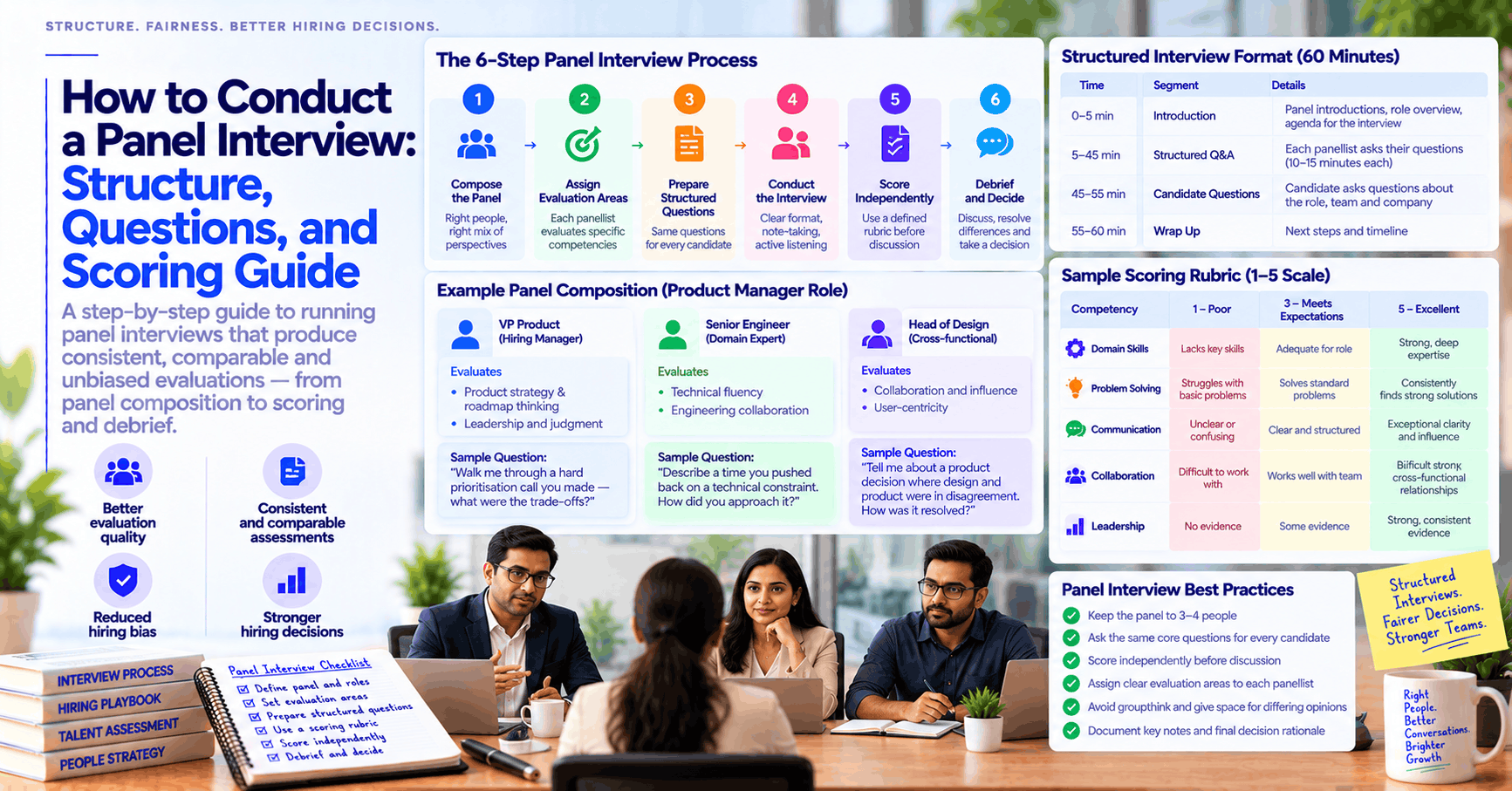
A panel interview where three people sit across from a candidate and take turns asking whatever comes to mind is not more rigorous than a one-on-one interview — it's just more intimidating. What makes a panel interview genuinely valuable is structure: assigned evaluation areas per panellist, consistent questions asked the same way to every candidate, independent scoring before group discussion, and a debrief process that surfaces genuine disagreement rather than defaulting to the most senior person's opinion. RecruitKar's interview scheduling connects directly into panellists' Google and Outlook calendars — so the logistics of coordinating three people's availability doesn't become the reason your interview process takes two weeks. This guide covers everything from panel composition to scoring to debrief.
Why panel interviews exist — and what they actually solve
Panel interviews were designed to solve a specific problem: individual interviewers are inconsistent and biased in ways they're usually unaware of. A single interviewer forms an impression in the first few minutes, then unconsciously interprets the rest of the conversation through that lens. Two interviewers evaluating the same candidate often reach different conclusions — which is the correct outcome, since it reveals something real about the ambiguity in the signal, rather than a false consensus produced by one person's judgment.
A well-structured panel interview doesn't eliminate bias — it distributes it across multiple people with different backgrounds and priorities, making it more likely that at least one panellist is evaluating a dimension the others would have missed or underweighted.
What it doesn't solve, and what people assume it does: a panel interview where all three panellists ask general questions and then discuss their impressions over chai afterward is not significantly more predictive than a single structured interview. The value comes from the structure, not from the presence of multiple people.
Step 1: Compose the panel deliberately
The panel should represent the dimensions of evaluation the role actually requires, not whoever is available that day.
A typical 3-person panel for a senior hire might include:
- The hiring manager — evaluates whether the candidate's working style, judgment, and experience match what the team needs day-to-day
- A functional peer or domain expert — evaluates technical or functional depth; often the best placed to catch gaps the hiring manager might miss if they're not deep in the domain themselves
- A cross-functional stakeholder — evaluates how the candidate communicates with and influences people outside their function; important for roles with significant cross-functional collaboration
What to avoid:
- Stacking the panel with people who all share the same background as the hiring manager (affinity bias compounds)
- Including panellists who have no genuine stake in the hire and are participating for optics
- Panels larger than 4 — beyond that, candidates experience significant anxiety that distorts their performance, and coordinating feedback from 5+ people typically produces more noise than signal
For senior or leadership roles: Consider including a direct report or a peer who will work closely with the hire. Their perspective on whether this person is someone they'd want to work with is genuinely useful, and including them signals to the candidate that the company takes cultural integration seriously.
Step 2: Assign evaluation areas before the interview
Each panellist should have a defined evaluation area — a specific competency or dimension they're primarily responsible for assessing. Without this, panels default to everyone asking similar questions from their own perspective, and the conversation ends up redundant rather than comprehensive.
Example allocation for a Product Manager role:
Panellist: VP Product (Hiring Manager) — Evaluation area: Product strategy and roadmap thinking — Example question: "Walk me through a hard prioritisation call you made — what were the trade-offs and how did you decide?"
Panellist: Senior Engineer — Evaluation area: Technical fluency and engineering collaboration — Example question: "Describe a time you pushed back on a technical constraint. How did you approach that conversation?"
Panellist: Head of Design — Evaluation area: Cross-functional collaboration and user-centricity — Example question: "Tell me about a product decision where design and product were in disagreement. How was it resolved?"
Each panellist asks their own primary questions and is free to ask brief follow-ups on other areas — but their scoring responsibility is concentrated on their assigned dimension. This prevents the situation where everyone evaluates "overall impression" and nobody has specifically evaluated technical depth.
Step 3: Write structured questions in advance
The questions each panellist asks should be written before the first candidate is interviewed — not improvised in the room. This is the difference between a structured interview and a "friendly chat that happens to involve evaluation."
Behavioural questions (most useful for competency evaluation)
Ask for specific past examples rather than hypothetical responses. Hypothetical questions ("what would you do if...") produce hypothetical answers that tell you what the candidate thinks they should say. Behavioural questions ("tell me about a time when...") produce real examples from which you can evaluate actual behavior.
Effective framing:
- "Tell me about a time you had to [competency] — walk me through the situation, what you did, and what the outcome was."
- "Give me a specific example of when [competency] was required in your work."
For each behavioural question, define what a strong answer looks like in advance:
Question: "Tell me about a time you managed a difficult stakeholder." — Strong answer demonstrates: Specific stakeholder, specific conflict, specific resolution approach, measurable outcome — Weak answer demonstrates: Vague "I communicated clearly" with no concrete example
Question: "Describe a time you shipped something despite significant uncertainty." — Strong answer demonstrates: Decision framework under ambiguity, what they decided, what they learned — Weak answer demonstrates: Only mentions uncertainty, not what they did about it
Role-specific technical or functional questions
For functions with testable knowledge — engineering, finance, legal, data — include questions that verify domain competency directly. These don't need to be technical tests; they can be "walk me through how you would approach X" questions that reveal depth of understanding through the answer.
A culture or values question (used sparingly)
One question per panel that explores alignment with how the company actually operates — not "do you like working in teams" (everyone says yes) but something specific: "Tell me about an environment where you did your best work — what made it work for you?" The answer reveals what conditions this person actually thrives in, and whether those conditions exist at your company.
Step 4: Conduct the panel with defined roles
Before the candidate arrives, agree on:
- Who opens and introduces the panel. Typically the hiring manager or recruiter — a brief, warm introduction of each panellist (name, role, what they'll be evaluating) reduces candidate anxiety and sets expectations for the structure.
- Who asks questions in which order. A defined sequence prevents panellists from talking over each other, stepping on each other's questions, or leaving long awkward silences while everyone waits for someone else to speak first.
- Who takes notes. Each panellist takes their own notes on their assigned dimension. Do not designate one person to take all notes for everyone — this produces an incomplete, one-perspective record.
- Who manages time. One panellist (usually the hiring manager) watches the clock and signals when it's time to move to the next section. Unmanaged panel interviews routinely run long in one section and rush through the last, producing uneven evaluation data.
- Who closes. Leave 5–10 minutes at the end for the candidate to ask questions — their questions are themselves evaluative signal. "What does the first 90 days look like in this role?" is a different question than "What's the team culture like?" — and noticing the difference is useful.
Step 5: Score independently before discussing
This is the most important structural rule of a panel interview and the one most frequently skipped.
Immediately after the candidate leaves — before anyone says anything — each panellist fills in their independent score on the evaluation rubric. Then, and only then, does the group discuss.
Independent scoring before discussion captures the genuine signal in the variance — if two panellists scored a dimension 4/5 and one scored it 2/5, that gap is more informative than if everyone had discussed themselves into 3/5.
Why this matters: When discussion happens before scoring, the most vocal or senior person's opinion anchors everyone else's. A hiring manager who says "I thought she was great" before the engineers have committed their scores produces a consensus that reflects the hierarchy, not independent judgment.
The scoring form (simple version):
- Dimension: [Competency 1], Score (1–5): [Score], Key observations: [Observations]
- Dimension: [Competency 2], Score (1–5): [Score], Key observations: [Observations]
- Dimension: [Competency 3], Score (1–5): [Score], Key observations: [Observations]
- Overall recommendation: Advance / Borderline / Do not advance
The "overall recommendation" field — a forced choice — is more useful than a numeric score for final decision-making, because it prevents endless deliberation over whether a 3.4 or a 3.7 means advance.
Step 6: Run a debrief that surfaces disagreement, not consensus
The instinct in a post-interview debrief is to move toward agreement as quickly as possible. This instinct should be actively resisted — disagreement between panellists is data, not a problem.
A productive debrief structure:
- Share scores without discussion — each panellist states their overall recommendation first, before explaining it. This establishes the range of views before anyone starts justifying.
- Start with the outlier. If two people said Advance and one said Do Not Advance, start by asking the Do Not Advance panellist to explain their reasoning. Their perspective is the minority but potentially the most important signal.
- Focus discussion on specific observed evidence, not impressions. "I scored communication 2/5 because when I asked about the stakeholder conflict, they described what happened but couldn't articulate what they personally did differently — the answer was very passive" is more useful than "I just didn't feel like they were that strong."
- Distinguish between "we disagree on the evidence" and "we weighted the criteria differently." The former is a signal the candidate gave ambiguous answers worth probing further. The latter is a conversation about what the role actually requires.
- Make a decision before leaving the room. A debrief that ends with "let's think about it" typically results in the most assertive person's view prevailing by default a day later, which is worse than a clear (even if difficult) decision made with everyone present.
Common panel interview mistakes worth avoiding
- Panellists reading from questions on a laptop without making eye contact. This produces a stiff, interrogation-like dynamic that makes candidates anxious and their answers worse. Write questions on paper or print them — and maintain normal conversational engagement while asking.
- Not briefing panellists before the interview. Panellists who arrive at a panel without knowing their assigned area, the candidate's background, or what questions they're asking produce chaos rather than structure. A 10-minute pre-brief — even by email the day before — is sufficient.
- Allowing dominant voices to anchor scores before independent completion. The hiring manager's opinion matters, but it should inform discussion after independent scoring, not replace independent scoring altogether.
- Confusing a panel interview with a group interview. A panel interview has multiple interviewers and one candidate. A group interview has one or more interviewers and multiple candidates simultaneously. These are different formats for different purposes — don't conflate them.
- Failing to inform the candidate about the format in advance. A candidate who expects a one-on-one and walks into a room with three people experiences significant anxiety that distorts their performance. Always inform candidates about the panel format, the panellists' names and roles, and the approximate structure, in the scheduling confirmation.
Scheduling a panel interview: the logistics reality
Coordinating three people's calendars for a 60–90 minute interview slot that also works for the candidate is the most reliably frustrating part of running a panel. A panel that was supposed to happen in Week 2 ends up in Week 4 because one panellist was travelling and another had a quarterly review — and a strong candidate has accepted another offer in between.
Calendar-integrated scheduling that shows real panellist availability and lets the candidate self-book from available slots eliminates most of this friction. The scheduling system blocks all three panellists' calendars simultaneously once a slot is confirmed, generates the meeting link automatically, and sends reminders to all parties — without a recruiter manually threading email chains across three people and a candidate.
Frequently asked questions
How many panellists is optimal for a panel interview? Three is the sweet spot for most roles. Two panellists produce a less comprehensive evaluation but are easier to coordinate; four or more panellists add marginal evaluation value while significantly increasing candidate anxiety and coordination overhead. For very senior roles (C-suite, VP), panels of 4 are common and justified by the stakes involved — but should still follow the structured format described above, not become a group interrogation.
Should the panel interview be the first, second, or final round? Panel interviews are most commonly used as a second or final round — after an initial screening (recruiter call, hiring manager intro call, or async video screen) has established basic fit. Using a panel as the first interaction is resource-intensive and produces poor signal, because candidates who haven't been pre-qualified yet are in the pool, wasting three people's time. Final round panel interviews work well when the decision is between two or three candidates and you want multiple stakeholders' input before extending an offer.
What should we tell the candidate about the panel format in advance? The scheduling confirmation should include: the names and roles of the panellists, the approximate duration, the general topics each panellist will cover, whether the candidate should prepare anything specific (a presentation, a case study), and whether it will be in-person or virtual. This is not "giving away the questions" — it's reducing anxiety so the candidate can perform at their actual level rather than being derailed by format surprise.
How do we handle a panellist who dominates the discussion and anchors others' scores? This is a management problem, not a process problem, but process can mitigate it. Independent scoring before discussion is the primary structural safeguard. Explicitly stating "let's hear from [quieter panellist] first" at the start of the debrief is another. If a specific panellist consistently dominates and produces anchoring effects, consider whether their presence on the panel is producing more signal than noise — and whether a different evaluation format (separate 1:1s, followed by a structured debrief without that person's score being shared first) would be more reliable.
How do we document and archive panel interview evaluations? Panellist scoring sheets, key observations, and the final recommendation should be logged against the candidate's record in the ATS — not kept in personal notebooks or email threads that can't be referenced later. If a hiring decision is ever questioned, a documented evaluation record with independent scores and specific observations is significantly more defensible than "we all felt she wasn't the right fit." Most modern ATS platforms have a structured interview feedback form that logs this directly against the candidate.
Schedule panel interviews without the calendar chaos. RecruitKar's calendar-integrated interview scheduling shows all panellists' real availability, lets candidates self-book a confirmed slot, and sends automatic reminders — so your panel interview happens in Week 2, not Week 4.