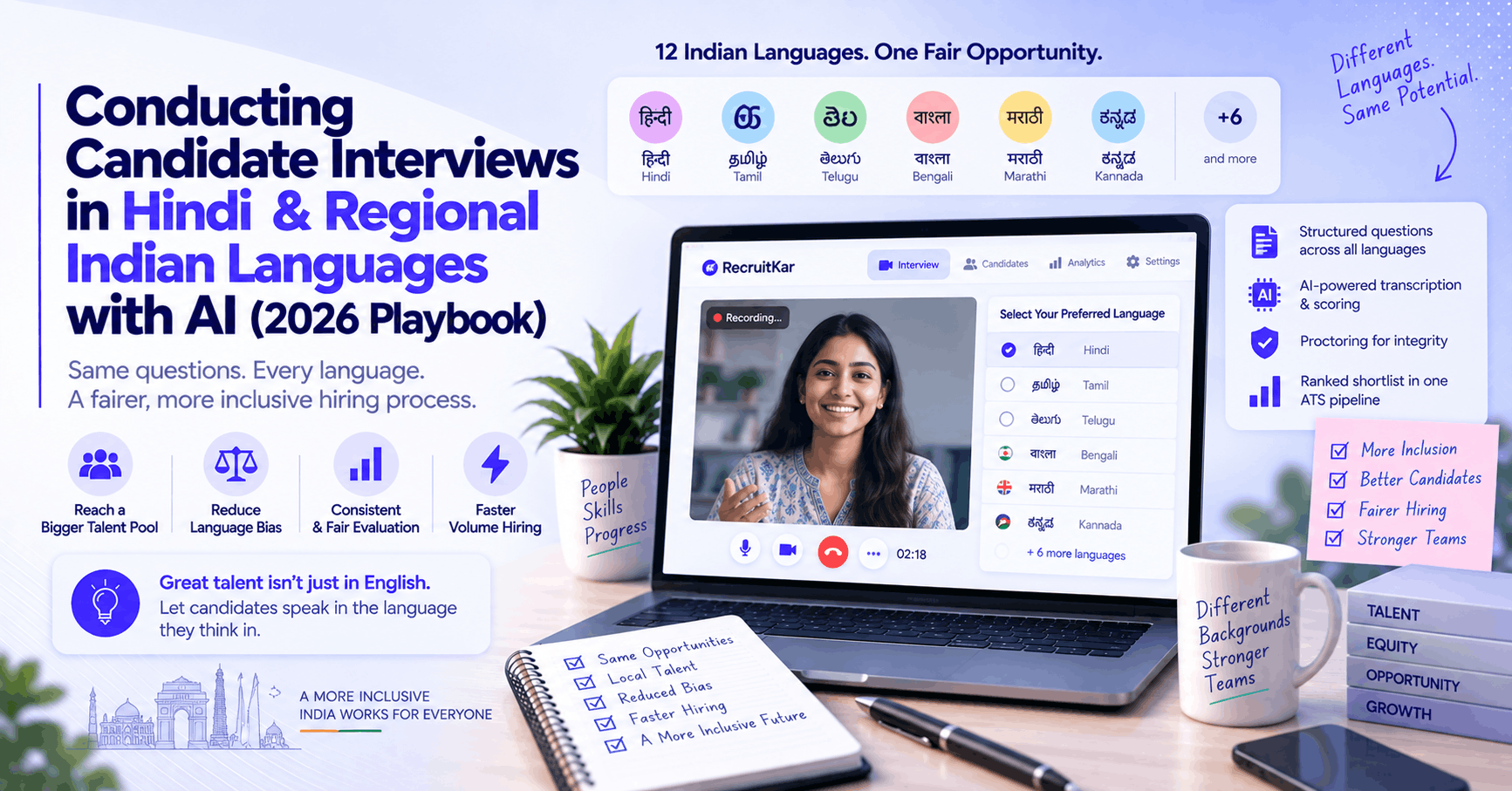
Multilingual AI interviews let candidates answer screening questions by voice or video in the language they think in — Hindi, Tamil, Telugu, Bengali, Marathi and others — while the system transcribes, scores, and ranks every response against the same job-specific rubric. For Indian employers hiring at volume, this removes a filter that has little to do with job performance: a candidate's fluency in English. RecruitKar's multilingual AI video interviews support 12 Indian languages, with proctoring and structured scoring applied consistently across all of them.
That's the short version. The longer version — why English-only screening is a quiet, expensive problem, how the technology actually works, and how to run it fairly — is what the rest of this playbook covers.
The problem: your screening filter is measuring the wrong thing
Consider a typical volume hiring drive for a BPO, retail chain, or BFSI branch network. Hundreds of applications arrive. First-round screening happens over a phone call or a video interview, conducted in English. Candidates who are articulate and confident in English progress. Candidates who are equally capable — sometimes more so — but who think, work, and communicate primarily in Hindi, Tamil, Marathi, or Bengali come across as hesitant, slower, less certain.
None of that reflects how well they would actually do the job. For a large share of roles in India — branch operations, field sales, customer support serving regional markets, warehouse supervision, retail floor management — the daily work happens substantially in a regional language. The English-language interview is testing for a skill the role may barely require, and filtering on it systematically.
This matters more the further you get from metro hiring. India's expanding Tier-2 and Tier-3 talent pools include large numbers of capable, educated candidates whose working comfort is in a regional language rather than English. An English-only screening process doesn't just inconvenience these candidates — it structurally underrepresents them in your shortlist, regardless of what your job description says about being an equal opportunity employer.
Why this has been hard to fix until recently
Employers have understood this problem for a long time. The obstacle was operational, not philosophical.
Running interviews in multiple languages manually means staffing recruiters fluent in each of them, across every hiring location — genuinely difficult at scale, and prohibitively expensive for a company running a 500-candidate drive across four states in two weeks. The fallback options were worse: informal translation by whoever happened to be available (which introduces its own inconsistency and distortion), or simply accepting the English filter and its consequences.
A second problem was consistency. Even with multilingual interviewers available, different interviewers in different languages applying their own judgment produces exactly the kind of unstructured, hard-to-compare evaluation that hiring research consistently finds to be both less predictive and more prone to bias.
How multilingual AI interviews actually work
Language selection sits with the candidate
The candidate receives an interview link and chooses the language they want to respond in. This matters: giving the candidate the choice, rather than assigning a language based on their location or name, avoids a different kind of assumption-making and lets candidates who are genuinely comfortable in English choose it.
Questions are structured and consistent across languages
The same core competency-based questions are asked of every candidate, translated accurately rather than improvised. This is what makes cross-language comparison meaningful — you're comparing answers to the same question, scored against the same rubric, not comparing whatever conversation happened to unfold with each interviewer.
Responses are transcribed and scored against a defined rubric
Voice or video responses are transcribed, then evaluated against pre-defined criteria tied to what the role actually requires. The scoring rubric is the substantive part here — a system that scores "does this answer demonstrate the specific competency asked about" is doing something meaningfully different from one that scores fluency or confidence.
Proctoring verifies integrity without adding recruiter workload
For volume hiring, verifying that the person answering is the actual applicant matters. Proctoring handles identity and environment verification automatically, rather than requiring a live human to supervise each session.
Everything lands in one pipeline
Completed interviews, transcripts, and scores feed directly into the visual ATS pipeline alongside the candidate's resume and application details, so a recruiter reviews a ranked shortlist rather than reconstructing scattered recordings from multiple sources.
Where voice screening fits alongside video
Video interviews aren't always the right first touch. For high-volume roles — especially where candidates are applying from mobile phones in areas with variable connectivity — a voice-based screening call is often a lower-friction first step, verifying basic qualifications, availability, notice period, and language comfort before anyone invests in a fuller interview.
RecruitKar's automated AI voice screening calls handle this stage, dialing out and conducting a structured conversation in the candidate's language, with recordings and outcomes logged automatically. A common, practical sequence for volume hiring in India: AI voice screening to verify basics and qualify the candidate, then a video interview for those who clear it, then human interviews for the shortlist.
Getting the implementation right
Decide honestly which roles actually require English
This is the foundational step, and it's worth doing role by role rather than applying a blanket policy. Some roles genuinely require strong English — a position handling international client communication, for instance. Many roles don't, and have simply inherited an English requirement as an unexamined default. Being explicit about which category each role falls into determines whether multilingual screening is a fairness improvement or an irrelevance for that specific opening.
Ask about transcription accuracy across accents specifically
This is the most important technical question to ask any vendor, and it's frequently glossed over. Speech-to-text systems trained primarily on American or British English pronunciation produce meaningfully more errors on Indian-accented English and regional-language speech. Since most AI scoring evaluates transcribed text rather than raw audio, a transcription error doesn't just create a minor glitch — it means the system is scoring a garbled version of what the candidate actually said. "Supports multiple languages" is not the same claim as "validated for accuracy on Indian languages and accents." Ask for the second.
Keep scoring tied to substance, not delivery
A well-built rubric evaluates whether an answer demonstrates the required competency. A poorly built one drifts toward rewarding fluency, pace, and confidence — reintroducing exactly the bias multilingual support was meant to remove, just in a different language. Review your rubrics specifically for this.
Use AI screening as a filter, not a verdict
The defensible pattern — and increasingly the expected one — is that AI screening narrows a large pool to a manageable shortlist, and a human makes the actual decision about who advances and who gets hired. This applies regardless of language.
Tell candidates clearly what's happening
Candidates should know that AI is involved in the screening process, roughly how it's used, and who makes the final call. Transparency here is both good practice and increasingly aligned with regulatory direction in India and globally. It also reduces the anxiety that makes candidates perform worse than their actual capability.
Brief your interviewers, not just your tooling
Even with multilingual AI handling the first round, human interviewers conduct later rounds — often in English. A short, explicit briefing that hesitation or less polished phrasing in a non-native language isn't a signal of lower competence prevents the bias from simply reappearing one stage later.
A realistic multilingual screening workflow
For a retail chain hiring 300 store staff across four states: applications come in through a shareable apply link and job board imports. AI voice screening calls go out to all applicants, conducted in the candidate's chosen language, verifying availability, location, notice period, and basic role fit. Candidates who qualify receive an asynchronous video interview link with three to four structured, competency-based questions, completed in their chosen language on a mobile browser. Responses are transcribed, scored against the role rubric, and ranked in the pipeline. Recruiters review the ranked shortlist — watching the actual recordings, not just the scores — and schedule human interviews for final selection.
The practical effect isn't that fewer candidates get evaluated carefully. It's that the candidates who reach a human interviewer were selected on job-relevant criteria rather than on English fluency.
Common objections, answered directly
"Our internal team can't review interviews in languages they don't speak." This is a legitimate operational concern, and it's why transcription matters as much as the interview itself. Transcripts and scores are reviewable regardless of the reviewing recruiter's own language proficiency, and for shortlisted candidates who advance to human interviews, you'll generally want an interviewer who shares the candidate's working language anyway — which is a much smaller staffing requirement at shortlist stage than it would be at first-screening stage across hundreds of applicants.
"Won't this lower our hiring bar?" It changes what the bar measures, which isn't the same thing. If English fluency was never a genuine requirement for the role, removing it as a de facto filter doesn't lower standards — it stops applying an irrelevant one. The competency rubric, which is what actually determines who advances, stays as demanding as you set it.
"Candidates might prefer English to seem more professional." Some will, and that's why the choice should sit with the candidate rather than being assigned. What matters is that choosing a regional language isn't penalized — either explicitly in the scoring or implicitly through worse transcription accuracy in that language.
"We hire mostly in metros, so this doesn't apply to us." Metro candidate pools are more English-comfortable on average, but not uniformly — and metro hiring for frontline, operations, and field roles frequently draws candidates who've moved from elsewhere and work primarily in a regional language. It's worth checking whether this actually doesn't apply to your roles, rather than assuming.
What this changes about your candidate pool
Employers who move from English-only to multilingual screening generally find their shortlists look different — more geographically distributed, drawing more from Tier-2 and Tier-3 locations, and including candidates who would previously have dropped out at the first screening stage. Whether that's an improvement depends entirely on whether English fluency was genuinely predictive for the role. For most volume hiring in India, it isn't, which means the previous shortlist was optimizing for the wrong variable.
This is also worth framing honestly as a competitive question rather than only an ethical one: if your competitors are screening a wider, more accurately evaluated pool for the same roles, they have access to candidates you're filtering out for reasons unrelated to performance.
Frequently asked questions
Which languages do AI interviews support in India? RecruitKar supports 12 Indian languages for AI video and voice interviews, covering Hindi and major regional languages. Candidates choose their preferred language themselves rather than having one assigned. When evaluating any platform, ask specifically which languages are supported and whether transcription accuracy has been validated for each — general "multilingual support" claims vary widely in what they actually deliver.
Are multilingual AI interviews fair to candidates? Fairness depends on implementation, not on the technology existing. A system that applies the same structured, competency-based rubric across every language, scores substance rather than delivery style, and feeds into a human-reviewed shortlist is meaningfully fairer than English-only screening. A system with poor transcription accuracy on Indian languages, or opaque scoring, can introduce new problems. The questions to ask a vendor are about transcription validation, rubric design, and whether a human reviews decisions.
Do candidates need to download an app? They shouldn't. Requiring an app download is one of the more reliable ways to lose completion rates in volume hiring, particularly for candidates on entry-level Android devices with limited storage. Browser-based interviews that run on a standard mobile browser consistently see better completion.
Can AI voice screening and video interviews be used together? Yes, and for high-volume hiring this combination usually works better than either alone. Voice screening is a low-friction first filter that verifies basics — availability, location, notice period, qualifications. Video interviews then evaluate competency in more depth for candidates who clear that first step. Both feed into the same pipeline.
How does this help with Tier-2 and Tier-3 city hiring specifically? Candidate pools outside metros skew toward stronger regional-language comfort and more variable English fluency. An English-only process filters this talent out at the first screening stage, before any job-relevant evaluation happens. Multilingual screening removes that filter, which is why it tends to matter most for employers expanding hiring beyond established metro markets.
Ready to try it? Invite your next batch of candidates to complete a 5-minute video interview in Hindi, English, or their preferred regional language — see how RecruitKar's AI video interviews work and set up your first multilingual screening pipeline.