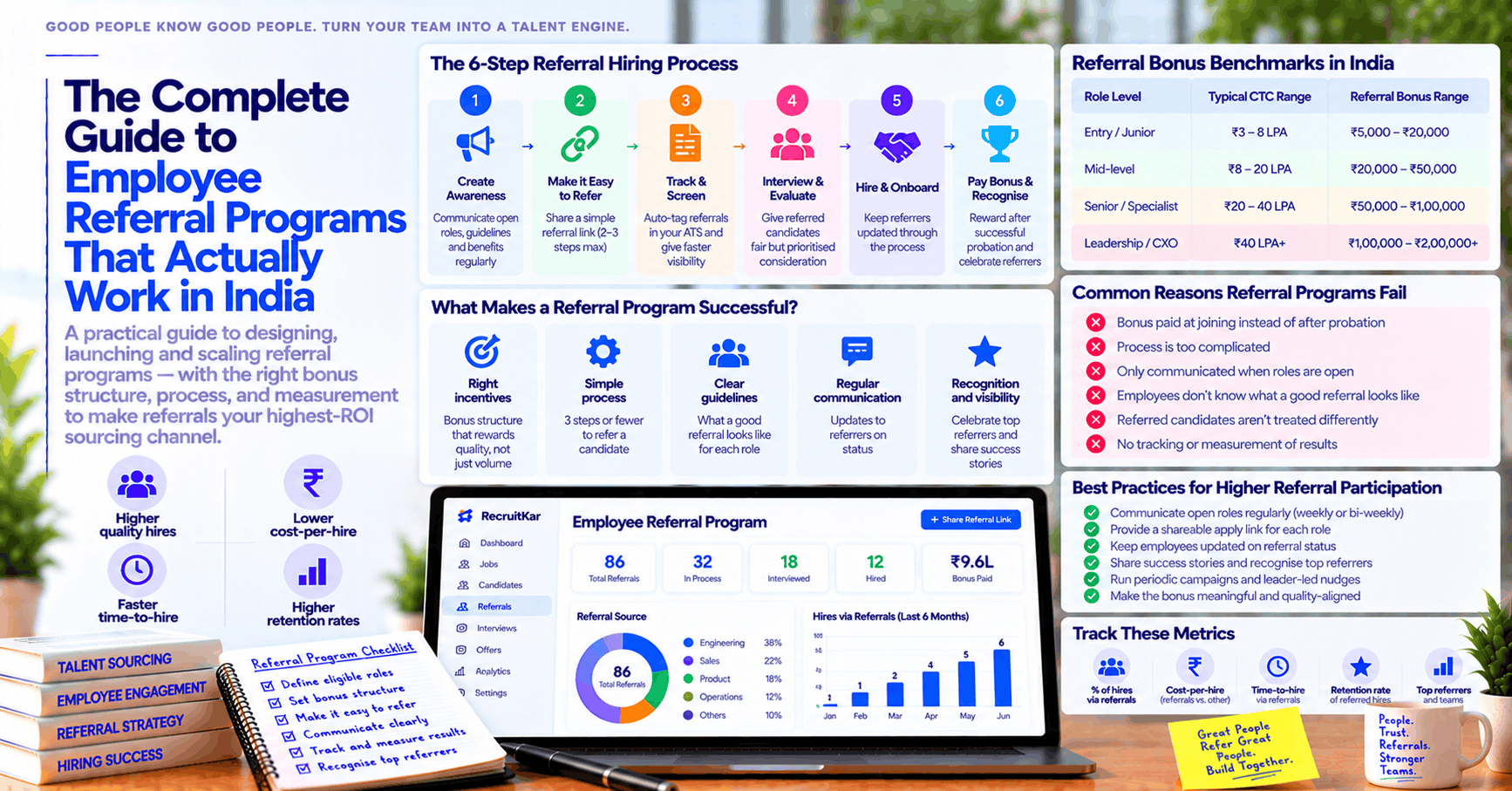
Employee referrals consistently produce the highest quality hires at the lowest cost-per-hire of any sourcing channel in Indian companies that measure it. They also produce the most inconsistent, underutilised results of any sourcing channel in companies that don't. The difference isn't whether a referral program exists — almost every company above 30 people has one on paper. The difference is whether the program is designed to produce quality referrals or just any referrals, whether the process makes it easy for employees to refer, and whether the bonus structure creates the right incentives at the right time. This guide covers every structural decision that separates programs that produce 20–30% of all hires from programs that produce 3–5%. Send referral requests directly through your pipeline with RecruitKar's shareable job apply links — employees share the link, candidates apply directly, and referred candidates are tagged and tracked automatically.
Why referral programs underperform in most Indian companies
Before the design guide: the specific failure modes worth diagnosing before fixing.
The bonus is paid at the wrong time. Many Indian referral programs pay the bonus when the referred candidate is hired, or on joining day. Employees who refer someone experience the reward immediately (social credit for helping a friend find a job, or a bonus payment) but bear the quality risk later — if the referred hire is a poor performer or leaves within 3 months, the referrer has already been paid and faces no consequence. Paying the bonus at a milestone that reflects quality (60–90 days of continued employment, or the end of probation) aligns incentives with hire quality rather than just hire volume.
The process is too cumbersome. An employee who wants to refer a friend navigates: finding the right HR contact, getting a job description, figuring out whether the friend's background fits, emailing or WhatsApp-ing the resume to HR, and then waiting with no visibility on what happened. Most employees who considered referring someone stop at the second or third step. A referral process that's three steps or fewer — share a link, friend applies, referral is automatically tagged — dramatically increases the number of referrals actually made versus intended.
The program only activates when roles are open. Most referral programs are reactive — HR sends a mass message when a role opens: "we're hiring [role], please refer anyone you know." This treats employees as a passive candidate database to be queried on demand. A program that builds ongoing relationships ("who's the best [role type] you know, regardless of whether we have an opening right now?") builds a warmer, more qualified pipeline than one that operates only when urgency creates pressure.
Employees don't know what a good referral looks like. "Refer anyone you think would be a good fit" is too vague. An employee who knows you're hiring a "senior backend engineer" but isn't sure whether their friend who does frontend work qualifies will typically not refer rather than risk an awkward conversation with HR. Specific, clear guidance on what a good referral looks like for each open role — including what makes someone NOT the right fit — produces more relevant referrals and fewer wasted screens.
The referral gets lost in the pipeline. A referred candidate whose resume disappears into the same undifferentiated inbox as 300 other applications, with no fast-track or visible differentiation, sends a message to the referrer: referring someone made no practical difference to how they were treated. If referred candidates aren't visibly prioritised — reviewed faster, communicated with more promptly — employees stop referring because they can't see the point.
Designing the referral bonus structure
Amount: competitive but not dominant
The referral bonus needs to be meaningful enough to create genuine motivation, but not so large that it creates pressure to refer people who aren't actually strong candidates. In India, common referral bonus amounts by role level:
Role level
Typical referral bonus range
Entry / Junior (₹3–8 LPA)
₹5,000–₹20,000
Mid-level (₹8–20 LPA)
₹20,000–₹50,000
Senior / Specialist (₹20–40 LPA)
₹50,000–₹1,00,000
Leadership / CXO (₹40 LPA+)
₹1,00,000–₹2,00,000+
These are directional benchmarks — the right number for your company depends on your typical cost-per-hire from other channels. If your average agency fee is ₹1,50,000 per mid-level hire, a ₹30,000 referral bonus produces the same hire at one-fifth the cost and aligns incentives in both directions.
Timing: quality-aligned, not joining-aligned
Not recommended: Pay 100% on joining day. Better: Pay 50% on joining, 50% after successful probation completion (typically 3 or 6 months). Best for quality: Pay 100% after probation completion, with a smaller "thank you" amount (₹2,000–₹5,000) on joining day to acknowledge the referral.
The quality-aligned structure does two things: it incentivises employees to refer people they genuinely believe will succeed (not just people who'll show up on Day 1), and it reduces the cost of bad referrals that don't survive probation.
What triggers payment: be precise
Specify clearly: is the bonus paid if the referred candidate joins for any role, or only for the specific role they were referred for? What if the candidate is rejected for one role but hired 3 months later for a different one — does the referral still count? What if the candidate was already in the database from a previous application? Ambiguity here creates disputes; precision prevents them.
Tax treatment: communicate this upfront
Referral bonuses paid by employers to employees are taxable as salary income in India. Employees who receive a ₹50,000 referral bonus and expect ₹50,000 in their account will be surprised to receive ₹35,000–₹40,000 after TDS. Communicating this clearly at program enrollment (not just in the fine print) prevents resentment.
Designing the referral process
Make the sharing mechanism three steps or fewer
The practical implementation that maximises participation: each open role has a unique shareable application link that the employee can send directly to their contact via WhatsApp, email, or any other channel. The referred candidate clicks the link, applies directly, and is automatically tagged as "Referred by [Employee Name]" in the pipeline — no email to HR, no resume forwarding, no manual tracking.
This removes every friction point except the decision to refer:
- Employee doesn't need to email HR: they just forward a link
- Referred candidate has a direct path to apply
- Referral attribution is automatic: HR doesn't need to cross-reference a separate referral list against applications
- Employee can track progress: if the pipeline is accessible to them, they can see that their referral is being reviewed
Create a fast-track for referred candidates
A referral that takes 3 weeks to receive a first response signals to the referring employee that their social capital with their friend was spent for nothing. Define a service level for referred applications — reviewed within 3 business days, first response within 5 — and make it visible to employees. Employees who see their referrals move quickly through the pipeline refer more frequently.
Close the loop with the referrer, not just the candidate
The referring employee is a stakeholder in the outcome. When their referral is reviewed, when they advance, when they're rejected, when they're hired — the referrer should receive a brief update at each milestone. This is both respectful (they put their social capital on the line) and practical (it keeps them engaged in the program as a future referrer).
Build in a non-hiring acknowledgment
An employee who refers someone who isn't ultimately hired should still receive acknowledgment — a genuine "thank you for the referral, [candidate name] was a strong candidate and we've kept their details for future openings" closes the loop without the referrer feeling like their effort was invisible. This small touch is what separates programs where employees refer again from programs where they refer once, get no feedback, and don't bother a second time.
Making the program proactive, not reactive
The most powerful referral programs don't wait for open roles to generate referrals — they build the pipeline continuously.
The standing ask: Train managers and HR to include a standing question in team conversations: "Who's the best [role type] you've worked with in your career, inside or outside the company?" This question doesn't require an open role — it surfaces names and relationships that can be logged in the candidate pipeline for future activation.
Role-specific asks at the right moment: Rather than mass-mailing the entire company about every open role, send targeted referral requests to employees who are most likely to have relevant networks — for an open data engineering role, ask the data team specifically rather than everyone. Targeted asks produce more qualified referrals than broad ones.
Alumni as a referral channel: Former employees who left on good terms often have relevant networks and are willing to refer — particularly if the referral bonus applies to external referrers (some companies extend the bonus to anyone who refers a successful hire, not just current employees). This is worth considering for hard-to-fill specialist roles.
Measuring the referral program
Track these metrics monthly to know whether the program is performing:
- Referral rate: What percentage of total hires come from referrals? (Target: 20–35% for a healthy program)
- Referral application-to-hire conversion rate: What percentage of referred candidates are ultimately hired, compared to non-referred applicants? (Referrals should convert at 2–4x the rate of general applicants if the program is working)
- Referral quality score: What is the early attrition rate (first 6 months) for referred hires vs. non-referred hires? (Referrals typically show lower early attrition — if they don't, the bonus structure may be creating low-quality referral incentives)
- Participation rate: What percentage of employees have referred at least one candidate in the past 12 months? (Below 20% indicates a process or awareness problem; above 40% indicates a healthy program)
- Average referral bonus paid per hire vs. cost-per-hire from other channels: The cost comparison that makes the ROI case to leadership
Common objections, answered
"Our employees say they don't know anyone suitable." This is almost always a communication problem, not a network problem. Employees who don't know what "suitable" means for a given role default to not referring rather than risking embarrassment. Providing specific, clear profile guidance per role — including what NOT to refer — consistently increases referrals from employees who previously said they had no relevant contacts.
"Referrals create a homogeneous team." This is a real risk that the referral program design can either amplify or mitigate. A program that relies heavily on referrals without diversity sourcing alongside it will reproduce the existing team's demographics. The solution isn't to eliminate referrals — it's to run active diversity sourcing in parallel and to explicitly encourage referrals from underrepresented employees (whose networks provide access to a different candidate pool).
"Employees refer friends they want to help, not candidates who are actually good." Addressed by the quality-aligned bonus structure (bonuses paid at probation completion, not joining day) and by the culture of feedback (employees who refer a poor-quality candidate and receive no feedback or a silent rejection learn nothing and may repeat the behaviour; employees who receive a candid "thanks for the referral — we passed because of [specific reason]" learn to refer better next time).
Frequently asked questions
What is a typical employee referral bonus in India? For mid-level professional roles (₹8–20 LPA), ₹20,000–₹50,000 is most common. For senior roles (₹20–40 LPA), ₹50,000–₹1,00,000. For leadership and specialist roles, ₹1,00,000 to ₹2,00,000. The right number for your company is the amount that's meaningful enough to motivate quality referrals while remaining comfortably below what you'd otherwise spend on agency fees or sourcing for the same role.
Should the referral bonus be paid to external referrers (people not currently employed at the company)? Some companies extend the referral bonus to former employees, clients, and other external contacts who refer successful hires. This broadens the referral network significantly, particularly for hard-to-fill specialist roles where the most relevant networks may be outside the company. The practical consideration: define "eligible referrer" clearly in the policy to avoid disputes about who qualifies for the bonus.
What happens if two employees refer the same candidate? Define this in the policy before it happens — the most common rule is first-referrer wins (the earlier submission receives the bonus if the candidate is hired). Communicate this rule clearly so employees don't assume they can split a bonus with a colleague who also knew the candidate.
How do we prevent employees from gaming the system — referring anyone to collect bonuses? The quality-aligned bonus structure (payment at probation completion rather than joining day) removes most gaming incentive. An employee who refers a poor-quality hire to collect a bonus will find that the bonus doesn't arrive until the hire completes probation — and if the hire fails probation, the bonus isn't paid. This structure makes gaming economically unattractive.
Can we run a referral drive with a higher bonus for a hard-to-fill role? Yes — time-limited bonus uplifts for specific hard-to-fill roles are a common and effective tactic. "We're offering ₹75,000 (instead of our standard ₹40,000) for referrals for the [Role] position for the next 30 days" creates urgency and focuses employee referral attention on your most urgent need. Keep these targeted and time-limited to preserve the incentive effect — if the uplifted bonus becomes the new normal, it loses its motivating power.
Track referred candidates automatically from the moment they apply. Share a unique job link with your team, and every candidate who applies through it is tagged as referred — no manual tracking, no chasing HR with resumes. Shareable job apply links + visual ATS pipeline — referral attribution built in from application to offer.