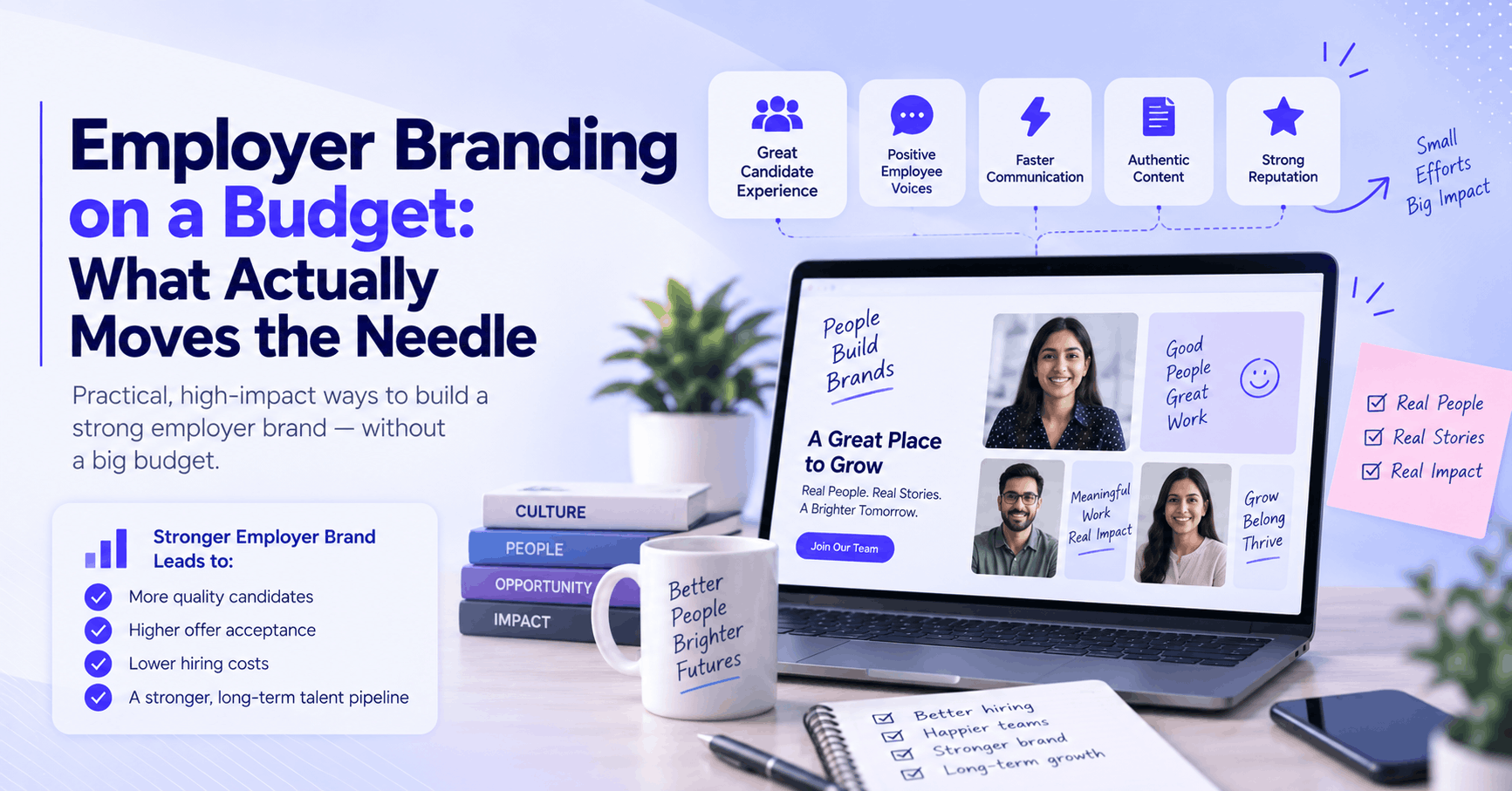
“Employer branding” often gets treated as something only large companies with dedicated marketing budgets can afford — glossy careers pages, produced culture videos, sponsored content. For a small or mid-sized company, it's tempting to conclude employer brand isn't worth investing in right now. That misses something important: what shapes how candidates perceive you as an employer is the accumulated, unglamorous experience of going through your hiring process, talking to your employees, and reading what past candidates and employees said afterward. Most of that is genuinely free to influence. This post focuses on what actually moves candidate perception, prioritized by real impact rather than production value.
What employer brand actually is, stripped of the marketing framing
Employer brand is what people believe it's like to work at your company — formed through direct experience, public information, and indirect signals. A polished careers page contributes, but it's a small piece of a larger picture built through accumulated real interactions.
What genuinely moves the needle, roughly in order of impact
1. The candidate experience of your actual hiring process
This is the highest-leverage lever, entirely within your control regardless of budget. Every candidate forms an impression based on how they were treated: response speed, communication clarity, whether they were kept informed, whether a rejection was handled respectfully. A candidate who had a well-run, respectful process is more likely to speak positively about you, reapply, or refer someone else than a candidate left in silence.
2. What current and former employees say, unprompted
Review sites, LinkedIn posts, and word-of-mouth carry disproportionate weight because they're perceived as more honest than anything you publish. This can't be manufactured — it's earned through how employees are actually treated. A practical step: genuinely encourage employees to share honest reviews, and respond thoughtfully — including to critical ones. A constructive response often impresses candidates more than only glowing reviews.
3. Response speed and communication quality throughout hiring
Candidates cite slow, unclear communication as a major frustration — and a clear signal about what it's like to work somewhere. Fast, clear, respectful communication costs nothing but process discipline, and it's a direct, controllable lever on candidate perception.
4. Genuine, specific content over generic polish
When you do create content, specificity beats production value. A short, honest post from an employee about a real project lands better than a glossy “we value innovation” video. Candidates detect generic corporate messaging, and it doesn't move perception the way credible detail does.
5. Consistency between what's said and what's experienced
A careers page promising flexibility and growth, followed by a slow, impersonal process, actively damages your brand — the mismatch becomes the story candidates tell. Consistency matters more than impressiveness of messaging.
What's lower priority, especially on a limited budget
Highly produced video content has diminishing returns without an existing large candidate audience — high cost, low impact compared to improving communication. Broad social media presence without a genuine strategy produces generic posts that don't differentiate you. Employer branding awards are a minor factor compared to real candidate experience — pursue only if genuinely earned, not as a goal in itself.
Practical, low-cost steps that add up
Audit your hiring process from a candidate's perspective. Time the gaps: application to first contact, emails to schedule an interview, updates after interviews. This costs nothing and surfaces high-impact fixes.
Write rejection messages that are brief but genuinely respectful. Most candidates who don't get an offer remember how the news was delivered — better than silence or a generic template.
Encourage genuine employee voice. A short, honest post about real work carries more weight than curated messaging — costs little beyond encouragement and editorial freedom.
Respond to reviews thoughtfully, especially critical ones. This signals you take feedback seriously, which candidates notice and weigh.
Be specific about the role and company in job descriptions and interviews — specificity builds trust more than vague positivity.
Keep candidates informed throughout the process on channels they'll see — for India, combine email with faster channels like WhatsApp for time-sensitive updates. A well-informed candidate forms a better impression.
How employer brand and recruiting process quietly reinforce each other
There's a feedback loop: a strong brand makes sourcing easier — candidates are more likely to respond to outreach and passive candidates more willing to engage. This frees up recruiter time to run a higher-quality process, which reinforces the brand. Conversely, weak brand makes sourcing harder, leading to rushed processes that further damage brand. Investing in candidate experience isn't just nice-to-have — it's an effective way to improve recruiting efficiency directly.
A short checklist for a low-budget employer branding push
- Time your own hiring process end to end — where are the longest, most uncertain gaps?
- Check rejection messages — sent consistently, and do they read as genuinely respectful?
- Read your recent reviews on platforms candidates check, and respond to those that warrant it.
- Ensure employees have genuine, low-friction opportunities to share honest perspectives without heavy scripting.
- Look for gaps between what your careers page or postings promise and what candidates experience.
- Track any employer brand health signal — referral volume, reapplication rate, review sentiment — even informally.
A note on employer brand during periods of layoffs or hiring freezes
How you communicate during layoffs, freezes, or uncertainty is remembered as much as during active hiring. Clarity, genuine support for departing employees, and transparency about pauses preserve brand better than poor handling. Plan for these moments proactively — they're less frequent but disproportionately memorable.
Measuring whether it's working
Monitor referral volume — a strong signal of how employees feel. Track whether non-offered candidates reapply. Read and respond to reviews periodically. Consider a brief, optional post-process survey for rejected candidates asking what felt clear or unclear — direct feedback is often more useful than indirect metrics.
Where this fits alongside broader recruiting strategy
Employer brand isn't separate from day-to-day recruiting — it's shaped primarily by recruiters and hiring managers, not just a marketing specialist. Recognizing this ownership explicitly leads to more consistent, sustained improvement than treating it as an occasional campaign.
The bottom line
Employer branding doesn't require a large marketing budget — the highest-leverage lever is running a hiring process that treats every candidate with genuine respect and clear communication. Polish can add to that foundation but can't substitute for it. A company with a slow, unresponsive process will accumulate a weaker brand than one with no budget but a process candidates leave feeling respected by.