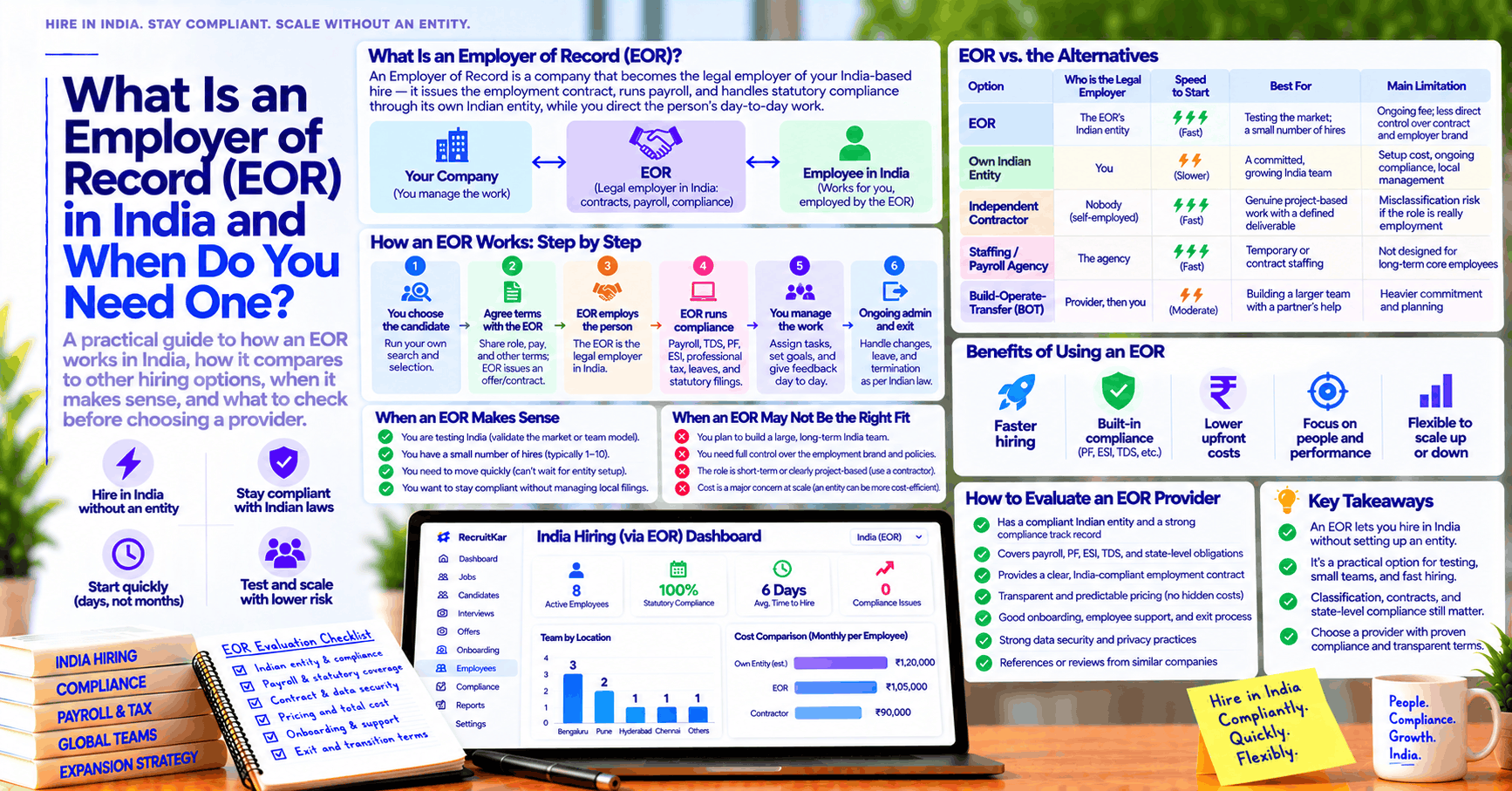
An Employer of Record (EOR) becomes the legal employer of your India-based hire on your behalf. It issues the employment contract, runs payroll, and handles statutory compliance through its own Indian entity, while you direct the person's day-to-day work. It lets a company with no Indian entity employ someone in India compliantly without first incorporating a subsidiary. An EOR is not a recruiter: you still have to find and choose the person. RecruitKar's startup hiring platform covers that front half, sourcing, screening, and interviewing candidates before the hire is handed to an EOR (or to your own entity). This guide explains how an EOR works, how it compares to the alternatives, when it makes sense, and what to check before signing with one.
This is general information, not legal or tax advice. Cross-border employment involves tax, foreign exchange, and corporate law that depend on your specific structure. Take advice from qualified counsel and tax advisers before choosing an approach.
The problem an EOR solves
Suppose a company headquartered outside India finds an excellent engineer in Pune and wants to hire them. The company has no Indian entity. What are the options?
Hire them as an independent contractor. Simple on paper, but if the person works full-time, under the company's direction, with no other clients, the arrangement may be treated as employment regardless of the label. The company then faces the compliance exposure it tried to avoid, and there is a related tax question about whether the company's activity in India creates a taxable presence there.
Set up an Indian entity. The cleanest long-term answer for a company planning to build a team in India, but it takes time and money, and carries ongoing filing, audit, and compliance obligations before the first hire has even started.
Use an EOR. The EOR employs the person through its existing Indian entity. You can have a compliant employee in place much faster, without incorporating anything yourself.
That is the whole logic of an EOR: it lets you test a market, or hire a small number of people, without the fixed cost and commitment of an entity.
How an EOR works, step by step
You choose the candidate. You run your own search and selection. The EOR does not find talent for you in the usual model.
You agree terms with the EOR. They issue an offer and employment contract in the EOR's name, based on the role and compensation you specify, and set up the employee on their Indian payroll.
The EOR employs the person. They are the legal employer: they run payroll, deduct and deposit TDS and professional tax, manage provident fund and ESI registrations and contributions where applicable, and handle statutory leave and benefits.
You manage the work. You assign tasks, set goals, give feedback, and treat the person as part of your team day to day.
The EOR handles administration and exit. Changes in compensation, leave, and termination run through the EOR so that they follow Indian law and the contract.
You pay the EOR. Typically a recurring fee on top of the employee's cost, with the exact structure set by each provider.
Because the EOR is the legal employer, the contract between you and the EOR matters as much as the employee's own contract. Both need to be reviewed.
EOR vs. the alternatives
The table below compares the main options by who the legal employer is, how fast you can start, what each suits, and its main limitation.
| Option | Who is the legal employer | Speed to start | Best for | Main limitation |
|---|---|---|---|---|
| EOR | The EOR's Indian entity | Fast | Testing the market; a small number of hires | Ongoing fee; less direct control over contract and employer brand |
| Own Indian entity | You | Slower to set up | A committed, growing India team | Setup cost, ongoing compliance, local management |
| Independent contractor | Nobody (self-employed) | Fast | Genuine project-based work with a defined deliverable | Misclassification risk if the role is really employment |
| Staffing / payroll agency | The agency | Fast | Temporary or contract staffing | Not designed for long-term core employees |
| Build-operate-transfer / managed capability centre | Provider, then you | Moderate | Building a larger team with a partner's help | Heavier commitment and planning |
None is universally best. They fit different stages of a company's India plans.
When an EOR makes sense
You are testing India. If you are not sure the market, the talent, or the team model will work, an EOR lets you try it with one or a few hires before committing to an entity.
You have a small number of hires. For one to a handful of employees, the cost of maintaining your own entity, accounting, audit, and statutory filings often outweighs the EOR's recurring fee.
You need to move quickly. A strong candidate will not wait for an incorporation. An EOR can usually get a compliant employment relationship in place much faster than forming a company.
You want to avoid misclassification. If the role is genuinely full-time and integrated into your team, an EOR gives you a legitimate employment structure rather than a stretched contractor arrangement.
When an EOR may not be the right answer
You plan to scale significantly in India. As headcount grows, an EOR's per-employee fees compound, and owning an entity usually becomes more economical and gives you more control. Many companies treat the EOR as a bridge and transition employees to their own entity later.
You want full control over contracts and benefits. The EOR's contract templates and benefits structures are theirs. If you need bespoke terms or a differentiated employer brand, that limitation can matter.
The work is truly project-based. If the engagement is a defined deliverable with a self-directed professional who works for others too, a properly structured contractor agreement may be appropriate, though you should confirm that with counsel rather than assume it.
You already have an Indian entity. Then you hire directly. An EOR is for companies without one (or hiring in a context their entity cannot cover).
What an EOR handles, and what it does not
Typically handled by the EOR:
Employment contracts and statutory compliance
Payroll, TDS, and statutory deductions and filings
Provident fund, ESI, professional tax, and labour welfare contributions where applicable
Leave management and statutory benefits administration
Compliant termination and exit procedures
Typically not handled by the EOR:
Finding and selecting the candidate. That is your job.
Managing performance and day-to-day work. You do that.
Your own tax position. Whether your company's activities create a taxable presence in India is a question for your tax advisers, not something an EOR can fully resolve for you.
Intellectual property and confidentiality. Make sure the contracts assign work product to you and bind the employee to confidentiality, and that the EOR arrangement does not leave your IP ownership ambiguous.
How to evaluate an EOR provider
Treat this as selecting a compliance partner, not buying software.
Do they operate through their own Indian entity? Ask who the legal employer is, and where they are registered.
Can they show statutory compliance across the states you will hire in? Payroll, PF, ESI, professional tax, and labour welfare rules differ by location, so confirm coverage for each state.
How current is their knowledge of the new labour codes? India's labour codes took effect in November 2025 and state implementation is still progressing, so ask how they track and apply it.
Contract terms: IP assignment, confidentiality, notice periods, and who bears what in a dispute.
Data protection: how they handle employee personal data under India's DPDP Act, and what happens to it if you leave.
Fee transparency: what is in the recurring fee, what costs extra, and whether there are setup fees, termination fees, or minimum commitments.
Exit and transition: if you later set up your own entity, how easily can you transfer employees, and what does that cost? A good EOR makes this straightforward.
Support and escalation: who you speak to when something goes wrong with payroll or a statutory notice.
Get written terms and have counsel review the master agreement before committing.
Where hiring fits alongside an EOR
An EOR employs; it generally does not recruit. The sourcing and selection work still sits with you, and it is where most of the time and uncertainty lie, especially for a foreign team that does not know the Indian talent market.
RecruitKar is not an EOR and does not employ anyone on your behalf. What it covers is the stage before the EOR contract: finding candidates through AI candidate discovery, screening them with AI video interviews that support regional languages, and tracking every candidate through a visual ATS pipeline. Once you have chosen someone, you hand their details and agreed terms to your EOR (or your own entity) to issue the contract.
Two practical points from that handoff:
Agree compensation and notice period before the EOR issues paperwork. Indian notice periods can be long, and the EOR's contract should reflect what you and the candidate have actually agreed.
Keep the candidate engaged between offer and joining. An EOR does not prevent counter-offers during the notice period, so the pre-joining engagement described in our guide to onboarding matters just as much.
A decision framework in four questions
How many people will you hire in India in the next 12 to 24 months? One to a few points toward EOR; many points toward your own entity.
How certain are you about India as a long-term base? Uncertain favours EOR; committed favours entity.
Do you need control over contracts, benefits, and employer brand? If yes, lean toward your own entity eventually.
How fast do you need to hire? If you must move in weeks, an EOR is often the only realistic route to a compliant employee.
For many companies the honest answer is "EOR now, entity later," with a plan for when the numbers justify the switch.
Frequently asked questions
Can a foreign company hire someone in India without any local entity? Not safely as a direct employer without a local presence. The usual compliant routes are to hire through an EOR, set up an Indian entity, or engage a genuinely independent contractor. Which is right depends on the role and your plans, so take advice before deciding.
Is using an EOR the same as hiring a contractor? No. With an EOR, the person is a full employee of the EOR's Indian entity, with statutory benefits and protections. A contractor is self-employed and outside that framework. Using a contractor arrangement for what is really full-time employment is the risk an EOR helps avoid.
How much does an EOR cost? Pricing varies by provider and structure, often a recurring fee per employee on top of the employee's cost, sometimes with additional charges. I'd rather not quote a number that may be out of date or wrong for your situation: ask two or three providers for written quotes covering everything that would be billed.
Can I move an employee from an EOR to my own entity later? Usually yes, and it is common as headcount grows. The mechanics involve the employee resigning from the EOR and joining your entity, or a transfer arrangement, and they raise questions about continuity of service and benefits. Ask any provider how they handle transitions before you sign.
Does an EOR protect me from all tax and legal risk in India? No. It handles employment compliance as the legal employer, but it does not resolve every question about your own company's tax position or corporate presence. Treat it as one part of a structure that your advisers should review as a whole.
Find the right person first, then choose how to employ them. Source and screen candidates with RecruitKar's startup hiring platform, then hand the selected hire to your EOR or Indian entity with terms already agreed.