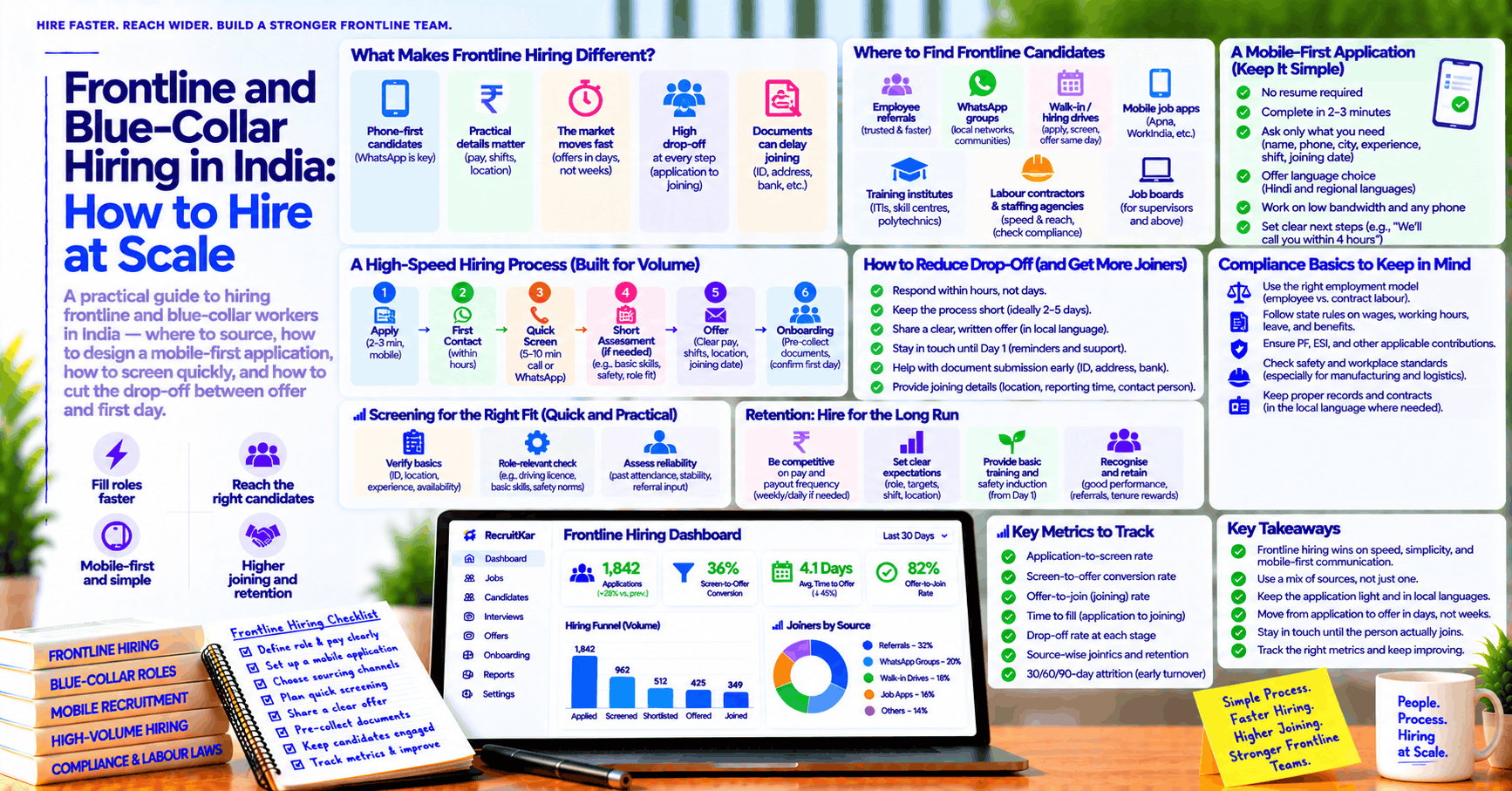
Frontline hiring in India is won on speed, simplicity, and reaching candidates where they actually are: on their phone, on WhatsApp, in their own language. A process designed for desk-based professionals, with a resume upload, an email thread, an English-only interview, and a three-week timeline, loses most frontline candidates before the first conversation. The fixes are practical: a two-minute mobile application, first contact within hours rather than days, a short structured screen, a clear offer in plain language, and regular contact until the person actually starts. RecruitKar's WhatsApp candidate outreach lets you send templated, tracked messages to applicants from a business number, so first contact and follow-up do not depend on a recruiter typing hundreds of individual messages. This guide covers sourcing, application design, screening, offers, retention, compliance basics, and the metrics worth tracking.
This is general information, not legal advice. Wage, contract-labour, and workplace rules differ by state and sector. Have your compliance team confirm what applies to you.
What is different about frontline hiring
Frontline roles include delivery partners and riders, warehouse and logistics staff, retail floor and store staff, factory and plant operators, security guards, housekeeping, drivers, and field technicians. Hiring for them differs from hiring office staff in ways that shape every step.
Candidates are phone-first. Many frontline candidates do not check email regularly and may not have a resume. Their phone, and WhatsApp in particular, is how they receive and respond to almost everything.
Practical details decide the offer. Pay structure and timing (daily, weekly, monthly), shift timings, commute distance, and location often matter more than brand or job title. A role that looks similar on paper loses to a competitor ten minutes closer or paying weekly.
The market moves fast. A candidate can receive several offers in days, including from gig and delivery platforms. A process that takes weeks is not competitive.
Drop-off is high at every step. Between application and interview, between interview and offer, and between offer and first day, candidates simply stop responding. Each step you remove or speed up recovers some of them.
Documents are a bottleneck. Identity, address, and bank details are needed to onboard, and collecting them late delays joining.
Volume is high and roles repeat. The same role may need dozens or hundreds of hires, so a well-designed repeatable process pays off.
Sourcing: where frontline candidates actually come from
No single channel works for every role or city. Most successful frontline programmes use several.
Employee referrals. Frontline workers often know others looking for work, and referrals tend to bring people who already understand the job. A simple referral process, with a shareable link and a prompt, clear bonus paid once the referred person has stayed for a defined period, works well. A shareable job apply link lets employees forward the opportunity over WhatsApp without involving HR at every step, and tags referred candidates automatically.
WhatsApp groups and community networks. Local community, society, and trade groups circulate job information effectively. Posting a role with a clear apply link and a contact number reaches people who would not see a job-board listing.
Walk-in and hiring drives. Fixed-day, fixed-location drives, advertised locally, let candidates apply, be screened, and sometimes receive an offer on the same day. They suit roles where the volume is high and the screening is simple.
Mobile job apps and local portals. Several mobile-first platforms focus on blue-collar and entry-level roles, with Apna and WorkIndia as examples. Check which are actively used in your city and sector before committing budget, since coverage varies by location.
Training institutes and skill centres. ITIs, polytechnics, and vocational and skill-development centres feed trained candidates for technician, operator, and trade roles.
Labour contractors and staffing agencies. Common in manufacturing and logistics. They add reach and speed but also compliance questions, covered below.
Job boards for supervisor and above. For team leads, supervisors, and store managers, mainstream job boards work better than frontline apps.
Track which channel each joiner came from. Source quality matters more than application volume.
Design the application for a phone
The application is where most candidates are lost, so make it as light as possible.
No resume required. Ask for the information you need instead.
Two to three minutes on a phone. Name, phone number, city or pincode, role applied for, prior experience (years, type), shift availability, and earliest joining date.
Language choice. Let candidates apply in Hindi or their regional language. An English-only form quietly excludes capable candidates.
Minimal typing. Use buttons and dropdowns where possible.
No account creation or app download. A browser link that works on a basic Android phone beats anything requiring installation.
WhatsApp as an entry point. Letting a candidate start the application by messaging a number, or tapping a link in WhatsApp, matches how they already use their phone.
Ask for documents later, once there is genuine mutual interest, not at the first step.
Screen fast, in plain language
For most frontline roles, the screening questions are practical and structured: where do you live, can you work these shifts, how much experience do you have, what pay do you expect, when can you start. These do not need a long interview.
Structured voice screening suits this stage well. Automated voice screening calls can dial applicants, ask the same short set of questions in their language, and log the answers against each candidate's record, so recruiters review qualified candidates instead of making hundreds of calls. Be transparent that the call is automated, and keep the script short.
Practical assessments work better than interviews for many trades. A short trade test for a technician, a basic numeracy or cash-handling check for retail, or a driving test for a driver tells you more than a conversation.
Verify the basics later. Identity and address verification belong after a conditional offer, as part of onboarding, not as a barrier to the first conversation.
Keep criteria job-relevant and fair. Avoid filters, such as English fluency or specific educational backgrounds, that are not actually needed for the role. They shrink your pool without improving hiring.
Make the process short
Each additional step costs candidates. A workable target for many frontline roles is two to three steps from application to offer.
A typical lean flow:
Apply on a phone in two to three minutes.
Screen by automated voice call or short WhatsApp exchange within a few hours of applying.
Meet and assess at a walk-in drive, a store, or a site, with a short practical check and a supervisor conversation, ideally on the same day.
Offer immediately or the next day, in simple language.
Compare that to a flow with a resume upload, an email invitation, a phone screen, a first interview, a second interview, and a HR round, spread over three weeks. For most frontline roles, the extra steps add delay without adding much signal.
Offer in plain language, and make it specific
A frontline offer should be understandable in one reading.
Role, location, and shift stated clearly
Pay: amount, how it is calculated (fixed, incentives, overtime), and when it is paid
Joining date and time, and where to report
What to bring: identity, address proof, bank details
Who they will report to, with a name and phone number if possible
Send it in writing, in the candidate's language, and by WhatsApp as well as any formal document. Candidates who understand exactly what they are getting are less likely to drop out or arrive with unmet expectations.
Pay clarity matters more than almost anything else here. Vague promises about incentives that turn out lower than expected are one of the quickest routes to early exits.
Cut the offer-to-joining drop-off
For frontline roles the gap between offer and first day is usually shorter than for professional roles, but the drop-off can still be large. The candidate may accept elsewhere, change their mind, or simply not show up.
Join quickly. Shorter gaps mean fewer chances to lose the candidate. Aim for joining within days where operations allow.
Confirm the day before. A WhatsApp reminder with the time, address, and contact, plus a "reply YES to confirm" request, surfaces no-shows early enough to fill the slot.
Share the practical details of the first day: who to ask for, what to wear, how to get there.
Stay in touch. A short message midway between offer and joining keeps the candidate engaged.
Over-invite slightly where the role permits. If experience shows a predictable show-up rate, plan for it, but treat it as a stopgap and not a substitute for fixing the causes.
Retention starts at hiring
High frontline attrition is often a hiring and first-weeks problem, not only a pay problem.
Set honest expectations at hiring. Describe shifts, physical demands, targets, and pay accurately. Exits in the first weeks often trace to a role that was described more attractively than it turned out to be.
Make Day 1 organised. Know who is meeting them, where to go, what training they will get, and what equipment and safety gear they need. A chaotic first day tells a new worker what to expect.
Check in early. A short WhatsApp check-in on Day 3, Day 7, and Day 30 catches problems while they are fixable.
Supervisor quality matters. Attrition often concentrates under certain supervisors. Track retention by team and supervisor, and act on patterns.
Pay on time, every time. Late or unexplained pay is among the fastest ways to lose frontline workers.
Offer a visible path. Even a simple route from entry role to senior operator or team lead improves retention.
Compliance basics worth checking
Frontline hiring carries more statutory detail than most office hiring. Confirm the specifics for your state and sector with your compliance team, and in particular consider:
Wages at or above applicable minimum wage requirements
Written appointment or engagement documentation and clear records of who the employer is
Provident fund and ESI where applicable
Contract labour: if you use contractors or agencies, understand the compliance responsibilities that remain with you as the principal employer, and choose contractors who are properly registered and compliant
Age and eligibility: verify age and legal eligibility, and note the restrictions on employing minors, especially in hazardous work
Workplace safety, training, and insurance appropriate to the role
Data protection: candidate phone numbers, identity documents, and bank details are personal data, so collect only what you need, store it securely, and get consent for contact on WhatsApp
India's labour codes took effect in November 2025 and state-level rules are still being finalised in places, so check your state's position rather than assuming a single national rule.
Metrics worth tracking
Time to first contact after application
Application-to-screen and screen-to-assessment conversion
Show-up rate at interviews and drives
Offer-acceptance rate
Offer-to-joining rate (who actually starts)
30-day and 90-day retention
Cost per joiner (not just per applicant)
Source quality: joiners and retention by channel
The most useful single signal is often offer-to-joining plus 30-day retention by source. A channel that produces many applicants but few people who stay is expensive, whatever it costs per click.
Example WhatsApp messages (translate and simplify for your audience)
First contact after application: "Hello [Name], this is [Company] about your application for [Role] in [City]. Are you still looking? Reply YES and we will share the next step. Reply STOP to opt out."
Interview or drive invitation: "Hello [Name], you are invited for [Role] at [Location] on [Date] at [Time]. Please bring: ID proof, address proof, a passport photo. Reply YES to confirm or tell us if you cannot come."
Day-before reminder: "Hello [Name], reminder: [Role] at [Location] tomorrow at [Time]. Ask for [Name] at the gate. Reply YES to confirm."
Offer: "Hello [Name], good news. We would like to offer you [Role] at [Location]. Pay: [Amount], paid [Frequency]. Shift: [Timing]. Joining: [Date]. We will send the details in writing. Reply YES to accept."
Keep each message short, one ask per message, and honour opt-outs immediately.
Common mistakes
Requiring a resume or an email address. Many good candidates have neither.
English-only forms and communication. It reduces your pool for no benefit.
A long process for a short-horizon role. Frontline candidates will not wait weeks.
Vague pay promises. They cause early exits and damage your reputation locally.
Waiting for documents before first contact. Ask for them after interest is established.
Treating attrition as only a pay issue. Look at expectations, Day 1, and supervisors too.
Messaging from a personal number at volume. It risks the number being blocked and loses the history. Use a business channel and log everything.
Frequently asked questions
How do I hire hundreds of frontline workers quickly? Make the process short and phone-first: a two-minute application, automated first contact and screening within hours, same-day assessment at a walk-in drive or site, and a plain-language offer. Use multiple sourcing channels, and track which ones produce joiners who stay, not just applicants.
Do I need a resume for blue-collar roles? Usually not. Collect the specific information you need through a short form or a WhatsApp flow, such as experience, location, shift availability, and joining date, and verify documents later.
Is WhatsApp appropriate for recruiting frontline workers? Yes, and it is often the most reliable channel. Use a business account, get consent, keep messages short and in the candidate's language, and honour opt-outs. Avoid sending sensitive documents or details that need a formal record by WhatsApp alone.
How do I reduce no-shows on the first day? Shorten the gap between offer and joining, send a confirmation request the day before, share the practical details of the first day, and stay in touch in between. Also check whether the role, pay, or location was described accurately, since no-shows sometimes reflect a mismatch rather than disinterest.
Should I use contractors or hire directly? Both are common. Contractors can add speed and reach but leave compliance responsibilities with you as principal employer, so choose registered, compliant partners and check your obligations. Direct hiring gives you more control over experience and retention. Many companies use a mix depending on the role and the season.
Hire frontline teams at the speed your operations need. Send templated, tracked WhatsApp outreach, collect applications through a shareable apply link, screen with AI voice calls, and keep every candidate's status in one visual ATS pipeline.