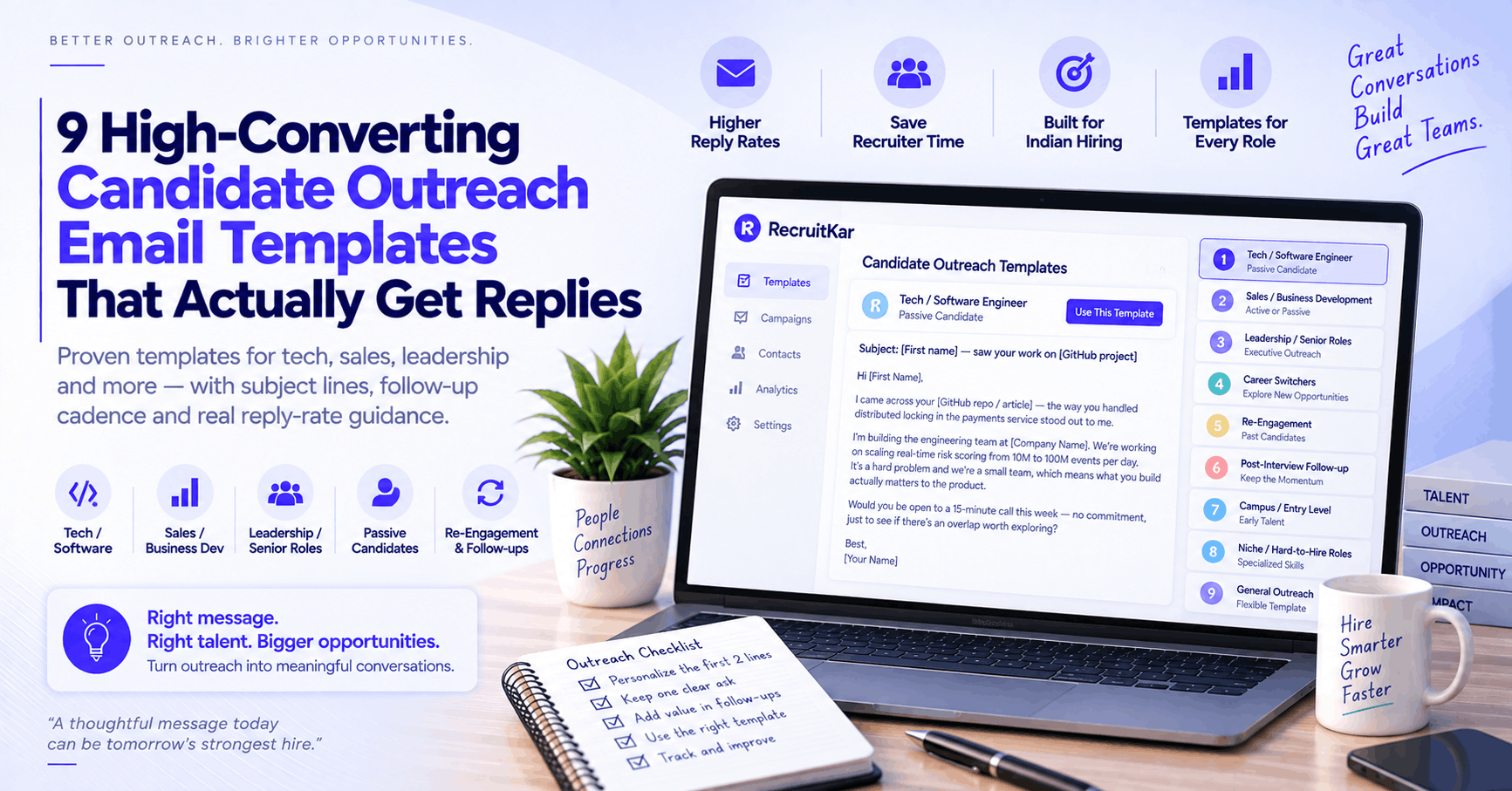
Cold recruiting emails fail for one reason: they're written for the sender's pipeline, not the recipient's inbox. The nine templates below are built around three principles — specificity over flattery, one clear ask per email, and a follow-up sequence that earns a reply rather than demanding one. They cover tech, sales, leadership, passive candidates, re-engagement, and post-interview follow-ups. Copy, adapt, and run them as automated email outreach sequences rather than one-off sends for the best results.
What separates emails that get replies from emails that get deleted
Before the templates: the mechanics matter as much as the words.
Subject line determines whether the email gets opened. A personalised, specific subject line outperforms a generic one every time. "Saw your work on [project]" gets opened. "Exciting opportunity for you" doesn't.
The first sentence determines whether it gets read. Open with something specific to the person — their company, a project, a published piece, a mutual connection. "I came across your profile" is not specific. "Your article on reducing ML inference latency caught my attention" is.
One ask per email. "Let me know if you're interested, and if so send me your updated CV, and also let me know your current CTC and notice period" is four asks. Pick one: interested or not. Everything else comes later.
A follow-up sequence doubles your reply rate. Most replies to cold outreach come on the second or third email, not the first. A planned, value-adding follow-up sequence — not a copy-paste "just checking in" — is what actually moves reply rates from 8–12% toward 35–45%.
Personalisation above the fold, template below. The most efficient approach: write the first 2–3 sentences fresh for each candidate, then let the template carry the rest.
Template 1: Tech / Software Engineer (Passive Candidate)
Best for: Senior and mid-senior software engineers who aren't actively looking.
Subject line options:
[First name] — saw your work on [GitHub project / blog post]
Quick question about your Python background
[Mutual connection] suggested I reach out
Hi [First Name],
I came across your [GitHub repo / article on / talk at] — [one specific, genuine observation about it, e.g., "the way you handled distributed locking in the payments service stood out to me"].
I'm building the engineering team at [Company Name]. We're working on [specific problem the candidate's background is directly relevant to — e.g., "scaling real-time risk scoring from 10M to 100M events per day"]. It's a hard problem and we're a small team, which means what you build actually matters to the product.
Would you be open to a 15-minute call this week — no commitment, just to see if there's an overlap worth exploring?
[Your name]
[Role, Company]
Follow-up (Day 5 if no reply):
Hi [First Name],
Following up on my earlier note. I know you're probably getting plenty of outreach, so I'll be brief — we're specifically looking for someone with [candidate's specific skill, e.g., "experience with consensus protocols"], which is a narrow search. If the timing is off, I'm happy to stay in touch for the future.
Worth 15 minutes?
[Your name]
Template 2: Sales / Business Development (Active or Passive)
Best for: AE, BDR, or Sales Manager candidates; works well for both active and passive candidates.
Subject line options:
[First name] — saw your [Company] ARR growth
Your outbound experience at [Current Company]
Sales role — [City / Remote], [CTC range]
Hi [First Name],
Your stint at [Current Company] caught my eye — taking a product from [X] to [Y] in [timeframe] is the kind of track record we're specifically looking for.
We're building a sales team at [Company Name] to go after [market segment]. The role comes with [specific, concrete detail — e.g., "a warm inbound pipeline that's currently generating 50 MQLs/month, not a cold-start situation"], which I know isn't always the case.
Comp range: [₹X–₹Y LPA + performance incentive]. Happy to share the full JD if this is directionally interesting.
[Your name]
Follow-up (Day 4):
Hi [First Name],
Just a quick follow-up on the [Company Name] sales role. If the comp range or market segment isn't the right fit, completely understood — no pressure. If there's a different kind of role or timing that works better, I'd still like to stay connected.
[Your name]
Template 3: Leadership / Senior Hire (CXO, VP, Director Level)
Best for: Director and above; works for both executive search and direct outreach.
Subject line options:
[First name] — [Company] board / leadership team
A conversation, not a JD
Confidential: [Function] leadership at [Company stage]
Hi [First Name],
I'll be direct — I'm not sending a job description. I'm reaching out because your background building [function] at [Company] is genuinely relevant to a conversation I'd like to have.
[Company Name] is at [stage — e.g., "Series B, ₹80Cr ARR, profitable unit economics"]. The founder is looking for someone to own [function] end-to-end — the kind of role where you set the agenda rather than execute someone else's.
I'm not going to ask for a CV or your CTC in this email. I'd rather have a 20-minute exploratory conversation to see if the direction is worth either of our time.
Are you open to a call this week?
[Your name]
[Role, Firm or Company]
Follow-up (Day 7):
Hi [First Name],
Wanted to follow up briefly. If the timing isn't right or the stage isn't your preference, I completely understand — these conversations only work if they're genuinely interesting to both sides. Happy to reconnect in a few months if the context changes.
[Your name]
Template 4: Re-engaging a Previous Candidate (Silver Medallist)
Best for: A candidate who reached the final round but wasn't selected for a previous role, and who a new, more relevant role has opened for.
Subject line options:
[First name] — a different role at [Company]
Following up from [month] — new opening that fits better
We have a role that's closer to what you were looking for
Hi [First Name],
We spoke in [month] when you interviewed for [previous role]. You were a strong candidate — the decision came down to something specific to that role rather than a reflection of your profile overall.
A different opening has come up at [Company] — [brief description, e.g., "a senior product role focused on the consumer app, rather than the enterprise track we were hiring for last time"]. Based on what I know about your background and what you were looking for, this one's a closer match.
Would you be open to a quick conversation to see if it's worth pursuing?
[Your name]
Template 5: Referred Candidate (Warm Outreach)
Best for: Any level; the warm connection does most of the work — keep it brief.
Subject line options:
[Referrer name] suggested I reach out
[First name] — [Referrer] thought we should connect
Hi [First Name],
[Referrer name] mentioned you and suggested I reach out directly. [One line of context from the referrer that's specific and relevant — e.g., "She mentioned your experience scaling data infrastructure at Flipkart is exactly what we're working on."]
I'll keep this short: we have an opening for [role] at [Company]. Happy to share more details if it's directionally interesting. Would a 15-minute call work?
[Your name]
Template 6: Campus / Early Career Outreach
Best for: Recent graduates or final-year students; works for both lateral and fresher hiring drives.
Subject line options:
[First name] — [Role] at [Company], [City / Remote]
Your [internship / project] at [Organisation] — quick question
Opportunity at [Company] — [2025 / 2026 batch]
Hi [First Name],
I came across your profile and noticed your [internship at / project on] — [specific observation].
We're hiring for [role] at [Company], suited for [2025/26 batch / recent graduates]. The role involves [two specific things the candidate would actually do, not boilerplate]. Stipend / CTC: [₹X].
Would you be open to a 10-minute call this week?
[Your name]
Template 7: Passive Candidate — Functional Role (Finance, Marketing, Operations)
Best for: Non-tech passive candidates; adapt the function-specific detail for each role.
Subject line options:
[First name] — [Role] opportunity, [City]
Your [function] background at [Current Company]
Quick question about your career direction
Hi [First Name],
I was looking at your background — [specific observation about their experience, e.g., "building the performance marketing function at [Company] from scratch"] — and wanted to reach out about a role that's a direct fit.
We're looking for a [Role] at [Company Name] to [specific mandate, e.g., "own P&L for the North India region"]. It's a newly created role, which means more scope to define it than a backfill.
Would you be open to learning more?
[Your name]
Template 8: Post-Interview Check-In (Candidate Who Has Gone Quiet)
Best for: A candidate who completed an interview round but hasn't responded to next-steps communication for 5–7 days.
Subject line options:
[First name] — quick update on the [Role] process
Checking in — [Company] interview
Hi [First Name],
I wanted to reach out after your interview for [Role] at [Company]. We enjoyed the conversation and wanted to keep the process moving.
I know timelines can be uncertain from your side too — if you've accepted another offer, or if this particular role isn't the right fit, just let me know and I can close the loop on our end. No hard feelings either way.
If you're still interested, I'd love to schedule the next step — [one specific next action, e.g., "a 30-minute call with the hiring manager"].
[Your name]
Template 9: Final Follow-Up Before Closing (Last Touch)
Best for: Last email in a sequence for a candidate who hasn't replied to any previous outreach; the goal is a clean close or a reply, not continued silence.
Subject line options:
Closing the loop — [Role] at [Company]
[First name] — last note from me on this
Hi [First Name],
I've reached out a couple of times about the [Role] opportunity at [Company] and haven't heard back — I completely understand you may be focused elsewhere or simply not interested in a change right now.
I'll leave it here rather than continue following up. If the timing changes or you'd like to revisit this conversation in the future, I'd be glad to reconnect.
Good luck with whatever you're working on.
[Your name]
A graceful close often gets a reply when nothing else did — and even if it doesn't, it ends the sequence on a note that preserves the relationship for a future opening.
Subject line and follow-up cadence cheat sheet
Subject lines that consistently outperform generics
Generic (low open rate)
"Exciting opportunity for you"
"I came across your profile"
"Are you open to new opportunities?"
"We're hiring!"
Specific (higher open rate)
"Saw your work at [Company]"
"Quick question about your ML background"
"[Mutual connection] suggested I reach out"
"Senior PM role — [City], [CTC range]"
Recommended follow-up cadence
For passive candidates who haven't replied:
Day 1: First outreach (Templates 1–7 above)
Day 5: First follow-up — add a piece of value (a relevant article, a specific detail about the role, an answer to a question they might have had)
Day 10: Second follow-up — brief, low-pressure
Day 18: Final close (Template 9)
Running this as an automated sequence rather than four separate manual sends means the cadence happens consistently regardless of a recruiter's individual workload — and reply tracking shows which message in the sequence actually converts for each role type, so you can improve over time.
Building these into a sourcing workflow
Individual emails outperform mass templates, but manually personalising at scale isn't sustainable. The practical approach that combines both:
Use the first 2–3 sentences as the personalisation layer — write these fresh per candidate using their specific background.
Let the template carry everything from the body onward.
Build the follow-up sequence once per role type, not per candidate.
Track opens, clicks, and replies to refine which subject lines and follow-up timing actually work for your specific candidate pool.
The candidate outreach automation hub on RecruitKar lets you run multi-stage email sequences across a candidate list, with per-candidate personalisation fields, open and reply tracking, and automatic progression through the sequence based on candidate response — so the follow-up cadence above runs without a recruiter manually checking who replied on which day.
If you're sourcing candidates from job board imports, LinkedIn, or direct applications, they flow directly into the outreach sequence without re-entry — templates, personalisation fields, and sequence stages apply to the imported list automatically.
For Indian-market sourcing specifically, consider pairing email sequences with WhatsApp and voice outreach since reply rates for email alone tend to be lower for passive candidates in India than for candidates actively checking a professional inbox.
Frequently asked questions
What's a realistic reply rate for cold recruiting emails in India? For well-personalised emails to relevant, accurately-targeted candidates, open rates of 40–60% and reply rates of 15–30% are achievable. Generic mass-sent templates typically see open rates below 20% and reply rates in the single digits. The gap between the two isn't talent — it's specificity and follow-up cadence. A four-touch sequence to a genuinely matched candidate pool consistently outperforms a single well-written email.
How many follow-ups should I send before stopping? Three to four total touches (including the first email) is the range that maximises reply rate without tipping into spam territory for most candidates. The final close email (Template 9) serves a dual purpose: it often generates replies precisely because it removes pressure, and it ends the sequence on a note that preserves the relationship for a future role.
Should I personalise every email or use a standard template? The personalisation that matters most is in the first two sentences — a specific observation about the candidate's background that demonstrates you've actually looked at their profile. Everything after that can be templated without meaningfully hurting reply rates. Trying to personalise every element of every email at scale is unsustainable; trying to template the opening is visible and counterproductive.
What's the best subject line format for passive candidates? Short, specific, and either a question or a reference to something about them specifically. "[First name] — saw your work at [Company]" and "Quick question about your [skill] background" both consistently outperform subject lines that lead with the role or with flattery. Avoid "exciting opportunity" and its variants — candidates recognise the template instantly.
Can I use these templates for WhatsApp outreach too? With significant adaptation. WhatsApp messages should be considerably shorter — two to three sentences maximum for a first touch — and the tone should be more conversational and direct than an email allows. The opening personalisation principle applies equally, but the template body should be stripped to one clear sentence and one ask. See the candidate outreach automation hub for WhatsApp-specific templates alongside the email sequences.
Put these to work: Build your multi-stage outreach sequence once on RecruitKar and run it across your entire sourced candidate list — automated email outreach sequences, open and reply tracking included.