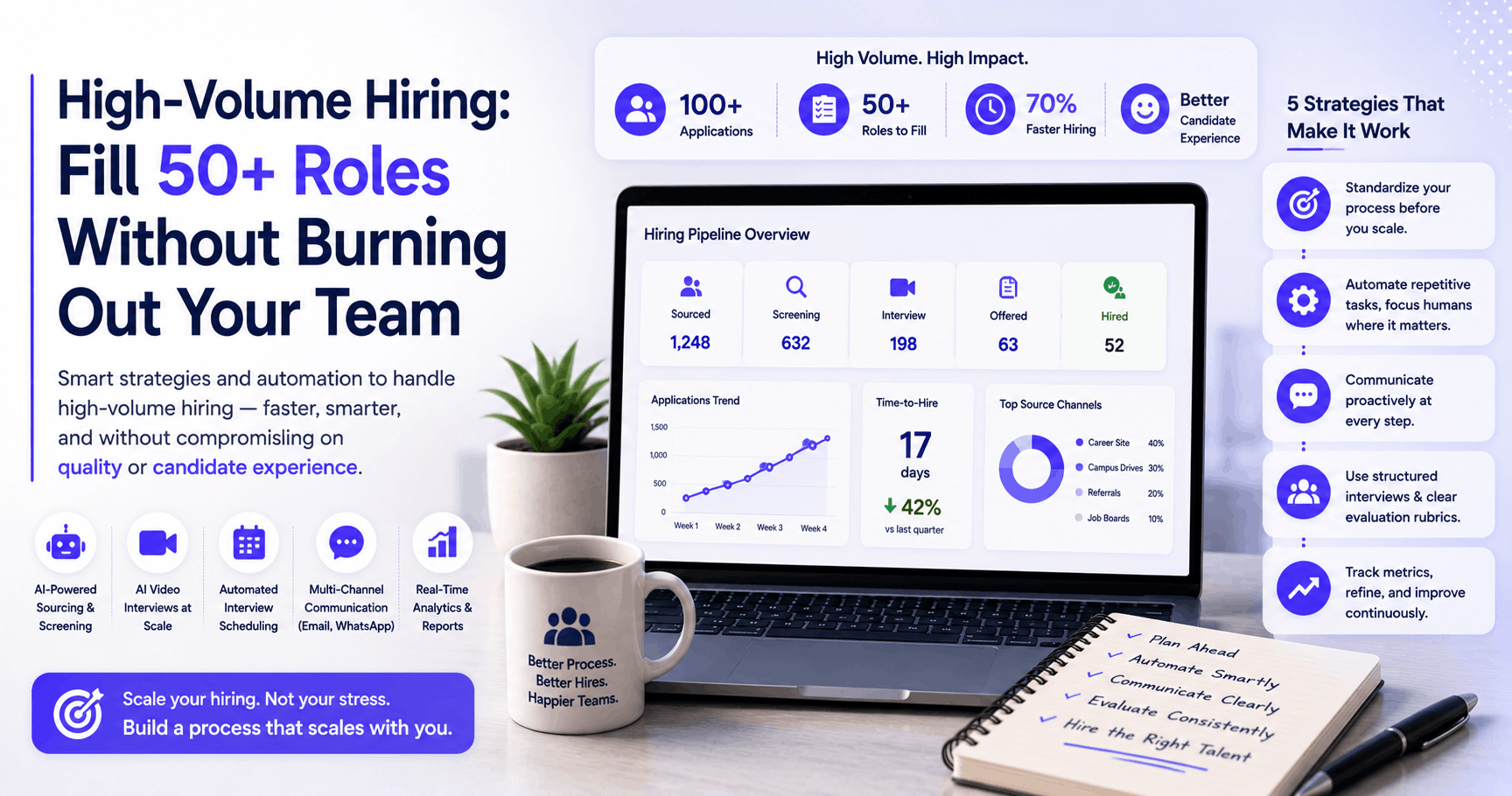
There's a specific kind of exhaustion that comes with high-volume hiring—the retail chain opening twenty new stores this quarter, the BPO ramping up a new client account, or the campus drive trying to fill a hundred graduate roles before the season ends. It's not the same problem as hiring one senior engineer carefully over six weeks. It's a fundamentally different discipline, and treating it like a scaled-up version of low-volume hiring is exactly what burns recruiting teams out.
This post covers what actually changes at high volume and practical strategies for handling it without the two most common failure modes: recruiters drowning in manual work, or candidate experience quietly collapsing because nobody has time to communicate properly with hundreds of applicants at once.
What's genuinely different about high-volume hiring
The math changes. At low volume, a recruiter can give real individual attention to every candidate. At high volume—say, filling 50 or more roles simultaneously, or processing hundreds of applicants for a smaller number of similar roles—that individual attention model simply doesn't scale. Something has to become systematic and consistent instead of personalized and ad hoc, or the whole process collapses under its own weight.
Consistency matters more than depth. For a single senior hire, deep, nuanced evaluation of one candidate is worth the time investment. For high-volume roles, a consistent, well-designed process applied to every candidate usually produces better overall outcomes than an inconsistent process that goes deep on some candidates and barely looks at others because time ran out.
Candidate experience risk multiplies. A slow, disorganized process affects one candidate's opinion of you at low volume. At high volume, the same disorganization affects hundreds or thousands of people simultaneously—and in tight-knit communities (a specific college, a specific industry), that reputation spreads fast.
The bottleneck moves. At low volume, sourcing enough candidates is often the hard part. At high volume, the bottleneck usually shifts downstream—to screening a large pool efficiently, scheduling interviews at scale, and making decisions fast enough that strong candidates don't accept a competing offer while waiting.
Building a process that scales
1. Standardize before you scale, not after
Trying to design your screening criteria, interview structure, and evaluation rubric while candidates are already flowing in is how inconsistency creeps in—different reviewers apply different standards because nothing was locked down beforehand. Before opening a high-volume requisition, define: what the non-negotiable requirements actually are, what the screening rubric looks like, how many interview rounds there will be and what each one assesses, and who has authority to make a final call. This groundwork takes real time upfront, but it's what prevents the process from becoming chaotic once volume hits.
2. Let automation handle the volume-heavy stages, and protect human time for the stages that need it
The instinct in high-volume hiring is often to try to move fast everywhere, which usually means every stage gets rushed, including the ones where careful judgment actually matters. A better approach: automate or systematize the stages that are genuinely repetitive and volume-heavy—initial sourcing and matching, first-pass screening, scheduling—and protect recruiter and hiring-manager time for the stages that benefit most from real judgment, like final interviews and offer decisions.
In practice, this often looks like: AI-assisted sourcing and screening to quickly narrow a large applicant pool to a genuinely qualified shortlist, asynchronous AI video interviews for a structured, consistent first round that doesn't require a recruiter to conduct a live call with every single applicant, and calendar-integrated interview scheduling so booking a slot doesn't require email back-and-forth multiplied across hundreds of candidates.
3. Communicate proactively, even with automated tools doing the heavy lifting
The single biggest candidate-experience failure at high volume is silence—candidates who apply and simply never hear anything, good or bad. This is entirely avoidable, even at scale, with the right tooling: automated status updates at each stage (application received, moving to interview, not selected) keep candidates informed without requiring a recruiter to personally message each one. Multi-channel outreach—particularly WhatsApp in the Indian market, where response and open rates tend to run well ahead of email—helps ensure these updates actually get seen rather than sitting unread in an inbox.
4. Batch what can be batched
Individual scheduling for hundreds of interviews is a losing battle. Batch interview days or windows—a set day where a large number of first-round interviews or assessment sessions happen back-to-back—reduce coordination overhead dramatically compared to scheduling one-off slots across weeks. This is especially effective for campus hiring, where an entire cohort can often go through the same process in a compressed timeframe rather than trickling in individually over months.
5. Build a genuinely fair, consistent evaluation rubric, and stick to it
At high volume, the single biggest risk to fairness isn't malicious bias—it's simple drift. Reviewer 1 in week one and reviewer 5 in week four, evaluating similar candidates, can end up applying meaningfully different standards without anyone noticing, unless there's a written, specific rubric everyone is trained on and expected to follow. Periodically auditing a sample of decisions across different reviewers and time periods is worth the effort to catch drift before it becomes a pattern.
6. Plan for the funnel math, not just the headcount target
If you need to hire 50 people, and your historical data shows roughly 10% of interviewed candidates convert to offers, and roughly 70% of offers get accepted, you need to be sourcing and interviewing at a volume that accounts for that funnel—not just sourcing "enough" candidates and hoping the numbers work out. Tracking your own historical conversion rates by stage is what turns high-volume hiring from a scramble into a plannable, predictable process.
Where high-volume hiring commonly goes wrong
Treating every applicant identically regardless of clear differences in fit. Standardization doesn't mean ignoring genuinely important differences—a rubric should still allow for meaningfully different outcomes for meaningfully different candidates, just applied consistently rather than arbitrarily.
Letting speed erode the candidate experience entirely. A fast process and a respectful process aren't mutually exclusive, but it takes deliberate design to keep both—automated communication, clear expectations set upfront about timelines, and prompt (even if templated) responses at each stage all help maintain this balance.
Underestimating hiring-manager bandwidth. Even with sourcing and screening automated, hiring managers still need to review shortlists and make final decisions—at high volume, that review time adds up fast, and it's worth explicitly planning for hiring-manager capacity, not just recruiter capacity.
No plan for offer-stage bottlenecks. If internal approval processes for offers weren't designed with high-volume hiring in mind, this stage becomes the hidden bottleneck no one accounted for—pre-approving compensation bands for standard, high-volume roles avoids a lot of this friction.
Losing strong candidates to slower competitors during a drawn-out process. In competitive hiring markets, a candidate with multiple options will usually go with whoever moves fastest and communicates most clearly—this is one of the strongest arguments for investing in process speed at the top of the funnel, not just as a nice-to-have.
Campus hiring: a specific case worth calling out
Campus hiring is one of the purest forms of high-volume hiring—a large, defined cohort, a compressed timeline, and typically less differentiated experience to evaluate against (since most candidates are at a similar career stage). A few things that specifically help here: structured assessments or AI video interviews that can process an entire cohort consistently within a tight recruiting-season window, batch interview days on or near campus rather than staggered individual scheduling, and clear, early communication about timelines, since students weighing multiple offers from different companies need to know when to expect a decision.
A realistic workflow for filling 50+ roles
Putting this together, a reasonably well-run high-volume process might look like this: a standardized rubric and interview structure gets locked in before the requisition opens. Sourcing pulls from multiple channels simultaneously—job boards, referrals, direct applications, AI-matched candidate discovery—feeding into one pipeline rather than several disconnected lists. Initial screening narrows the pool automatically against the pre-defined rubric, with a human spot-checking a sample regularly to catch drift or bias. Candidates move through structured, often asynchronous first-round interviews, batched where possible. Automated, multi-channel status updates keep everyone informed throughout, even the candidates who won't ultimately be selected. And a pre-agreed, fast offer-approval process—ideally with compensation bands already approved for standard roles—means strong candidates aren't lost to slower internal processes while waiting for sign-off.
Measuring whether your high-volume process is actually working
A few metrics matter more at high volume than they do for individual hiring, and are worth tracking deliberately rather than only reviewing at the end of a campaign:
- Time-in-stage, not just overall time-to-hire. At high volume, a single slow stage (screening, scheduling, offer approval) can quietly bottleneck the entire pipeline even if the rest of the process is fast—tracking each stage separately shows you where to actually intervene.
- Conversion rate by stage, by cohort. If a particular sourcing channel or campus produces candidates who consistently convert better (or worse) through your funnel, that's worth knowing before your next hiring cycle, not after.
- Candidate satisfaction, even for rejected candidates. A short, optional post-process survey—even just for candidates who didn't get an offer—can surface communication or process gaps that internal metrics alone won't catch, and it's a relatively low-effort way to protect your employer brand at scale.
- Offer-acceptance rate and time-to-offer. If strong candidates are declining offers, it's worth checking whether a slow internal process lost them to a faster-moving competitor—this is one of the clearest, most fixable signals in high-volume hiring.
- Recruiter and hiring-manager workload, not just candidate-side metrics. A process that hits its hiring targets but burns out the team running it isn't actually sustainable—tracking hours spent per hire, not just headcount filled, helps catch this before it becomes a retention problem on your own team.
A short checklist before launching a high-volume hiring campaign
- Is the screening rubric and interview structure locked down and documented before the requisition opens, not designed on the fly?
- Are compensation bands and offer-approval authority pre-agreed for standard roles, to avoid a bottleneck at the finish line?
- Is there a plan for multi-channel candidate communication, including automated updates for candidates who won't advance?
- Has hiring-manager review capacity been explicitly planned for, not just recruiter capacity?
- Is there a way to spot-check evaluation consistency across different reviewers and different weeks of the campaign?
- Do you know your own historical conversion rates by stage, so sourcing volume targets are based on real numbers rather than a guess?
Industry-specific considerations worth a quick mention
High-volume hiring looks somewhat different depending on the sector. Retail and manufacturing roles often involve candidates who may not check email regularly, making multi-channel outreach (particularly WhatsApp and voice calls) more important than it would be for office-based hiring. BPO and customer-facing roles frequently need to assess communication skills at scale, which is exactly where structured, consistent interview formats matter most, since inconsistent evaluation is especially risky when hundreds of similar candidates are being compared against each other for a limited number of seats. Campus and graduate hiring operates on a hard external deadline (the recruiting season), which makes process speed a genuine constraint, not just a nice-to-have—a slow process doesn't just lose individual candidates, it can mean missing the hiring window for an entire cohort.
The bottom line
High-volume hiring breaks any process built for one-off, individually-tailored hiring—the fix isn't working harder within the same process, it's building a fundamentally different one designed for consistency, communication at scale, and protecting human judgment for the stages that genuinely need it. Done well, high-volume hiring doesn't have to mean either a burned-out recruiting team or a poor candidate experience—it means being deliberate about which parts of the process can be systematized, and disciplined about keeping the rest genuinely fair and consistent as volume climbs.