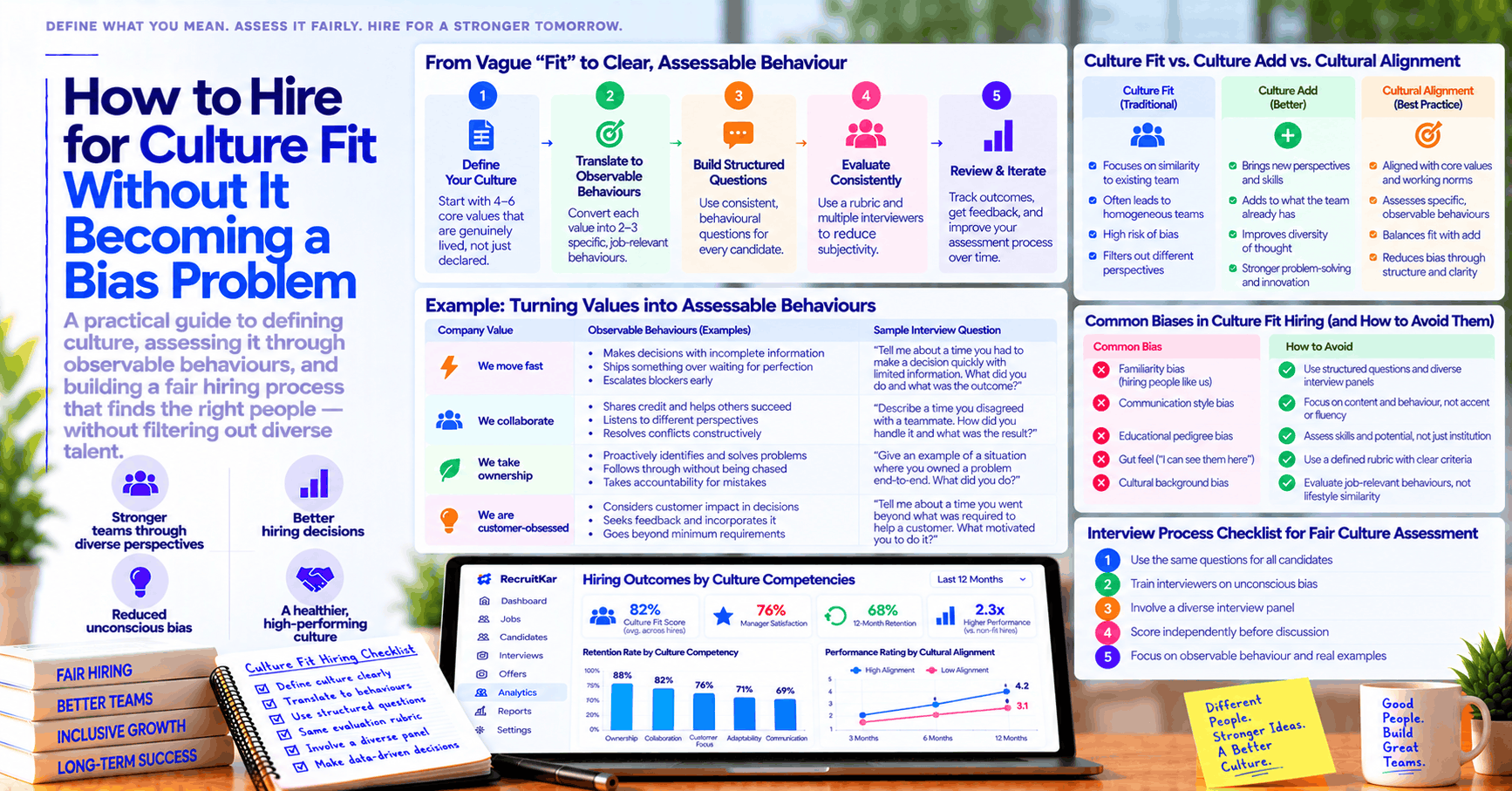
"Culture fit" is one of the most commonly cited reasons for rejecting a candidate in Indian companies, and one of the least defined. When a hiring manager says "she's technically strong but not a culture fit," what they almost always mean is one of three things: she communicates differently than our current team does, she comes from a different kind of background, or I can't articulate why, I just don't see her here. None of these are culture — they're proxies for familiarity. Genuine culture fit assessment is both possible and valuable; it's also one of the most reliably biased activities in a hiring process when left undefined. This guide shows you how to define what you actually mean by culture, translate it into assessable, job-relevant behaviours, and build interview questions that evaluate it consistently. RecruitKar's structured interview scheduling ensures every candidate goes through the same process with the same panel — the logistics layer that keeps culture assessment consistent rather than arbitrary.
Why "culture fit" produces bias in most hiring processes
The problem with culture fit as typically used isn't the concept — it's the implementation. When "fit" is left undefined, it defaults to the path of least cognitive resistance: does this person remind me of people already on the team?
In Indian professional contexts, this produces a specific cluster of biases:
Communication style as a proxy for competence. A candidate who speaks English fluently, uses corporate vocabulary comfortably, and communicates with confidence in an interview room is perceived as a stronger "culture fit" than one who is equally capable but communicates with more hesitation, a different accent, or in a more indirect style. None of these are indicators of job performance; all of them correlate with educational background and socioeconomic context.
Educational pedigree as culture. "We're a high-performance team" used as a shorthand for "we hire from IITs and IIMs" isn't culture assessment — it's credential filtering with a culture label attached. The argument that top-institution graduates are culturally different from others is rarely examined and rarely true in job-relevant ways.
Familiarity with specific communication norms. A candidate who navigates corporate communication norms — following up promptly, framing feedback diplomatically, using the right vocabulary for the industry — performs better on culture fit assessments in most Indian companies. These norms are learnable and context-dependent, not a fixed attribute of the person.
"I can picture them in the role" as final arbiter. The closing gut-feel question — "can I see this person sitting with the team?" — is the most reliably biased question in any hiring process, because the image being conjured is drawn from the existing team, which already reflects the biases of previous hiring.
The result: "culture fit" rejects candidates who are different from the current team for reasons unrelated to whether they would actually perform well in the role.
The culture add reframe: why it's useful but not enough on its own
"Culture add" — hiring for what a candidate brings that the team doesn't already have, rather than how closely they match the current team — is a useful corrective to the worst excesses of culture fit filtering. A team that only hires for similarity becomes progressively more homogeneous and less capable of the cognitive diversity that produces better decisions.
But "culture add" without definition is also susceptible to becoming a brand value rather than an operational standard. "We want people who challenge conventional thinking" sounds meaningfully different from "we want people who fit our culture" — but if neither is translated into specific, observable behaviors that interviewers actually assess, both produce the same outcome: a vague holistic impression that's vulnerable to the same biases.
The useful reframe isn't "fit versus add" — it's "undefined impression versus defined behaviours."
How to define culture operationally
Culture that can be assessed in hiring must be reduced to specific, observable behaviors — not values, not adjectives, and not abstract principles.
The process:
Step 1: Start with your company's values (if they exist and are genuinely lived, not just declared). Most Indian companies with a values framework have 4–6 values stated somewhere. Take each one and ask: what does this look like in someone's day-to-day behaviour? Not "what does it look like in a mission statement," but what would I observe a person doing at their desk, in a meeting, or in a difficult situation that would make me say "yes, they embody this value."
Step 2: Translate each value into 2–3 observable behaviors.
Value
Observable behaviors
"We move fast"
Makes decisions with incomplete information; ships something over waiting for perfection; escalates blockers immediately rather than sitting on them
"We're direct"
Gives specific critical feedback in a group setting without softening to the point of uselessness; disagrees with a senior person's idea in a meeting; answers questions directly rather than hedging
"We own our outcomes"
Doesn't point to external factors as primary explanation for a missed target; follows up on commitments without being chased; proactively updates stakeholders when something changes
Step 3: Write interview questions that give candidates the opportunity to demonstrate these behaviours through past examples.
For "we're direct": "Tell me about a time you disagreed with a decision made by someone more senior than you. What did you do?"
For "we own our outcomes": "Walk me through a time you missed a target or commitment. What happened, and what did you do about it?"
Step 4: Define what a strong answer looks like, a borderline answer, and a weak answer — before you start interviewing anyone.
What good culture fit questions look like vs. what most companies use
What most companies use:
- "Why do you want to work here?"
- "How would you describe your working style?"
- "Are you a team player?"
- "Where do you see yourself in 5 years?"
- "Tell me about yourself."
These questions invite self-presentation — a candidate describes who they want to be seen as. They produce the most polished, least predictive answers in the entire interview and are disproportionately answered well by candidates who have had the most practice presenting themselves in professional interview settings.
What actually evaluates culture:
For "we move fast": "Tell me about a project or decision where you had to act without all the information you would have wanted. What did you decide, and how did it turn out?"
For "we give direct feedback": "Describe a situation where you gave someone feedback they didn't want to hear. How did you approach it, and how did they respond?"
For "we take ownership": "Tell me about a time something in your work went significantly wrong. What specifically did you do to fix it, and what would you do differently?"
For "we're collaborative but not consensus-driven": "Give me an example of a time you moved forward on a decision without full team agreement. How did you handle the disagreement?"
Every question asks for a past example, specifies what aspect of culture it's assessing, and can be scored against a pre-defined rubric — not left to a holistic impression.
Building a culture assessment rubric
Without a rubric, culture assessment defaults to overall impression. With one, it becomes a structured evaluation of whether specific behaviors are present in the candidate's examples.
Example rubric for "we move fast":
Evidence level
What it looks like
Strong (4–5)
Candidate describes a specific situation with genuine uncertainty, names the decision they made, can articulate what they prioritised and what they deliberately deprioritised, describes an outcome that was meaningfully affected by the speed of the decision
Acceptable (2–3)
Candidate describes a situation with some ambiguity but the decision was relatively safe; shows awareness of trade-offs without fully owning the risk
Weak (1)
Candidate describes a situation where they waited for more information, or where the "fast" decision was actually quite low-stakes; or provides a hypothetical rather than a real example
This rubric can be completed by any interviewer in 3 minutes after hearing the candidate's answer. It produces a consistent, comparable score rather than a feeling.
Who should assess culture fit in the interview process
Culture fit assessment should not be concentrated in one interviewer or one unstructured conversation. It should be:
Distributed across multiple interviewers, each evaluating one or two culture dimensions specifically, so the assessment covers multiple aspects of culture without any single interviewer carrying the full subjective weight.
Completed independently before the debrief, using the rubric, before any group discussion that might anchor individual scores toward the most senior person's impression.
Explicitly separate from functional assessment. A technical panel interviewer who is evaluating engineering skills should not also be conducting a holistic culture assessment — the two dimensions should be evaluated separately, by interviewers who are briefed on what they're specifically assessing.
Red flags that culture fit is functioning as bias
Watch for these patterns — they indicate that "culture fit" is functioning as a demographic filter rather than a values assessment:
- Candidates with equivalent functional skills and equivalent culture rubric scores receiving different culture ratings with no specific behavioral evidence cited for the difference
- Culture rejection reasons that describe communication style (accent, fluency, directness) rather than observable behaviors
- Culture assessment scores that correlate strongly with educational institution or family background
- A hiring manager who consistently rejects diverse candidates for culture fit while advancing similar-background candidates
- "I just don't see it" as a final culture verdict with no specific behavioral evidence offered
Any of these warrant a direct conversation: "What specific behavior did you observe that led to this culture assessment?" If the answer doesn't reference a specific observed behavior, the assessment needs to be revisited.
A note on values that are genuinely exclusive
Not every culture value can be made bias-neutral — some values genuinely select against certain people, and that's both honest and acceptable provided the selection criterion is legitimately job-relevant.
A company that genuinely operates at extreme pace — shipping daily, making irreversible decisions weekly, functioning with sustained ambiguity — will not be a good environment for someone who requires predictability and defined processes to perform well. That's not bias; it's an honest assessment of fit.
The test is: can you specify the job-relevant behavior this value requires, can you observe that behavior (or its absence) in a candidate's real past examples, and does the requirement apply equally to all candidates regardless of demographic background? If yes to all three, the assessment is defensible. If the "value" can't be translated into observable behaviors, it's probably a demographic preference wearing a cultural label.
Frequently asked questions
How do we stop hiring managers from using "culture fit" as a veto without evidence? The most effective intervention is requiring specific behavioral evidence as the justification for any culture fit rejection. "Not a culture fit" is not an acceptable rejection reason without a specific behavioral observation attached: "Their answer to the feedback question showed they avoided direct confrontation in a situation where the role requires it" is a valid culture rejection. "I just don't see it" is not. Making this explicit in interviewer training and reinforcing it in debrief processes changes behaviour faster than awareness training alone.
What is "culture add" and should we use it instead of "culture fit"? Culture add refers to hiring for what a candidate contributes that the team doesn't already have — deliberately seeking candidates who expand the team's perspective rather than replicate the existing one. It's a useful corrective to the worst outcomes of culture fit, particularly for teams that have become homogeneous. In practice, the most useful framing is neither "fit" nor "add" in isolation — it's "what specific behaviours does this role and team context require, and does this candidate demonstrate them?" Both fit and add are downstream of that more fundamental question.
How do we assess culture for a company whose values are still being defined? If your company doesn't yet have clearly defined values, interview for the specific behavioural attributes that your current high performers share — the things that distinguish people who thrive in your environment from people who struggle. Observe your best performers: how do they communicate under pressure? How do they make decisions with limited information? How do they handle disagreement? These observations, translated into behavioral questions, produce more useful culture assessment than a values statement written by a leadership team in a workshop.
Can we use AI video interviews for culture assessment? With significant caution. AI-scored video interviews that evaluate communication style, pace, or vocabulary as proxies for cultural attributes are among the most bias-prone applications of AI in hiring. Culture assessment through AI video works only if the scoring rubric is tied to specific, job-relevant competencies (as described above), and even then requires human review of any borderline culture assessments rather than automated pass/fail decisions.
Should culture fit assessment be the same for all roles? No — the specific behaviours that constitute "culture fit" should reflect what each role actually requires. A customer-facing sales role and a back-end engineering role in the same company may share core values but require different behavioural manifestations of those values. The "we're direct" value looks different in a daily client-facing role than in a solo coding environment. Tailor the behavioral indicators and questions per role type rather than applying a single universal culture assessment.
Run consistent culture assessments with the same panel, same questions, and same scheduling for every candidate. RecruitKar's structured interview scheduling ensures every candidate for the same role meets the same panel in the same format — the logistics foundation that makes culture assessment comparable rather than arbitrary. Why structured hiring teams choose RecruitKar.