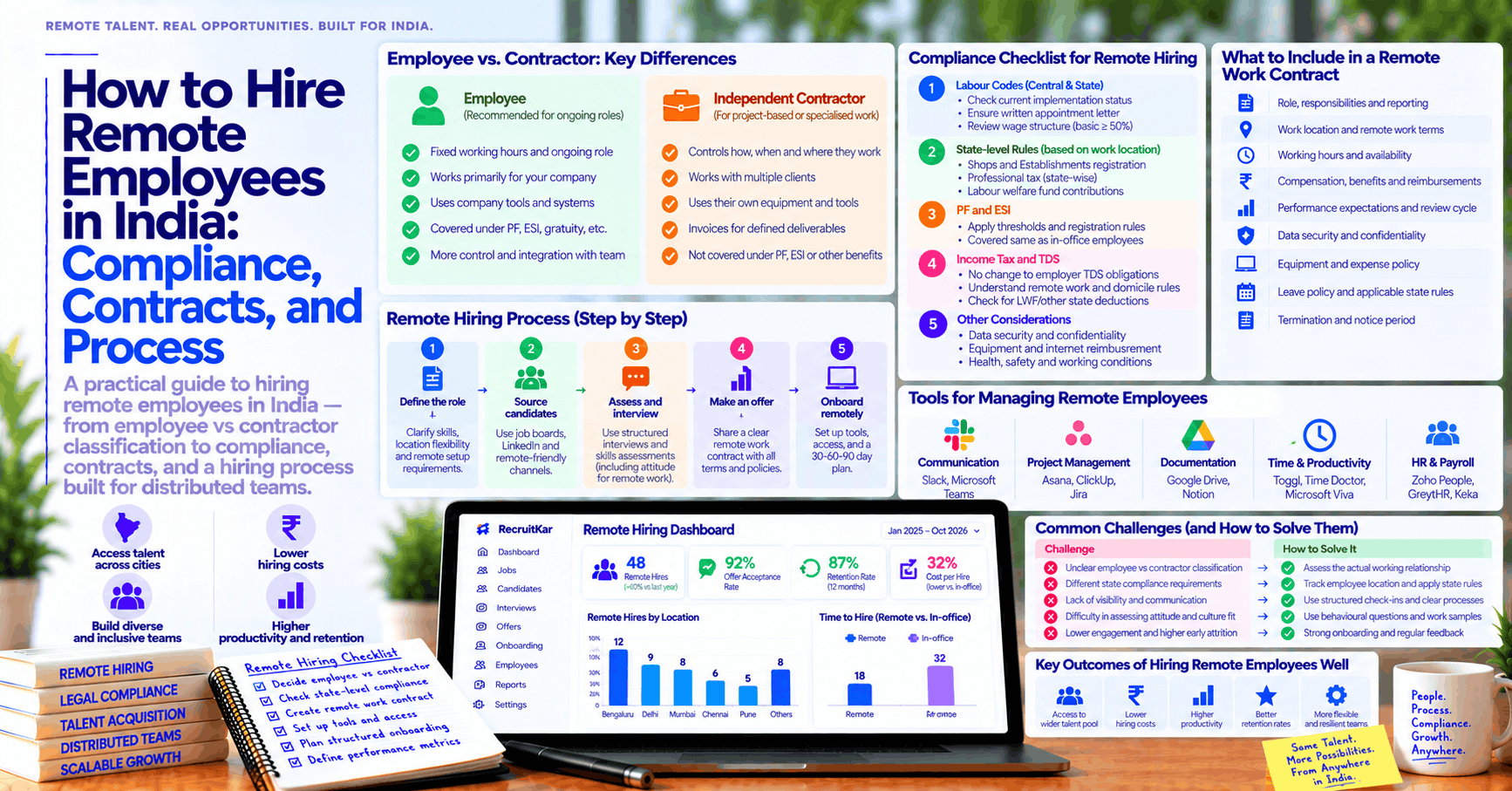
Hiring a remote employee in India is operationally simple and legally easy to get subtly wrong. The simple part: you can source, interview, and onboard someone in another city entirely online. The subtle part: the employee's physical location determines which state's rules apply to them, a remote engineer in Bengaluru and one in Chennai can sit under different procedural regimes, and calling someone a "contractor" does not make them one if the working relationship looks like employment. This guide covers the classification question, the compliance layers to check, what a remote work contract should include, and how to run a hiring process designed for distributed teams. RecruitKar's visual ATS pipeline keeps every candidate's location, stage, and documentation in one place, which matters more than usual when your team is spread across cities and states.
This guide is general information for HR teams, not legal advice. Employment law in India is changing and varies by state; have counsel or your payroll compliance provider confirm the specifics for your situation before finalising contracts or policies.
Start with the classification question: employee or contractor?
The first decision in remote hiring is whether the person is an employee or an independent contractor, and it is the one most often made for convenience rather than on the facts.
Signs of a genuine contractor relationship:
- They control how, when, and where the work is done
- They work for multiple clients and can take on or decline assignments
- They use their own equipment and tools
- The engagement is for a defined deliverable or project, not an open-ended role
- They invoice for the work rather than receiving a monthly salary
Signs of employment, whatever the contract says:
- Fixed working hours set by the company
- A single full-time engagement with no other clients
- Reporting into a manager, attending team meetings, using company tools and email
- An open-ended arrangement with no defined end date
- Monthly fixed payment regardless of deliverables
If a "contractor" looks like the second list, the company risks the relationship being treated as employment, with the PF, ESI, gratuity, and other obligations that follow.
Labelling does not settle it. For roles that are genuinely ongoing and integrated into your team, employment is usually the safer and more honest structure, even when the person works from another city.
The compliance layers to check
Remote work does not remove workplace obligations. It changes where you need to look for them.
1. The labour codes, and where your state stands
India's four labour codes, which consolidated 29 earlier central labour laws, took effect on 21 November 2025, and central rules have since been issued. Implementation at the state level has been progressing unevenly, with states at different stages of finalising their own rules. For a company with remote employees across several states, this means tracking more than one implementation timeline, not assuming one national position.
One change worth knowing about: the codes strengthen the expectation of a written appointment letter for employees. If you hire remotely and rely on informal emails or chat confirmations, tighten this up.
Another that affects payroll design: under the Code on Wages, the definition of wages generally requires that basic-type components make up at least half of total remuneration, which flows through to PF and gratuity calculations. If your salary structures were built around a low basic and a large allowance component, ask your payroll provider how the new definition affects them.
2. State-level rules based on the employee's location
Several obligations attach to where the employee actually works, not where your company is registered:
- Shops and Establishments rules: state laws that govern working hours, leave, and related conditions. Whether and how these apply to someone working from home varies by state, so confirm for each state where you have remote staff.
- Professional tax: levied by some states and not others. An employee in a state that charges it needs it deducted and deposited, even if your head office is in a state that does not.
- Labour welfare fund: state-specific contributions with different rates and schedules.
The practical rule: record the employee's work state at hire, and have your payroll provider apply that state's rules from the first salary cycle.
3. Provident fund and ESI
PF registration and contribution rules apply based on your establishment and the employee's wage level, and remote employees are covered the same way as in-office ones. ESI applies below its wage threshold where the scheme is applicable to the location. Neither is optional because someone works from home.
4. Income tax and TDS
Employer TDS obligations are unchanged by remote work. The remote-specific item is HRA: employees who relocate to their home town, or move between cities, may have different HRA exemption positions, and they will ask you about it. Have a clear process for collecting updated rent details and declarations.
5. Data protection
Remote work means candidate and employee personal data, and company confidential data, sits on devices and networks you do not control. Under India's DPDP Act 2023, your obligations around purpose limitation, security safeguards, and handling of personal data apply regardless of where the employee sits. Have a written policy on device security, data access, and what, if anything, you monitor.
6. Workplace conduct and safety
Anti-harassment obligations are generally understood to extend to the virtual workplace, including video calls, chat, and work-related messaging. If you have a prevention-of-sexual-harassment policy and internal committee, confirm it explicitly covers remote contexts and that remote employees know how to reach it.
What a remote employee's contract should include
A standard offer or appointment letter needs a few additions for remote roles. Beyond the basics of a good offer letter (see our guide to offer letter format in India), include:
- Work location and changes: State the employee's declared work location, and require them to notify you before moving cities or states, since that can change tax, professional tax, and statutory treatment. Without this clause, you may discover a relocation after the fact.
- Working hours and availability: Remote does not mean always available, and it does not mean unconstrained. State expected working hours or core overlap hours, and how time off is requested.
- Equipment and costs: Who provides the laptop and peripherals, who owns them, who pays for internet and electricity, and what happens to company equipment when employment ends. Ambiguity here is the most common source of small but persistent disputes.
- Reimbursements: If you reimburse internet, phone, or co-working costs, state the monthly limit and the claim process.
- Confidentiality and data security: Specific obligations around company data on personal networks, use of personal devices, and secure disposal. Reference your security policy.
- Right to require office attendance: If you may ask employees to come to the office for certain events or periodically, say so, and specify notice and whether travel is reimbursed. Employees who joined on a fully remote understanding and are later required to relocate are a frequent source of attrition and grievance.
- Notice period and exit logistics: Remote exits need equipment return procedures, access revocation timelines, and a practical way to complete handover.
Running a hiring process built for remote roles
Compliance is half the work. The other half is hiring people who will actually do well remotely, through a process that does not disadvantage candidates who are not near your office.
Sourcing
Remote roles open your candidate pool beyond your city, and that is the main advantage. Source across cities rather than defaulting to your own, including Tier-2 and Tier-3 locations where strong candidates often prefer remote roles precisely because they would rather not relocate. AI candidate discovery that matches on experience rather than location keywords helps you see candidates you would miss with a metro-only search.
Screening
Use structured, asynchronous screening so candidates in different locations and time zones can complete it on their own schedule. AI video interviews that run in a mobile browser and support regional languages remove two common barriers for candidates outside metros: scheduling around working hours and English-only evaluation.
Interviewing for remote readiness
Technical or functional skill is necessary but not sufficient for remote work. Assess the behaviours that matter specifically when no one is watching:
- Self-direction: "Tell me about a time you had to deliver something with minimal supervision. How did you organise your work?"
- Written communication: Ask for a short written response or review how they communicate in the process itself. Remote teams run on writing.
- Proactive communication: "Describe a time you were blocked and how you handled it. When did you tell others?"
- Working environment: A practical, non-intrusive conversation about whether they have a reliable setup. Ask about connectivity and workspace as a requirement of the role, not as a judgement of their circumstances.
Score these against a defined rubric rather than an overall impression, so remote-readiness assessment stays consistent across candidates.
Scheduling
Coordinating interview panels across different cities and calendars is where remote hiring slows down. Calendar-integrated interview scheduling lets candidates self-book from the panel's real availability and generates the meeting link automatically.
Verification and offer
Background and document verification can be done remotely, but build in the extra time for it. Keep the offer pipeline visible so offer, acceptance, and joining dates are tracked rather than lost across email threads.
Onboarding
Remote onboarding needs deliberate design: equipment shipped before the first day, structured virtual introductions, and more proactive manager contact in the first weeks than an office hire would need. A pre-joining plan matters especially with India's long notice periods, when a remote hire has no physical office to feel connected to yet.
Common mistakes in remote hiring
- Treating every remote worker as a contractor to avoid compliance. The classification risk usually costs more than the compliance it was meant to avoid.
- Not recording the employee's work state. Professional tax and state rules then get applied wrongly or not at all.
- Assuming office policies translate automatically. Leave, working hours, equipment, and conduct policies written for a shared office often need explicit remote versions.
- Hiring for skill and ignoring remote-readiness. A strong performer in an office can struggle without the structure an office provides. Assess for it.
- Underinvesting in remote onboarding. The first 30 days set the pattern. A remote hire left to figure things out alone is one of the quickest routes to early attrition.
A remote hiring checklist
- [ ] Classification decided on the facts, not convenience: employee or contractor
- [ ] Employee's work state recorded; payroll provider briefed on that state's rules
- [ ] Appointment letter issued in writing, with remote-specific clauses added
- [ ] Equipment, reimbursement, and data security terms stated
- [ ] Relocation-notification and office-attendance clauses included
- [ ] Remote-readiness assessed with structured questions
- [ ] Interview scheduling and screening set up for different locations and time zones
- [ ] Remote onboarding plan and pre-joining engagement scheduled
- [ ] Anti-harassment policy confirmed to cover remote work
- [ ] Counsel or compliance provider has reviewed the template contract
Frequently asked questions
Do I need a registered office in a state to hire a remote employee there? It depends on the state's rules and on how your business is structured, and the answer is not the same everywhere. Employing someone in a state can create registration, tax, and compliance consequences there. Before hiring in a new state, ask your compliance provider whether any registrations are required. If you are a foreign company without an Indian entity, this question leads toward an employer-of-record arrangement, which is a separate topic from hiring through your own Indian company.
Can I hire a remote employee on a fixed-term contract? Yes, fixed-term employment is recognised, and the labour codes address the position of fixed-term employees. Treat a fixed-term contract as employment for compliance purposes, not as a way around it, and confirm how benefits such as gratuity apply with your payroll provider.
What happens if a remote employee moves to a different state? Their applicable state rules may change, including professional tax and welfare fund treatment. This is why the contract should require advance notice of relocation. Update their payroll records and statutory registrations from the effective date of the move.
Can I monitor remote employees' computers? Some monitoring is common for security, but it must be proportionate, disclosed, and consistent with data protection obligations. Put a written monitoring policy in place, tell employees what is and is not monitored, and avoid covert or excessive tracking. Have counsel review it, since this is where employee trust and legal risk meet.
Is hiring remote employees cheaper? It can reduce office costs and widen the talent pool, but it adds costs elsewhere: equipment, connectivity support, compliance across multiple states, and more deliberate management and onboarding. Compare total cost honestly rather than assuming remote is automatically cheaper.
Keep a distributed hiring process organised. Track every candidate's location, stage, and documentation in one visual ATS pipeline, screen asynchronously with AI video interviews, and schedule panels across cities with calendar-integrated scheduling.