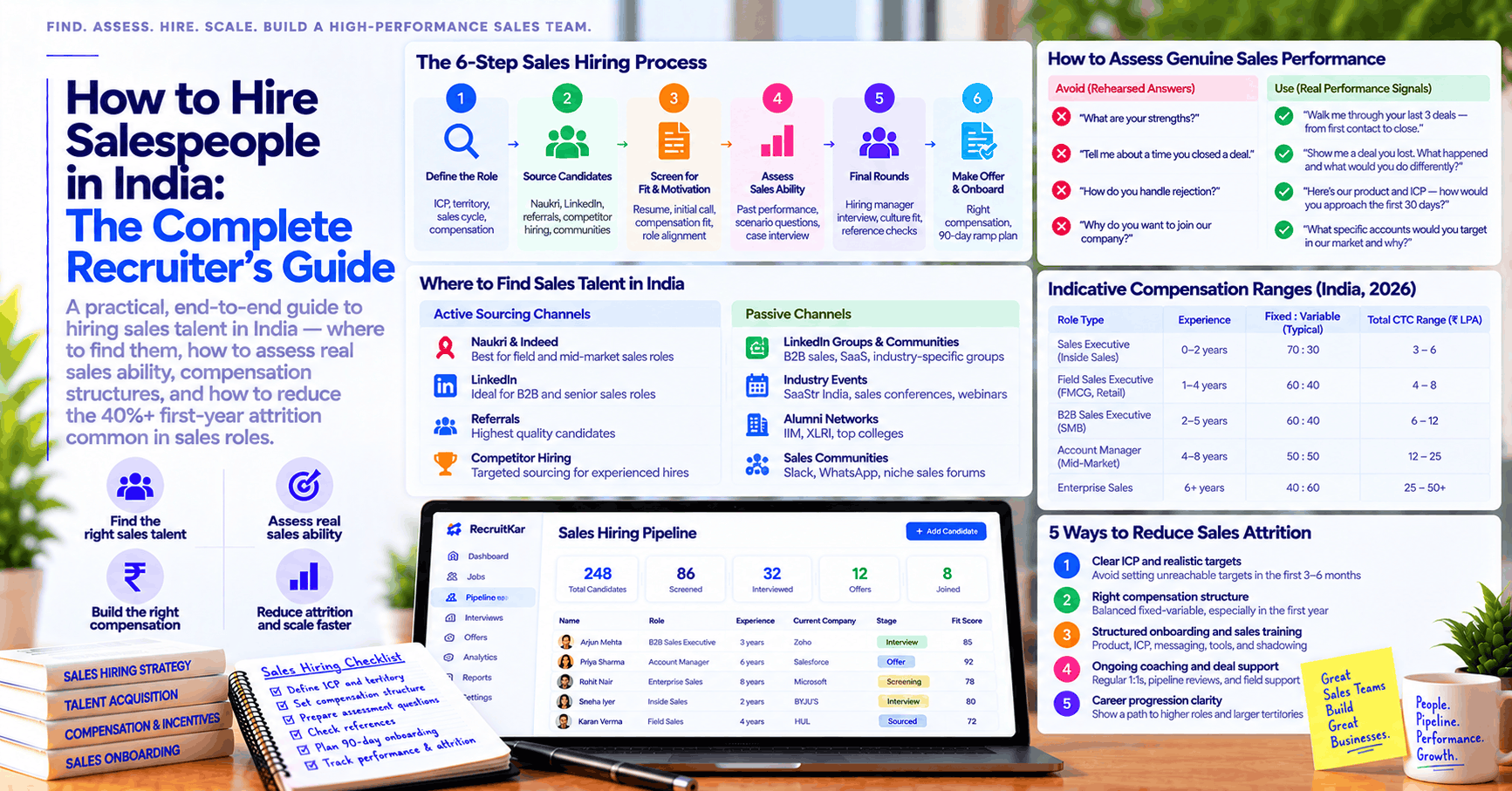
Sales hiring in India has a specific failure pattern: a candidate with an impressive resume and polished interview performance joins, misses target for two quarters, and leaves or is managed out within 12 months — leaving the company to absorb a placement fee, an onboarding investment, and 6 months of unproductive pipeline. The problem is almost never that India lacks good salespeople. It's that most sales interviews assess presentation skills rather than actual sales capability, and that most compensation structures create the wrong incentives for the first 90 days.
This guide covers where to find sales talent, how to assess it accurately, how to structure compensation, and how to run a sourcing and screening process efficiently. RecruitKar's AI candidate discovery finds sales professionals by actual track record and industry background, not just job-title keyword matching.
Why sales hiring is harder than other professional hiring
Sales hiring has three characteristics that make it structurally more difficult than most professional roles:
Self-presentation is a core skill for the role. A software engineer who interviews poorly might still be an excellent engineer — the interview format doesn't match the job. A salesperson who interviews well has demonstrated the exact skill the job requires — persuading someone. This creates a selection bias: the best interviewers are often the best self-presenters rather than the best performers. Reversing this requires deliberately assessing performance evidence, not presentation quality.
High base attrition in the sales function. Sales roles in India see some of the highest voluntary attrition of any professional function — field sales for FMCG and insurance routinely exceed 30–40% annually; B2B SaaS and enterprise sales are lower but still run 20–30%. A hiring process that doesn't account for this ends up in a cycle of constant re-hiring.
Compensation structure strongly influences hiring pool. A sales role with a high fixed and low variable attracts candidates who want income stability — typically those with lower risk appetite, who may be less motivated by target achievement. A role with low fixed and high variable attracts candidates with higher confidence in their own performance — typically stronger performers, but harder to attract during the offer stage. Getting the structure wrong attracts the wrong candidates regardless of how well the rest of the hiring process is run.
Where to find sales talent in India
Active sourcing channels
Naukri and Indeed are the primary channels for most sales role hiring in India, with the deepest database for frontline and mid-market sales roles. The key to quality filtering on Naukri: search on specific industry experience and company names (candidates who've sold into the same industry or customer segment as yours), not just the generic "sales executive" title. A candidate who spent 3 years at a SaaS company selling to similar customers as yours will ramp faster than one who has equivalent years in a different industry.
LinkedIn is more useful for B2B sales roles at ₹15 LPA+ where industry network and account coverage matter. A B2B sales candidate's LinkedIn profile shows their network size in the relevant industry, whether they've been publicly referenced by clients or former managers, and their content activity — all signals relevant to sales effectiveness that don't appear on a resume.
Referrals from top performers. The single highest-signal sourcing channel for sales is asking your current best salespeople who they would want working alongside them. A-players tend to know other A-players, and a referral from a top performer in your team carries significantly more signal than a cold application. Structure a referral bonus that rewards quality (a bonus paid only after the referred hire has been in role for 3 months and is tracking toward target, not just for any hire) to incentivise quality referrals rather than volume.
Poaching from named competitors or industry leaders. For senior sales roles (₹25 LPA+), targeted sourcing from the sales teams of companies whose customers overlap with yours is more efficient than broad database search. A competitor's account manager who already knows your target customer segment is a more valuable hire than an equivalent-level candidate from an adjacent industry who needs to rebuild their network from scratch.
Passive candidate channels
Sales professionals are among the more reachable passive candidates on LinkedIn, because many maintain active profiles for client-facing reasons. A message that specifically references their industry experience, the companies they've sold into, and the type of customer segment they'd be working with tends to produce higher response rates than generic "exciting sales opportunity" outreach.
For tech and SaaS sales specifically, communities like LinkedIn groups for B2B sales professionals, SaaStr India events, and sales-focused Slack communities in India's startup ecosystem are places where active, engaged salespeople can be found organically.
How to assess sales capability (not just sales presentation)
This is the core challenge of sales hiring. The standard interview produces strong signal about presentation skills and almost no signal about sales performance. Fixing it requires a different evaluation approach.
1. Past performance numbers, verified and contextualised
Every sales interview should include a detailed review of the candidate's actual quota attainment history — not the headline claim ("consistently exceeded targets") but the specific numbers:
- Quota in absolute terms: What was your quota for the last 3 years, in absolute terms (revenue, units, accounts)?
- Actual achievement: What did you actually achieve, quarter by quarter?
- Team comparison: How did your achievement compare to your team's average achievement?
- Market conditions: What were the market conditions in those years — was the whole team exceeding targets, or were you specifically outperforming?
- Verification: Can you provide a reference who can verify these numbers?
A salesperson who achieved 110% of an easy target in a team where everyone achieved 100–115% is a different hire from one who achieved 95% of an aggressive target in a team where the median achievement was 70%. The headline achievement number is meaningless without the team context, market context, and quota basis.
2. A structured role-play or deal simulation
Ask the candidate to sell something to you in the interview. Specifically:
- Preparation: Give them 10 minutes to review your product/service overview (a one-pager or website)
- Role-play: Ask them to role-play a first call with a target customer (play the customer yourself, or have a sales leader play it)
- Observation: Observe: how do they open? Do they ask questions or pitch immediately? How do they handle objections? Do they progress toward a next step or let the call drift?
This is not a perfect simulation — candidates who know they're being observed behave differently from their natural state. But it reveals a lot about their fundamental sales approach and methodology that the standard interview doesn't surface.
3. A deal walk-through
Ask the candidate to walk you through a specific deal they closed — their single most complex or most proud sale in the last 2 years. Listen for:
- Do they understand the buying process from the customer's perspective, or only from the seller's?
- Can they name the specific people involved in the decision and describe each one's motivation?
- Did they create the deal, or were they handed a warm lead and managed the close?
- What was their specific contribution versus the team's contribution?
- What would have caused this deal to not close, and how did they mitigate that risk?
A candidate who can walk through a deal in specific, named, concrete detail — with clear attribution of what they personally did — is demonstrating sales process understanding that a polished general pitch doesn't reveal.
A candidate who can walk through a deal in specific, named, concrete detail — with clear attribution of what they personally did — is demonstrating sales process understanding that a polished general pitch doesn't reveal.
4. Reference checks with former managers, not colleagues
Sales references from former colleagues are largely useless — colleagues self-select toward people they liked working with, not necessarily the highest performers. The reference that matters is the candidate's former direct manager, specifically asked:
- Ranking: Where did this person rank in the team, in your assessment?
- Rehire: Would you hire them again, and at what level?
- Quota achievement: What was their quota achievement in percentage terms?
- Improvement area: What was the one thing they needed to improve?
A candidate who refuses to provide a former manager reference, or provides only colleague references, is a candidate worth probing further before extending an offer.
Compensation structure: getting it right
Compensation structure for sales roles in India is often set by copying what other companies do, without thinking through what behaviour the structure actually incentivises.
Fixed-to-variable ratio
High fixed (70:30 or 80:20): Attracts candidates who want income stability. Works for roles where the sales cycle is long (enterprise sales), where building relationships over 12+ months is the primary activity, and where variable pay at the end of a cycle can be substantial.
Balanced (60:40 or 50:50): The most common structure for B2B sales in Indian SaaS and tech. Attracts a mix; tests whether a candidate is confident enough in their ability to accept meaningful income variability.
Low fixed (40:60 or lower): Primarily used for frontline and field sales in high-frequency, high-volume categories. Attracts candidates who are highly confident in their own performance but can create cash-flow pressure in slow months that drives attrition.
Accelerators and floor mechanics
A variable structure without accelerators produces mediocre incentives — a salesperson who reaches 100% of quota has no financial reason to go beyond it. An accelerator that increases commission rate above 100% of quota (e.g., 1.5x commission rate for every rupee above target) creates the right incentive to push past minimum performance.
A floor (minimum performance required before variable pay begins, e.g., variable only kicks in at 60% of quota achievement) prevents variable pay from becoming a guaranteed income for poor performers.
Ramp-up provisions for new hires
A new salesperson who joins on full OTE (On-Target Earnings) structure but needs 3–6 months to build their pipeline often earns nearly nothing in variable for their first quarter, even if they're performing adequately for their stage. This creates financial pressure that drives early attrition. A ramp-up provision — guaranteed floor of 50% variable for the first 3 months, declining to 25% in months 4–6, then full variable from Month 7 — keeps good hires financially stable through the ramp period without permanently subsidising poor performance.
Screening at volume: sales roles typically attract high application volume
Popular sales roles on Naukri for funded Indian companies attract 200–500 applications within days of posting. The screening challenge is separating credible performers from candidates who've learned to present as strong performers without the numbers to back it.
Automated first-pass screening that filters on:
- Industry experience: Specific industry experience (sold to similar customer segments)
- Company type: Company type (product company vs. services vs. distribution)
- Quota achievement: Realistic quota achievement (a field that can be screened on, if your screening asks for it)
...before a recruiter spends significant time on any individual application meaningfully reduces the manual review burden. Bulk resume screening against a role-specific rubric that includes industry and company-type criteria produces a more focused shortlist than keyword matching on "sales executive."
Reducing first-year attrition in sales hires
The structural causes of high sales attrition in India and their fixes:
Compensation surprise at offer. If a candidate discovers the variable component is harder to earn than the headline OTE implied, they lose motivation in the first 90 days. Set realistic expectations at offer stage — show the bell curve of how much your current team actually earns, not just the OTE ceiling.
Missing ramp support. A new salesperson without leads, without clear territory, and without management coaching is set up to fail. Define the ramp support program at offer stage — what leads they'll receive, what training, what coaching frequency — before they join.
Quota set too high too fast. An aggressive first-year quota that nobody in the team has ever achieved signals an unrealistic expectation. Quota calibration that's achievable for a good performer in their first year, increasing in Year 2 and 3, produces better first-year performance and retention.
Manager quality. Sales attrition concentrates under specific managers — the ones who provide no coaching, only pressure. Tracking attrition by sales manager and addressing management capability directly is more effective than adjusting compensation or sourcing.
Frequently asked questions
What is the typical notice period for sales professionals in India?
30–60 days for most mid-level sales roles; 60–90 days for senior individual contributors and managers. Unlike tech roles, sales professionals sometimes negotiate early release because their current employer recognises that a demotivated salesperson staying for 90 days produces little value and some client relationship risk. Negotiating a 30-day buyout clause explicitly at offer stage (the company will pay the candidate's notice period salary if required to release early) can shorten the effective joining timeline for strong candidates.
Should we use a placement consultancy or hire salespeople directly?
For frontline and field sales roles where the candidate pool on Naukri is deep, in-house sourcing with AI screening is almost always more cost-efficient than a consultancy. For senior B2B enterprise sales roles (₹25 LPA+) where passive candidate sourcing and specific industry network matter, a specialist sales recruitment consultancy with relevant industry relationships may be worth the fee — particularly for the first few senior hires when the company doesn't yet have an established employer brand in the sales talent market.
How do we evaluate a sales candidate's honesty about their track record?
You ask for specific numbers, you ask for the context, and you verify with a manager reference. A candidate who gives vague answers ("I consistently overachieved my targets") without specific numbers is either uncomfortable sharing specifics (sometimes because the numbers don't hold up) or hasn't thought carefully about their own performance. Ask clearly: "What was your specific quota in Year X in absolute terms, and what did you achieve?" and see whether a concrete answer comes.
What's the right OTE structure for a B2B SaaS sales role in India in 2026?
For an Account Executive in a funded B2B SaaS company in metro India with 3–7 years of experience: total OTE in the range of ₹18–30 LPA is typical, split 50:50 to 60:40 fixed:variable. Exact numbers vary significantly by company stage (early-stage companies often compensate with equity rather than cash), product ACV, and whether the role is inbound-supported or outbound-led. Benchmark against 3–5 comparable companies in your stage and sector rather than using a single industry average.
How do we prevent salespeople from taking client relationships with them when they leave?
Non-solicitation clauses in employment agreements restrict a departing salesperson from actively soliciting your clients for a defined period after leaving. These are enforceable in India subject to reasonableness (scope and duration), though enforcement requires willingness to litigate. More practically: CRM hygiene that keeps all client interaction in a company-managed system (rather than personal WhatsApp and personal email) means client relationships are documented and transferable. A salesperson who has managed all client communication through personal channels takes more relationship capital with them than one whose interactions are logged in a shared system.
Source, screen, and hire salespeople faster on RecruitKar. AI discovery matches by industry experience and company background — not just "sales executive" keywords. AI candidate discovery + bulk resume scoring for high-volume sales hiring pipelines.