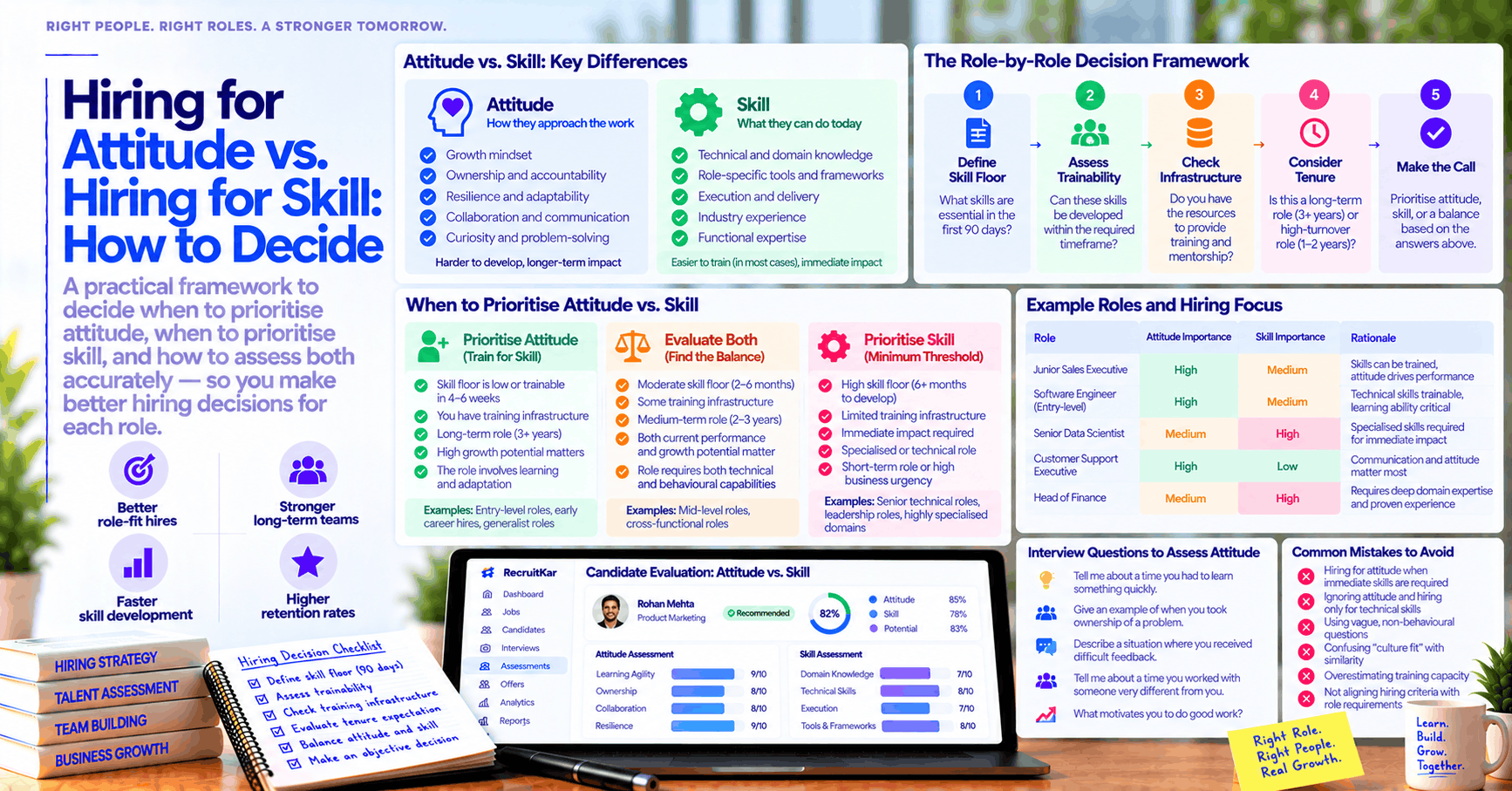
"Hire for attitude, train for skill" is common advice in India — and frequently misapplied. Applied thoughtfully, it produces genuine gems: candidates with high growth potential and strong foundations who develop into exceptional performers. Applied carelessly, it produces a team full of enthusiastic people who can't yet do their jobs, a training burden nobody planned for, and a hiring decision that looks good on paper until the role's deliverables arrive. The right answer isn't a universal preference for attitude or skill — it's a role-by-role decision based on what's teachable, the ramp time, and what the role requires in its first 90 days. RecruitKar's AI video interviews help assess attitude-related competencies at scale — structured questions about resilience, learning agility, and ownership across a shortlist, evaluated consistently without a recruiter spending a full day on calls.
Why "hire for attitude, train for skill" is incomplete advice
The phrase has genuine insight: attitudes — growth mindset, ownership, resilience, intellectual curiosity — are harder to develop in someone who doesn't have them than skills are in someone who does. A candidate who approaches problems with genuine curiosity and bounces back from setbacks will, given adequate support, develop functional skills faster than a highly skilled candidate who is defensive, resistant to feedback, and content with the status quo.
But the phrase contains a hidden assumption: that the skills required for the role can be trained within a timeframe the business can absorb.
This assumption breaks in specific situations:
- When ramp time exceeds business tolerance. A startup that needs a head of growth to produce results in 60 days cannot absorb a 6-month skill development curve for an enthusiastic marketer without relevant experience. The business will run out of runway before the attitude advantage materialises.
- When the skill has a high floor and a long ceiling. Some roles require a minimum skill level that takes years to develop — a cardiovascular surgeon, a principal engineer in a specialised domain, a chief financial officer for a listed company. "Attitude" doesn't get someone to that minimum floor any faster than structured training does; often it doesn't get there at all within a relevant timeframe.
- When there's no training infrastructure. "Train for skill" assumes someone in the organisation has the time, capability, and resources to provide that training. A 10-person startup where everyone is at maximum capacity has no spare training bandwidth. Hiring for attitude in that context means hiring someone who will either develop skills through trial and error (expensive) or leave before developing them (expensive and demoralising).
- When the job feedback loop is too long. In roles where the outcome of a decision takes 6–12 months to become visible (certain strategy, product, or research roles), the feedback that enables skill development is slow. Attitude and potential are valuable in these roles — but they don't compress the feedback loop.
A role-by-role framework for deciding
Rather than a universal attitude-or-skill preference, apply these questions to each specific role:
Question 1: What is the minimum skill floor for this role in its first 90 days?
Define the specific skills a hire needs to perform basic functions of the role without constant intervention in their first 3 months. This is not the ceiling — what they'll be doing in Year 2 — but the floor: what they must be able to do for the hire to be considered a functional one in the near term.
If the skill floor is low or trainable in 4–6 weeks: attitude becomes a primary hiring factor. The skill gap can close fast enough that attitude is the differentiating variable.
If the skill floor is high and takes 6+ months to develop: skill becomes a hard filter. Attitude matters — a skilled candidate with poor attitude is a limited hire — but it can't substitute for the minimum skill threshold.
Question 2: Does the organisation have the training infrastructure to close the skill gap?
If yes: the "hire for attitude" approach is viable. Someone who will invest in developing skills can reach competence given adequate support.
If no: the hire who needs significant skill development is likely to flounder, however strong their attitude. The training has to come from somewhere.
Question 3: What's the tenure expectation for this role?
For roles with high expected tenure (3–5+ years), attitude is a significantly stronger hiring factor. A long-tenure hire who develops skills on the job compounds over time — the attitude advantage has years to materialise.
For roles with inherently high turnover (certain sales, customer support, and operational roles where 1–2 year tenure is normal), the skill development investment may not be recouped before the hire moves on. Hiring for more baseline skill at a lower investment in development can be more efficient.
Question 4: How closely does the hire's current skill level need to match the role, versus how closely does their trajectory need to match?
Some roles require current capability (execution roles where output is expected immediately). Others benefit most from trajectory — where the candidate is going and how fast, not where they are today. Understanding which category a role falls into determines whether current skill or learning velocity is the more important variable.
How to actually assess attitude in interviews
This is where most "hire for attitude" hiring fails — the assessment is vague and inconsistent, reducing to an interviewer's overall impression rather than an evaluation of specific, observable attitude-related competencies.
Attitude isn't one thing. It's a cluster of distinct competencies, each of which can be assessed specifically:
Growth mindset (openness to learning and development)
Weak question: "Do you consider yourself a continuous learner?" (Produces: "Yes, absolutely, I love learning." Useless.)
Strong question: "Tell me about the last skill you taught yourself that wasn't required by your job. What prompted it, and how did you approach it?"
A candidate with genuine growth mindset can describe specific, self-directed learning with a real motivation behind it. A candidate who claims growth mindset but can't produce a concrete example is demonstrating something less than the advertised attitude.
Resilience and response to failure
Weak question: "How do you handle setbacks?" (Produces: "I try to stay positive and learn from my mistakes." Useless.)
Strong question: "Tell me about the most significant professional failure or setback you've experienced. What happened, what did you do, and what would you do differently?"
A resilient candidate describes a real failure, takes genuine ownership without excessive self-flagellation, articulates what they learned specifically, and shows that the learning affected subsequent behavior. A candidate who describes a "failure" that was clearly not their fault and from which they emerged with no real learning is showing something different.
Ownership and accountability
Weak question: "Are you someone who takes initiative?" (Produces: "Yes, I always take ownership of my work." Useless.)
Strong question: "Tell me about a time a project or outcome you were responsible for went significantly off track. What specifically did you do, and what would you change?"
Ownership shows up in the specificity of "what I did" versus the breadth of "what happened." A candidate who consistently describes their own actions in response to problems is demonstrating ownership. One who consistently describes external factors and team dynamics is demonstrating something else.
Intellectual curiosity
Weak question: "What are you curious about?" (Produces: a list of topics that sound impressive. Low signal.)
Strong question: "What's something you've changed your mind about in the last year — in your professional field or in how you think about your work? What changed it?"
Genuine intellectual curiosity produces real examples of updated beliefs with specific causes. A candidate who can't identify something they've changed their mind about recently is either very certain in their existing views (itself a signal) or not paying close enough attention to new information.
Adaptability
Strong question: "Describe a situation where you were mid-way through an approach when something changed significantly — a requirement shift, a team change, a priority change. How did you respond?"
The attitude-skill matrix: placing roles
Mapping your open roles against two dimensions — minimum skill floor (low to high) and training infrastructure availability (low to high) — produces a practical guide:
Strong training infrastructure
Weak training infrastructure
Low skill floor
Strong case for attitude-led hiring
Cautious attitude-led hiring — ensure the hire can self-direct
High skill floor
Hybrid — attitude matters but skill floor is a hard filter
Skill-led hiring — attitude matters for ceiling, but floor must be met
Most Indian startups operate in the bottom-left quadrant for many roles — high skill floors with limited training bandwidth. This is where "hire for attitude" advice is most likely to produce an underpowered hire in a company that can't absorb the development cost.
What to do when you find a candidate with exceptional attitude but insufficient skill
This is the most common dilemma for hiring managers who embrace the attitude-over-skill philosophy and then encounter a real candidate who embodies it.
- Option 1: Define what "sufficient skill" actually means, not what ideal skill would be. Many hiring managers have an inflated skill specification — they want someone who can do the full job from Day 1, which is actually a Year 2 requirement disguised as a Day 1 requirement. Separating the genuine Day 1 floor from the ideal long-term ceiling sometimes reveals that the attitude-strong candidate actually clears the real minimum bar.
- Option 2: Hire at a lower level with a clear growth path. If a candidate is genuinely strong on attitude but not yet at the level the role demands, consider whether there's a junior version of the role they can fill while developing — with a specific commitment to the path toward the senior version if development milestones are met.
- Option 3: Pass, and be honest about it. If the skill gap is genuinely too large for the organisation to absorb and there's no junior version of the role, passing on an attitude-strong candidate is the right call. The "hire for attitude" philosophy doesn't mean hiring everyone with good attitude regardless of the role's requirements.
Frequently asked questions
What specific interview questions best assess attitude? Behavioural questions asking for specific past examples of growth, failure, ownership, and adaptability — as described in the assessment section above. Avoid hypothetical questions ("what would you do if...") and self-assessment questions ("how would you describe your work ethic?") — both produce answers candidates have prepared rather than evidence of actual behaviour. The most signal-rich attitude question of all is often: "Tell me about a time you were wrong about something important at work. What happened?"
How do you assess attitude accurately in a 30-minute interview? You can't get a complete picture in 30 minutes — but you can get meaningful signal. Focus on two or three specific attitude dimensions most critical for the role, ask one well-structured behavioural question per dimension, and score responses against a pre-defined rubric that specifies what a strong, average, and weak answer demonstrates. Combine with reference checks that ask specifically about growth, ownership, and response to feedback from a former manager.
Is hiring for attitude more appropriate at junior levels? Not universally, but the case is strongest at junior levels where: the skill floor is lower, there's more organisational bandwidth to invest in development, and the tenure expectation is long enough for attitude to compound. At senior levels, attitude is still important (a senior hire with poor growth mindset is a ceiling problem), but the minimum skill threshold is higher and the organisation has less capacity to absorb a significant skill gap regardless of attitude.
How do we avoid attitude assessment becoming a proxy for cultural similarity? By defining attitude as specific, observable behaviours rather than a holistic impression, and by assessing each behaviour with a structured question and a defined rubric. When attitude assessment is left as an overall impression, it defaults to cultural familiarity — someone who communicates and presents themselves in familiar ways "feels" like they have better attitude. Behavioural rubrics break this link by requiring specific evidence rather than overall impression.
Can AI-assisted interviews help assess attitude? Yes, with the right question design. Structured AI video interviews that ask specific behavioural questions — "tell me about a time you had to change your approach significantly mid-project" — and score responses against a defined rubric for indicators like specificity, ownership language, and learning articulation can evaluate attitude-related competencies at scale with more consistency than unstructured human interviews. The key is the rubric: an AI scoring "confidence" or "communication style" is measuring presentation, not attitude. An AI scoring "does the answer describe specific personal actions" and "does the candidate identify a lesson learned" is measuring something closer to real attitude.
Assess attitude-related competencies consistently across your shortlist. RecruitKar's AI video interviews let you ask the same structured behavioural questions to every candidate and score responses against a defined rubric — so attitude assessment is based on evidence, not overall impression. Pair with AI candidate discovery to build a shortlist worth assessing in the first place.