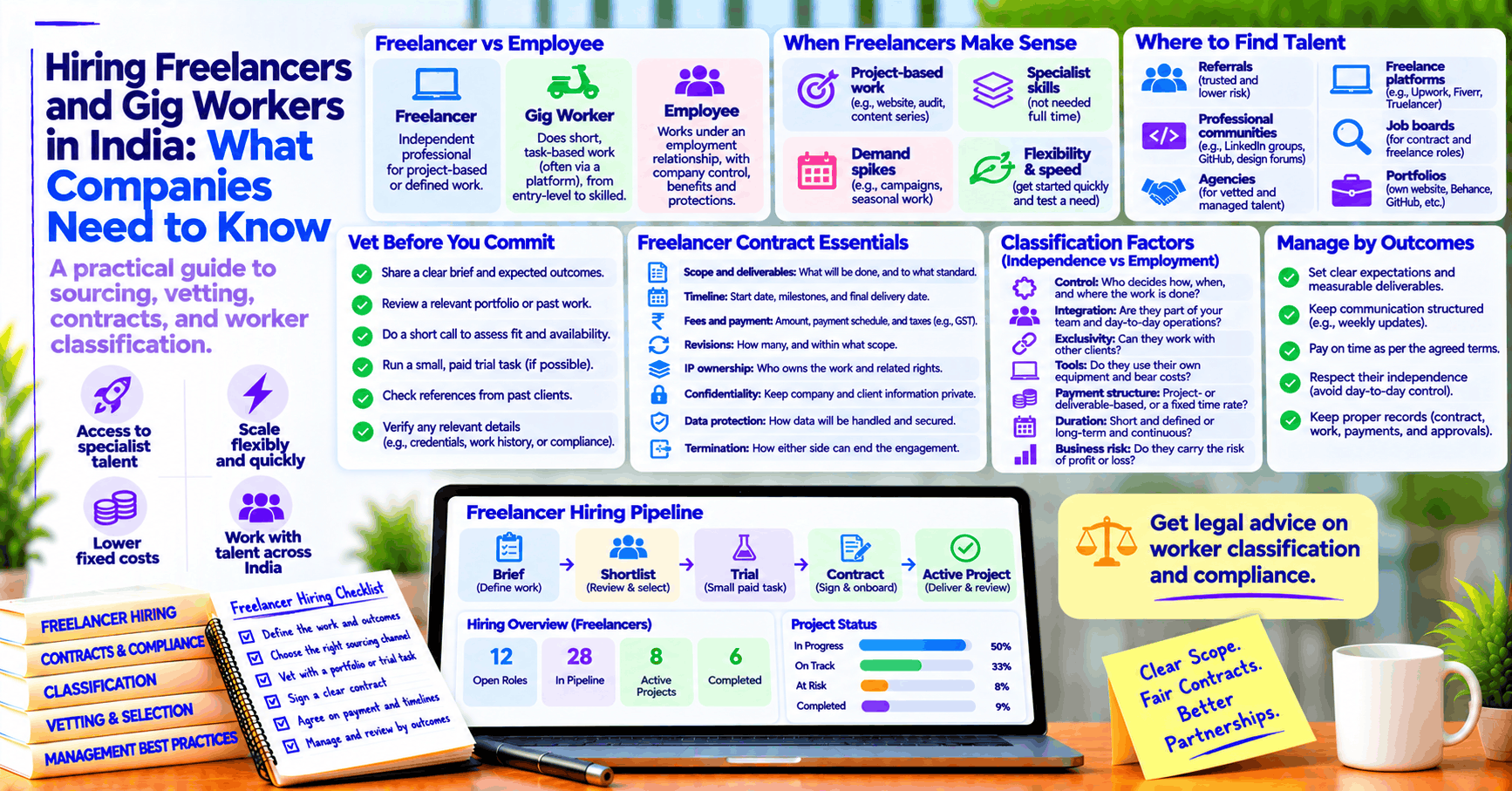
To hire freelancers in India well, define the work and deliverables first, choose a sourcing channel that fits the skill, vet candidates with a short paid or practical task, and sign a clear written contract that covers scope, payment, ownership of work, and confidentiality. Treat freelancers differently from employees in how you manage them, and get legal advice on classification. For startups and small teams, RecruitKar's startup solution helps keep freelancer and full-time hiring organised in one pipeline. This guide covers when to use freelancers, how to find and vet them, what to include in contracts, and what to check with counsel.
Freelancer, Gig Worker, Contractor, Employee: What Is the Difference?
These terms are often used loosely, and the differences matter for how you hire and manage people.
Freelancer. An independent professional who offers services to multiple clients, usually for defined projects or a set period. Common in writing, design, software development, marketing, consulting, and translation.
Gig worker. A person who does short, task-based work, often through a platform or on-demand arrangement, such as delivery, ride services, or short field tasks. The term covers a wide range of work, from highly skilled to entry-level.
Independent contractor. A broader term for someone who provides services under a contract for services, not under an employment contract. Freelancers are usually contractors.
Contract staff or fixed-term employee. Someone who works for a set period but is employed, often through your company's payroll or a staffing partner, with the rights and obligations that come with employment.
Employee. A person employed under an employment relationship, with the rights and protections that apply under Indian law and the company's policies.
The label in the contract does not automatically decide the legal reality. How the relationship actually works matters. That is why classification is covered carefully below.
When It Makes Sense to Use Freelancers
Freelancers can be a smart choice in several situations.
Project-based work. A website redesign, a one-time audit, a content series, or a product launch with a clear start and end.
Specialist skills you do not need full time. A part-time finance expert, an occasional legal drafter, a niche developer.
Spikes in demand. Seasonal campaigns, peak periods, or sudden workload increases.
Testing a need before committing. Trying a function with a freelancer before hiring for it.
Flexibility and speed. Getting started quickly without a long hiring cycle.
Access to wider talent. Working with skilled people across cities without relocation.
Freelancers are usually a weaker fit when:
The work is core, ongoing, and needs deep integration with your team.
You need to control how, when, and where the person works day to day.
You need long-term knowledge building inside the company.
The role needs full-time availability and exclusivity.
If you find yourself managing a freelancer exactly like an employee, that is a signal to reconsider the arrangement, both for practical and legal reasons.
Understanding the Classification Question
One of the biggest risks in hiring freelancers is treating someone as an independent contractor when the relationship looks more like employment. The consequences can include disputes about benefits, contributions, notice, and other obligations.
Because this area is complex and evolving, this article gives general guidance and not a legal answer. Please see the compliance note below and have counsel review your approach.
In general terms, the following factors tend to matter when people assess whether a relationship is closer to independence or employment. They are not a legal test, and no single factor decides the outcome.
Control. Who decides how the work is done, the hours, and the methods? More control by the company points toward employment.
Integration. Is the person part of your team, using your email address, attending routine meetings, and appearing as staff? Deep integration points toward employment.
Exclusivity. Is the person free to take other clients? A freelancer typically is.
Tools and costs. Does the person use their own equipment and bear their own business costs?
Payment structure. Is payment tied to deliverables or projects, or is it a regular monthly amount for time?
Duration and continuity. Is the engagement short and defined, or open-ended and continuous?
Ability to substitute. Can the person send someone else to do the work, or must they do it personally?
Business risk. Does the person carry the risk of profit or loss?
Labour and social security rules in India have been developing, including new provisions that refer to gig and platform workers, and rules can differ by state. Because requirements and their implementation timelines change, check the current position with a qualified advisor before you finalise your approach.
How to Find Freelancers in India
Different sources suit different needs. A mix usually works best.
Your own network and referrals. Colleagues, former coworkers, and founders in your circle often know reliable freelancers. Referrals tend to reduce risk because someone you trust has already seen the person's work.
Freelance marketplaces and platforms. These offer wide reach and often include ratings, work histories, and payment tools. Quality varies, so check profiles carefully. Compare platform terms before using them, and avoid assuming that ratings alone prove quality.
Professional networks and communities. LinkedIn, specialist forums, design and developer communities, and industry groups are common places to find skilled freelancers. Reaching out directly with a clear brief often works well.
Job boards and portals. Many professionals list themselves as available for freelance or contract work. If you already post roles on job portals, RecruitKar's import from job boards can help you bring applicants into one place, including those interested in contract work.
Agencies and staffing partners. For larger or regulated engagements, a staffing or services partner may handle contracting, payments, and compliance for you. Understand who carries which responsibility before you sign.
Portfolios and past work. For creative and technical roles, public portfolios, code repositories, and published work show real ability better than a CV.
For gig and field work. For short-term, task-based or on-demand roles, local networks, job apps built for frontline work, and community groups are common channels. Fast follow-up through WhatsApp outreach helps because these candidates often decide quickly.
How to Vet a Freelancer Before You Commit
Hiring a freelancer should still follow a clear process. A lighter process than full-time hiring is fine, but skipping vetting altogether is risky.
1. Write a clear brief
Describe the project, the deliverables, the timeline, the tools involved, and the budget range or payment approach. A clear brief attracts better freelancers and helps you compare proposals fairly.
2. Review past work
Look at portfolios, samples, and case studies. Ask the freelancer to explain their role in each project, because a portfolio may show team work.
3. Have a short conversation
A 20- to 30-minute call helps you assess communication, understanding of the brief, and reliability. Ask how they would approach the project, how they handle feedback and revisions, and what their availability looks like. If you coordinate several calls, interview scheduling in RecruitKar can reduce back-and-forth.
4. Use a paid trial task where appropriate
A small, well-defined, paid task is the most reliable way to see how someone actually works. Pay fairly for the time involved. Avoid asking for large amounts of unpaid work as a test, since it is unfair and may also create ownership disputes.
5. Check references
Talk to previous clients where possible. Ask about reliability, communication, quality, and how problems were handled. Our guide to reference checks is a good starting point for building a consistent approach.
6. Verify identity and credentials where relevant
For regulated work, or work involving sensitive data, confirm identity, qualifications, and any required licences. Do this with consent and in line with data protection practices.
7. Agree how you will work together
Before starting, agree on communication channels, check-in frequency, review points, and how revisions and approvals will work.
What to Put in a Freelancer Contract
A clear written contract protects both sides. Even for small projects, a short agreement is better than none. A lawyer should review your template, but the following are typical items to cover.
Parties and relationship. Who the parties are, and a clear statement that the freelancer is engaged as an independent contractor to provide services. Remember that the real working relationship matters more than the label.
Scope of work and deliverables. What will be delivered, in what format, to what standard, and by when. Vague scope is the most common source of disputes.
Timeline and milestones. Key dates, review points, and what happens if deadlines slip.
Fees and payment terms. The amount, how it is calculated, whether it is fixed price or hourly, invoicing method, payment timing, and what happens with late payment. Clarify who is responsible for taxes and any applicable deductions, and confirm the details with your finance or tax advisor.
Revisions and acceptance. How many rounds of revisions are included, how acceptance is confirmed, and what counts as additional work.
Intellectual property. Who owns the work product once it is paid for. This is especially important for design, code, content, and anything creative. Without a clear written assignment, ownership can be unclear.
Confidentiality. What information is confidential, how it must be handled, and how long the obligation lasts.
Data protection. If the freelancer will handle personal data, set out what they may do with it, how it must be secured, and what happens when the work ends.
Independence. The freelancer's freedom to work for others, to use their own tools, and to decide how to deliver the work, within the agreed scope. Only include this if it reflects reality.
Conflicts of interest and non-solicitation. Reasonable limits, drafted carefully. Overly broad restrictions may not be enforceable and may discourage good freelancers.
Termination. How either party can end the contract, notice periods, and payment for work completed up to that point.
Liability and indemnity. Limits on responsibility for errors, and who bears what risk.
Dispute resolution and governing law. Where and how disagreements are handled.
Contract-to-Hire: A Bridge Between Freelance and Full-Time
Many companies start people on a contract with the possibility of full-time employment later. This can reduce risk on both sides, because you see how the person works and they see how your company works.
A few points help it go well:
Be honest about the possibility. Do not promise conversion you cannot guarantee. Explain what will be assessed and the likely timeline.
Set clear expectations. Share what success looks like during the contract period, and give regular feedback.
Keep the contract terms fair. A contract-to-hire arrangement should not become a long period of employment-like work without the protections of employment.
Plan the conversion process. Decide in advance how compensation, notice, and onboarding will work if you convert the person, and involve your legal and HR advisors.
Avoid indefinite extensions. Repeated short renewals for work that looks permanent can cause classification and fairness concerns.
Managing Freelancers Well
The way you manage freelancers affects both results and legal risk.
Manage by outcomes. Focus on deliverables and quality instead of hours and presence.
Communicate clearly. Provide context, answers, and timely feedback. Delays on your side often cause delays on theirs.
Pay on time. Prompt, fair payment is the strongest way to keep good freelancers. Late payment is a common complaint and a quick way to lose people.
Respect their independence. Avoid treating them as employees by requiring fixed hours, staff email, or attendance at routine team activities unless the contract really calls for it.
Onboard lightly but properly. Share the brief, tools, contacts, and any necessary security or confidentiality rules.
Keep records. Store contracts, invoices, briefs, and approvals in one place. If you track freelancers in a central system such as the RecruitKar ATS pipeline, you can keep a talent pool of reliable freelancers you may want to work with again.
Review after the project. Note what worked and what did not, and decide whether to engage the person again.
Building a Freelancer Talent Pool
Finding good freelancers is time-consuming, so avoid starting from zero every time. Keep a simple, organised record of people who did good work, with their skills, rates, availability, and notes on past projects. When a new need appears, you can reach out quickly through email outreach or a short message and start work sooner. Always respect consent and data protection principles when storing and contacting people.
Hiring Gig Workers for Short-Term and Field Roles
Gig-style hiring for tasks such as deliveries, event staffing, surveys, or short field assignments needs a slightly different approach.
Be clear and simple. State the task, location, time, pay, and payment timing in plain language.
Verify before assigning. Where tasks involve customer access, cash, vehicles, or sensitive locations, run appropriate identity and background checks, with consent.
Provide safety and basic training. Make sure workers understand how to do the task safely and correctly.
Pay promptly and transparently. Delays and unclear deductions are major causes of lost trust.
Consider insurance and welfare requirements. Depending on the work and location, there may be expectations or obligations. Check current requirements with an advisor.
Avoid disguised employment. If someone is working fixed hours, under close supervision, on a continuing basis, consider whether employment is the more appropriate structure.
Common Mistakes When Hiring Freelancers
No written contract. Verbal agreements lead to disputes over scope, payment, and ownership.
Vague briefs. Unclear scope causes rework, delays, and conflict.
Choosing on price alone. The cheapest option is often the most expensive after rework.
Treating freelancers like employees. Strict control, fixed hours, and continuous integration can blur classification.
Unclear intellectual property terms. Not agreeing who owns the work creates problems later.
Ignoring data protection. Sharing personal data with freelancers without safeguards creates risk.
Large unpaid test projects. These are unfair and can create ownership disputes.
Slow payment. It damages relationships and your reputation among freelancers.
Not planning the end. Failing to plan handover, access removal, and final payment leaves loose ends.
A Note on Classification, Contracts, and Data Protection
This article is for general information and is not legal advice. Worker classification, labour and social security obligations, tax treatment, and data protection requirements, including those under India's data protection law and its rules, are complex and may change. They can also differ by state and by type of work. Before finalising your approach, have qualified legal counsel review your contract templates, your classification approach for different types of workers, how you collect and store personal data about freelancers, and any obligations that apply to your industry. Confirm tax and payment details with your finance or tax advisor.
Frequently Asked Questions
1. What is the difference between a freelancer and an employee in India?
A freelancer is usually an independent professional who provides services under a contract, works for multiple clients, uses their own tools, and is paid for defined work. An employee works under an employment relationship with the rights and obligations that follow. The label in the contract does not decide the matter alone; how the relationship works in practice matters. Get legal advice on classification for your situation.
2. Do I need a written contract to hire a freelancer?
A written contract is strongly recommended. It should cover scope, deliverables, timeline, payment, revisions, ownership of the work, confidentiality, data protection, and termination. Even for small projects, a short clear agreement prevents misunderstandings. Have a lawyer review your template, and adapt it to each engagement.
3. How do I vet a freelancer before hiring?
Write a clear brief, review past work, have a short conversation, and ideally run a small paid trial task. Check references with previous clients, and verify identity or credentials where the work is sensitive or regulated. Agree on communication, review points, and payment terms before the project begins.
4. Who owns the work a freelancer creates?
Ownership depends on what the contract says and on applicable law. Without a clear written agreement, it may be uncertain who owns the work. For code, design, writing, and other creative output, include an explicit intellectual property clause that states who owns the finished work and when ownership transfers, usually upon payment. Ask your lawyer to review the wording.
5. Can I convert a freelancer to a full-time employee later?
Yes, many companies do. Be honest about the possibility, set clear expectations during the contract period, and plan how compensation, notice, and onboarding will work on conversion. Avoid indefinite repeated contract renewals for work that looks permanent, since this can raise classification and fairness concerns. Involve your legal and HR advisors in the process.
Final Thoughts
Hiring freelancers and gig workers can give companies flexibility, speed, and access to specialist skills, as long as the work is defined clearly and the relationship is set up properly. Be clear about scope, vet people with practical tasks, put everything in a written contract, manage by outcomes, pay on time, and take classification and data protection seriously with proper legal advice.
If you want one place to track freelancers, contract candidates, and full-time hires, with outreach and scheduling alongside, explore RecruitKar and see how it fits your hiring workflow.