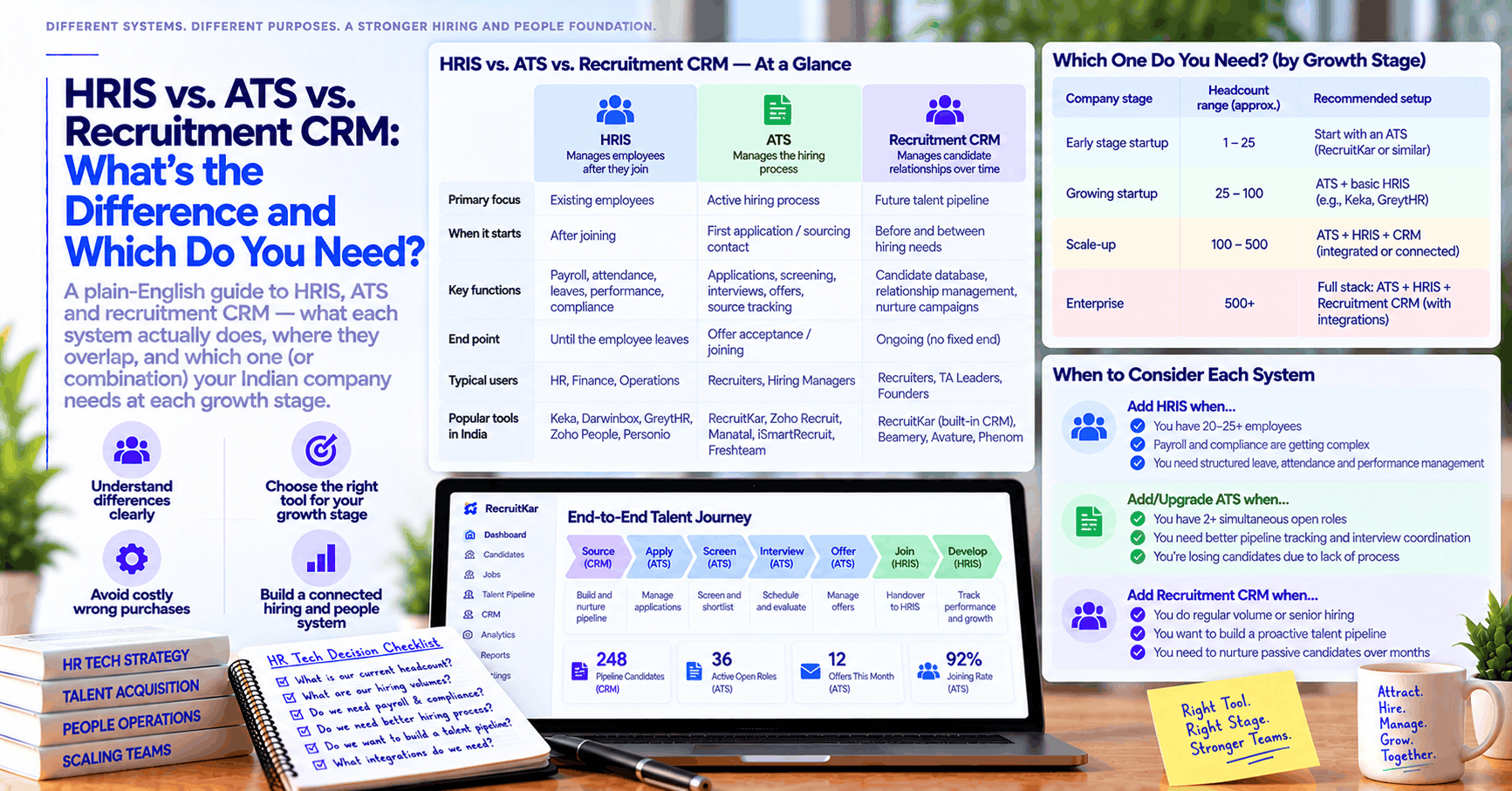
HRIS (Human Resource Information System) manages employees after they join — payroll, attendance, leaves, performance. ATS (Applicant Tracking System) manages candidates before they join — applications, screening, interviews, offers. Recruitment CRM manages candidate relationships over time — building and nurturing a talent pool before and between specific hiring needs.
They solve different problems at different stages of the employee lifecycle, and most growing Indian companies need all three eventually — but rarely at the same time, and rarely from the same vendor. RecruitKar's visual ATS pipeline is the ATS layer — built for active sourcing, screening, and hiring. This post explains what each system does, where they overlap, and which one your company actually needs right now.
The three systems, explained without jargon
HRIS (Human Resource Information System)
An HRIS is the system of record for your existing employees. Once someone joins, their professional life inside your company is tracked here: salary and payroll processing, attendance and leave management, performance review cycles, employee documents, appraisal history, and the organisational chart. In India, HRIS platforms also handle statutory compliance — PF, ESI, professional tax, TDS deduction, and generating Form 16.
What it does not do: An HRIS is not built to manage the process of finding and hiring candidates. It starts when an employee joins — not before. Some HRIS platforms include a basic ATS module (Keka Hire, Darwinbox's recruiting module, SAP SuccessFactors Recruiting), but these are generally less capable than standalone ATS platforms because recruiting is a feature of their system, not the core product.
When you need it: When managing employee data, payroll, and compliance across more than 20–25 employees becomes too complex for spreadsheets and a CA's manual input. Most Indian companies reach this inflection point somewhere between 25–60 employees.
Common HRIS platforms in India: Keka, Darwinbox, GreytHR, Zoho People, Personio (for international-first companies)
ATS (Applicant Tracking System)
An ATS manages the hiring process — from a candidate's first application or sourcing contact through screening, interviewing, offer, and joining confirmation. It's the operational tool recruiters use daily: pipeline visibility, resume storage and search, interview scheduling, offer management, and source tracking.
A modern ATS does more than track applicants — it includes active sourcing tools (AI candidate discovery, job board imports), screening automation (resume scoring, async video interviews), outreach capabilities (email and WhatsApp sequences), and pipeline analytics.
What it does not do: An ATS doesn't manage employees after they join. It doesn't run payroll, track attendance, or manage performance reviews. The ATS hands off to the HRIS at the point of joining — the hired candidate's data is exported to or re-entered into the HRIS when they become an employee.
When you need it: As soon as hiring involves more than one person making decisions, more than two or three simultaneous open roles, or any meaningful candidate volume that can't be managed in a shared inbox and spreadsheet. Most companies need an ATS earlier than they think — the trigger is usually the first candidate who fell through the cracks because nobody was tracking their status.
Common ATS platforms in India: RecruitKar, Zoho Recruit, Manatal, iSmartRecruit, Freshteam (basic)
Recruitment CRM (Candidate Relationship Management)
A recruitment CRM is specifically designed for managing candidate relationships over time — before, between, and across specific hiring needs. Where an ATS tracks candidates through a specific role's pipeline, a CRM tracks candidates across a longer relationship: initial discovery, early contact, follow-up over months, re-engagement when a role opens, and nurturing of a talent pool that isn't attached to any specific opening.
What it does: Stores candidates with relationship history, enables sequenced nurture campaigns to warm candidates over time, tracks engagement (email opens, link clicks, replies), and surfaces candidates from the pipeline when a role opens that matches their profile.
What it does not do: A recruitment CRM is not an operational ATS — it doesn't manage an active hiring pipeline with stage tracking, interview scheduling, and offer management. Most CRMs are used alongside an ATS, not instead of one.
When you need it: When you're building a proactive talent pipeline — specifically, when you're doing enough volume hiring that maintaining warm relationships with a large pool of pre-identified candidates produces meaningful ROI, or when your hiring is senior enough that most good candidates require months of relationship-building before a role conversation is appropriate.
Common standalone recruitment CRMs: Beamery, Avature, Phenom — these are primarily enterprise tools. Most mid-market companies use the candidate database within their ATS as a light CRM, supplemented by email and WhatsApp outreach tools for nurture sequences.
Where they overlap — and where the confusion comes from
The lines between these three systems have blurred significantly as each category has expanded its scope:
HRIS platforms are adding ATS modules. Keka Hire, Darwinbox Recruit, and GreytHR's recruiting features mean companies using an HRIS for payroll often get a basic ATS bundled in. This is convenient but creates the false impression that one system covers both needs equally well — in practice, the ATS module in an HRIS is generally less capable than a dedicated ATS for active sourcing and screening.
ATS platforms are adding CRM features. Modern ATS platforms increasingly include talent pool management, candidate nurture campaigns, and long-horizon relationship tracking that were traditionally CRM functionality. For most Indian companies below enterprise scale, a good ATS with CRM-light features covers the majority of proactive pipeline building without a separate CRM.
All three claim to do everything. Software marketing has reached a point where most HR tech vendors claim to cover the full employee lifecycle. In practice, each system still has a clear strength — the HRIS is strongest post-hire, the ATS is strongest in the active hiring funnel, and the CRM is strongest in pre-hire relationship management. Understanding where your actual gap is determines which one to prioritise.
A decision framework: which do you actually need right now?
Work through this sequence:
Question 1: Do you have 25+ employees whose payroll, leave, and attendance is being managed manually or in spreadsheets?
Yes → You need an HRIS first. The operational HR problem (paying people correctly, tracking leaves, statutory compliance) is more urgent than a recruiting problem at this stage. Get payroll and HR operations systematised before layering recruiting software on top.
No → Continue to Question 2.
Question 2: Are you actively hiring — more than 5 roles simultaneously, or more than 20 hires per year — and managing it through email, spreadsheets, or WhatsApp?
Yes → You need an ATS. The coordination overhead of active hiring without pipeline tracking is costing you candidates and recruiter time. An ATS that handles sourcing, screening, and pipeline management is the highest-priority HR tech investment at this stage.
No (hiring is occasional and low-volume) → Continue to Question 3.
Question 3: Do you hire for the same role types repeatedly, and would building a warm candidate pool in advance meaningfully reduce your time-to-hire and cost-per-hire?
Yes → Consider an ATS with CRM-light features. You don't need a standalone enterprise CRM — an ATS with candidate pool management and outreach sequences handles proactive pipeline building adequately for most Indian companies below 500 employees.
No → A basic ATS or even a well-maintained spreadsheet process may be sufficient for now. Don't buy software you don't need.
The typical Indian company HR tech stack at each growth stage
Seed / Pre-Series A (0–30 employees, hiring 5–15 people per year)
What you need: A lightweight ATS or a very well-managed spreadsheet. Payroll is often handled by a CA or a basic payroll tool. The HRIS need is minimal at this size.
Common setup: Google Sheets for hiring tracking + a payroll tool (RazorpayX Payroll, Zoho Payroll, or CA-managed) + WhatsApp for coordination.
When to upgrade: When you're losing candidates because nobody was tracking their status, or when two people are managing hiring and their spreadsheets diverge.
Series A (30–150 employees, hiring 20–50 people per year)
What you need: A dedicated ATS that handles sourcing, screening, and pipeline management — and an HRIS for employee management. These can be from different vendors (a dedicated ATS + Keka for HRMS) or from a platform that handles both adequately.
Common setup: RecruitKar or Zoho Recruit for ATS + Keka or GreytHR for HRMS. The two systems are separate with a manual or light-integration handoff at offer acceptance.
When to upgrade: When sourcing needs outgrow the ATS (needing AI discovery, multi-channel outreach, voice screening at volume) or when HRMS needs outgrow the platform (complex organisational structures, performance management sophistication).
Series B+ (150+ employees, hiring 50–200+ people per year)
What you need: A capable ATS with full sourcing and screening automation, a mature HRMS, and either a CRM module within the ATS or a dedicated light-CRM approach for talent pipeline management.
Common setup: A dedicated recruiting platform (RecruitKar or similar) for active hiring + Keka/Darwinbox for HRMS + structured talent pipeline management within the ATS database. Enterprise CRM adoption (Beamery, Phenom) is uncommon below 500 employees in India.
What to look for when evaluating each
Evaluating an ATS
- Inbound vs outbound: Does it handle both inbound (applications) and outbound (sourcing) recruiting, or only inbound?
- Channels: What channels can candidates enter from — job boards, LinkedIn, direct apply link, CSV import, referrals?
- Screening automation: Is screening automation included (resume scoring, async video interviews) or a paid add-on?
- Interview scheduling: How is interview scheduling handled — manual coordination or calendar integration?
- Pipeline reporting: What does the pipeline reporting look like — can you track time-in-stage, source-of-hire, and conversion rates without building a separate spreadsheet?
Evaluating an HRIS
- Statutory compliance: Does it handle Indian payroll compliance — PF, ESI, TDS, professional tax — without customisation?
- Mobile experience: What's the mobile experience for employees managing their own attendance, leaves, and documents?
- Payroll integration: Does it integrate with your current payroll bank or NACH setup?
- Implementation and support: What's the implementation timeline and support model?
Evaluating whether you need a separate CRM
- Reactive vs proactive: Are you currently losing candidates to competitors because your talent pipeline is reactive, not proactive?
- Senior hiring: Do you hire senior roles frequently enough that a 6–12 month candidate relationship process would materially improve your hiring outcomes?
- ATS capability: Does your current ATS allow you to store, tag, and outreach to candidates not attached to a specific open role?
If the answer to the last question is yes, you probably don't need a separate CRM — your ATS already provides the core functionality. For most Indian companies below 500 employees, this is the case.
Frequently asked questions
Can one system do all three — HRIS, ATS, and CRM — well? Not currently, for most mid-market Indian companies. Platforms that claim to cover the full lifecycle (some enterprise HRMS platforms, some PE-backed HR suite vendors) often cover each area with mixed depth. The most common trade-off: a platform that handles payroll and HRMS well but has a weak ATS module, or a platform with a strong ATS that lacks the payroll compliance depth needed for Indian statutory requirements. Most companies at Series A stage are better served by best-of-breed for each function than by an "all-in-one" that does each adequately.
Which should a startup implement first — HRIS or ATS? It depends on which problem is more acute. If you have 40 employees whose payroll and compliance is a manual mess, fix the HRIS problem first — a payroll error or a PF compliance gap is a more immediate operational risk than a slightly slower hiring process. If you have 8 open roles and no organised pipeline, and you're losing candidates because nobody's tracking their status, fix the ATS problem first — a lost hire is a tangible cost. In practice, most Indian startups implement a payroll/HRMS solution around the 30-employee mark and an ATS around the same time or slightly earlier.
What's the difference between Zoho People and Zoho Recruit? Zoho People is an HRMS — it manages employee lifecycle, attendance, leaves, and performance for existing employees. Zoho Recruit is an ATS — it manages the hiring process for candidates. Both are Zoho products but serve different functions. A company that uses Zoho People for HRMS still typically needs Zoho Recruit (or a different ATS) to manage recruiting, and the two integrate with each other within the Zoho ecosystem.
Does RecruitKar replace our HRMS? No — RecruitKar is an ATS, not an HRMS. It manages the sourcing, screening, interviewing, and offer stage of the hiring process. Once a candidate accepts an offer and becomes an employee, their data typically moves to the HRMS (Keka, Darwinbox, GreytHR, or similar) for payroll, attendance, and ongoing HR management. The two systems serve adjacent but distinct functions and most companies use both.
What happens to candidate data in the ATS after they join — do we lose it? It stays in the ATS unless you actively delete it. Historical candidate records — resumes, interview notes, outreach history — remain searchable in the ATS pipeline even after a candidate has been marked "Hired." This is valuable for future reference (what was discussed during the interview, what compensation was offered) and for the candidate's record if they ever re-apply in the future. What transfers to the HRMS is the employee's formal HR record — personal details, offer terms, joining date — not the full interview and outreach history from the ATS.
RecruitKar is your ATS layer — sourcing, screening, outreach, interviews, and offer tracking, all in one pipeline. Pair it with the HRMS your team already uses for payroll and employee management. Visual ATS pipeline — and explore why growing Indian teams choose RecruitKar for their recruiting stack.