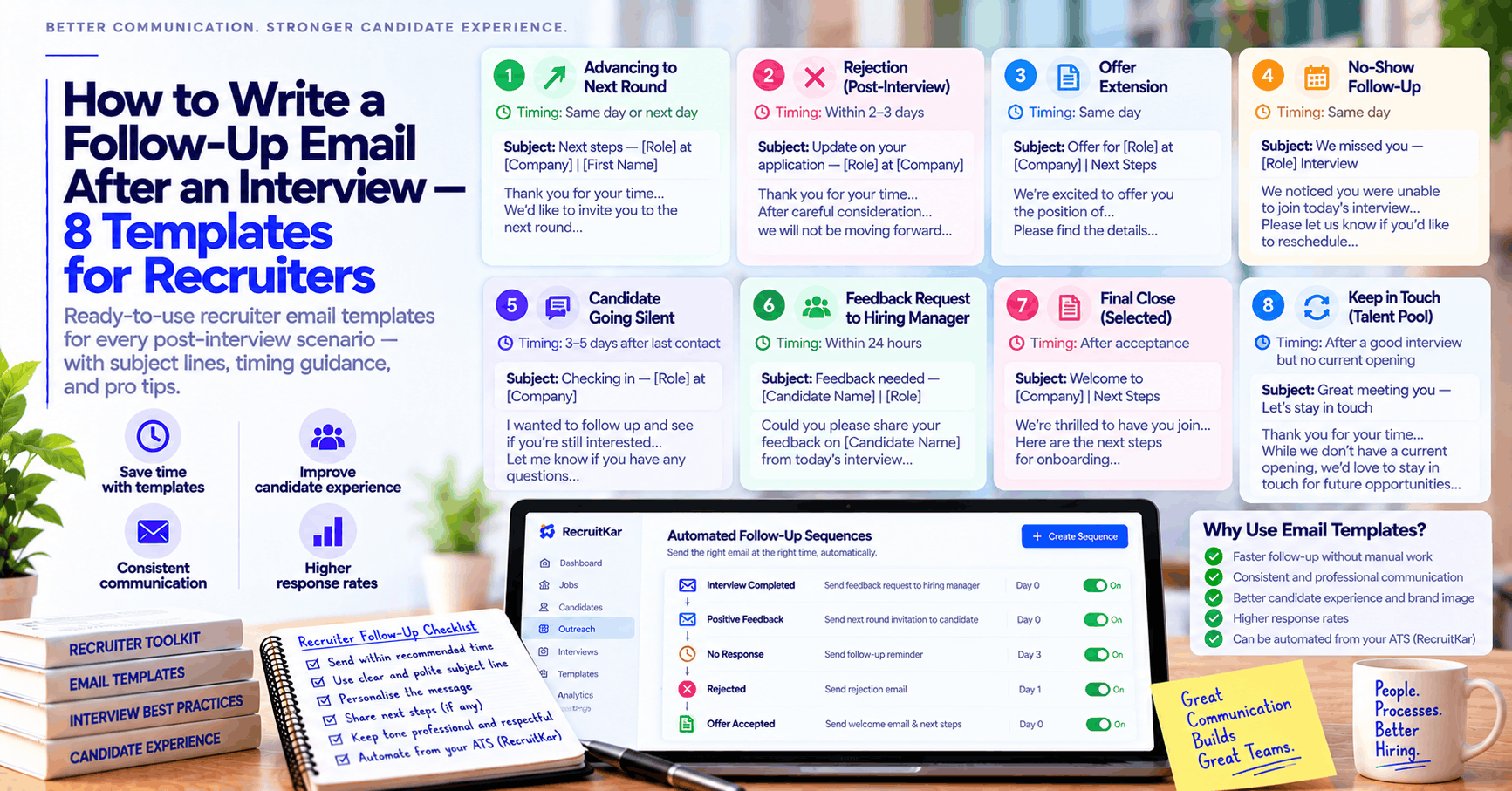
Post-interview follow-up is where candidate experience is won or lost. A candidate who interviewed on Tuesday and hears nothing by Friday has already started mentally exiting the process — and in India's competitive talent market, they've probably taken another call by Monday. The eight templates below cover every post-interview scenario a recruiter faces: advancing to next round, rejection, offer extension, no-show follow-up, candidate going silent, feedback request to hiring manager, and the final close. Run them as automated email sequences triggered directly from stage changes in your pipeline — so follow-up happens consistently without a recruiter remembering to send each one manually.
Why post-interview follow-up is the most neglected stage in recruiting
There's a pattern in almost every recruiter's week: sourcing gets the most attention, screening gets a process, and interviews get scheduled. But the window between an interview ending and a candidate hearing the outcome — which can stretch to 5, 7, or 10 days in most Indian companies — gets almost no systematic attention.
The consequences are predictable:
- Candidates disengage. A candidate who is genuinely excited about a role immediately after an interview becomes progressively less certain as silence accumulates. By Day 5 of no contact, doubt has replaced enthusiasm. By Day 10, they've likely accepted another offer or at least taken competing interviews.
- Strong candidates are disproportionately affected. The strongest candidates — those with the most options — are exactly the ones who disengage fastest when communication stalls, because they have the least reason to wait. The candidates who wait patiently for two weeks of silence are often those without other options, which skews the shortlist toward a less competitive pool.
- The recruiter's time investment is wasted. Sourcing, screening, and scheduling an interview represents hours of recruiter time. Losing a candidate to silence after that investment is one of the most expensive and avoidable outcomes in the hiring process.
The fix is not complex — it's systematic follow-up at each stage, sent consistently, without depending on a recruiter's memory or available time on any given day.
Timing principles before the templates
How quickly should follow-up happen? As a rule: same day for positive outcomes (advance to next round, offer), next day at the latest for rejections, and within 48 hours for anything requiring the candidate to take action (provide documents, confirm availability for the next round).
The instinct to wait until "the team has had time to discuss" before sending anything to the candidate is understandable but costly. A brief interim message — "we're completing our discussions this week and will be in touch by [specific date]" — costs nothing to send and prevents the silence that drives drop-off.
Which channel? Email for anything requiring documentation or that may be referenced later (offer letters, formal rejections, confirmation of next steps). WhatsApp for quick, time-sensitive updates and reminders where you need the candidate to see the message quickly. The templates below are written for email — see notes on WhatsApp adaptation for templates where channel matters.
Who should send it? The recruiter, always — not the hiring manager, even for senior roles. The recruiter owns the candidate relationship and process consistency. A hiring manager sending their own ad hoc follow-up (or not sending one) introduces the inconsistency that produces bad candidate experience at scale.
Template 1: Advancing to next round
Use when: A candidate has completed one interview round and is being invited to the next
Subject: Next steps — [Role] at [Company] | [Candidate First Name]
Timing: Same day as the decision, or the morning after at the latest
Hi [First Name],
Thank you for your time [yesterday / on [day]] — we appreciated the conversation and the team is keen to move forward.
We'd like to invite you to the next round: a [30-minute / 1-hour] [technical / hiring manager / panel] interview with [interviewer name/role]. Here are three slots that work on our end:
📅 [Day, Date, Time IST]
📅 [Day, Date, Time IST]
📅 [Day, Date, Time IST]
Please let me know which works for you, or share your availability if none of the above fit.
Looking forward to the next conversation.
[Your name]
[Title, Company]
Notes: Offering three specific slots — rather than asking the candidate to propose times — is consistently faster. Include a brief description of the format so the candidate can prepare appropriately. If the next round involves a technical test or case study, mention it here so it doesn't arrive as a surprise.
Template 2: Rejection (post-first interview)
Use when: A candidate has been interviewed and is not being advanced
Subject: Your application for [Role] at [Company]
Timing: Within 24 hours of the decision — not "eventually" or "when I have time"
Hi [First Name],
Thank you for taking the time to interview for the [Role] position at [Company]. We appreciated getting to know you better.
After careful consideration, we've decided to move forward with other candidates whose experience more closely aligns with our current requirements. This was a competitive process and the decision was not straightforward.
We'd genuinely like to keep your details in our system for future opportunities that may be a better fit. If you'd prefer not to be contacted in the future, just let me know and I'll remove your details accordingly.
Thank you again for your time and interest — we wish you all the best in your search.
[Your name]
[Title, Company]
Notes: The phrase "after careful consideration" is standard but acceptable — what matters more is the speed and the opt-out option at the end. Do not include specific feedback in a rejection email unless your company has a clear policy and process for providing it, because inconsistent feedback across candidates creates legal and fairness exposure. If the candidate replies asking for feedback, handle that conversation separately.
Template 3: Rejection (post-final round / late stage)
Use when: A candidate has completed multiple rounds and reached the final stage — a more personal rejection is appropriate here
Subject: An update on your application — [Role] at [Company]
Timing: Same day as the decision
Hi [First Name],
I wanted to reach out directly with an update on the [Role] at [Company].
We've completed our process and have made a final decision. Unfortunately, we're not able to move forward with your candidacy at this stage. I want to be honest that this was a genuinely difficult decision — you were a strong candidate and the discussions about your background were positive throughout.
The final decision came down to [a brief, honest, non-disparaging reason — e.g., "a specific technical experience area" or "a slight difference in the direction the role has evolved" — or simply: "a very close evaluation between two strong final candidates"].
I sincerely hope we can stay in touch. If a role opens that's a stronger fit, I'd reach out — and if you're comfortable with that, I'll keep your details on file.
Thank you for the time and energy you invested in this process.
[Your name]
[Title, Company]
Notes: A late-stage rejection deserves a more personal email than an early-stage one — this candidate has invested significantly more time and emotional energy. The honesty about it being a difficult decision is not fluff; it's accurate, and candidates at this stage can tell the difference between a form rejection and a genuine one. Be careful about specificity on the rejection reason — keep it vague enough not to create legal exposure but specific enough to feel genuine rather than evasive.
Template 4: Offer extension
Use when: Making a verbal offer by email before the formal letter follows
Subject: 🎉 Offer for [Role] at [Company] — [First Name]
Timing: Same day as the offer decision — delay between decision and offer communication loses candidates
Hi [First Name],
Excellent news — we'd like to offer you the [Role] position at [Company].
Here are the headline details:
- CTC: ₹[X] LPA ([fixed/variable split if applicable])
- Start date: [Target date or range]
- Work mode: [Remote / Hybrid (X days/week in office) / In-office]
- Location: [City, Office address if in-office]
A formal offer letter will be sent to [email address] within [X] working days, which will include the full compensation breakdown and terms.
Please let me know if you have any questions before the formal letter arrives — I'm happy to talk through any details. We're very much looking forward to having you on the team.
[Your name]
[Title, Company]
Notes: Sending the verbal offer details by email before the formal letter has two benefits: the candidate gets a fast, positive first signal on a channel they're likely to check, and it removes the awkward "so what does the offer actually look like?" waiting period. The formal letter still follows in writing; this email creates the emotional anchor moment rather than leaving it to a PDF attachment.
Template 5: Post-interview — no response from hiring manager (internal follow-up)
Use when: You've completed an interview but the hiring manager hasn't given feedback within the expected window
Subject: Feedback needed — [Candidate Name] / [Role]
Timing: 24–48 hours after the interview, if feedback hasn't been received
Hi [Hiring Manager Name],
Just following up on [Candidate Name]'s interview for [Role] — are you able to share your feedback so we can keep the process moving?
A quick summary is fine — strong/borderline/not a fit, and any specific notes. I'll need this to either advance them or send a respectful close before they go to another opportunity.
[Link to candidate record / interview notes form if applicable]
Happy to chat through it briefly if that's easier than typing it out.
Thanks,
[Your name]
Notes: This one is internal but often the most important follow-up email in the process. Delayed hiring manager feedback is the single largest contributor to candidate drop-off between interview and next step. Keeping this email short, specific, and with a clear ask ("strong / borderline / not a fit") reduces the cognitive barrier to a quick reply. The phrase "before they go to another opportunity" creates the urgency framing that hiring managers often need to prioritise a reply.
Template 6: Interview no-show follow-up
Use when: A candidate didn't attend their scheduled interview without prior notice
Subject: Missed interview — [Role] at [Company] | [First Name]
Timing: Within 2 hours of the missed interview slot
Hi [First Name],
We had your interview for the [Role] at [Company] scheduled for [time] today, but we weren't able to connect.
I understand things come up — if you'd like to reschedule, I'm happy to find another time. Just reply here or WhatsApp me on [number] and we'll get something set up quickly.
If you've decided to move in a different direction, that's completely fine too — just a quick note either way would help us close the loop on our end.
[Your name]
[Title, Company]
Notes: This is one of the most important templates to have, because the default response to a no-show is often either silence (poor practice) or a frustrated message that closes the relationship permanently. The tone here leaves the door open — a no-show is sometimes a genuine emergency, and a recruiter who handles it gracefully has a higher chance of recovering the candidate. The WhatsApp option is important because no-show candidates often feel embarrassed to re-engage by email but will respond to a more informal channel.
Template 7: Candidate has gone silent post-interview
Use when: A candidate who completed an interview hasn't responded to follow-up attempts for 5+ days
Subject: Checking in — [Role] at [Company]
Timing: Day 5–7 after last contact attempt
Hi [First Name],
I've tried to reach you a couple of times following your interview for the [Role] at [Company] — I don't want to keep messaging if the timing isn't right or you've moved in a different direction.
If you're still interested and life just got busy, I'm happy to reconnect. And if you've decided this isn't the right opportunity, just a quick note would be genuinely helpful so I can close the loop.
Either way, thank you for the time you invested in our process.
[Your name]
[Title, Company]
Notes: The "graceful close" phrasing — acknowledging they may have moved on, giving explicit permission to say no — consistently generates replies from candidates who had gone quiet because they were avoiding an awkward conversation. A clean "thanks but I've accepted another offer" reply is a better outcome than continued silence, because it confirms the candidate is unavailable rather than leaving their status ambiguous in your pipeline.
Template 8: Requesting interview feedback from a panel (post-debrief)
Use when: Multiple interviewers participated in a panel and you need structured feedback from each before a decision can be made
Subject: Interview feedback needed — [Candidate Name] | [Role] | By [Date]
Timing: Sent to all interviewers within 2 hours of the interview completing
Hi [Panel Members],
Thank you for your time interviewing [Candidate Name] for the [Role] today.
Please share your feedback by [specific date — ideally tomorrow] using the link below / form attached. A few lines on each area is sufficient:
- Overall recommendation: Advance / Borderline / Do not advance
- Specific strengths observed
- Areas of concern or gaps noted
- Any follow-up questions you'd want addressed in the next round
We have a debrief call / async decision scheduled for [date/time] — your input by [deadline] will allow us to make a decision before [candidate's other deadline / offer deadline / etc.].
[Link to feedback form / candidate record]
Thanks,
[Your name]
Notes: The specific deadline — not "when you get a chance" but "by tomorrow" — is the most important element of this email. Vague feedback requests produce vague timelines. The structured format (four bullet points) reduces the barrier to submitting feedback by making it clear that a few lines per area is sufficient, rather than implying an elaborate write-up is required.
Building these into an automated pipeline workflow
Sending these eight templates manually across every candidate at every stage is exactly the kind of task that gets dropped when a recruiter is managing 10 open roles simultaneously. The right implementation is trigger-based: when a candidate is moved to a specific pipeline stage, the corresponding template fires automatically.
In RecruitKar's visual ATS pipeline, stage transitions can trigger email sequences automatically — a candidate moved from "Interviewed" to "Advancing" sends Template 1; a candidate moved to "Rejected" sends Template 2 or 3 depending on how many rounds they completed; a candidate moved to "Offer Extended" sends Template 4. The recruiter's action is moving the card; the communication happens automatically.
This doesn't replace the personal touch for high-priority candidates or senior roles — those should still receive a direct call or personal email from the recruiter. It ensures that every candidate at every stage receives timely, professional communication regardless of how busy the recruiter is that day.
Frequently asked questions
How quickly should a recruiter follow up after an interview?
For positive outcomes (advancing, offer), same day or the morning after. For rejections, within 24 hours — not "when I have time." The instinct to delay rejection emails out of consideration for the candidate is well-intentioned but counterproductive: a candidate waiting five days for a rejection that isn't coming is in a worse position than one who receives a respectful rejection within 24 hours and can move on. The temporary discomfort of receiving a rejection quickly is better than the prolonged uncertainty of not knowing.
Should rejection emails include specific feedback?
Generally not in the initial email, for three reasons: it creates inconsistency across candidates if some receive detailed feedback and others don't; specifics can create legal exposure if a candidate believes the stated reason is a pretext; and a rejection email is not the right format for a nuanced performance discussion. If a candidate replies asking for feedback, that conversation is better handled on a call where tone and context can be managed, with feedback kept high-level ("we felt the technical depth wasn't quite at the level we need for this role at this stage").
Is it unprofessional to send rejection emails quickly?
No — the opposite is true. A rapid, respectful rejection is a sign of a well-organised, candidate-respecting process. What feels unprofessional is either silence (no rejection at all) or a rejection so delayed it arrives after the candidate has already followed up twice. Speed and respect are compatible.
What should I do if a candidate replies to a rejection asking for a second chance?
Acknowledge the reply personally rather than ignoring it. If there's a genuine reason for reconsideration (a misunderstanding about requirements, a different role opening that fits better), follow up on it. If the decision is final, a brief, kind reply confirming that — without being drawn into a detailed justification — closes the loop respectfully. Ignoring a reply to a rejection email is one of the most damaging things a recruiter can do to employer brand at no benefit to themselves.
Should follow-up emails come from the recruiter or the company's generic HR email?
From the recruiter, always — ideally with their name in the sender field, not just "HR Team at [Company]." A named individual sender increases open rates and response rates significantly compared to generic team inboxes, and it reinforces that the candidate has a specific person managing their process rather than being processed by a faceless system. For automated sequences, configure the sender name and email to be the recruiter's, not a generic noreply address.
Stop losing candidates to post-interview silence. Set up stage-triggered follow-up sequences in RecruitKar — every candidate gets timely, professional communication automatically when they move between pipeline stages. Automated email outreach sequences — built into every RecruitKar plan.