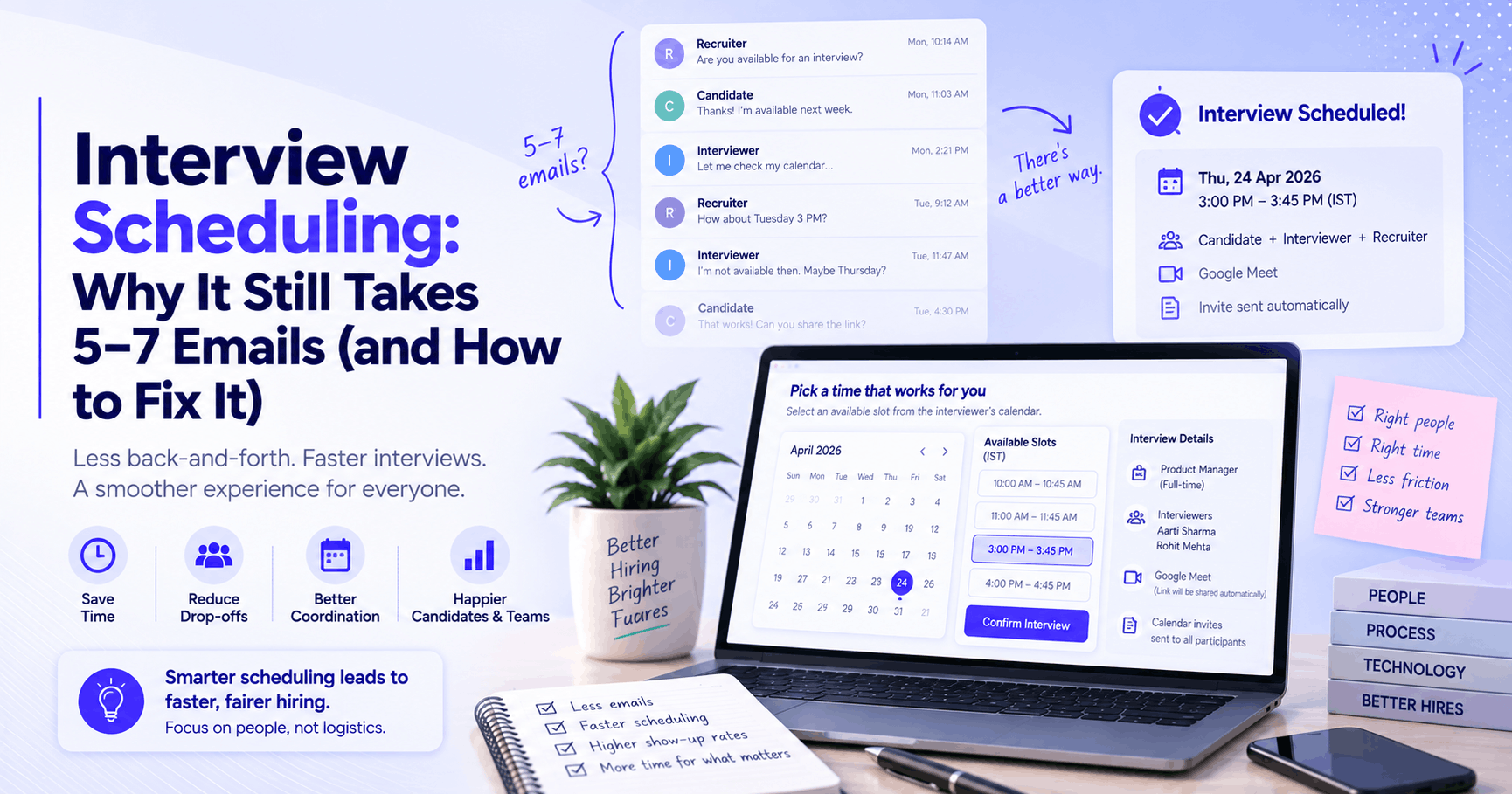
Scheduling a single interview shouldn't be hard. In practice, for a lot of teams, it routinely takes five to seven separate emails, spread across two or three days, involving a recruiter, a candidate, and one or more interviewers whose calendars nobody has real visibility into. It's one of the most mundane parts of recruiting, and also one of the most consistently underestimated sources of delay and candidate drop-off in the entire hiring process.
This post digs specifically into why scheduling is so friction-heavy by default, and what genuinely fixes it — not just generic advice to "use a scheduling tool," but the specific mechanics of what makes scheduling hard and how different approaches actually address each piece.
Why scheduling is harder than it should be
Multiple parties, multiple calendars, zero shared visibility. A typical interview involves a candidate, a recruiter coordinating logistics, and one or more interviewers — often across different teams or seniority levels. Without a shared way to see everyone's actual availability, coordination happens through sequential, asynchronous emails: propose a time, wait for a response, propose another if it doesn't work, check with the interviewer, wait again.
Interviewer availability is often the true bottleneck, not candidate availability. Candidates are frequently more flexible than assumed, especially if given several options at once. The real constraint is often a busy hiring manager or senior interviewer whose calendar is booked days out, and coordinating around their limited windows adds most of the delay.
Time zone and format confusion. For remote or hybrid interviews, confirming time zone, meeting format (video link vs. phone vs. in-person), and platform (Zoom, Teams, Meet) adds additional back-and-forth on top of simply finding a mutually available time.
No single source of truth for scheduling status. If scheduling coordination happens over email, it's easy to lose track of which candidate is waiting on which interviewer's response, especially across multiple simultaneous searches — this often means candidates fall through the cracks not from neglect, but from genuinely losing track amid parallel threads.
Rescheduling compounds the problem. A candidate or interviewer needing to reschedule doesn't just delay by the length of the new gap — it often restarts the entire coordination process from scratch, since the original proposed times are no longer relevant and a new round of back-and-forth begins.
What this actually costs
Beyond the obvious inconvenience, scheduling friction has real, measurable downstream effects. Every day added to the gap between first contact and a scheduled interview is a day a motivated candidate has to lose momentum, get distracted by other opportunities, or simply drift toward disengagement — this is one of the most common, avoidable drop-off points in the entire hiring funnel. At volume, the coordination overhead also consumes a disproportionate share of recruiter time relative to how mechanical the task actually is — hours spent per week on pure logistics that add no evaluative value to the hiring decision itself.
What genuinely fixes this, mechanism by mechanism
1. Shared, real availability instead of proposed guesses
The core fix for the "propose a time, wait, propose another" cycle is giving a candidate visibility into actual open slots on relevant calendars, rather than a recruiter guessing at availability and iterating by email. Calendar-integrated scheduling tools — connecting directly into Google or Outlook calendars — let a candidate see genuinely available windows and pick one directly, collapsing what would otherwise be several rounds of back-and-forth into a single step. Recruitkar's interview scheduling works this way specifically, connecting calendars directly into Meet, Zoom, or Teams so a candidate can book a real, confirmed slot without a recruiter manually checking and re-checking interviewer availability.
2. Batching interviewer availability upfront, rather than checking per-candidate
Rather than checking an interviewer's calendar fresh for every single candidate, having interviewers block out dedicated interview windows in advance — say, two afternoons a week reserved specifically for interviews — means a recruiter or scheduling tool can offer candidates from that pre-committed pool of time without needing to re-negotiate interviewer availability for every individual search. This shifts availability-checking from a per-candidate bottleneck to a one-time, periodic commitment.
3. Offering multiple options at once, rather than sequential single proposals
A significant amount of the back-and-forth in manual scheduling comes from proposing one time, waiting for a response, and only then proposing an alternative if it doesn't work. Offering several real options simultaneously — whether manually or through a scheduling tool — collapses this sequential exchange into a single round: the candidate picks whichever of several options actually works for them, without needing multiple rounds of negotiation.
4. Automated confirmations and reminders
Once a time is booked, automated confirmation (with clear details on format, platform, and any preparation needed) and a reminder closer to the actual interview time reduce both no-shows and the manual effort of a recruiter sending these individually. Reminders sent through a channel candidates actually check promptly — for candidates in India, WhatsApp often gets noticed faster than an email reminder that can sit unread — meaningfully reduce no-show rates without adding recruiter effort per candidate.
5. One system of record for scheduling status
If a recruiter is coordinating scheduling for several candidates across several roles simultaneously, tracking status manually across separate email threads is where candidates most easily get lost. A shared pipeline that shows scheduling status directly against each candidate's record — booked, pending, needs rescheduling — gives visibility that a scattered set of email threads simply can't provide at any real scale.
6. A clear, low-friction rescheduling path
Since rescheduling is nearly inevitable at any real hiring volume, building an easy path for it — a direct reschedule link rather than requiring an entirely new email exchange — prevents a single reschedule from cascading into the same multi-day coordination problem as the original booking.
What doesn't actually fix it
Simply asking candidates and interviewers to "be more responsive." This treats scheduling friction as a behavior problem rather than a structural one — even highly responsive people can't fix a fundamental lack of shared calendar visibility just by replying to emails faster.
Adding more manual coordination steps in the name of "personal touch." A recruiter manually checking calendars and sending individually crafted scheduling emails can feel more personal, but at any real volume, it simply doesn't scale, and the personal-touch benefit is arguably better spent on other parts of the candidate relationship where a human's judgment genuinely adds value, rather than on pure calendar logistics.
A scheduling tool with no interviewer calendar integration. Some tools present a candidate-facing booking interface without actually pulling real interviewer availability, which just moves the coordination problem rather than solving it — a candidate might book a time that then still requires manual confirmation from an interviewer, reintroducing the same back-and-forth one step later in the process.
A realistic before/after
Before: A recruiter emails a candidate proposing three possible times. The candidate replies two days later saying none work and offers two alternatives. The recruiter checks with the interviewer, who's only available for one of those two, but at a slightly different time than proposed. Another email round confirms the adjusted time. Total elapsed time: 4–5 days, 5+ emails, no automated confirmation or reminder sent afterward, and a manual calendar invite created separately.
After: A recruiter (or an automated trigger, once a candidate reaches the interview stage) sends a scheduling link showing real, currently open interviewer availability. The candidate picks a slot directly. A confirmation with meeting details goes out automatically, followed by a reminder closer to the interview time through whichever channel the candidate is most likely to see promptly. Total elapsed time: same day to next day, one interaction from the candidate's side, no manual back-and-forth required from the recruiter beyond initially sending the link.
Measuring your own scheduling friction
It's worth quantifying this rather than assuming it's fine because it's "always been this way." Pull a sample of 10–15 recent interviews and count, for each one, the number of separate email or message exchanges between first scheduling attempt and a confirmed time, and the total elapsed days between those two points. Teams that do this exercise are often surprised by the actual numbers — what feels like "a bit of back-and-forth" in the moment frequently adds up to several days and half a dozen messages once measured directly, rather than estimated from memory. This same measurement, repeated after implementing any of the fixes above, is also the clearest way to confirm whether a change actually reduced friction or just moved it somewhere less visible.
Scheduling for asynchronous, AI-driven first rounds
For high-volume roles using asynchronous video interviews as a first-round filter, the scheduling problem looks somewhat different — there's no live interviewer calendar to coordinate against, since the candidate completes the interview on their own schedule within a given window. Here, the friction shifts from calendar coordination to a different kind of clarity problem: making sure candidates understand the deadline for completing the asynchronous interview, what to expect technically (browser requirements, time limits per question), and what happens next once it's submitted. Treating this stage with the same communication discipline as live scheduling — clear expectations, automated reminders as a deadline approaches, and prompt follow-up once a submission is reviewed — prevents this format from simply relocating the friction rather than actually reducing it.
A quick checklist for auditing your current process
- How many separate messages, on average, does it take to go from first scheduling attempt to a confirmed interview time?
- Do interviewers have any pre-committed, dedicated interview windows, or is their calendar checked fresh for every candidate?
- Are candidates offered multiple time options simultaneously, or one proposal at a time?
- Is there an automated confirmation and reminder, and does it go out through a channel candidates are likely to see promptly?
- If a reschedule is needed, is there a direct, low-friction path, or does it restart the entire coordination process?
- Can anyone on the team see current scheduling status for every active candidate at a glance, or does that information live only in scattered email threads?
Handling edge cases well
Multiple interviewers with different availability. Rather than trying to find one slot that works for everyone simultaneously (often the hardest coordination problem), consider whether all interviewers genuinely need to be present at once, or whether sequential shorter interviews — each scheduled independently against that specific interviewer's availability — might actually reduce total coordination time, even if it means slightly more total interview time for the candidate.
Candidates in different time zones. Make time zone explicit in every proposed time and confirmation (not just relying on a candidate to correctly interpret a time without a zone specified), and where possible, let the scheduling interface display times automatically in the candidate's local zone rather than requiring manual conversion.
Last-minute cancellations. Have a clear, fast fallback process for same-day cancellations — a simple, immediate way to either quickly rebook or clearly communicate next steps, rather than leaving a candidate whose interview was just canceled without a clear sense of what happens next.
The bottom line
Interview scheduling is mundane precisely because it should be — there's no genuine judgment or evaluation involved in finding a mutually available time, which is exactly why manual, email-based coordination is such a poor fit for it. The fixes that actually work address the structural causes directly: shared calendar visibility instead of guessed proposals, options offered simultaneously rather than sequentially, automated confirmations and reminders, and one clear system tracking status rather than scattered email threads. None of this requires sacrificing a genuinely personal candidate experience — if anything, removing the friction of scheduling logistics frees up more of a recruiter's actual attention for the parts of the relationship that benefit from it.