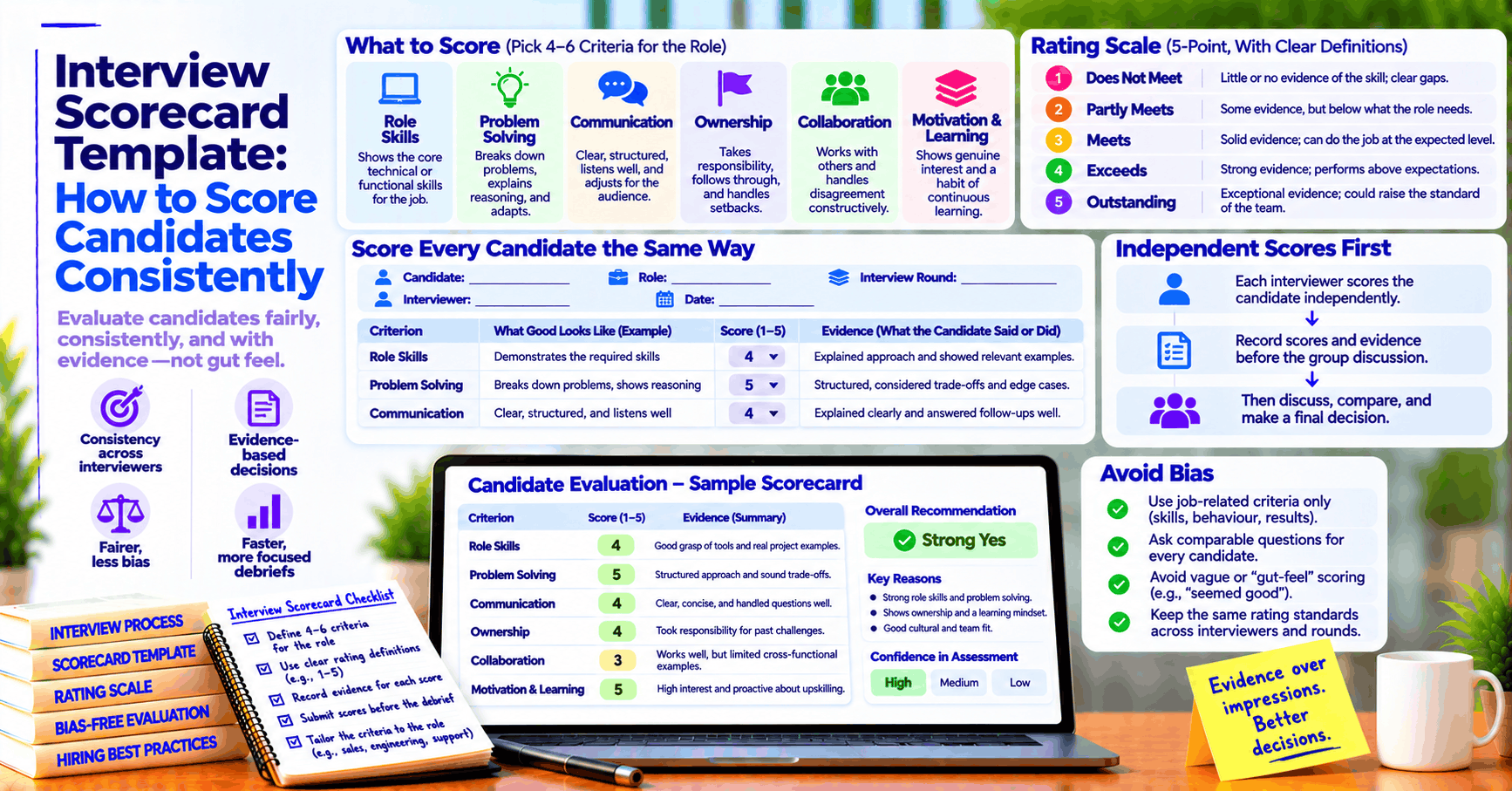
An interview scorecard is a simple form that lists the skills and behaviours a role needs, with a rating scale and space for evidence, so every interviewer scores every candidate the same way. To build one, pick four to six job-related criteria, define what each rating means, and ask interviewers to score before they discuss. Pairing scorecards with RecruitKar's interview scheduling keeps each round, panel, and feedback form organised in one place. Below you will find a ready-to-use template, a rating scale, and a process your team can adopt this week.
Why Interviews Need a Scorecard
Without a scorecard, interview feedback tends to sound like this: "Seemed good, nice energy," "Not sure about culture fit," or "I liked him." These comments are hard to compare, hard to defend, and easy to bend toward personal bias. Two interviewers can meet the same candidate and describe two different people, and the final decision often goes to whoever speaks most confidently in the debrief.
A scorecard fixes several things at once:
- Consistency. Every candidate is measured against the same criteria.
- Evidence. Interviewers must note what the candidate actually said or did, not just a general impression.
- Fairness. Job-related criteria reduce the room for unconscious bias.
- Speed. Debriefs are shorter because everyone arrives with structured notes.
- Learning. Over time you can see which criteria really predict success in your company.
A scorecard does not remove human judgement. It organises it, so that judgement rests on evidence and not on mood or first impressions.
What a Good Interview Scorecard Contains
A useful scorecard is short enough to complete in a few minutes and specific enough to be meaningful. Include the following parts.
1. Role and candidate details. Role title, candidate name, interview round, interviewer name, and date.
2. Four to six criteria. These are the skills, knowledge, and behaviours that matter for the job. More than six becomes hard to assess in a single interview.
3. A rating scale with definitions. Numbers alone mean little. Each score needs a short description so that a "4" from one interviewer means roughly the same as a "4" from another.
4. An evidence field per criterion. A space for notes on what the candidate said or did. This is the most valuable part of the form.
5. An overall recommendation. A clear, standard choice such as strong yes, yes, no, or strong no, with a short reason.
6. Concerns and follow-ups. Any open questions for later rounds or for reference checks.
A Simple Rating Scale You Can Use
A five-point scale is the most common, but a four-point scale avoids the safe middle option. Whatever you choose, define each point in plain language.
| Score | Label | What it means |
|---|---|---|
| 1 | Does not meet | Little or no evidence of the skill; clear gaps for the role |
| 2 | Partly meets | Some evidence, but below what the role needs |
| 3 | Meets | Solid evidence; can do the job at the expected level |
| 4 | Exceeds | Strong evidence; performs above expectations |
| 5 | Outstanding | Exceptional evidence; could raise the standard of the team |
Share the scale with every interviewer before interviews begin, and keep it identical across candidates for the same role.
Interview Scorecard Template (Copy and Adapt)
Use this general template as a starting point, then replace the criteria with ones specific to your role.
Candidate name: ____________ Role: ____________ Interview round: ____________ Interviewer: ____________ Date: ____________
| Criterion | What good looks like | Score (1-5) | Evidence (what the candidate said or did) |
|---|---|---|---|
| Role skills | Demonstrates the core technical or functional skills the job needs | ||
| Problem solving | Breaks down problems, explains reasoning, adapts when new facts arrive | ||
| Communication | Clear, structured, listens well, adjusts for the audience | ||
| Ownership and reliability | Takes responsibility, follows through, handles setbacks | ||
| Collaboration | Works with others, handles disagreement constructively | ||
| Motivation and learning | Shows genuine interest in the role and a habit of learning |
Overall recommendation: Strong yes / Yes / No / Strong no
Main reasons (two or three lines): ____________
Concerns or points to probe in the next round: ____________
Interviewer's confidence in this assessment: High / Medium / Low
The final confidence line is a small addition with real value. If an interviewer was rushed, or the candidate was nervous, or a topic was not fully covered, marking low confidence tells the team to dig further instead of treating the score as final.
Role-Specific Criteria Examples
The six-row template works as a base. Tailor the criteria to the role so scores reflect what actually matters.
Sales executive
- Prospecting and pipeline approach
- Handling objections
- Understanding customer needs
- Target orientation and follow-through
- Communication and rapport
- Product learning speed
Software engineer
- Coding and technical fundamentals
- Problem decomposition
- Code quality and testing habits
- System thinking appropriate to level
- Collaboration and code review mindset
- Learning and curiosity
Customer support or call-centre role
- Clarity of speech and listening
- Empathy and tone under pressure
- Process adherence
- Problem resolution approach
- Reliability and attendance mindset
- Willingness to learn product details
Frontline or operations role
- Reliability and punctuality
- Following instructions and safety practices
- Physical and logistical fit for the work
- Teamwork
- Basic communication in the working language
- Willingness to learn
People manager
- Setting direction and priorities
- Coaching and developing others
- Handling conflict and difficult conversations
- Decision-making
- Stakeholder communication
- Accountability for results
Keep the list short. A role has a few things that truly decide success, and a scorecard should spotlight those.
How to Build Your Own Scorecard in Five Steps
Step 1: Start with the job, not the candidate
Before interviews begin, sit down with the hiring manager and ask: "What will a great person in this role achieve in the first six to twelve months, and what skills and behaviours will make that happen?" The answers become your criteria.
Step 2: Choose four to six criteria
Separate must-have criteria from nice-to-have. If everything is a priority, nothing is. Where possible, express criteria as observable behaviours, such as "explains technical trade-offs clearly," and not as vague traits such as "smart" or "culture fit."
Step 3: Define the rating scale
Write one or two lines per score. Add short examples of strong and weak answers for the key criteria, so that interviewers calibrate their ratings.
Step 4: Match questions to criteria
Assign each criterion to a particular round or interviewer so the panel does not ask the same things repeatedly. For each criterion, prepare two or three questions. A common technique is to use behavioural questions ("Tell me about a time when...") and situational questions ("What would you do if..."), then ask follow-ups for detail.
Step 5: Train interviewers
Brief everyone for fifteen minutes before interviews start. Cover how to use the scale, how to write evidence, and what not to ask. A scorecard handed over without explanation will be filled in carelessly.
How to Use the Scorecard in Practice
Before the interview. Share the scorecard, the job description, and the candidate's CV with each interviewer. Assign criteria to interviewers. If you are running multiple rounds, interview scheduling in RecruitKar can help you coordinate panels and rounds so each interviewer knows their slot and focus.
During the interview. Take brief notes on what the candidate says and does. Avoid scoring while the candidate is still answering, since it distracts you from listening. Note specific examples, numbers, and phrases.
Right after the interview. Fill in scores and evidence while memory is fresh. Do this within a short time, ideally before talking to anyone else about the candidate.
Before the debrief. Ask every interviewer to submit their scorecard independently. This prevents the first or loudest voice from anchoring everyone else.
In the debrief. Start by comparing scores criterion by criterion. Where scores differ, ask each interviewer for the evidence behind it. Differences are useful: they show where the candidate may have performed differently, or where interviewers read the same answer differently.
After the decision. Store the scorecards with the candidate's record. A central view such as the RecruitKar ATS pipeline keeps feedback, stages, and decisions together so hiring managers can see the full picture.
Writing Good Interview Feedback: Evidence Over Impressions
The evidence field is where scorecards succeed or fail. Compare these two examples.
Weak: "Good communicator. Seems confident. Would fit the team well."
Strong: "Explained a recent project clearly, starting with the goal and ending with the result. When asked about a missed deadline, described the cause, what they changed, and how they informed the client. Took about two minutes per answer; answers were structured and easy to follow."
The second note tells the hiring manager what happened, allows another person to judge it, and leaves less space for bias. Encourage interviewers to include:
- What question was asked
- What the candidate said or did
- Why that supports the score
- Anything they could not assess
Avoid phrases such as "gut feeling," "not a culture fit," or "didn't click" without evidence. If an interviewer cannot explain a reaction in job-related terms, it is probably a bias and not a signal.
Common Scorecard Mistakes
- Too many criteria. Interviewers cannot evaluate ten things in 45 minutes. Keep it to four to six.
- Vague criteria. "Attitude" and "personality" mean different things to different people. Describe observable behaviours.
- Scores without evidence. A number alone cannot be reviewed or challenged.
- Discussing before scoring. Once opinions are shared aloud, independent judgement disappears.
- Changing criteria per candidate. If you adjust the standards mid-process, comparisons become unfair.
- Ignoring the scorecard in the final decision. If the decision follows a different logic from the scores, interviewers stop taking the form seriously. If you override scores, note why.
- Treating the average as the answer. An average score can hide a serious weakness in a critical area. Look at each criterion, especially the must-haves.
- One scorecard for all roles. Reuse the structure, but tailor the criteria.
Making Scorecards Fair
A structured approach supports fair hiring, but only if you also manage what goes into it.
- Stay job-related. Criteria and questions should link to what the role needs.
- Avoid protected or personal topics. Do not score or ask about marital status, religion, caste, health, family plans, age, or similar matters unrelated to the job.
- Ask the same core questions. Give all candidates for a role comparable questions, with follow-ups as needed.
- Calibrate across interviewers. Review a few scorecards together to see whether interviewers rate similarly. If one interviewer always gives high or low scores, discuss it.
- Include diverse panels where possible. Different perspectives help catch blind spots.
- Review outcomes. Periodically check whether scores and decisions look consistent across different groups of candidates, and investigate unexplained gaps.
Connecting Scorecards to the Rest of Your Hiring Process
A scorecard works best as part of a connected workflow.
- Link scorecards to stages. Make scorecard completion a requirement before a candidate moves to the next stage.
- Use scorecard gaps to guide reference checks. If an interviewer marked low confidence on ownership, ask referees about it.
- Keep candidates informed. Use email outreach to send timely, respectful updates, whatever the decision.
- Review after hiring. After a few months, compare hiring scores with on-the-job performance. Which criteria predicted success? Which did not? Refine accordingly.
Small teams and startups often skip structure because it feels heavy. A one-page scorecard is light enough for a team of three, and it pays off the first time two founders disagree about a candidate. If you are building your first hiring process, RecruitKar's startup solution shows how a lean team can keep pipeline, outreach, and interviews together. And to see how scheduling, outreach, and tracking come together, read why recruiting teams choose RecruitKar.
A Note on Fairness, Data, and Compliance
This article is for general information and is not legal advice. Interview notes and scores are personal data about candidates, and hiring decisions can raise anti-discrimination and data-protection considerations. Have your legal counsel or HR compliance advisor review your scorecard criteria, how long you keep interview records, who can access them, and how you handle candidate requests about their data.
Frequently Asked Questions
1. What is an interview scorecard?
An interview scorecard is a structured form that interviewers use to rate candidates against the same job-related criteria. It usually includes a list of skills or behaviours, a rating scale with definitions, a space for evidence, and an overall recommendation. It helps teams compare candidates consistently and reduces reliance on gut feel.
2. How many criteria should an interview scorecard have?
Four to six is a practical range. Fewer than four may miss important areas, and more than six becomes difficult to assess in a single interview. Focus on the skills and behaviours that most influence success in the role, and assign different criteria to different interview rounds if needed.
3. What rating scale works best for interview evaluation?
Five-point scales are common, and four-point scales avoid the safe middle. The key is not the number of points but the definitions. Write a short description for each score so that interviewers interpret it the same way, and share it before interviews begin.
4. Should interviewers discuss candidates before filling in their scorecards?
No. Ask each interviewer to complete their scorecard independently first. Discussion before scoring lets early or louder opinions influence everyone else. After scorecards are submitted, compare scores criterion by criterion and ask interviewers to explain differences using evidence.
5. Can I use the same scorecard for different roles?
You can reuse the structure, such as the rating scale, the evidence field, and the recommendation options, but the criteria should match the role. A sales role and an engineering role need different skills assessed. Create a short criteria list for each role family and keep it consistent across all candidates for that role.
Final Thoughts
A good interview scorecard is simple: a few job-related criteria, a clear scale, evidence for every score, and independent ratings before discussion. It will not make hiring perfect, but it makes it more consistent, more defensible, and easier to improve over time. Start with one role, use the template above, and refine it after your next few hires.
If you want interview rounds, feedback, outreach, and your pipeline connected in one place, explore RecruitKar and see how it fits your hiring workflow.