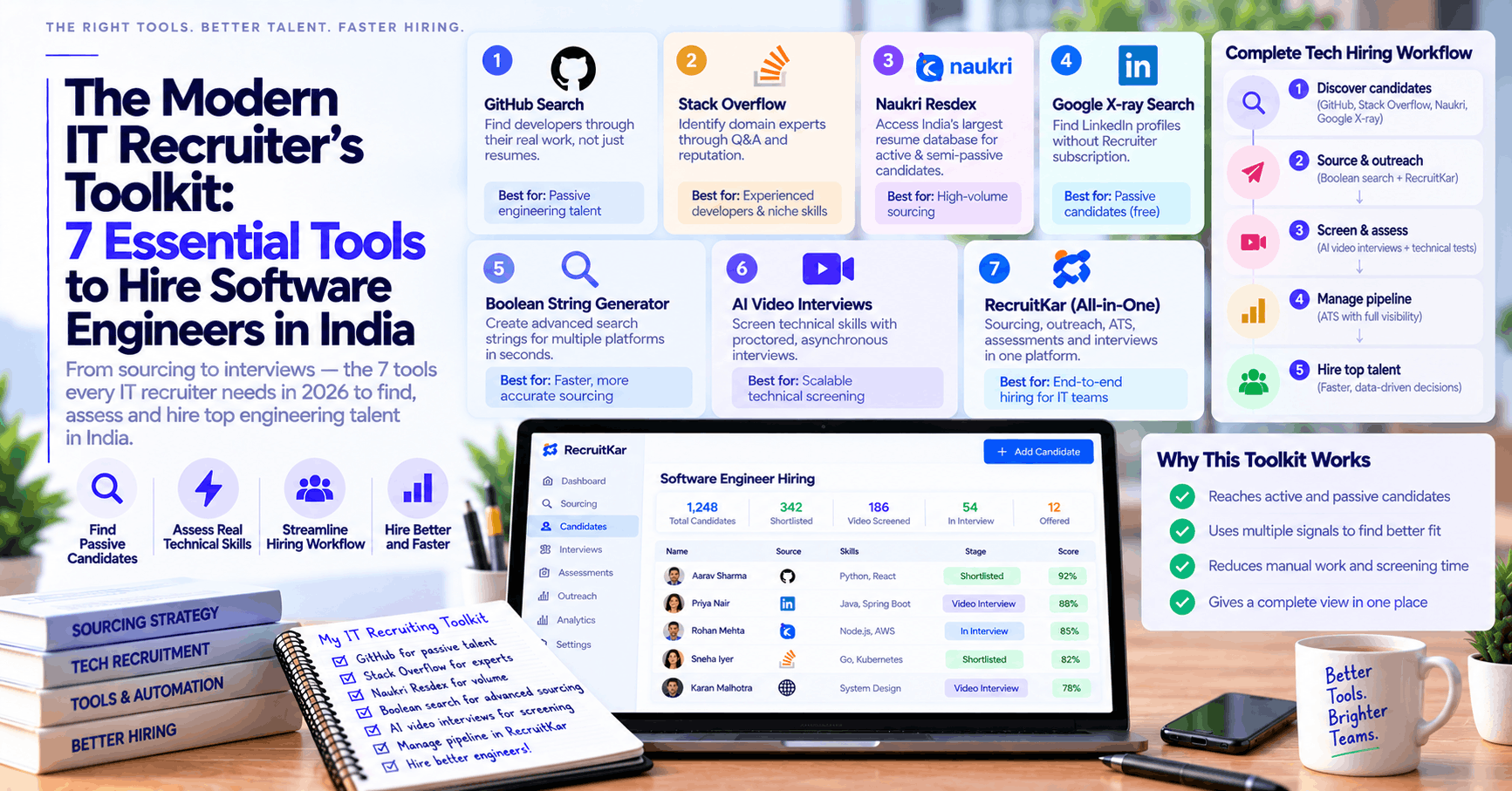
Hiring software engineers in India in 2026 requires a different toolkit than it did five years ago. Naukri alone doesn't reach passive candidates. LinkedIn InMail response rates have declined. Resume keyword-matching misses engineers who describe their experience differently than your search string. And coordinating sourcing, outreach, screening, and interviews across four separate tools means candidate data lives in four separate places. This post covers the 7 tools every serious IT recruiter in India needs — from GitHub search and Naukri Resdex to AI-powered discovery and proctored video screening — with honest notes on where each fits and what it doesn't do. For the full end-to-end stack, RecruitKar's AI hiring for IT and software teams consolidates sourcing, screening, outreach, and interviews in one platform built for technical hiring.
Why IT recruiting requires a different approach
Software engineering roles in India have three characteristics that make them harder to fill than most other professional roles:
The best candidates are largely passive. Developers with 4+ years of experience in sought-after stacks — React, Python, Go, Kubernetes, ML engineering — are typically already employed, usually performing well, and not actively searching. They're not refreshing their Naukri inbox. Reaching them requires going where they actually are: GitHub, Stack Overflow, technical communities, conference talks, or their own blogs.
Skills are verifiable before the interview. Unlike most professional roles, engineering skills leave a publicly visible trail — GitHub commits, Stack Overflow answers, open-source contributions, technical blog posts. A recruiter who ignores these signals and relies exclusively on resume keywords is leaving information on the table that directly predicts on-the-job performance.
The assessment layer matters more. A marketing manager candidate can be evaluated primarily through structured interview questions. A software engineer's technical competency requires a different evaluation layer — code assessment, technical problem-solving, architecture discussion — that most general recruiting tools weren't built to handle.
With that context, here are the 7 tools that make the difference.
Tool 1: GitHub Search
What it does: GitHub is the world's largest repository of public code. Engineers who contribute to open-source projects, maintain personal repositories, or publish their work on GitHub leave a verifiable, searchable record of their actual capabilities — not just their self-reported skills.
How to use it for IT recruiting:
GitHub's search function (github.com/search) allows filtering by programming language, location, follower count, and repository stars:
location:India language:Python followers:>100
This returns Indian developers whose primary GitHub language is Python and who have more than 100 followers — a proxy for some level of community recognition.
location:Bengaluru language:Go stars:>20
Developers in Bengaluru with Go repositories that have received 20+ stars from others.
What to look for once you find a profile:
- Recency and consistency of contributions (not just a burst of activity 3 years ago)
- Quality of repository documentation — engineers who write clear READMEs tend to communicate clearly in code reviews too
- Contributions to well-regarded open-source projects — signals community standing, not just personal projects
- The technologies actually used versus what the developer claims — a resume that lists Kubernetes but a GitHub profile showing almost exclusively Python scripting is a mismatch worth probing
Honest limitation: GitHub visibility is opt-in. Many excellent engineers keep their work private or don't maintain a public profile. And some engineers who post prolifically on GitHub are active open-source contributors but less effective in a product engineering context. GitHub evidence should inform outreach priority and interview questions, not replace assessment.
Tool 2: Stack Overflow Talent and Community
What it does: Stack Overflow is where engineers demonstrate domain expertise publicly through their questions, answers, and reputation scores. A developer with 10,000+ reputation points in a specific technology area has demonstrably helped hundreds of other engineers in that domain — a stronger signal of expertise than most resume lines.
How to use it:
Stack Overflow's search allows filtering by tag (technology) and location:
[python] [machine-learning] user:location:India
The careers/jobs section of Stack Overflow (now partially integrated into other platforms) allows direct candidate sourcing by technology tag and geography.
For direct outreach: Stack Overflow profiles typically link to personal websites, GitHub profiles, or Twitter/X accounts — all of which usually provide a contact path.
The depth of information available: A developer's Stack Overflow history shows which specific problems they've solved, at what complexity level, and how they communicate technical concepts. This is directly useful for designing technical interview questions — asking about a problem type you can see from their Stack Overflow history they've already solved at a high level reveals a different quality of conversation than generic interview questions.
Honest limitation: Stack Overflow expertise and on-the-job software engineering are related but not identical. Some excellent engineers answer Stack Overflow questions rarely; some prolific Stack Overflow contributors are less effective in product engineering contexts. The same caveat as GitHub applies — use it to inform, not replace.
Tool 3: Naukri Resdex with Boolean Search
What it does: Naukri Resdex is the largest searchable resume database in India — over 120 million profiles, including many who aren't actively searching but whose resumes remain searchable. For mid-market and volume tech roles, it remains the highest-yield single sourcing channel for Indian IT recruiters.
What makes the difference is how you search:
Plain keyword search in Resdex returns too many loosely relevant results. Boolean search with Resdex-specific field operators produces a meaningfully tighter shortlist:
title:("software engineer" OR "backend engineer") AND skill:Python AND skill:AWS AND np:30 AND loc:Bengaluru
This returns profiles where: the person's current title matches the role, Python and AWS are explicitly listed as skills, notice period is 30 days or less, and they're currently in Bengaluru.
The np: (notice period) filter is one of the most valuable but least-used Resdex-specific operators — filtering on it from the start means your shortlist reflects candidates who can actually join within your required timeline, rather than discovering at the offer stage that your top three candidates have 90-day notice periods.
RecruitKar's free Boolean Search Generator generates Naukri-formatted search strings from a job title and key requirements — a useful starting point for sourcers less familiar with Boolean syntax or handling an unfamiliar technology stack.
For importing shortlisted profiles: Rather than manually copying candidate details from Naukri into your ATS, the Naukri Chrome extension imports shortlisted profiles directly into your RecruitKar pipeline in one click — resume, contact details, and sourcing metadata all carried over automatically.
Honest limitation: Naukri Resdex is strongest for candidates who are at least somewhat open to opportunities — fully passive candidates who haven't touched their profile in years may be technically reachable but less likely to respond. And the database, despite its scale, has less depth for very senior specialist roles than a well-networked executive search approach.
Tool 4: LinkedIn (X-ray Search, Not Just InMail)
What it does: LinkedIn has the broadest professional profile coverage for white-collar Indian professionals, particularly at mid-to-senior levels. The challenge is cost and diminishing InMail returns.
The X-ray search alternative:
LinkedIn's public profiles are indexed by Google, enabling free search via:
site:linkedin.com/in ("senior software engineer" OR "staff engineer") "Bengaluru" "fintech" -"looking for opportunities"
This returns LinkedIn profiles matching the criteria without requiring a paid LinkedIn Recruiter subscription or InMail credits.
When InMail is still worth it: For roles requiring senior specialists at ₹30+ LPA where the candidate pool is thin, LinkedIn Recruiter's InMail capability and advanced filtering remain justified on pure sourcing value. For mid-market roles with good Naukri coverage, X-ray search plus direct WhatsApp outreach often produces comparable results at a fraction of the cost.
What the profile tells you beyond keyword match: Recommendations from former colleagues, specific endorsements from verified connections, the consistency of job tenure, and whether a candidate has published articles or given talks — all publicly visible signals that inform both outreach targeting and interview question design.
Tool 5: AI-Powered Candidate Discovery
What it does: Unlike the manual search tools above, AI candidate discovery takes a job description as input and returns a ranked list of candidates whose actual described experience is semantically similar to the role requirements — without requiring a recruiter to predict the exact keywords a well-qualified candidate would use in their profile.
Why this matters for IT recruiting specifically:
A React developer with 5 years of experience might describe their work as "frontend development," "UI engineering," "web application development," or "JavaScript development" — all of which mean roughly the same thing but would be missed by a search string for "React developer." AI discovery matches on the substance of described experience, not keyword overlap.
RecruitKar's AI hiring for IT and software teams uses this approach for technical role discovery — a recruiter pastes or uploads the job description, and the system returns a ranked candidate list from across multiple sources with match rationale per candidate.
Best paired with: Manual channels (GitHub, Stack Overflow) for high-signal candidates worth personal outreach, and Naukri Boolean search for volume. AI discovery handles the matching layer that sits between these — finding relevant candidates who weren't already identified through targeted manual search or who didn't appear in an obvious keyword search.
Tool 6: Technical Assessment Platform
What it does: Technical skills for engineering roles need to be verified, not just claimed. A structured coding or system design assessment — administered before the human interview panel — filters for genuine technical competency and reduces the time senior engineers spend in first-round interviews with candidates who can't pass a basic technical screen.
What to look for in an assessment tool:
- Role-relevant problem types: A backend engineer assessment should include backend-specific problems (API design, database query optimisation, system scaling), not generic algorithm puzzles that may or may not reflect the actual work
- Proctoring: For remote assessments, basic proctoring (browser activity monitoring, code editor activity tracking) reduces the risk of assisted completion
- Reasonable time limits: Timed assessments that are long enough to reveal how a candidate approaches a problem but short enough not to require a half-day commitment from the candidate
- Language flexibility: Candidates should be able to use the language they're actually strongest in, not forced into a specific language unless the role genuinely requires it
Honest note: Technical assessments are a filter, not a hiring decision. Strong engineers occasionally perform poorly on timed assessments under pressure; candidates who pass assessments don't always perform equivalently in collaborative engineering environments. Assessment results should inform the technical interview discussion, not replace it.
Tool 7: Proctored AI Video Interviews for Technical First Rounds
What it does: Before a senior engineer spends an hour on a technical call with a candidate who will immediately reveal they're not at the level their resume implied, a structured asynchronous video screen — asking candidates to walk through their technical approach to a specific scenario or problem — creates a meaningful first filter without consuming engineer time.
What to ask in a technical video screen:
Rather than generic behavioural questions, technical video screens for engineering roles benefit from:
- "Walk me through a production incident you worked on — what was the problem, how did you debug it, and what did you fix?"
- "Describe a system design decision you made in a recent project. What alternatives did you consider and why did you make the choice you did?"
- "Tell me about a technical skill you've built in the last year — what prompted it, how you learned it, and where you've applied it."
These questions produce responses that reveal how a candidate thinks about engineering problems, not just whether they can recite standard answers. The proctored component verifies the person completing the interview is the actual applicant.
In the RecruitKar workflow: Candidates shortlisted from Naukri, GitHub, or AI discovery receive a video interview link directly from the pipeline — no separate platform login, no external tool. Responses and AI-generated scores land back in the candidate's pipeline record, visible to the hiring manager alongside the resume and sourcing notes.
How the 7 tools work together: a sample IT sourcing workflow
Role: Senior Backend Engineer (Go/Python, 5–8 years, Bengaluru, ₹30–40 LPA)
- 1. Generate Boolean string — Boolean Search Generator — 5 min — Naukri and LinkedIn search strings
- 2. Naukri Resdex search — Naukri Resdex + Chrome extension — 45 min — 60 imported profiles
- 3. GitHub search for active contributors — GitHub search — 30 min — 12 high-signal profiles
- 4. AI discovery for broader matching — AI candidate discovery — 15 min — 40 additional matched profiles
- 5. LinkedIn X-ray for senior profiles — Google X-ray search — 20 min — 20 profiles
- 6. Outreach sequence launched — Email + WhatsApp sequence — 20 min — 132 candidates in active outreach
- 7. Shortlist from responses — Manual review of replies — 1 hour — 25 interested candidates
- 8. Technical video screen — Proctored AI video interviews — Async (candidate-side) — 18 completed screens reviewed
- 9. Human technical interviews — Calendar scheduling — As scheduled — 8 candidates to panel
Total recruiter time to panel-interview stage: Approximately 4 hours of active work spread over 5–7 days, compared to 10–15 hours for the same process without these tools.
Frequently asked questions
Is GitHub search or Stack Overflow sourcing useful for non-metro cities in India? Less so than for Bengaluru, Hyderabad, and Pune — the density of Indian developers with active public GitHub profiles and Stack Overflow accounts skews toward metro areas and developers in product and startup environments. For Tier-2 city hiring, Naukri Resdex and direct college/professional network outreach tend to produce better results than public community search.
How many tools does a solo IT recruiter actually need? A solo IT recruiter managing 5–8 open roles simultaneously needs: one sourcing channel for volume (Naukri Resdex), one channel for passive/high-signal candidates (GitHub or LinkedIn X-ray depending on role level), one outreach platform (email + WhatsApp), and one pipeline + assessment platform (ATS with video screening). The 7 tools above represent a complete stack — a solo recruiter typically uses 4–5 of them depending on role type and volume.
What's the most common mistake IT recruiters make with sourcing tools? Using too many disconnected tools without a unified pipeline to track the output. Candidate information from GitHub, Naukri, LinkedIn, and direct applications that lands in four different places — a spreadsheet, an inbox, a Naukri saved list, and a WhatsApp chat — produces a fragmented view that makes follow-through difficult and drop-off invisible. The specific tools matter less than whether they feed into a single organised pipeline.
Does AI candidate discovery work better than manual Boolean search? Neither is strictly better — they find different candidates. Boolean search finds candidates whose profile language closely matches your search terms. AI discovery finds candidates whose actual experience is semantically similar to the role requirements, regardless of exact terminology. The two approaches are complementary rather than competing: Boolean search for precision when you know exactly what you're looking for; AI discovery for coverage when the candidate pool is defined by competency rather than specific keywords.
How do technical video screens compare to live technical phone screens for efficiency? A live technical phone screen with a recruiter or engineer takes 45–60 minutes of the interviewer's time per candidate. An async video screen takes zero real-time recruiter time to deliver — candidates complete it on their schedule, and the reviewing engineer spends 10–15 minutes watching the recorded response. For a shortlist of 20 candidates, the difference is 15–20 hours of engineer time (live screens) vs. 3–4 hours of engineer time (video review). The tradeoff is less interactivity — the video screen can't follow up dynamically on a candidate's answer. The practical solution is using the video screen to filter the 20 to 8, then using live technical interviews for the 8, which produces the same quality assessment at roughly half the total engineer time investment.
Accelerate tech hiring with RecruitKar's purpose-built IT recruiter stack. Boolean search generation, 1-click Naukri imports, AI candidate discovery, multi-channel outreach, and proctored video screening — purpose-built for AI hiring for IT and software teams.