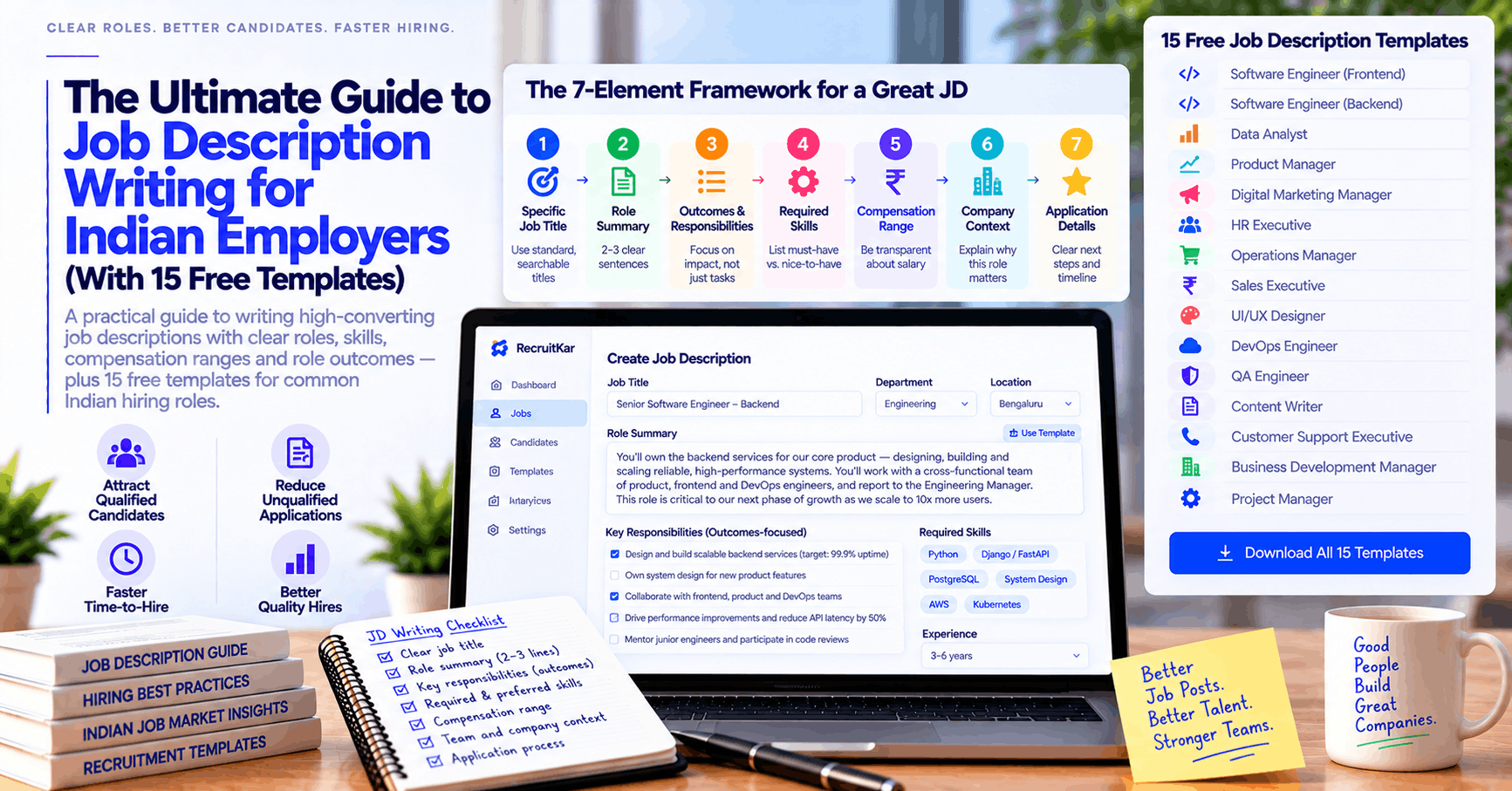
A poorly written job description doesn't just attract unqualified candidates — it actively filters out the candidates you most want to hire. Strong candidates with specific, sought-after skills have options; they self-select out of vague JDs that don't tell them what they'd actually be doing, what success looks like, or what they'd be paid. The result: a high-volume, low-quality applicant pool that overwhelms your screening process with the wrong people. RecruitKar's free job description templates for 15 common Indian hiring roles are built around the principles in this guide — specific outcomes, transparent compensation ranges, and clear tech-stack requirements. This guide explains the framework behind them and how to adapt it to your specific role.
Why most Indian job descriptions fail — and who they fail
The standard Indian job description template looks like this:
Company Name is a leading [industry] company looking for a dynamic, self-motivated [Job Title] to join our growing team. The ideal candidate will be a team player with excellent communication skills and a passion for [industry].
Responsibilities:
- Manage and oversee [vague function]
- Collaborate with cross-functional teams
- Drive strategic initiatives
- Ensure quality delivery of projects
Requirements:
- 3–5 years of experience
- Bachelor's degree in relevant field
- Strong communication skills
- Ability to work in a fast-paced environment
This template fails in every direction:
- It says nothing specific about the actual job. A candidate reading this has no idea what they would actually do day-to-day, what problems they'd be solving, or what a good outcome looks like. "Drive strategic initiatives" and "collaborate with cross-functional teams" describe approximately 80% of all professional roles.
- It attracts everyone and no one. Generic requirements attract everyone who vaguely matches the category — producing 400 applications for a role that actually fits 40 people. At the same time, the lack of specificity causes exactly the candidates you most want — those with specific, in-demand skills — to self-select out, because they can't tell from the description whether this is actually their kind of work.
- It says nothing about compensation. The candidate finds out the salary range after investing 3–4 rounds of interview time. When the number doesn't match expectations, everyone has wasted weeks of effort.
The 7-element framework for JDs that actually work
Element 1: A specific, searchable job title
Wrong: "Growth Ninja" | "Marketing Rockstar" | "Associate – Digital Operations" Right: "Performance Marketing Manager" | "Senior Software Engineer – Backend" | "Data Analyst – Growth"
The job title is the first search filter candidates use. It needs to match what people in this role are actually called in the market — not an internally branded variant that no one is searching for.
For Indian job boards specifically: Naukri and Indeed search on exact job title matches before expanding to other keywords. A non-standard title means your posting appears lower in candidate searches, generating less relevant traffic regardless of how well-written the body of the JD is.
Element 2: A clear 2–3 sentence role summary
Before the bullet list, write 2–3 sentences that answer: what does this person actually own, who do they work with, and why does this role matter to the company?
Example for a product manager role:
You'll own the core checkout flow on our e-commerce app — from product discovery and roadmap prioritisation to defining success metrics and working with engineering to ship. You'll report to the VP Product and work daily with a dedicated engineering squad of 5. This role exists because checkout conversion is our biggest growth lever and we need someone who can own it end-to-end.
Three sentences. A candidate now knows: what they own, who they work with, and why the role matters. That's more signal than most Indian JDs provide in 500 words.
Element 3: Outcomes and responsibilities, not just tasks
Task-oriented (weak):
- Manage social media channels
- Create content for blog and website
- Coordinate with design team
Outcome-oriented (strong):
- Own organic content strategy — blog, LinkedIn, and email newsletter — with a target of 3x qualified inbound traffic in Year 1
- Write 6–8 long-form pieces per month; manage one content contractor once the pipeline is established
- Partner with the design team on visual assets; you write the brief, they execute
The second version tells a candidate what success looks like, what their scope is, and what they'll be expected to produce — not just what tasks they'll be assigned.
Element 4: Requirements that are genuinely required
The most common JD mistake is listing every skill that might conceivably be useful as a "requirement." This produces a unicorn specification that discourages strong candidates from applying (because they don't meet 100% of an inflated list) while doing nothing to deter mediocre candidates who apply regardless.
The discipline required: for each listed requirement, ask: would we immediately disqualify a candidate who didn't have this? If the answer is no, it's a "nice to have" — move it to a separate section or remove it.
Required vs. nice to have — example for a data analyst role:
Required:
- 2+ years of hands-on SQL experience — you'll be writing complex queries from Day 1
- Proficiency in Python for data analysis (pandas, numpy); experience with dashboarding tools (Tableau, Looker, or Metabase)
- Ability to communicate findings clearly to non-technical stakeholders
Nice to have:
- Experience with dbt or data warehouse tooling (BigQuery, Snowflake)
- Background in fintech or consumer analytics
- Prior startup experience
Element 5: Compensation range — stated clearly
This is the highest-leverage change most Indian employers can make to their JDs and the one with the most direct impact on application quality.
Why transparency improves application quality: candidates who apply knowing the compensation range have self-selected as comfortable with that range. Candidates who apply without knowing — and discover at the offer stage that the range doesn't match — create a wasted process for both parties. Compensation transparency filters on an important dimension before the first resume is reviewed.
What to include:
- CTC range (e.g., ₹12–16 LPA)
- Whether it's fixed or includes variable component — and at what ratio (e.g., ₹12–16 LPA, including 15% variable at target)
- Equity, if any — even a rough indication (e.g., ESOP eligible; details at offer stage)
- Other meaningful compensation elements (specific benefits, annual bonus structure)
What "negotiable" means in practice: Many Indian companies write "as per industry standards" or "negotiable" in place of a range. Candidates read this as: the range is either low and they're embarrassed about it, or they genuinely haven't decided and the process will be chaotic. Neither reading builds confidence. Even a wide range (₹10–18 LPA) is more useful than no range.
Element 6: Location, remote/hybrid policy, and logistics
State clearly:
- Office location (city, area — not just "Mumbai" for a company whose office is 90 minutes from the nearest train station)
- Work mode: fully remote, hybrid (how many days/week in office), or fully in-office
- Shift requirements, if any
- Travel expectations, if any
These are frequently the first things a candidate checks, and leaving them vague generates a wave of mismatched applicants who assumed the answers matched their requirements.
Element 7: Company context that's specific, not generic
Generic (useless): "Join our dynamic team at a leading company in the [industry] space. We are passionate about innovation and are committed to employee growth."
Specific (useful): "[Company Name] is a Series A fintech (₹80Cr ARR, profitable unit economics since Year 2) building insurance distribution infrastructure for Tier-2 India. We're 60 people, with the engineering team at 25. The product has grown 3x in the last 18 months — the growth is real and the problem is genuinely hard."
Specificity signals confidence and gives candidates the context to decide whether this is an opportunity they're genuinely excited about. Generic language reads as either institutional caution or a company that doesn't know what makes it worth joining.
The 15 templates — role categories covered
The free job description templates follow the 7-element framework above, adapted for each role category's specific conventions and what candidates in that market expect to see:
Engineering:
- Backend Software Engineer (Node.js / Python / Java / Go)
- Frontend Engineer (React / Vue)
- Full-Stack Engineer
- Data Engineer
- DevOps / SRE Engineer
- Engineering Manager
Product & Design:
- Product Manager
- Product Designer / UX Designer
- Growth Product Manager
Data & Analytics:
- Data Analyst
- Data Scientist / ML Engineer
Business:
- Sales Development Representative (SDR / BDR)
- Account Executive (B2B SaaS)
- Performance Marketing Manager
- Content Marketing Manager / Content Lead
Each template includes: role summary, 5–7 specific outcome-oriented responsibilities, a separated required vs. nice-to-have requirements list, a compensation range placeholder with format guidance, and location/remote policy fields.
Adapting the templates for Naukri and LinkedIn specifically
The same JD performs differently on different Indian job boards because of how each platform's algorithm surfaces listings and how candidates on each platform behave.
For Naukri
Naukri's search algorithm weights the job title field and the skills section heavily. Ensure:
- The job title matches common search terms on Naukri (check what comes up when you search for your own role — that's the title candidates are using)
- Key technical skills are listed explicitly in the skills section, not just mentioned in the body of the JD
- Experience range is specified numerically in the dedicated field, not just mentioned in the body text
- Notice period preference is stated explicitly — this filters candidates on Naukri before they even click the posting
Once your JD is posted on Naukri, the shareable job apply link lets you distribute it across WhatsApp groups, college placement cells, and community forums so applications from all sources consolidate in one pipeline rather than arriving through multiple channels.
For LinkedIn
LinkedIn weights the job description text more than Naukri does, and the algorithm rewards posts that generate early engagement (applications, shares). Ensure:
- The role summary is compelling in the first 3 lines — this is what appears in the feed preview before "see more"
- The company description includes funding stage, size, and growth — LinkedIn's candidate pool for professional roles responds to growth signals more explicitly than Naukri's
- Skills required match LinkedIn's own skills taxonomy where possible — this enables LinkedIn's automated skill-match feature to surface your posting to relevant candidates
Red flags that disqualify a JD before it's posted
Before finalising any JD, check it against this list:
- The title test: Is this exactly what candidates in this role are searching for on Naukri and LinkedIn? If not, fix the title.
- The vagueness test: Could this JD describe the same role at 20 different companies without changing anything? If yes, it needs more specifics.
- The inflation test: Is every "required" item genuinely disqualifying if absent, or have some nice-to-haves crept into the required list? Trim the required list to what's actually required.
- The compensation test: Does the JD tell a candidate what they'll be paid — at least in a range? If it says "negotiable" or nothing, add a range.
- The logistics test: Does a candidate know the city, the work mode (remote/hybrid/in-office), and any shift or travel requirements? If not, add them.
- The specificity test: Does the company context section contain information that's specific to this company — ARR, growth rate, team size, product stage — or is it generic corporate language that could apply to any employer?
What happens after the JD is posted
A well-written JD is the top of the funnel — it determines the quality of who applies. What happens next determines whether the right candidates make it through.
Applications from your shareable link, Naukri, and LinkedIn all consolidate in the visual ATS pipeline, where each applicant is visible in one place with their resume, application details, and any notes attached. Automated AI resume scoring ranks incoming applications against the JD's requirements, so a recruiter reviewing 200 applications sees a ranked shortlist rather than an unsorted pile.
The loop from JD to shortlist to interview pipeline — without manual data entry at any stage — is what actually turns a well-written JD into a faster, higher-quality hire rather than just a better-sourced pile of resumes to manually sort through.
Frequently asked questions
Should Indian companies include salary ranges in job descriptions? Yes — the evidence on this is consistent. Compensation transparency reduces mismatched applications, shortens the hiring cycle (no late-stage offer surprises), and is increasingly expected by candidates in the Indian professional market, particularly mid-senior level candidates with multiple options. The most common objection — "competitors will poach our staff if they know what we pay" — is generally outweighed by the applicant quality improvement. The DPDP Act and market-transparency expectations are also moving in the direction of making compensation opacity increasingly anomalous.
How long should a JD be? 400–700 words for most professional roles. Long enough to convey genuine specificity; short enough that a candidate reads the whole thing rather than scanning the requirements and ignoring the rest. The 7-element framework above produces a JD in this range naturally. JDs that run to 1,200+ words typically contain inflated requirements lists, redundant bullet points, and lengthy company descriptions that candidates skip.
Should a JD be the same for Naukri and LinkedIn? The content should be the same; the format can be optimised slightly for each platform. On Naukri, the skills section and experience range in the structured fields matter more than the free-text body. On LinkedIn, the first 3 lines of the description matter disproportionately because that's the preview. Writing one strong JD and then adapting the posting structure for each platform produces better results than maintaining platform-specific content in parallel.
What's the right experience range to specify? The range should reflect what's actually required, not what you aspire to hire. A "2–5 years required" specification for a role where candidates with 2 years of experience have a realistic chance of succeeding attracts a genuinely broader pool than a "3–7 years required" specification for the same role. Over-specifying experience ranges (e.g., "5–8 years" when 3 years of strong experience would also work) narrows the pool unnecessarily and specifically discourages women, who tend to self-select out of roles where they don't meet 100% of stated requirements at higher rates than men.
How do we handle roles where compensation varies widely based on candidate experience? State a range that reflects where you'd place a strong candidate at the lower end and a standout candidate at the upper end — don't compress it to the point of meaninglessness. For a role where you'd pay ₹12 LPA for a solid candidate and ₹20 LPA for an exceptional one, a range of ₹12–20 LPA is honest and useful. A range of ₹14–16 LPA for the same role implies much less flexibility than actually exists and will lose strong candidates who assume they'd land at the top of that range and don't apply.
Download 15 free, customisable job description templates for the most common Indian hiring roles on RecruitKar — pre-formatted for Naukri and LinkedIn, with compensation range placeholders, outcome-oriented responsibility sections, and required vs. nice-to-have separation built in. Free job description templates — download and customise in minutes.