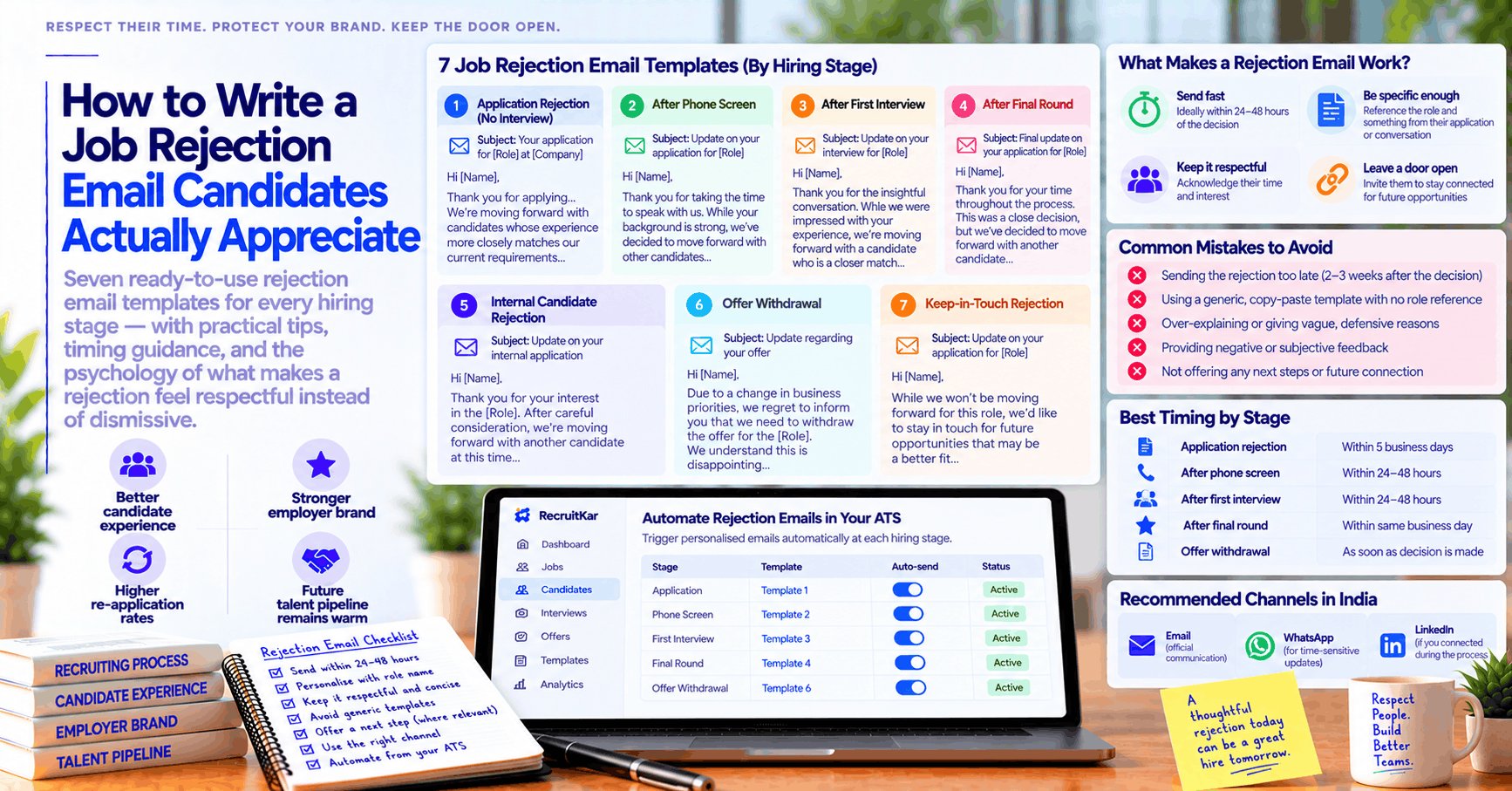
The average Indian recruiter sends dozens of rejection emails a week and writes almost none of them from scratch — they paste from a template, hit send, and move on. That's the right instinct on volume. But most templates in circulation fail at the same thing: they're written to close the recruiter's task, not to leave the candidate feeling respected. A candidate who receives a respectful, timely rejection is far more likely to reapply, refer others, and say positive things about your company than one who received silence or a copy-paste dismiss. The seven templates below are built around what candidates actually experience when they read a rejection — and what changes that experience from bad to acceptable to genuinely appreciated. Triggering rejection emails automatically from stage changes in your ATS pipeline means every candidate gets timely communication regardless of recruiter workload.
Why most rejection emails fail — and why it matters
Before the templates: understanding why standard rejections feel bad helps you write ones that don't.
They arrive too late. A rejection email that arrives 3 weeks after an interview, when the candidate has already moved on and half-forgotten the application, is almost worse than one that arrives on time — it reopens a wound that had started healing. Timing matters as much as content: a rejection within 24–48 hours of a decision is respectful; one that arrives 2–3 weeks later is an afterthought.
They're written for the sender, not the reader. "After careful consideration of many strong candidates, we have decided to move forward with other applicants" is written to make the rejector feel like they did something considerate. It tells the rejected candidate nothing about why, when, or what happens next.
They're obviously templated. A rejection email that could have been sent to any of 400 candidates — no name, no role reference, no specific acknowledgment — signals that the candidate was processed, not considered. Even a small amount of specificity changes the experience.
They provide no path forward. Most rejections are dead ends — they close the conversation entirely. A well-written rejection can leave a door open (for future roles, for the candidate database, for a referral relationship) that serves both parties.
They go to the wrong place. In India, a rejection email sent to a gmail account that the candidate checks occasionally — while the candidate is checking WhatsApp hourly — reaches them slowly or not at all. Channel matters for rejection communication just as it does for initial outreach.
The principles behind rejections that actually work
Send fast. Within 24 hours of a decision is the target for all stages. Within the same business day for post-final-round rejections where the candidate has invested significantly.
Be specific enough to feel real. Reference the role name, at minimum. Reference something from the conversation or application if the candidate made it to an interview stage. The specificity signals that the candidate was seen, not processed.
Don't over-explain or justify. A rejection email is not an appeal to a grievance committee — excessive justification often reads as defensive rather than considerate. A brief, clear reason (or no reason beyond "the final decision was very close") is better than a lengthy explanation that creates room for argument.
Offer something, even if it's small. The candidate gave their time. A brief expression of what was strong about them, or an invitation to stay connected for future roles, is not expensive to give and meaningfully changes how the rejection lands.
Be honest about the reason — to a point. "We've decided to move forward with a candidate whose background is a closer match to our current needs" is honest, non-specific, and accurate in most cases. "You weren't technical enough" or "the hiring manager didn't click with you" creates legal and relational risk without adding meaningful value to the candidate.
Template 1: Application rejection (no interview)
Use when: The candidate applied but didn't make it to a screening call. High volume — automate this one.
Subject: Your application for [Role] at [Company]
Timing: Within 5 business days of the application closing or a shortlist being confirmed
Hi [First Name],
Thank you for applying for the [Role] position at [Company].
We've reviewed your application carefully. While your background is interesting, we're moving forward with candidates whose experience more closely matches our current requirements for this role.
We'd encourage you to keep an eye on our future openings at [careers page URL]. We'll keep your application on file and may be in touch if a relevant opportunity arises.
Thank you for your interest in [Company].
[Your name] [Title, Company]
Notes: Keep it short — the candidate invested minimal time at this stage. No need for extensive explanation. Including the careers page URL gives them a clear path to reapply.
Template 2: Phone/video screen rejection
Use when: The candidate completed an initial screening call or async video screen but isn't advancing to the interview stage.
Subject: Update on your [Role] application — [Company]
Timing: Within 48 hours of the screening decision
Hi [First Name],
Thank you for taking the time to speak with us [yesterday / on [day]] about the [Role] opportunity at [Company].
After our conversation, we've decided to move forward with candidates whose experience is a closer match to the specific background we're looking for at this stage. This was a difficult decision — you came across well, and the conversation was genuinely useful.
We'd like to stay in touch for future opportunities that may be a better fit. If you're comfortable with that, we'll keep your details on file.
Thank you again for your time.
[Your name] [Title, Company]
Notes: The phrase "came across well, and the conversation was genuinely useful" is worth including if true — it's specific enough to feel real without opening the door to a detailed justification of why they weren't advanced.
The phrase "came across well, and the conversation was genuinely useful" is worth including if true — it's specific enough to feel real without opening the door to a detailed justification of why they weren't advanced.
Template 3: First interview rejection
Use when: The candidate completed one or more interview rounds but isn't being invited to the final stage.
Subject: Feedback on your [Role] interview — [Company]
Timing: Same day as the decision, next morning at the latest
Hi [First Name],
Thank you for your time interviewing for the [Role] at [Company] — we appreciated the depth of your experience and the quality of the conversation.
After the interview process, we've made the difficult decision to move forward with other candidates for this specific role. The decision was close and wasn't a straightforward one.
I want to be transparent: [optional — one brief, honest observation, e.g., "we were looking for someone with a stronger background in [specific area]" or "the final decision came down to a very specific experience requirement we needed to prioritise"]. This reflects the particular needs of this role rather than a broader assessment of your capabilities.
We were genuinely impressed with [something specific and true — a specific skill they demonstrated, a particular insight they shared]. I'd like to keep your profile in mind for future openings.
Thank you for the time and energy you invested in this process.
[Your name] [Title, Company]
Notes: The optional feedback line requires judgment — include it only if you have something specific and genuinely useful to say, and only if it can't be read as disparaging. "We were looking for deeper Python experience" is fine. "The hiring manager found the conversation a bit flat" is not. If you can't say something specific and constructive, skip the line.
Template 4: Final round rejection (most important to get right)
Use when: The candidate reached the last round of interviews and isn't receiving an offer. This is the rejection that costs most in terms of candidate experience and employer brand if handled poorly.
Subject: Your application for [Role] — an update from [Company]
Timing: Same day as the decision. Not next week. Same day.
Hi [First Name],
I wanted to reach out personally with an update on your application for the [Role] at [Company].
We've completed our final round and have made our decision. Unfortunately, we're not able to extend an offer at this time.
I want to be honest with you: this was genuinely one of the hardest decisions we've made in this process. You were a strong candidate throughout — [something specific and true about their candidacy, e.g., "your approach to the system design question in the technical round was impressive" or "the way you described your previous experience managing a distributed team was exactly what we were looking for in terms of approach"]. The final decision came down to [a vague but honest reason — e.g., "one very specific experience requirement" or "an extremely close comparison between two equally strong final candidates"].
I recognise that you've invested significant time and energy in this process, and I'm genuinely sorry the outcome wasn't different.
I'd like to stay connected — both because I think there may be future opportunities where your background would be an even stronger fit, and because I've been genuinely impressed by you throughout this process. Would you be open to staying in touch?
[Your name] [Title, Company]
Notes: This template is longer and more personal than the others because the candidate has earned that. A final-round rejection sent as a form letter is one of the most consistent employer brand failures in Indian hiring — candidates at this stage have often taken time off, prepared extensively, and in some cases turned down other conversations. The personal investment here is earned, not excessive.
Template 5: Offer withdrawal (rare but critical to handle correctly)
Use when: An offer has been extended but must be withdrawn — most commonly due to background verification issues, a sudden budget freeze, or a role being eliminated before joining.
Subject: An important update regarding your offer — [Company]
Timing: Same day the decision is made. No delay.
Hi [First Name],
I'm writing with an update I didn't expect to be sending, and I want to be direct with you.
[Choose the appropriate reason:]
For budget/role elimination: Due to [a business decision beyond our control / a budget review / an organisational restructuring] that occurred after your offer was extended, we are no longer able to proceed with this hire. This has nothing to do with you or your candidacy — it is entirely a function of circumstances on our end.
For background verification failure: Our background verification has surfaced a discrepancy that we're required to investigate before we can proceed. [If the offer is being withdrawn as a result:] Having reviewed the findings, we're not able to proceed with the offer at this time.
I understand this is deeply disappointing news, particularly given the time you've invested and any decisions you may have made in anticipation of joining. That is not lost on me, and I'm genuinely sorry for the impact this creates.
[For budget/role elimination only:] I would like to actively support your search for the next step — whether that's a reference, an introduction to someone in my network, or simply a candid conversation about the market. Please let me know how I can help.
[Your name] [Title, Company]
Notes: An offer withdrawal is a significant event that can cause a candidate to resign from their current employer, decline other offers, or make financial commitments. The legal exposure and the human cost both require treating this with maximum care and minimum delay. Consult legal counsel before withdrawing an offer in any situation where the candidate may claim damages.
Template 6: Rejection after a long hiring process (candidate was kept waiting too long)
Use when: The process took significantly longer than initially indicated, and you're now rejecting a candidate who has been waiting patiently.
Subject: Your [Role] application — I owe you this update
Timing: Immediately, regardless of how long it's been
Hi [First Name],
I've wanted to reach out sooner and I owe you an apology for the delay in this update.
We've completed our process for the [Role] and have decided to move forward with another candidate. I recognise this update is overdue — our timeline extended well beyond what I initially indicated, and that created an unfair situation for you.
Thank you for your patience throughout this process. It reflected well on you, and I'm sorry the outcome wasn't what either of us would have wanted.
[Your name] [Title, Company]
Notes: The acknowledgment of the delay is the most important element here. A candidate who waited 6 weeks for a rejection they were told would come in 2 does not need a lengthy explanation — they need an honest acknowledgment that the timeline wasn't what was promised.
Template 7: WhatsApp rejection (for candidates where WhatsApp was the primary channel)
Use when: Outreach and communication happened primarily over WhatsApp, and a formal email rejection would be out of register with the established channel.
Timing: Same day as decision, during working hours
Hi [First Name], I wanted to update you directly on the [Role] at [Company]. Unfortunately we've decided to move forward with another candidate — the decision was close, and you made a strong impression throughout. I hope we get the chance to work together in the future. Thank you for your time and good luck with your search. — [Your name]
Notes: WhatsApp messages should be short, warm, and conversational. A long paragraph that reads like a formal email pasted into WhatsApp feels worse than a brief, direct message. For candidates where the relationship was built in WhatsApp, keep the rejection in that register.
Setting up rejection emails as automated triggers
The most consistent rejection email process is one that doesn't depend on a recruiter remembering to send it. In RecruitKar's ATS pipeline, stage transitions can trigger automated email sequences — when a candidate is moved to "Rejected" at any stage, the appropriate template fires automatically based on which stage they reached. The recruiter moves the card; the communication happens without a separate action.
For personalised rejections (Templates 3, 4, 5), automation handles the base template and the recruiter adds any specific personal touches before the email goes out — reducing the barrier to personalisation from "writing the whole email" to "adding one specific sentence." Automated email outreach from within the pipeline keeps this efficient without making it robotic.
Frequently asked questions
Should rejection emails include specific feedback on why the candidate wasn't selected? For application-stage and phone-screen rejections: generally no. The volume makes specific feedback unsustainable, and vague generic feedback is often worse than no feedback at all. For first-round interview rejections: one brief, honest, high-level observation is appropriate if you have something specific and constructive to say. For final-round rejections: a brief, honest reason is genuinely valuable and is the stage where candidates most consistently ask for it and deserve it. Avoid specifics that create legal exposure or that are unkind without being useful.
Is it better to call a candidate or email them with a rejection? For final-round candidates who have invested significantly, a phone call before (or alongside) the email is best practice and meaningfully improves the experience. For earlier stages, email is standard and appropriate. A phone call for a first-round rejection adds little value relative to the time cost; a phone call for a final-round rejection signals genuine respect for the candidate's investment.
What if a candidate replies asking for more detailed feedback? Respond personally, keep it brief, and give one or two specific, constructive observations at most. "The technical panel felt your system design experience wasn't yet at the senior level we need for this role" is useful. "The team just didn't feel you were the right fit" is not. Avoid anything that can be read as discriminatory or that implies a character judgment rather than a specific experience gap.
How long should a company keep rejected candidates' details on file? Under India's DPDP Act 2023, personal data should not be retained beyond the period necessary for the purpose it was collected. For rejected candidates, a reasonable retention period (12–24 months is common) after which data is deleted or the candidate is contacted for renewed consent is good practice. Include a brief opt-out option in rejection emails ("if you'd prefer we remove your details, just reply and we'll do so") to make this process clean.
What should we do if we want to consider a rejected candidate for a future role? Tag them in the ATS as "strong candidate — future opportunity" at the point of rejection, with notes on what made them strong and what role types they'd be a fit for. When a relevant future role opens, outreach that references the previous conversation ("we spoke earlier this year about [Role] — I wanted to reach out about an opening that I think is a closer fit") is warmer, higher-converting, and more respectful of the candidate's previous investment than a fresh cold message that ignores the history.
Send every rejection email on time, automatically. Configure stage-based email triggers in RecruitKar — when a candidate is moved to rejected at any stage, the right template fires automatically. Automated email outreach + visual ATS pipeline — no candidate left without an update.