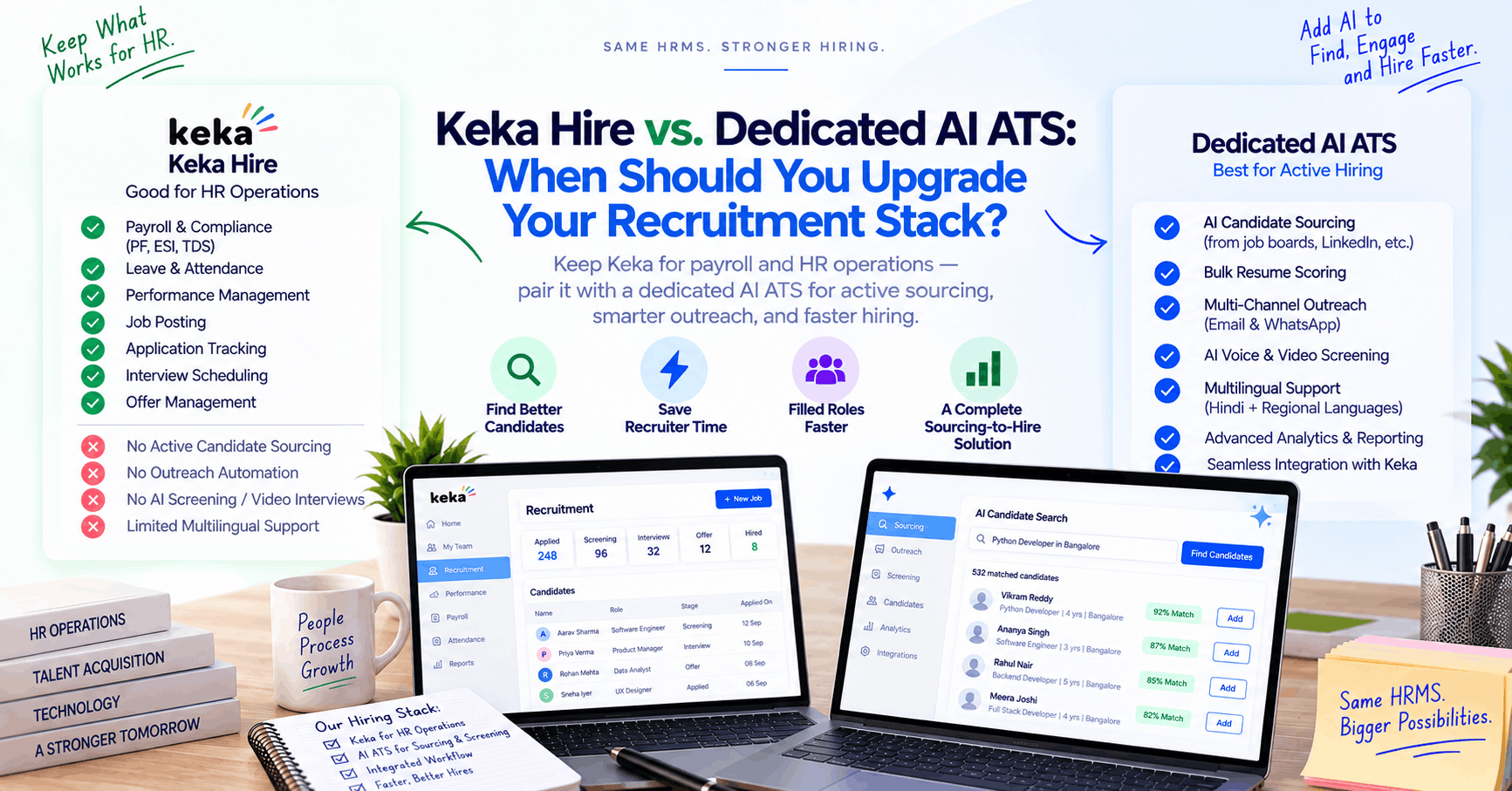
Keka is one of the best payroll and HR operations platforms in India — attendance, leaves, performance management, and employee records handled cleanly in one place. Its recruitment module, Keka Hire, does the basics: job posting, application tracking, interview scheduling, and offer management. What it doesn't do is find candidates.
For high-growth Indian companies that need active AI sourcing, multi-channel outreach, and automated screening alongside their Keka payroll setup, the answer isn't replacing Keka — it's pairing it with a dedicated recruitment platform. This post explains exactly when that pairing makes sense and what to look for in a Keka ATS alternative comparison.
What Keka does well — and why most companies shouldn't replace it
Let's be specific, because "Keka is great for payroll but not recruitment" is a statement that needs unpacking before it becomes actionable advice.
Keka's genuine strengths are in the operational HR layer — the systems that manage existing employees after they're hired. Payroll processing for Indian compliance (PF, ESI, TDS, professional tax) is where Keka has invested significantly, and it shows: the platform handles the complexity of Indian payroll regulation reliably, with a level of local compliance depth that most global HRMS platforms don't match.
Attendance tracking, leave management, performance review cycles, and employee self-service are all solid. These strengths are why companies should generally keep Keka as their HRMS. Replacing it with a standalone ATS that doesn't include payroll would create a larger gap than the one it fills.
The recruitment module — Keka Hire — is a different matter. It was designed to manage inbound applicants through a structured process, not to proactively build a candidate pipeline. That distinction is what matters when evaluating whether it's sufficient for your hiring needs.
What Keka Hire actually covers
Keka Hire handles:
- Job requisition and approval workflows: Creating a new job opening through an internal approval chain before publishing — useful in companies with formal headcount approval processes.
- Multi-channel job posting: Distributing job postings to Naukri, LinkedIn, Indeed, and other boards from one interface.
- Application tracking pipeline: Moving candidates through stages (Applied → Screening → Interview → Offer → Hired) with notes, ratings, and interview feedback attached.
- Interview scheduling: Calendar integration for scheduling interviews and sending invitations.
- Offer management: Generating and sending offer letters with approval workflow integration.
- Basic analytics: Time-to-hire, source-of-hire, and funnel conversion rates at a summary level.
For a company with a relatively straightforward hiring process — roles posted, applications managed, interviews scheduled, offers sent — Keka Hire covers the workflow adequately.
What Keka Hire doesn't do — and where growth companies hit the wall
The gap appears when a company moves from managing inbound applications to actively building a candidate pipeline. The specific capabilities Keka Hire doesn't include:
Active AI candidate sourcing. Keka Hire doesn't have an outbound discovery tool — there's no equivalent of dropping a job description and getting a matched candidate shortlist from public profiles, job board databases, or your own past candidate history. Sourcing happens outside Keka and feeds in manually or through job board integrations for applications only.
Multi-channel outreach automation. There's no built-in email sequence tool for sourced candidates, and no WhatsApp integration for candidate communication. Recruiters using Keka Hire manage outreach through personal email clients and personal WhatsApp — which means no tracking, no automation, and no unified inbox showing all candidate communication history.
AI screening and video interviews. First-round screening in Keka Hire is manual — a recruiter calls or meets every candidate to verify basics. There's no AI voice screening, no asynchronous AI video interview, and no automated resume scoring against a role-specific rubric. At modest hiring volumes this is manageable; at 50+ applications per role it becomes the bottleneck.
Multilingual screening. The platform is English-facing, which creates friction for hiring teams sourcing in Tier-2 cities or screening candidates more comfortable in Hindi or regional languages.
Candidate reuse across roles. If a strong candidate wasn't hired for one role but would be a good fit for a different one six months later, finding and reactivating them in Keka Hire requires manual search through historical applications — there's no AI-assisted talent pool reuse.
The two types of companies that hit Keka Hire's limits
Type 1: High-growth startups and scaleups
A startup that was hiring 5 people a quarter from inbound referrals can manage comfortably in Keka Hire. The same company at Series B, hiring 40 people a quarter across engineering, sales, and operations, often needs active sourcing (most good candidates aren't applying; they need to be found), structured screening at volume (manually calling 200 applicants per month isn't a recruiter's best use of time), and outreach automation (following up with every sourced candidate across email and WhatsApp manually doesn't scale).
At this stage, the company still wants Keka for payroll and HR operations. It needs something else for the recruiting workflow.
Type 2: Companies hiring for roles with thin inbound
Specialized tech roles, senior positions, and roles in competitive talent markets often generate thin or low-quality inbound applications regardless of how good the job posting is. A ₹30 LPA senior data engineer opening at a mid-sized company isn't going to be filled by waiting for the right person to apply — it requires active search. Keka Hire's toolset doesn't support that search; a dedicated sourcing platform does.
How high-growth companies use Keka and RecruitKar together
The practical setup most commonly used by companies in this situation isn't replacing Keka — it's treating Keka as the post-hire HRMS and RecruitKar as the pre-hire recruiting engine, with a clean handoff point when a candidate accepts an offer.
The workflow:
- Role opens in Keka (through the requisition and approval workflow the company already has configured).
- Active sourcing and screening happens in RecruitKar: AI candidate discovery from the job description, Naukri and Indeed imports via 1-click Chrome extension, resume scoring against the role rubric, email and WhatsApp outreach sequences, AI voice screening for volume roles, and AI video interviews for shortlisted candidates.
- The hired candidate is exported from RecruitKar (or entered directly) into Keka as a new employee record, triggering the onboarding workflow, equipment provisioning, and payroll setup that Keka handles well.
- All subsequent HR operations — payroll, attendance, performance reviews, leaves — run through Keka as before.
The duplication is minimal: a recruiter manages the hiring workflow in RecruitKar, and the Keka admin or HR ops team handles the post-hire process in Keka. These are genuinely different users doing genuinely different things, so the "two tools" overhead is lower in practice than it sounds in principle.
When Keka Hire is actually sufficient
To be honest about this: not every company needs to add a dedicated ATS alongside Keka. Keka Hire is sufficient when:
- Hiring volume is under 10–15 people per quarter
- Most hires come from inbound applications or referrals, not active sourcing
- First-round screening is light — a quick call to verify basics before a hiring manager interview
- The recruiting team is one or two people who can manage manual outreach within their workload
- The company doesn't have specific requirements for multilingual screening, AI video interviews, or WhatsApp outreach at scale
At this scale and workflow, the cost and adoption overhead of a dedicated ATS doesn't pay for itself. Keka Hire is the right tool for the job.
The question to ask honestly: are you hitting the limits described above, or are you anticipating hitting them soon? The answer determines whether adding a dedicated recruiting platform is a current need or a future consideration.
What to look for in a Keka Hire alternative or complement
If you've decided the dedicated ATS addition makes sense, a few criteria matter specifically for teams coming from Keka:
INR pricing that doesn't inflate with headcount. A per-seat USD tool adds cost every time a recruiter is added — which compounds quickly at growth-stage hiring pace. Usage-based INR pricing scales with actual hiring activity rather than team headcount.
Active sourcing, not just inbound management. The gap Keka Hire leaves is on the sourcing side — choose a tool that fills that specific gap, with AI candidate discovery and job board imports, rather than one that just replicates the inbound management Keka already handles.
Multi-channel outreach built in. Email sequences and WhatsApp outreach tracked against each candidate record, in the same platform as sourcing and pipeline — so a recruiter has one unified view of every candidate interaction rather than a separate email client and a personal phone.
Screening automation for volume. AI video interviews and voice screening that remove the manual first-round call burden for high-volume roles.
Clean data export for handoff to Keka. When a candidate is hired, the data transfer to Keka for new-employee onboarding should be clean — no manual re-entry, no reconciliation task.
A before/after workflow comparison
To make the practical difference concrete, here's how the same hiring task looks in each setup.
Scenario: Hiring a senior backend engineer. 180 applications arrive over two weeks. The hiring manager wants a shortlist of 5 for panel interviews within 10 days.
Sourcing beyond inbound: In Keka Hire only, manual LinkedIn/Naukri search with copy-paste profiles. With Keka + RecruitKar, AI discovery from the job description, 1-click Naukri import, and resume scoring.
First-round screening: In Keka Hire only, a recruiter manually calls 40–50 candidates who look relevant. With Keka + RecruitKar, AI voice screening dials all 180 and qualifies 35 in one business day.
Outreach to sourced candidates: In Keka Hire only, personal email and personal WhatsApp with no tracking. With Keka + RecruitKar, automated email and WhatsApp sequences with reply tracking in the pipeline.
Video interview (shortlist of 35): In Keka Hire only, a recruiter books 35 individual calendar slots. With Keka + RecruitKar, candidates complete async AI video interviews on their schedule.
Shortlist delivery to hiring manager: In Keka Hire only, a recruiter summarises notes from memory or scattered email. With Keka + RecruitKar, a ranked shortlist with recordings, scores, and transcripts in one view.
Time to shortlist of 5: In Keka Hire only, 8–12 working days. With Keka + RecruitKar, 3–5 working days.
RecruitKar fills the gap without requiring any change to how Keka handles payroll, performance, and employee records.
Pricing comparison at a typical mid-market company
To make this concrete: a 200-person company, hiring 25 people per quarter, with one dedicated recruiter and one part-time TA contributor, using Keka for payroll and HRMS.
Keka Hire included in existing Keka contract: Typically bundled — no additional per-seat cost for the recruiting module if already on a Keka plan that includes it.
Adding RecruitKar (Growth plan, ₹6,599/month + GST): Covers AI sourcing, outreach, AI video interviews, and pipeline management for the full 25 hires/quarter. At 2,000 credits/month, this covers roughly 25–30 hires per month depending on sourcing intensity.
Total additional cost: Approximately ₹7,787/month (including 18% GST) for a fully active sourcing + screening + outreach workflow on top of Keka's existing HR operations. At 25 hires/quarter (~8/month), that's approximately ₹970 per hire in additional tooling cost — comfortably offset by the reduction in agency fees or recruiter overtime for roles that would otherwise require significantly more manual effort.
Frequently asked questions
Does adding RecruitKar mean I stop using Keka Hire entirely? Most companies that add RecruitKar use it as the primary recruiting workflow tool and keep Keka Hire only for the job requisition approval workflow (if their finance/headcount process requires it) and for the post-hire onboarding handoff. Some teams stop using Keka Hire's pipeline management entirely once RecruitKar is in place; others keep the approval workflow step in Keka. The choice depends on how embedded Keka's requisition approval workflow is in your internal process.
Can RecruitKar and Keka share candidate data automatically? Direct API integration between RecruitKar and Keka for real-time data sync is on the integration roadmap. Currently, hired candidate data is transferred via export/import or manual new-employee entry in Keka. Since this only happens at the point of hire (not for every candidate reviewed), the manual step is typically low-overhead in practice — one data entry per hire rather than a recurring reconciliation task.
What if we're not using Keka — does this comparison still apply? The same logic applies to any HRMS-bundled recruiting module — Darwinbox Recruit, GreytHR's recruiting features, SAP SuccessFactors Recruiting at enterprise scale. The pattern is consistent: HRMS platforms build recruiting modules to manage the workflow for existing employees' lifecycle, not to drive proactive candidate acquisition. Teams that need active sourcing and screening at scale tend to need a dedicated tool alongside their HRMS regardless of which HRMS they're on.
Is there a way to try the RecruitKar + Keka combination before committing? The most practical evaluation is sourcing and filling one open role through RecruitKar while running the same role's approval workflow through Keka as usual, then handing off the hired candidate's data to Keka for onboarding. This tests the full workflow without disrupting your existing Keka processes for other HR operations.
Where can I see a detailed feature comparison with Keka Hire specifically? The Keka ATS alternative comparison covers the feature-by-feature differences, pricing comparison at different company sizes, and a migration checklist for teams moving their active pipeline data.
Keep Keka for payroll. Upgrade your recruitment. See how high-growth Indian companies use RecruitKar alongside their existing HRMS to go from passive inbound management to active AI-driven hiring — Keka ATS alternative comparison.