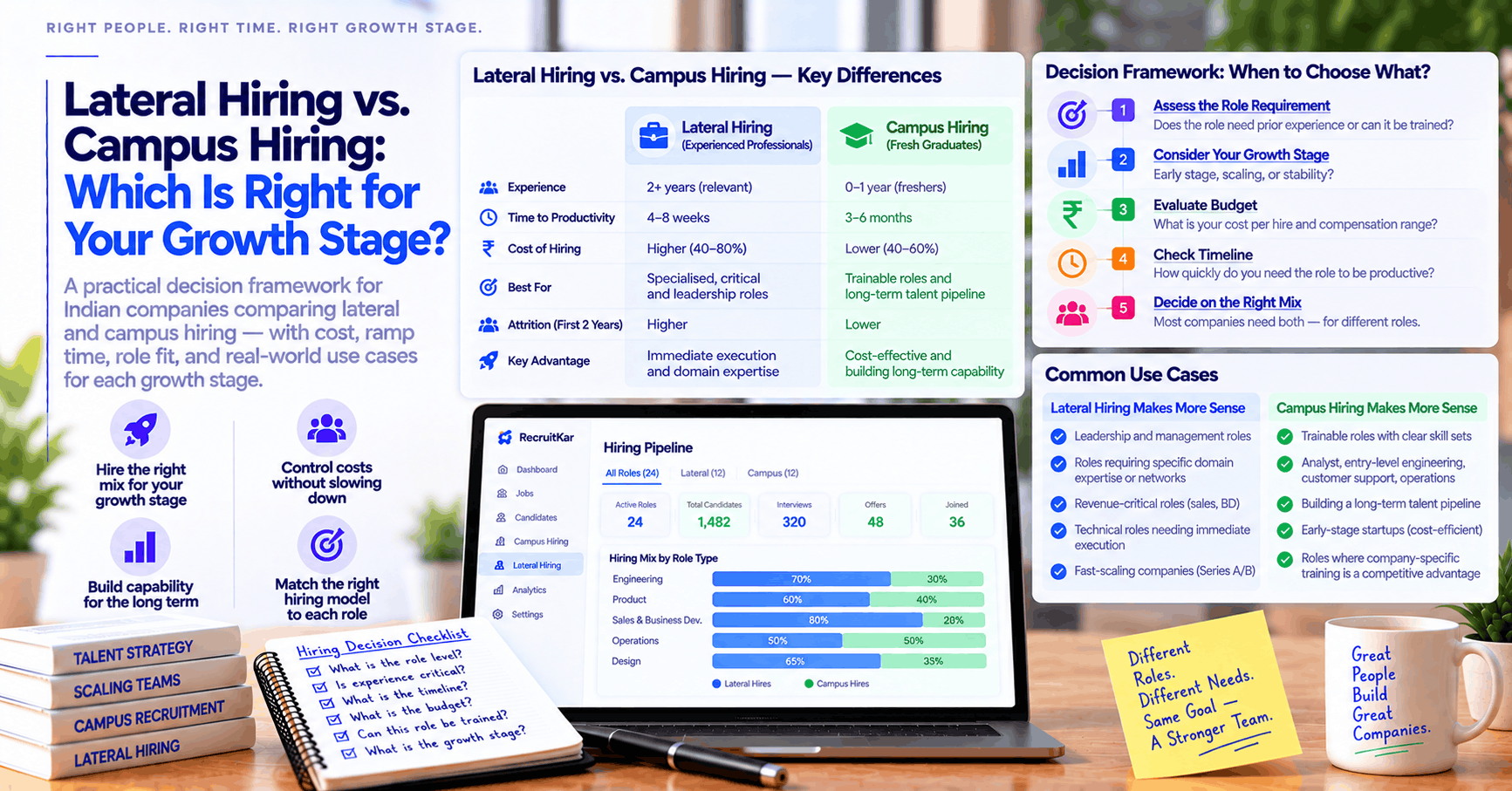
Lateral hiring (bringing in experienced professionals from other organisations) and campus hiring (recruiting fresh graduates directly from colleges) are not competing strategies — they solve different problems, at different costs, with different timelines. A startup that hires only laterally burns cash on experienced salaries for roles a campus hire could fill in three months. A company that hires only from campus misses the execution velocity that experienced hires provide when the business needs to move fast. This post gives you the decision framework — by role type, growth stage, and budget — to choose the right mix. For both hiring motions, RecruitKar's campus recruitment automation and multi-source sourcing pipeline handle the volume and outreach without requiring a separate tool for each.
What "lateral hire" actually means
A lateral hire is an experienced professional joining from another organisation — typically someone with 2+ years of relevant work experience who can contribute independently within weeks rather than months. "Lateral" refers to the fact that they move across from one organisation to another, usually at a comparable or higher seniority level.
This is distinct from:
- Campus hire: A fresher joining directly from their educational institution, typically with little or no full-time work experience
- Promotion: An internal employee moving to a higher role
- Rehire: A former employee returning to the organisation
The lateral vs. campus decision is primarily about the trade-off between speed-to-productivity and cost — and secondarily about what the role actually requires.
The core trade-off: speed vs. cost
Lateral hires are faster to productivity and more expensive. An experienced lateral hire typically reaches independent productivity in 4–8 weeks. They understand professional norms, can navigate ambiguity, have relevant skills already developed, and don't require the foundational training that a fresher needs. They cost more — both in salary (typically 40–80% higher than a comparable campus hire for equivalent output in Year 1) and in recruiting cost (agency fees, Naukri Resdex spend, or LinkedIn sourcing time).
Campus hires are slower to productivity and significantly cheaper. A campus hire typically takes 3–6 months to reach meaningful independent productivity, depending on role complexity and the quality of onboarding and mentoring. The first few months are an investment — training, structured supervision, gradual increase in responsibility. But their total cost of employment in Year 1 is often 40–60% of an equivalent lateral hire's cost, and they typically stay longer (lower attrition in the first 2 years) because they're building their career identity within your company rather than arriving with an established one.
When lateral hiring makes more sense
1. The role requires experience that can't be taught quickly
Some roles need a specific combination of skills and judgment that takes years to develop. A VP of Sales who needs to close ₹2Cr enterprise deals in the first quarter, a DevOps engineer who needs to independently manage a production infrastructure from Day 1, or a finance controller who must handle a board audit within 90 days of joining — these roles cannot absorb a 6-month ramp time. The cost premium of a lateral hire is justified by the time value of the role being productive immediately.
2. The company is in a fast-scaling phase
Series A and Series B companies growing headcount by 50–100% in a year typically need people who can execute independently rather than people who need to be trained before they can execute. The bandwidth for mentoring and structured development is limited when everyone is moving fast — and an inexperienced hire in a critical function during a growth sprint can slow rather than accelerate the team.
3. Domain expertise or network is specifically required
A business development role that requires an existing network of industry contacts, a product manager who needs to have shipped consumer products at scale before, or a compliance officer who needs deep familiarity with RBI regulations — these are roles where the relevant experience is a genuine requirement, not a preference. Campus hiring can't produce this regardless of training investment.
4. The role is senior or leadership-level
Management roles almost universally require lateral hiring — a first-time manager promoted from campus hire takes 2–3 years to develop; a manager hired laterally with 5 years of team leadership experience delivers on their management responsibilities from Week 1. This is the clearest case for lateral hiring.
When campus hiring makes more sense
1. The role is trainable within a structured program
Roles with a well-defined skill set that can be taught — certain engineering positions with good internal tooling and mentorship, analyst roles with structured onboarding, customer success roles with defined playbooks — are strong candidates for campus hiring. The training investment is real but bounded, and the cost savings over the hire's first 2 years are substantial.
2. You have (or can build) the mentorship infrastructure
Campus hiring produces better outcomes when the organisation can provide structured onboarding, a mentoring relationship with a more experienced colleague, and regular feedback in the first 3–6 months. A company that hires 10 campus engineers without a senior engineer available to mentor them has created a slow-burn problem rather than a cost-saving. The infrastructure question — do we have the bandwidth and the people to develop this hire? — must be answered honestly before committing to campus hiring at scale.
3. You're building a long-term team, not plugging an immediate gap
Campus hires who are given real responsibility, genuine growth, and a career within the organisation tend to have longer tenure than lateral hires, who arrive with the option to leave for another lateral move at any time. If the goal is building a stable team with deep institutional knowledge over a 3–5 year horizon, campus hiring produces that outcome more reliably — at a lower total cost — than a continuous cycle of lateral hires who each stay 18–24 months and then move on.
4. Volume roles at standardised entry levels
High-volume hiring for roles that are structurally entry-level — customer support, QA testing, data entry and operations, retail associates — almost always benefits from campus hiring. The skill requirements are trainable, the supply of qualified campus candidates is deep, and the cost efficiency is significant at volume. Spending on lateral hire premiums for roles that could be filled from campus is a straightforward budget inefficiency.
5. When you want to shape culture from the ground up
Founders building culture deliberately sometimes prefer to build it through campus hires who have no prior corporate identity to unlearn. Lateral hires bring habits, expectations, and working styles from previous organisations — some useful, some not. A campus hire builds their professional identity within your culture, which is an advantage when building a specific kind of team environment from scratch.
The hybrid approach: most companies need both
The clean "lateral vs. campus" framing is useful for the decision at the individual role level, but at the organisational level, most Indian companies need a mix — and the mix shifts as the company grows.
Seed to Series A: Mostly lateral hiring. The company is moving too fast for the ramp time that campus hiring requires. Every hire needs to produce output quickly, and the team is too small to absorb a meaningful ratio of trainees. Campus hiring is limited to specific roles where structured programs exist.
Series A to Series B: A deliberate mix. Lateral hiring for senior individual contributors, managers, and specialist roles. Campus hiring begins to scale for volume roles, analyst pipelines, and roles with structured training programs. The company now has enough senior talent to provide mentorship for campus hires.
Series B and beyond: Campus programs formalised as a deliberate talent pipeline strategy. Lateral hiring concentrated at senior, leadership, and specialist levels. Campus hiring feeds the base of the pyramid, with internal promotion and development creating the mid-layer over time. The cost structure becomes more sustainable as the lateral-to-campus ratio shifts.
Cost comparison: lateral vs. campus for equivalent roles (worked example)
Role: Junior Software Engineer, 0–2 years experience level
- Annual CTC: Campus hire ₹5–8 LPA vs. lateral hire (2 years exp.) ₹10–16 LPA
- Recruiting cost: Campus — low (drive + process); lateral — higher (Naukri, sourcing, time)
- Time to independent productivity: Campus — 3–5 months; lateral — 4–8 weeks
- Expected tenure: Campus — 2.5–3 years (lower early attrition); lateral — 1.5–2 years (higher lateral mobility)
- Year 1 total cost (CTC + recruiting): Campus — ₹6–9 LPA equivalent; lateral — ₹12–18 LPA equivalent
- Year 2 total cost: Campus — ₹6–9 LPA (now fully productive); lateral — ₹11–17 LPA
- Year 3 total cost: Campus — ₹7–10 LPA (increment); lateral — likely departed; re-hiring cycle starts
Over a 3-year horizon, the campus hire often produces a meaningfully lower total cost of ownership for equivalent output — once the ramp time is absorbed in Year 1. The lateral hire produces higher output in Year 1 specifically but at a cost that doesn't always justify the premium when evaluated across a longer horizon.
This calculation shifts significantly for senior roles — where a campus hire can't substitute for a lateral regardless of cost — and for roles where speed of delivery in Year 1 has direct revenue implications.
Running both motions simultaneously: the tooling challenge
The operational challenge of running lateral and campus hiring simultaneously is that they're genuinely different workflows:
Campus hiring involves: a shareable apply link distributed across multiple colleges, bulk resume scoring against entry-level criteria, high-volume asynchronous video screening, batch interview days, and offer management at volume — often for dozens of roles being filled in a compressed seasonal window.
Lateral hiring involves: active sourcing from Naukri, LinkedIn, and GitHub; personalised multi-channel outreach to passive candidates; a more intensive interview process with technical assessment; individual offer negotiation; and a longer notice period between offer and join.
Running these as separate processes in separate tools — one spreadsheet for campus, one email thread for lateral — produces the fragmentation that causes candidates to fall through the cracks. A single visual ATS pipeline that handles both motions with separate role-type configurations, both connecting into the same candidate database for reuse across future roles, reduces that overhead meaningfully regardless of which mix you're running.
Frequently asked questions
What is lateral hiring in simple terms? Lateral hiring is recruiting a professional who is already employed elsewhere — hiring them away from another organisation at a comparable or slightly higher level. The "lateral" refers to the sideways move across organisations, as opposed to an internal promotion (moving up within the same company) or a campus hire (joining fresh from education with no professional experience). In India, lateral hiring is the primary sourcing model for most mid-to-senior professional roles.
What is the typical notice period challenge with lateral hires in India? India's long notice periods — commonly 60–90 days for professional roles, sometimes longer at senior levels — mean the gap between offer acceptance and actual joining is significant. This creates risk: a lateral hire who accepts an offer in January may not join until April, during which time they remain in their current employer's environment and are fully available for a counter-offer. Managing the post-offer engagement period — regular contact, team introductions, forward-looking role context — is a critical part of lateral hiring that many companies handle poorly.
How do companies decide the campus hiring intake size each year? Typically by working backward from two inputs: the expected number of junior-level vacancies to be filled in the next 12 months (based on growth plan and historical attrition at those levels), and the expected attrition from the campus hire cohort itself (campus hires have lower early-tenure attrition but it's not zero). A company that needs 40 junior engineers in Year 1 of a new cohort and expects 20% first-year attrition from the campus batch needs to onboard approximately 50 campus hires to net 40.
Is it ever worth hiring a campus graduate for a role that would typically be lateral? Occasionally — particularly for a company that genuinely has the infrastructure to develop talent faster than average, or for a rare campus hire who is demonstrably ahead of their cohort in relevant areas. But this should be a deliberate exception, not a cost-saving shortcut. A role that genuinely requires 3 years of experience to perform adequately will not suddenly become manageable for a fresher because the company hired a "smart" one. The role requirements should drive the experience requirement, not the hiring budget.
What's the ROI difference between lateral and campus hiring over a 5-year horizon? It depends heavily on role type and sector. For high-attrition industries (BPO, retail, certain sales roles), the lateral hire premium and the campus hire ramp time both get "reset" frequently by attrition, and the ROI calculation over 5 years is less clear. For companies that retain employees well — particularly in stable product engineering or operations environments — campus hires who grow into mid-level roles internally often show the highest ROI over a 5-year horizon, because the salary compression at hire compounds with lower recruiting cost and lower attrition over the period.
Run lateral and campus hiring from one pipeline. AI sourcing for experienced hires, shareable apply links and bulk video screening for campus drives — both feeding into the same candidate database and the same ATS. Campus recruitment automation and AI candidate discovery — built for Indian companies running both motions simultaneously.