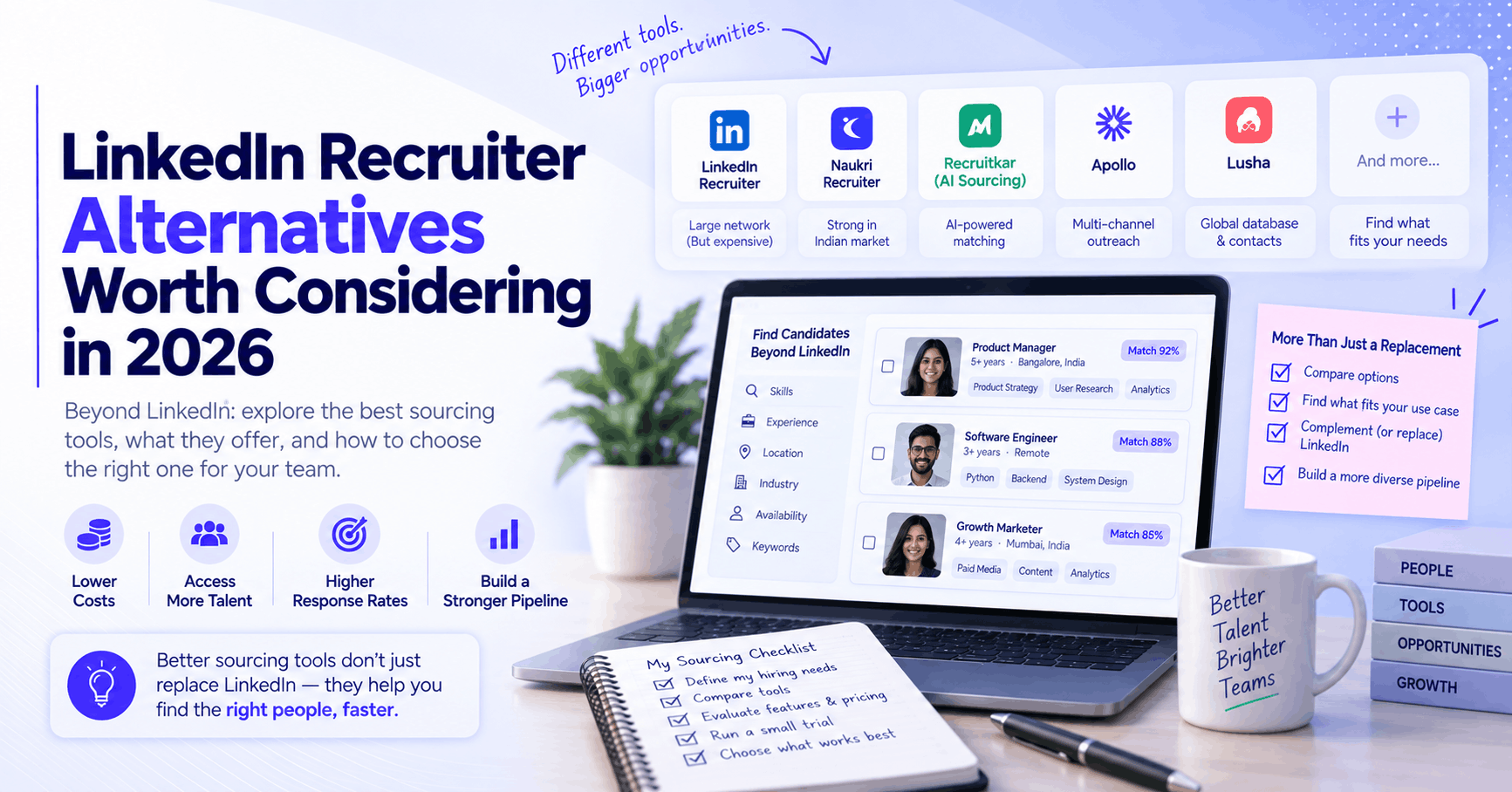
LinkedIn Recruiter is, for many teams, the default starting point for sourcing — it's where a large share of the professional workforce maintains a profile, and its search and InMail features are genuinely useful for reaching passive candidates. It's also expensive, increasingly crowded with recruiters all messaging the same visible candidates, and not the only viable option anymore. This post looks honestly at why teams start evaluating alternatives, what different categories of tools actually offer instead, and how to think through whether switching, supplementing, or staying put makes sense for your situation.
Why teams look for alternatives in the first place
Cost, especially at scale. LinkedIn Recruiter licenses are priced per seat and represent a meaningful line item, particularly for smaller teams or those needing multiple seats across a growing recruiting function. For teams weighing cost against actual usage, it's worth honestly tracking how much of the license's capability gets used versus paid for.
InMail response rates have been declining. As more recruiters use the same platform to reach the same visible, active-on-LinkedIn candidates, response rates to cold InMail outreach have trended downward over time — candidates who are frequently messaged simply respond less, regardless of how well-crafted any individual message is.
It only reaches candidates active on LinkedIn. A meaningful share of the workforce — particularly in high-volume, blue-collar, or certain regional and industry contexts — isn't primarily active on LinkedIn, or maintains a sparse, rarely-updated profile there. Relying solely on LinkedIn sourcing structurally misses these candidates regardless of search sophistication.
Search relies heavily on keyword matching. Like many platforms, LinkedIn's search still leans on matching profile text against search terms, which means candidates who describe their experience differently than the exact terms searched can be missed — the same structural limitation that affects Boolean search more broadly.
It's one tool, not a full pipeline. LinkedIn Recruiter is a sourcing and outreach tool; it doesn't manage the rest of the hiring process (screening, interviewing, pipeline tracking), which means most teams are already using it alongside a separate ATS or additional tools regardless.
What alternatives actually offer, by category
AI-driven sourcing platforms
Tools in this category — built to match candidates to roles based on actual experience and context rather than keyword search — aim to solve LinkedIn's structural keyword-matching limitation directly.Recruitkar's AI candidate discovery, for example, matches candidates against the substance of a job description rather than requiring an exact keyword or title match, which can surface strong candidates a keyword-based LinkedIn search might miss. This category is generally strongest for teams whose primary frustration with LinkedIn is missed matches due to terminology mismatch, rather than cost alone.
Job-board-native recruiter tools
Platforms like Naukri offer their own recruiter-facing search tools, giving direct access to their own large candidate databases — particularly relevant in the Indian market, where Naukri maintains one of the largest active job-seeker pools. These tools are strongest as a sourcing channel specifically, typically requiring a separate ATS or pipeline tool alongside them, and are most useful for teams whose target candidates are more likely to be actively job-searching (and therefore on a job board) rather than passive.
Multi-channel outreach platforms
Rather than replacing LinkedIn sourcing entirely, some tools focus on the outreach layer — combining email, WhatsApp, and voice calling into sequenced, tracked campaigns, addressing the declining-response-rate problem by reaching candidates through channels less saturated with recruiter messages than LinkedIn InMail currently is.Recruitkar's outreach tools, for instance, combine multiple channels in one tracked sequence — this is less a direct LinkedIn replacement and more a complement, useful once a candidate has been identified through any sourcing channel, including LinkedIn itself.
Full-pipeline platforms combining sourcing, outreach, and interviews
Rather than being a point solution for one stage, some platforms aim to consolidate sourcing, outreach, and interview scheduling into one connected pipeline, reducing the fragmentation of using LinkedIn for sourcing, a separate tool for outreach, and yet another for tracking candidates through stages. This category tends to appeal most to teams frustrated less with LinkedIn specifically and more with the overall complexity of managing multiple disconnected tools across the hiring funnel.
What LinkedIn still does better than most alternatives
In the interest of an honest comparison, it's worth naming LinkedIn's genuine strengths clearly, since the goal here isn't to argue it should be abandoned entirely:
Breadth of professional profile data, particularly for white-collar, corporate, and internationally-mobile roles, remains difficult for any single alternative to fully replicate — LinkedIn's scale advantage here is real and substantial.
Passive candidate visibility. Even with declining response rates, LinkedIn remains one of the more effective ways to identify (even if not always successfully engage) passive candidates who aren't actively job-searching but maintain a professional profile.
Brand and credibility signal. A message from a recruiter reaching out through LinkedIn, with a visible company page and mutual connections, can carry more immediate credibility with some candidates than an unfamiliar tool or cold outreach channel, particularly for more senior or established candidates.
Network-based context. LinkedIn's connection graph — mutual connections, shared groups, alumni networks — offers a kind of social proof and warm-introduction pathway that's genuinely hard to replicate through pure database search on another platform.
A realistic way to think about this decision
For most teams, the actual choice usually isn't a clean binary between "keep LinkedIn" and "switch entirely to something else" — it's about identifying which specific frustration is driving the search for alternatives, and addressing that specifically:
If the frustration is primarily cost, evaluate whether a lower-volume LinkedIn tier, combined with a lower-cost sourcing tool for less senior or more standardized roles, meets the need better than a full LinkedIn Recruiter license used across all hiring.
If the frustration is primarily missed candidates due to keyword mismatch, a context-aware AI sourcing tool used alongside LinkedIn (rather than instead of it) can catch candidates a keyword-based LinkedIn search structurally misses, without giving up LinkedIn's genuine strengths for the searches where it does work well.
If the frustration is declining response rates, the fix may have less to do with LinkedIn itself and more to do with outreach strategy broadly — diversifying channels (multi-channel sequencing rather than relying solely on InMail) often addresses this more directly than switching sourcing platforms entirely.
If the frustration is tool fragmentation, a consolidated platform that handles sourcing, outreach, and pipeline tracking together may reduce more overall friction than optimizing any single stage in isolation, even if LinkedIn remains one input into that consolidated sourcing effort.
A quick comparison by use case
If your main concern is...
Consider...
Why
- Cost at scale — Lower-cost sourcing tools for standard/junior roles, reserving LinkedIn for senior or specialized searches. Avoids paying full-seat pricing for roles that don't need LinkedIn's specific strengths.
- Missed candidates due to keyword mismatch — Context-aware AI sourcing, used alongside LinkedIn. Catches candidates whose profiles use different terminology than your exact search.
- Declining InMail response rates — Multi-channel outreach (email, WhatsApp, voice). Reaches candidates through less saturated channels than LinkedIn InMail.
- Tool fragmentation across sourcing, outreach, and pipeline — Consolidated platform combining all three. Reduces the overhead of managing multiple disconnected systems.
- Reaching candidates who aren't LinkedIn-active — Job-board-native tools, or broader multi-source pipelines. LinkedIn structurally can't reach candidates who don't maintain an active profile there.
Combining LinkedIn with other channels, rather than replacing it outright
For most teams, the most realistic and lowest-risk approach isn't dropping LinkedIn and switching to something else entirely — it's treating LinkedIn as one input among several, feeding into a broader sourcing and outreach strategy rather than being the entire strategy. A candidate identified through LinkedIn search can still be brought into a pipeline that also draws from job boards, referrals, direct applications, and AI-matched discovery — and once identified, outreach doesn't need to stay confined to InMail; sequencing a LinkedIn-sourced candidate through email and WhatsApp follow-up, for instance, often produces better engagement than relying on InMail alone, regardless of how the candidate was originally found. This blended approach captures LinkedIn's genuine strengths (breadth of professional data, passive candidate visibility) while directly addressing its specific weaknesses (response rate decline, keyword-dependent search, coverage gaps) through complementary tools rather than requiring an all-or-nothing platform decision.
What a phased evaluation might look like
Rather than committing to a full platform switch immediately, a lower-risk approach is running a pilot: select one or two open roles, source half through your existing LinkedIn process and half through an alternative tool or approach, and compare actual outcomes — response rates, quality of shortlisted candidates, time to first qualified candidate, and ultimately whether the role gets filled successfully through either path. This kind of direct, role-matched comparison tends to surface more reliable, actionable signal than evaluating tools based on feature lists or vendor claims alone, and it limits the risk of a full switch before you've confirmed an alternative genuinely performs better for your specific candidate pool and role types.
What to evaluate if you're considering a switch or addition
- Does the alternative actually reach candidates LinkedIn doesn't (different geography, different active-user base, different candidate type), or is it largely redundant with what LinkedIn already surfaces?
- How does pricing actually compare at your real usage volume, not just headline per-seat cost — a credit or usage-based alternative might cost more or less than a LinkedIn license depending on actual hiring volume.
- Does it integrate with or feed into your existing pipeline, or does adopting it add yet another disconnected tool to manage alongside LinkedIn rather than genuinely simplifying anything?
- What's the realistic learning curve for your team, since a tool that's technically more capable but takes months to adopt effectively may not pay off as quickly as expected.
The bottom line
LinkedIn Recruiter remains a genuinely strong tool for certain use cases — broad professional data, passive candidate visibility, and network-based context — and it's not something most teams need to abandon entirely. But it's also no longer the only reasonable option, and its real limitations (cost at scale, declining InMail response rates, keyword-dependent search, coverage gaps for candidates who aren't LinkedIn-active) are worth weighing honestly against what alternatives in each category actually solve. The most practical path for most teams isn't a wholesale replacement decision — it's identifying the specific frustration driving the search for alternatives, and addressing that gap directly, often by using a complementary tool alongside LinkedIn rather than choosing one over the other entirely.