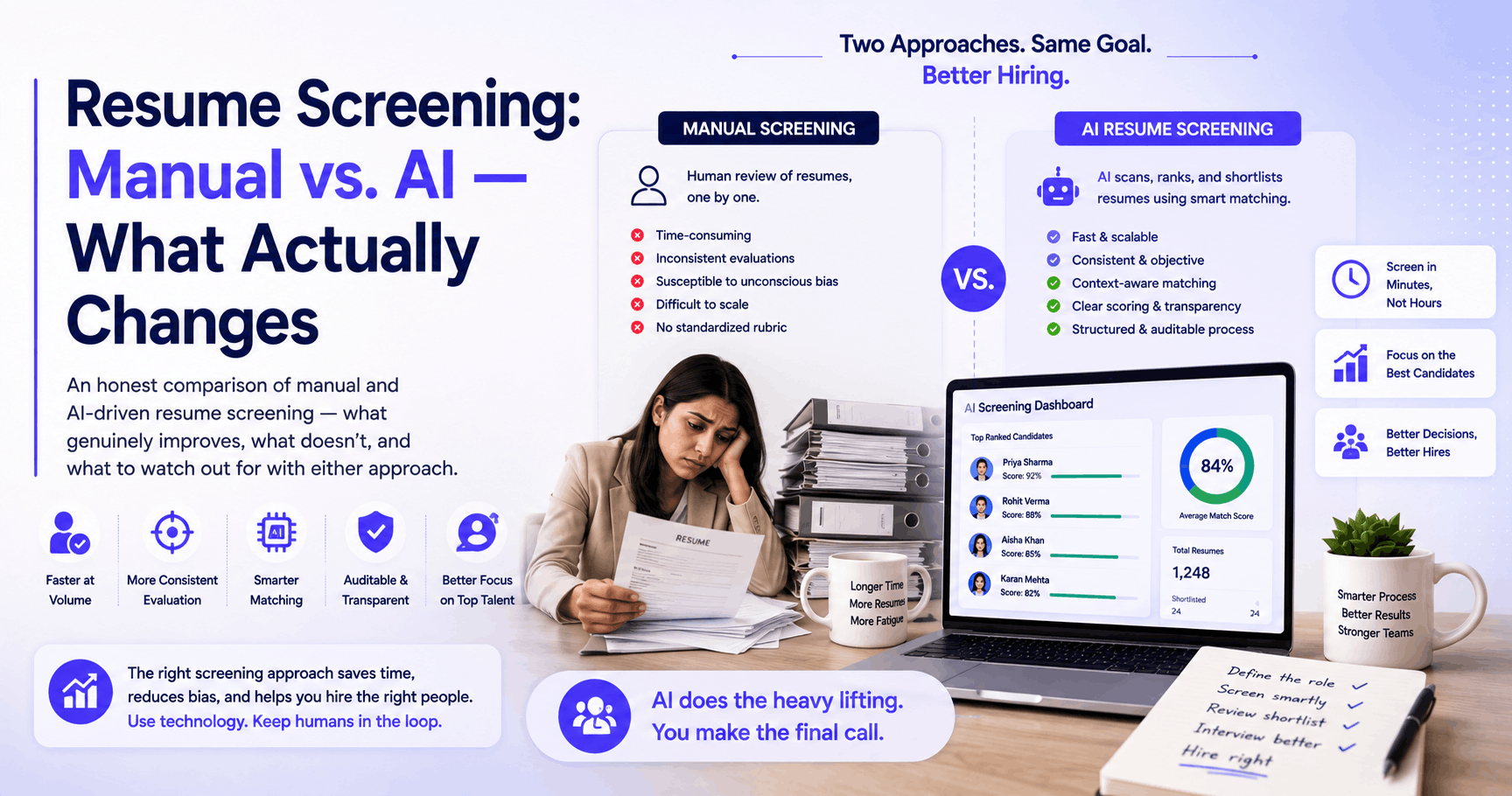
Resume screening has a bad reputation on both sides of the hiring table. Candidates complain about being "rejected by a robot" without ever reaching a human. Recruiters complain about spending entire days scrolling through hundreds of resumes, most of which were never going to be a fit, looking for the handful worth a closer look. Both complaints are pointing at the same underlying problem: screening at any real volume is genuinely hard to do well, whether a person or a system is doing it.
This post is a straightforward comparison — not a case for AI screening being strictly better, because it isn't strictly better, just different in specific, sometimes trade-off-heavy ways. The goal is to help you actually decide what fits your hiring volume and risk tolerance, not to make you feel like you're using the "wrong" one.
What manual resume screening actually involves
Manual screening means a person — usually a recruiter, sometimes a hiring manager — reads through resumes and decides who advances. In theory, this allows for nuanced judgment: recognizing potential in a nontraditional career path, understanding context behind an employment gap, or noticing relevant experience described in unconventional language that a keyword search might miss.
In practice, at any real volume, manual screening runs into predictable problems:
- Fatigue and inconsistency. Decision quality on resume 100 of the day is rarely as sharp as on resume 10 — attention degrades, and two recruiters (or even the same recruiter on different days) will often make different calls on similar resumes.
- Unconscious bias. Names, colleges, employment gaps, and even resume formatting can trigger unconscious associations that have nothing to do with actual job fit — well-documented in hiring research, and a real risk regardless of how fair-minded an individual recruiter believes themselves to be.
- Speed limits. A person can only read so many resumes per hour with real attention. For a role attracting hundreds or thousands of applications, manual screening alone becomes a genuine bottleneck, not just a slow process.
- No consistent, documented rubric. Without a written scoring framework, manual screening decisions often live only in a recruiter's head — hard to audit later, hard to hand off if someone leaves the team mid-process, and hard to explain if a decision is ever questioned.
What AI resume screening actually involves
AI screening tools score or rank candidates against a role automatically, based on parsed resume content compared to the job's requirements. There's a meaningful distinction worth understanding here, since not all "AI screening" works the same way:
Keyword-based systems (the older generation, still common in many legacy ATS platforms) match resumes against specific terms in the job posting. This is exactly where the "robot rejected my resume" reputation comes from — a genuinely qualified candidate who described their experience in different words than the job posting used can get filtered out for no substantive reason.
Context-aware systems (the newer generation) attempt to understand what a candidate actually did — the substance of their experience — rather than matching exact phrases, which in principle catches strong candidates that keyword matching would miss. This is a real improvement over pure keyword matching, though it's not a perfect solve, and the quality varies significantly between vendors.
In either case, the system typically produces a score or rank, which a recruiter then uses to prioritize which resumes to actually review — the AI narrows the pool; a human still generally makes the final call on who advances to an interview.
Where AI screening genuinely helps
- Consistency across every candidate. The same criteria get applied to resume 1 and resume 1,000, without the fatigue-driven drift that affects manual review at scale.
- Speed at volume. For roles attracting hundreds or thousands of applications, AI screening turns an unmanageable pile into a ranked, prioritized shortlist in a fraction of the time manual review would take — this is the single clearest, most defensible use case.
- Surfacing candidates a keyword search would miss. Context-aware matching can catch relevant experience described in nonstandard language — someone whose resume says "coordinated cross-functional launches" instead of "project management," for instance — that a rigid keyword filter would have excluded.
- A documented, auditable rubric. A scoring system based on defined criteria creates a record of why a candidate was ranked where they were, which is genuinely useful both for internal consistency and for being able to explain a decision later if it's ever questioned.
Where AI screening genuinely falls short — and this matters
It would be dishonest to present AI screening as a clean upgrade without naming the real risks clearly.
- It can encode and scale existing bias. If a scoring model is built or trained using historical hiring data, and that historical data reflects biased outcomes (certain colleges, employment gaps, or backgrounds having been favored or penalized in the past for reasons unrelated to actual competence), the system can learn and repeat that pattern — consistently, at scale, across every candidate, which is a meaningfully different problem than one biased individual recruiter making inconsistent calls.
- It can miss context that matters. A career change, a gap for caregiving or health reasons, or nontraditional experience that doesn't map cleanly onto standard resume language can be undervalued by a system that's pattern-matching against more conventional resumes, even a context-aware one.
- Poor implementations still lean heavily on keywords. Not every tool marketed as "AI screening" is actually doing sophisticated context matching — some are keyword systems with better marketing. It's worth asking a vendor directly how their matching actually works, rather than assuming "AI" implies genuine semantic understanding.
- It can create a false sense of objectivity. A numeric score can feel more objective than a human's gut call, even when the underlying model has its own embedded biases — the appearance of objectivity is not the same thing as actual fairness, and it's worth resisting the instinct to trust a score simply because it's a number.
- Regulatory scrutiny is increasing. Automated employment decision tools are facing growing oversight — New York City's Local Law 144 requires bias audits and disclosure for tools used in hiring decisions, and the EU AI Act classifies hiring-related AI systems as high-risk, with corresponding compliance obligations. This isn't a reason to avoid AI screening, but it is a reason to take bias testing seriously rather than as an afterthought.
A fair side-by-side
Manual screening
- Speed at high volume: Poor — becomes a real bottleneck
- Consistency across candidates: Variable — depends on fatigue, reviewer, day
- Nuance for nontraditional backgrounds: Can be strong, if the reviewer is thoughtful
- Risk of unconscious bias: Real, and hard to audit or prove
- Documentation / auditability: Weak, unless deliberately logged
- Cost at scale: High (recruiter time)
- Best suited for: Senior, nuanced, or low-volume roles
AI screening
- Speed at high volume: Strong — this is its core advantage
- Consistency across candidates: High — same criteria applied every time
- Nuance for nontraditional backgrounds: Depends heavily on implementation quality
- Risk of unconscious bias: Real, but more visible and auditable if tested properly
- Documentation / auditability: Strong, if the scoring rubric is transparent
- Cost at scale: Lower per-resume, but requires upfront tool investment
- Best suited for: High-volume roles with clearer, more standardized requirements
Neither column is universally better — the right approach genuinely depends on role type, hiring volume, and how much you're willing to invest in getting either approach right.
What "doing it well" looks like, regardless of approach
If you're screening manually: build a written rubric before you start reading resumes, not after — deciding what actually matters ahead of time reduces the fatigue-driven drift that happens when criteria get looser as the pile gets longer. Consider a second reviewer for borderline cases, and periodically audit a sample of your own rejected resumes to check for patterns worth questioning.
If you're using AI screening: ask the vendor directly how the scoring model was built and whether it's been tested for bias across different candidate groups. Use the score to prioritize and shortlist, not as an automatic reject — a human should generally review borderline or rejected candidates before those decisions are finalized, particularly early in using a new tool, until you've built confidence in how it's actually scoring. Recruitkar's approach, for instance — scoring resumes against a specific role during bulk upload — is designed to prioritize a shortlist for recruiter review rather than auto-reject candidates outright, which is the safer pattern regardless of which vendor's tool you're using.
Either way: revisit your criteria periodically. A rubric or scoring model built for a role six months ago may not reflect what the team actually needs today, and stale criteria — whether applied by a person or a system — quietly produce worse hiring decisions over time.
A realistic hybrid approach
For most teams, the honest answer isn't "manual vs. AI" as a binary choice — it's using each where it's genuinely strongest. AI screening handles the volume problem: turning an unmanageable pile of applications into a ranked, prioritized shortlist quickly and consistently. Manual review then handles the nuance problem: a human looking closely at that shortlist, with real attention (because it's now a manageable size), catching context an automated system might miss and making the actual judgment call. This combination tends to outperform either approach used in isolation — AI without human review risks encoding bias at scale unnoticed; manual review without any automated first pass simply doesn't scale past a certain volume of applications.
Signs your current screening process needs attention
A few warning signs, applicable to either approach, worth checking against your own process:
- Wildly inconsistent shortlists for similar roles. If the same role posted twice, a few months apart, produces meaningfully different-looking shortlists with no clear reason why, that's usually a sign the screening criteria weren't actually consistent — whether that's due to a different manual reviewer or a model that's drifted from what you originally intended it to prioritize.
- A shortlist that skews heavily toward one profile type. If your shortlists consistently favor a narrow demographic, educational background, or career path in ways that don't obviously map to the actual job requirements, that's worth investigating directly rather than assuming it reflects genuine differences in candidate quality.
- No one can explain why a specific candidate was screened out. Whether the decision was made by a person or a system, if nobody can articulate the actual reason a candidate didn't advance, that's a documentation and accountability gap worth closing — both for fairness and for being able to answer a candidate who asks.
- Screening time keeps growing even as your team's process supposedly matures. If manual review time per resume isn't improving even after establishing a clearer rubric, or if an AI tool's shortlist still requires extensive manual re-review to feel trustworthy, the underlying criteria — not just the method — probably need revisiting.
A few common questions
Does using AI screening mean no human ever looks at rejected resumes? It shouldn't, in a well-designed process. A responsible implementation uses AI to prioritize and shortlist, with a human reviewing at least a sample of lower-scored or borderline resumes — not treating an AI score as an automatic, unreviewed rejection.
Can a candidate ask how they were screened? Increasingly, yes — and it's a fair question. Growing regulatory expectations around transparency in automated hiring tools mean this is a reasonable thing for candidates to ask and for companies to be able to answer clearly.
Is manual screening always more accurate for senior roles? Generally, senior and highly specialized roles benefit more from human nuance than high-volume automated scoring, simply because the criteria for "fit" at that level are harder to reduce to a rubric — but even senior-role screening benefits from a written, consistent framework rather than pure gut instinct.
How do you know if an AI screening tool is actually biased? The honest answer is that you often can't know without deliberate testing — reviewing outcomes across different demographic groups, checking whether rejection rates vary in ways unrelated to actual qualification. This is exactly why asking a vendor about their bias-testing process matters, and why periodic audits of outcomes (not just intentions) are worth doing regardless of which screening method you use.
The bottom line
Neither manual nor AI resume screening is a clean solution on its own — manual screening doesn't scale and carries its own unaudited bias risk; AI screening scales well but can quietly encode and amplify bias if it isn't tested and monitored carefully. The honest, defensible approach for most teams is a hybrid: let automation handle volume and consistency, keep a human genuinely reviewing the output rather than rubber-stamping it, and treat both the rubric and the model as things worth revisiting, not settling once and forgetting.