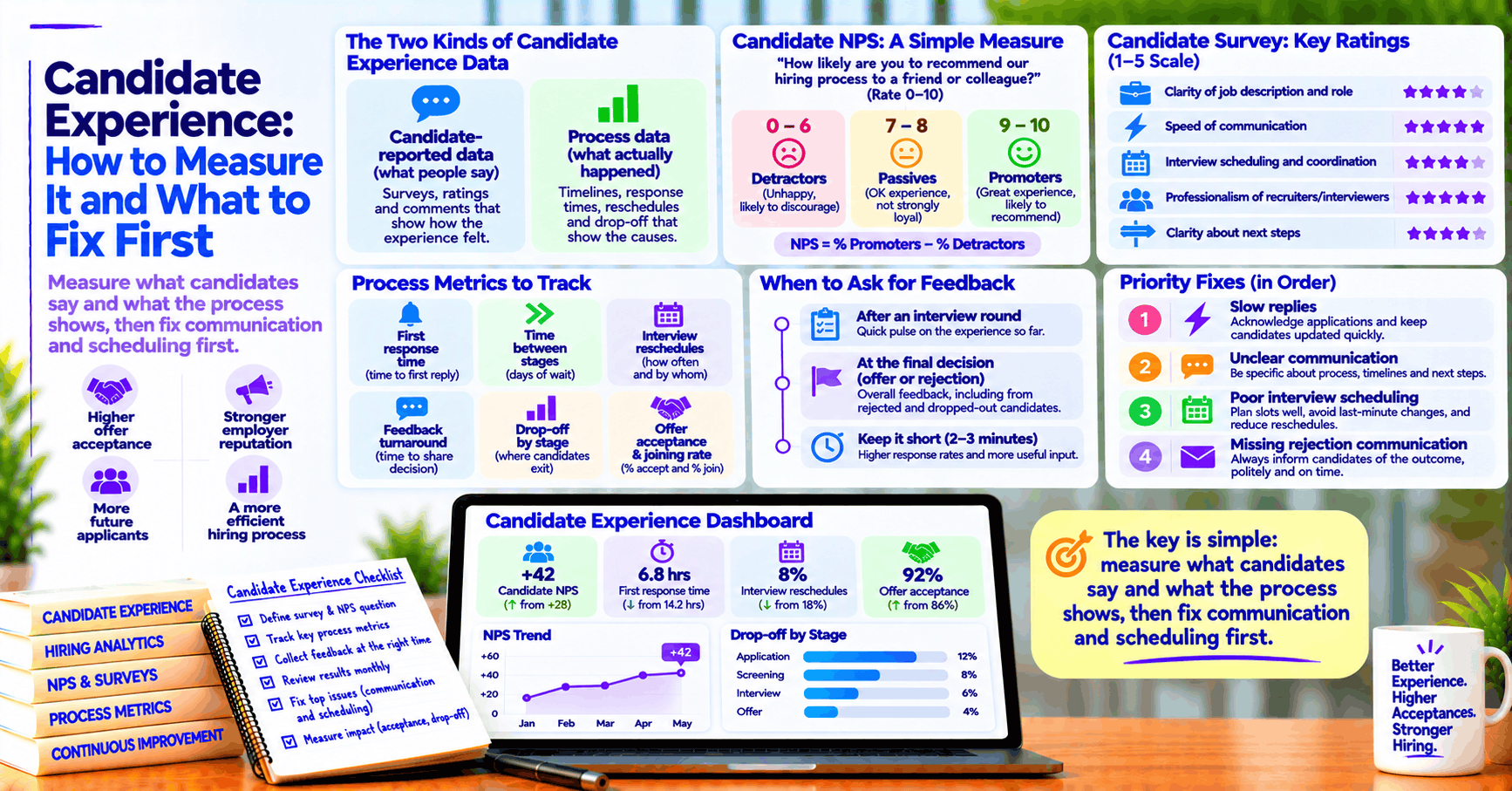
To measure candidate experience, combine two things: what candidates tell you, through short surveys and a candidate NPS question, and what your process shows, such as response time, number of follow-ups, and drop-off at each stage. Then fix the biggest gaps first, which are usually slow replies, unclear communication, and poor interview coordination. Consistent, timely messaging through RecruitKar's outreach tools makes it easier to improve the experience and to ask candidates for feedback at the right moments. This guide shows what to measure, how to run a simple survey, and where to focus first.
What Candidate Experience Actually Means
Candidate experience is how a person feels about your company based on every interaction they have during hiring. It starts when they first see a job post or receive your message, and it continues through screening, interviews, the offer, and the notice period. It even includes how you treat people you reject.
It matters for practical reasons:
Acceptance. Candidates who feel respected are more likely to accept offers and to join.
Reputation. People talk. Candidates share experiences with friends, colleagues, and on review sites and social media, and this shapes who applies to you later.
Future hiring. A rejected candidate who was treated well may apply again or recommend others.
Customers. In many businesses, candidates are also customers or future customers.
Efficiency. Many experience problems, such as silence, repeated questions, and rescheduling, are also process problems that waste your team's time.
Good candidate experience does not mean being soft on standards. It means being clear, timely, respectful, and fair.
Why Many Teams Do Not Measure It
Most recruiting teams track time to fill and cost per hire, and few track how candidates feel. The usual reasons are:
No one owns the topic.
Candidates who are rejected seem unlikely to respond.
Teams worry that feedback will be negative.
Data sits in different tools, so it is hard to collect.
These are all fixable. You do not need a large programme. A short survey, a few process measures, and a monthly review are enough to start.
The Two Kinds of Candidate Experience Data
A useful measurement approach combines two types of information.
1. Candidate-reported data (what people say). Survey answers, ratings, and comments. This tells you how the experience felt.
2. Process data (what actually happened). Response times, number of touchpoints, interview delays, and drop-off by stage. This tells you what caused the feeling.
Using only surveys gives you opinions without causes. Using only process data gives you numbers without meaning. Together they show what to fix.
Candidate-Reported Measures
Candidate NPS
Net Promoter Score, adapted for candidates, asks one question: "How likely are you to recommend our hiring process to a friend or colleague?" Candidates answer on a scale from 0 to 10.
The standard way to calculate it:
Promoters score 9 or 10.
Passives score 7 or 8.
Detractors score 0 to 6.
NPS equals the percentage of promoters minus the percentage of detractors.
Follow the number with an open question: "What is the main reason for your score?" The comments are usually more useful than the number.
Candidate NPS works best when you ask all groups, including people you rejected and people who dropped out. If you only ask hired candidates, you will get an unrealistically positive picture.
Short satisfaction ratings
You can also ask candidates to rate specific parts of the process on a five-point scale, such as:
Clarity of the job description and role
Speed of communication
Professionalism of recruiters and interviewers
Fairness of the interview
Clarity about next steps
Overall experience
These ratings help you pinpoint where the experience breaks down.
Open comments
One or two free-text questions often give the richest information. For example: "What was the best part of your experience?" and "What is one thing we could do better?"
Process Measures to Track Alongside Surveys
These measures come from your own pipeline and do not require candidates to do anything.
First response time. How long between a candidate applying and receiving a first reply?
Time between stages. How many days do candidates wait between screening, interviews, and decisions?
Interview reschedules. How often are interviews moved, and by whom? Reschedules caused by your team hurt the experience.
Feedback turnaround. How long after the final interview does a candidate hear the outcome?
Drop-off by stage. At which stage do candidates stop responding or withdraw?
Offer acceptance and joining rate. Of candidates who receive an offer, how many accept, and how many actually join?
Reasons for withdrawal. When candidates pull out, what do they say?
Rejection communication. What share of rejected candidates receive a response at all?
A central pipeline, such as the RecruitKar ATS pipeline, puts these timestamps and stages in one place, so you can see where candidates wait the longest or disappear.
When to Ask for Feedback
Timing affects both response rates and the quality of answers. Consider surveying at several points.
After application or first screening. Captures the first impression and clarity of the process.
After interviews. Captures how interviewers and scheduling felt, while memory is fresh.
After the final decision, for both selected and rejected candidates. Rejected candidates often give the most honest feedback.
After joining, perhaps 30 to 90 days in. New hires can compare what they were told with what they found.
After withdrawal. A short note to candidates who dropped out can reveal fixable problems.
Do not survey at every step, or candidates will tire of it. For a simple start, pick two touchpoints: after interviews and after the final decision.
A Simple Candidate Experience Survey Template
Keep the survey under two minutes. Here is a starting template.
Introduction: "Thank you for taking part in our hiring process for [Role]. We would value your honest feedback to help us improve. This takes about two minutes, and your answers will be used only to improve our process."
Questions:
How likely are you to recommend our hiring process to a friend or colleague? (0 to 10)
What is the main reason for your score? (open text)
Please rate the following from 1 (poor) to 5 (excellent):
Clarity of the job description and what to expect
Speed of communication from our team
Ease of scheduling interviews
Professionalism and respect from interviewers
Clarity about next steps and timelines
Did you feel the interview questions were fair and relevant to the role? (Yes / Mostly / No)
What is one thing we did well? (open text)
What is one thing we could improve? (open text)
Optional: May we contact you to learn more about your feedback? (Yes / No)
Closing: "Thank you. Your feedback helps us build a better experience for future candidates."
Offer anonymity where possible. Candidates are more honest when they believe their answers will not affect the decision. State clearly whether answers are anonymous or linked to their record.
How to Send the Survey So People Actually Reply
Response rates depend heavily on how and when you ask.
Use the channel candidates already respond on. For many candidates in India, this is WhatsApp or a short message. For others it is email. Using WhatsApp outreach through RecruitKar or email outreach, you can send the same short request in a consistent format.
Keep it very short. Two minutes or less. Mobile-friendly.
Ask soon after the interaction. Feedback is better when the experience is fresh.
Explain why you are asking. A short, honest reason works well.
Avoid making it feel obligatory or tied to the outcome. For rejected candidates, send it separately from the rejection message or after a short gap.
For frontline roles, consider a short phone call. A quick two- or three-question conversation through voice calls can give more honest answers than a form for candidates who prefer talking to typing.
How to Read the Results
Once responses come in, resist the urge to focus on one score. Look at patterns.
Compare groups. Look at feedback from hired, rejected, and withdrawn candidates separately. A big gap between groups is informative.
Look for repeated themes in comments. If several candidates mention slow replies or confusing interview logistics, that is a priority, whatever the average score says.
Segment by role, location, and recruiter or hiring manager. An overall average can hide a team or process that is performing very differently.
Track change over time. A single NPS number matters less than whether it is improving. Review monthly or quarterly.
Avoid overreacting to a small sample. A handful of responses can mislead. Treat early results as signals, not conclusions, and gather more before making large changes.
Close the loop. Share what you learned and what you changed with your team, and where appropriate, with candidates.
What to Fix First: A Priority Order
Not every problem deserves equal attention. In most hiring processes, the following issues come up most often and tend to have the biggest effect. Fix them roughly in this order.
1. Silence and slow responses
The most common complaint from candidates anywhere is not hearing back. Set a clear standard, such as acknowledging every application within a defined number of days and replying to candidate questions within one working day. Automate acknowledgements where you can, and make sure humans handle anything more personal.
2. Unclear communication about the process
Candidates want to know how many rounds there will be, who they will meet, how long it will take, and when they will hear back. Share this at the first conversation and update them if timelines change. Silence after an interview is especially frustrating.
3. Poor interview scheduling
Last-minute changes, unclear joining links, interviewers who are late, and long gaps between rounds all leave a bad impression. Use a clear scheduling process with confirmations and reminders. Interview scheduling in RecruitKar can help reduce back-and-forth and no-shows for both sides.
4. Rejections that never arrive
A short, respectful rejection is far better than silence. Send it promptly, thank the candidate, and where appropriate give brief, honest, job-related feedback. Even a standard template, personalised with the candidate's name and role, shows respect.
5. Misleading or incomplete job descriptions
If the role, pay range, location, or working hours differ from what candidates were told, trust breaks quickly. Make sure your job posts and recruiter conversations match the reality of the job.
6. Unprepared or inconsistent interviewers
Candidates notice when interviewers have not read their CV, ask random questions, or contradict each other. Brief interviewers, share candidate information beforehand, and use structured questions and scorecards so interviews feel fair and relevant.
7. Long, repetitive application processes
Asking candidates to enter the same details multiple times, or to complete long forms at the start, loses good people. Keep first-stage applications short.
8. Offer and notice period handling
A good process can fall apart after the offer. Delays in the offer letter, unclear compensation breakdowns, and silence during the notice period cause drop-offs. Keep in touch regularly and make joining formalities simple.
9. Onboarding gaps
Candidate experience does not end at the offer. Make sure new joiners know where to go, who to meet, and what to expect on day one.
Start with the first three. They are usually fixable quickly, cost little, and affect many candidates.
Building a Simple Measurement Routine
You do not need a large programme. A light routine works well.
Week 1: Set up. Choose two or three process measures and one short survey. Decide who owns them. Pick the channels you will use to send surveys.
Weeks 2 to 4: Collect. Send the survey after interviews and after final decisions. Record process data from your pipeline.
Monthly: Review. Meet briefly with recruiters and hiring managers. Look at candidate NPS, key themes from comments, and the process measures. Pick one or two improvements for the next month.
Quarterly: Step back. Compare trends over time, segment by role or team, and update your priorities.
Keep the focus on action. A review that produces no change will lose the team's attention quickly. If you are a small team building your first process, RecruitKar's startup solution shows how you can keep sourcing, outreach, and tracking organised without heavy tooling. To see how the pieces fit together, read why recruiting teams choose RecruitKar.
Common Mistakes in Measuring Candidate Experience
Surveying only hired candidates. You will miss the people with the most useful criticism.
Collecting feedback and doing nothing. If candidates see no change, trust in the process, and in future surveys, falls.
Asking too many questions. Long surveys get few responses and tired answers.
Focusing on a single score. The number matters less than the reasons behind it.
Ignoring process data. Survey comments tell you what people felt; process data tells you why.
Making feedback feel risky. If candidates believe honest answers will hurt their chances, they will not give them.
Blaming candidates for low response. Low response is often a sign that the survey is too long, too late, or sent through the wrong channel.
A Note on Candidate Data and Privacy
This article is for general information and is not legal advice. Candidate feedback and survey responses can be personal data, especially when linked to a named individual. Be clear about what you collect, why, who can see it, and how long you keep it. Have your legal counsel or HR compliance advisor review your survey wording, consent language, and data retention approach.
Frequently Asked Questions
1. How do you measure candidate experience?
Combine candidate-reported data with process data. Ask candidates a short survey that includes an NPS-style recommendation question and a few ratings, and track measures from your pipeline such as first response time, time between stages, interview reschedules, and drop-off by stage. Review both together each month to see what to fix.
2. What is candidate NPS and how is it calculated?
Candidate NPS asks candidates how likely they are to recommend your hiring process on a scale of 0 to 10. Scores of 9 and 10 are promoters, 7 and 8 are passives, and 0 to 6 are detractors. Subtract the percentage of detractors from the percentage of promoters to get the score. Always add an open question asking for the reason behind the rating.
3. When should I send a candidate feedback survey?
Common moments are after interviews and after the final decision, for both selected and rejected candidates. Some teams also survey new joiners after 30 to 90 days and send a short note to candidates who withdrew. Avoid surveying at every step, and start with one or two touchpoints.
4. Should I ask rejected candidates for feedback?
Yes, but handle it thoughtfully. Rejected candidates often give the most honest and useful feedback. Send the request separately from the rejection message or after a short gap, keep it short, make it optional, and be clear about how their answers will be used. Do not pressure anyone to respond.
5. What is the first thing to fix to improve candidate experience in India?
Start with communication: reply to applications and questions quickly, tell candidates what the process will look like, and make sure they hear the outcome after every interview. Then improve interview scheduling and send respectful rejections. These fixes are usually inexpensive and affect most candidates. Use candidate feedback and your own process data to decide what comes next.
Final Thoughts
Measuring candidate experience does not need to be complicated. Ask a short set of questions, track a few process measures, review them regularly, and fix the biggest problems first, which are usually communication and scheduling. Candidates notice when a company is clear, responsive, and respectful, and they remember it.
If you want your outreach, interview scheduling, and pipeline tracking connected so you can respond faster and see where candidates get stuck, explore RecruitKar and see how it fits your hiring workflow.