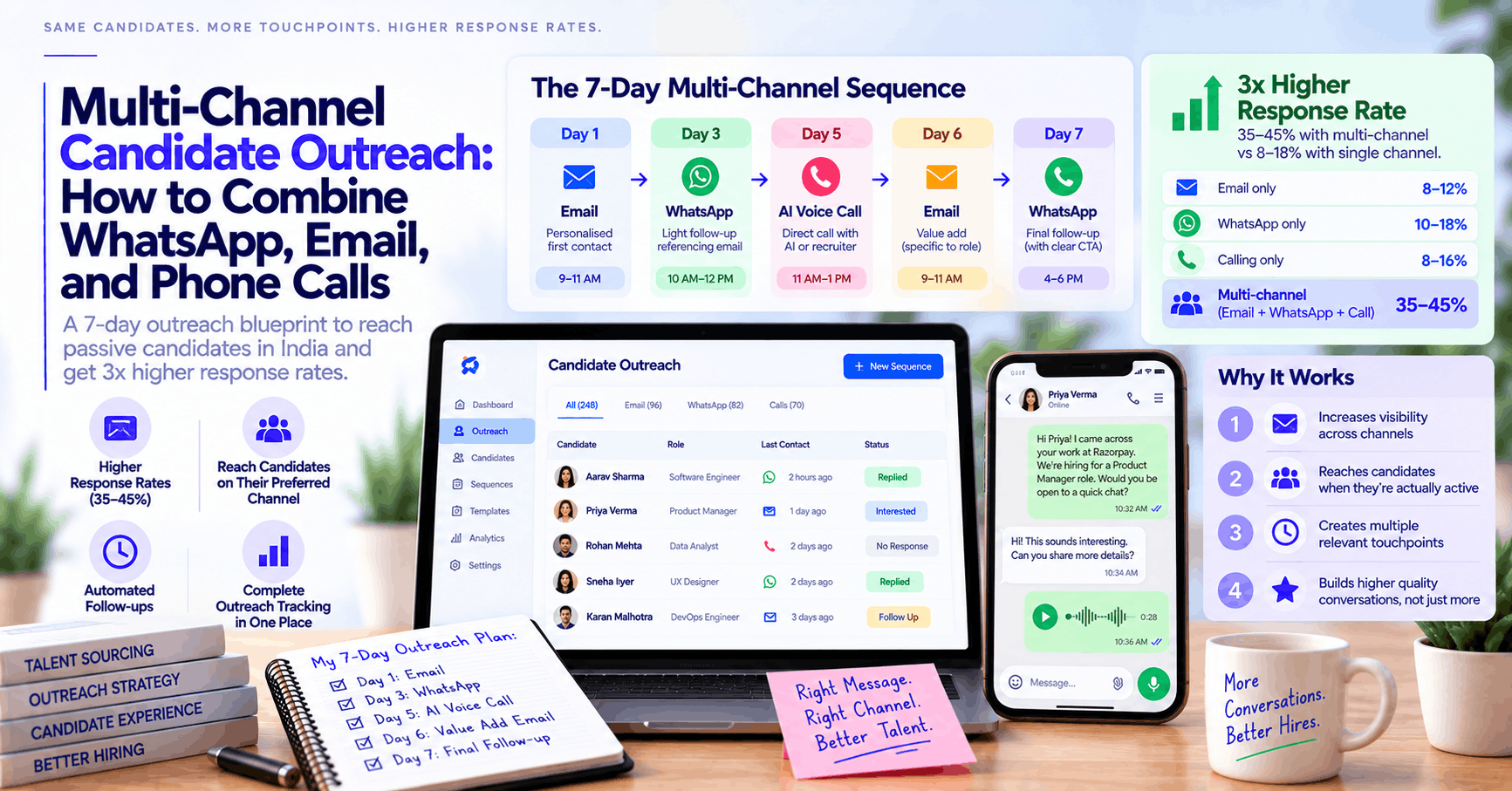
Single-channel outreach — email only, or WhatsApp only, or calling alone — typically produces response rates of 8–18% with passive candidates in India. A coordinated 7-day sequence across all three channels — Email → WhatsApp → AI Voice Call → Final Follow-up — consistently achieves 35–45% response rates on the same candidate pool, because it reaches candidates where they're actually paying attention rather than betting everything on one channel they may not be monitoring. RecruitKar's unified candidate outreach hub runs all three channels from one interface, with response tracking across each touchpoint, so a recruiter sees the full contact history rather than managing three separate tools.
This post maps out the exact 7-day sequence, the message content for each touchpoint, and the decision logic that determines what happens next based on how (or whether) a candidate responds.
Why single-channel outreach underperforms, and why it's getting worse
The core problem isn't that email is dead, or that WhatsApp is oversaturated, or that candidates don't pick up phone calls. It's that no single channel reaches all candidates at the moment they're paying attention, and the overlap between "candidates who respond to email" and "candidates who respond to WhatsApp" is smaller than most recruiters assume.
Some candidates — typically more senior, more formally oriented professionals — check their email regularly and find a cold InMail or email from a recruiter entirely acceptable. Others — particularly mid-level and operational candidates for whom WhatsApp is the primary professional communication channel — won't see an email for three days but will see a WhatsApp message within the hour. And some candidates, particularly those who are genuinely passive and not monitoring either channel for job-related messages, are most reachable via a direct phone call that creates an immediate conversation.
The response rate gap between single-channel and multi-channel isn't because the multi-channel version is more persuasive — it's because more candidates are reached at a moment when they're actually present to respond.
Multi-channel outreach doesn't just diversify reach — it creates multiple distinct impressions across different contexts, each of which is easier to notice than one message lost in a crowded inbox.
The second reason single-channel is getting worse: inbox saturation. Both email inboxes and WhatsApp contact lists are more crowded than they were three years ago with recruiting outreach. A message that would have stood out in 2021 is now competing with significantly more noise on the same channel.
The 7-day multi-channel sequence: blueprint
The sequence below is designed for passive candidate outreach — professionals who are currently employed and not actively looking. Adjust timing for active candidates (who typically respond faster and need fewer touchpoints).
Day 1 — Email: personalised first contact
Channel: Email
Timing: Send between 9–11am on a Tuesday, Wednesday, or Thursday (consistently highest open rates for professional email)
Goal: Create initial awareness and interest; establish you've actually looked at their background
Template framework:
Subject: [First Name] — [specific observation about their work/background]
Hi [First Name],
[One specific sentence about something in their background — a project, a company they built something at, a technology they're known for.] I came across your profile while sourcing for a [Role] at [Company] and wanted to reach out directly.
We're working on [specific problem the role addresses — 1 sentence]. Given your experience with [specific relevant skill/domain], I thought this might be worth a conversation.
Would you be open to a 15-minute call this week? Happy to share more details first if that's helpful.
[Your name]
What to avoid: Attaching a JD at this stage. A PDF attachment either goes to spam or creates a barrier to engagement — save the JD for after the first reply. Keep the email under 100 words in the body.
Day 3 — WhatsApp: light follow-up referencing the email
Channel: WhatsApp
Timing: 2 days after the email, between 10am–12pm or 4pm–6pm
Goal: Create a second impression on a channel the candidate is more likely to be checking actively
Template:
Hi [First Name], I sent you an email a couple of days ago about a [Role] at [Company] — just checking if it landed. Happy to give you more details here if easier. — [Your name], [Company]
Key design decisions:
Acknowledge the email explicitly so the candidate has context — this isn't a cold WhatsApp from an unknown number
Keep it under 150 characters — it should be readable in a notification without opening
Don't resend the full email pitch — this is a nudge, not a repeat
If the candidate has a LinkedIn profile: the WhatsApp message can reference it: "I came across your LinkedIn profile while sourcing for [role] — just checking if my email landed."
Day 5 — AI Voice Call: direct reach for non-responders
Channel: Automated voice call
Timing: 2 days after the WhatsApp message, mid-morning or early afternoon
Goal: Create direct, synchronous contact with candidates who haven't responded to written outreach
This touchpoint applies only to candidates who haven't replied to either Day 1 or Day 3. Candidates who have replied — even to say they're not interested — should be removed from the sequence at that point.
The AI voice call is a brief, structured outreach rather than a full screening call:
"Hi [First Name], this is [Company] calling about a [Role] we're currently hiring for. I'm [Recruiter Name] and I reached out earlier by email and WhatsApp. I wanted to call directly to see if this is something you'd be open to discussing — if so, please call back on [number] or reply to my email/WhatsApp. I'll be brief: [one sentence on what makes the role interesting]. Thanks for your time."
What this achieves that written outreach doesn't:
Creates an immediate, real-time impression that written messages lack
Some candidates who don't monitor email or WhatsApp for job-related messages do answer unfamiliar calls
A missed call with a voicemail creates an asymmetric dynamic — the candidate is now aware that a human has called specifically for them, which slightly increases the likelihood they engage with the WhatsApp follow-up
RecruitKar's automated voice screening calls can be configured for initial outreach (as described here) or for structured first-round screening — the same system serves both use cases depending on the script configured.
Day 7 — Final follow-up: clean close
Channel: WhatsApp (or email, depending on which the candidate is more likely to see)
Timing: 2 days after the voice call
Goal: Either generate a reply or cleanly close the sequence without burning the relationship
Template:
Hi [First Name], I've reached out a few times about the [Role] at [Company] and I don't want to keep your inbox busy if the timing isn't right. If you're open to a conversation at any point — now or later — I'm easy to reach on this number or at [email].
Good luck with whatever you're working on. — [Your name]
Why the graceful close works:
Removes pressure, which paradoxically increases response rates from candidates who were interested but hadn't found the moment to reply
Leaves the relationship intact — a candidate who wasn't interested this time may be looking in 6 months
Signals that the recruiter respects their time, which is itself a signal about the company culture
What not to do at Day 7: Do not send a fourth pitch message. If the first three haven't generated a response, a fourth pitch is not what's missing — it's that this candidate is either not interested or genuinely unreachable through these channels. The graceful close is more likely to generate a late reply than another attempt at persuasion.
Decision logic: what happens based on candidate response
The sequence above is for non-responders at each stage. The decision tree for each scenario:
Candidate replies to Day 1 email — positive: Remove from the sequence. Move immediately to scheduling a call or sharing the JD based on what they've asked for. No WhatsApp or voice call needed.
Candidate replies to Day 1 email — not interested: Remove from the sequence. Log the reason. Tag for future consideration if the "not interested" was timing-related ("happy where I am right now" suggests they may be reachable in 6–12 months).
Candidate replies to Day 3 WhatsApp — positive: Remove from the sequence. Continue the conversation on WhatsApp if that's where they responded, or shift to email/call based on their preference.
Candidate replies to Day 3 WhatsApp — not interested: Remove from the sequence. Same tagging logic as email.
Candidate calls back after Day 5 voice call: This is a warm conversation — the candidate has already taken an action. Have a brief pitch ready and a scheduling link available for a follow-up call.
Candidate doesn't respond to any touchpoint: Day 7 close goes out. After that, no further outreach in the current sequence. Tag as "unresponsive" in the pipeline. If the role remains open after 3–4 weeks, a fresh, different-angle approach (rather than continuing the same sequence) is appropriate.
Channel-specific timing principles
Email best times for India: Tuesday–Thursday, 9–11am or 3–5pm. Mondays have the highest email volume overall (people catching up on weekends), so your message competes more on Monday than mid-week.
WhatsApp best times: 9–10am or 7–8pm — breakfast-to-work transition and post-work hours are when most professionals are on WhatsApp personally. Avoid 1–3pm (lunch hours tend to have high message volume and lower response rates) and late evening.
Voice calls: 10am–12pm and 2–4pm produce the best answer rates for professional candidates. Avoid calling before 9am or after 6pm — this is a professional context, not a personal one.
Day-of-week for voice calls: Tuesday and Wednesday consistently produce higher answer rates than Monday (too busy) and Friday (people are in wind-down mode and less likely to engage with a new opportunity).
What multi-channel outreach looks like at scale
For a single recruiter managing multiple open roles, manually executing a 7-day, 4-touchpoint sequence across email, WhatsApp, and voice for 60 candidates per role across 4 open roles simultaneously isn't achievable without automation. The manual version of this — tracking who got which message, on which channel, on which day, and whether they replied — breaks down within the first week.
Automation handles:
Scheduling each touchpoint at the configured day and time
Sending WhatsApp messages from a business number rather than a personal phone
Triggering voice calls to the candidate list automatically
Pausing the sequence when a candidate replies (on any channel)
Logging every touchpoint and response in the candidate's pipeline record
RecruitKar's unified candidate outreach hub manages all three channels from one interface — a recruiter builds the sequence once per role, assigns the candidate list, and the system handles delivery, tracking, and automatic sequence pause on reply. Response rates, open rates, and reply rates across channels are visible in one dashboard rather than across three separate tools.
The WhatsApp candidate outreach and automated voice screening calls are both included within the same system — no separate tool subscription or manual reconciliation required.
Measuring which channel is actually working for your candidate pool
Multi-channel outreach produces better aggregate response rates than single-channel — but it also produces data that tells you which specific channels are driving responses for your specific candidate types. After running the sequence for 3–4 roles, the analytics should show:
What percentage of positive replies came from email vs. WhatsApp vs. voice
At which touchpoint (Day 1, 3, 5, or 7) most replies arrive
Whether certain role types or experience levels respond more to one channel than another
A senior technical lead pool in Bengaluru may respond primarily to email (Day 1), while a mid-level customer support candidate pool in a Tier-2 city responds primarily to WhatsApp (Day 3) and rarely opens email at all. Knowing this lets you adjust the sequence for future sourcing — investing more in the channels that actually convert for each candidate segment, rather than treating all candidates identically.
Frequently asked questions
Is running WhatsApp outreach and voice calls through automation legal in India?
For candidates who have provided their phone number in the context of a job application or professional inquiry, outreach via WhatsApp and phone is within normal professional communication norms. Using WhatsApp Business API through a platform rather than a personal number ensures the outreach is attributed to a business rather than an individual and is trackable for consent and opt-out management. India's TRAI regulations on commercial communication apply primarily to promotional bulk SMS/calls rather than to structured professional outreach — but maintaining opt-out capability and honouring any requests to stop contact is both a legal best practice and a professional one.
How do I avoid the sequence feeling spammy to candidates?
Personalisation at Day 1 is the primary safeguard — a message that's clearly specific to the candidate rather than generic reduces the "spam" perception significantly. Keeping each touchpoint brief and each with a slightly different angle (Day 1: the role; Day 3: a follow-up reference to the email; Day 5: direct contact; Day 7: graceful close) means a candidate who sees all four isn't reading four identical messages. The 7-day spread — rather than four messages in one day — also avoids the volume effect that reads as spam.
What if a candidate is in the sequence for one role and we open a different, better-fit role for them?
Pause the existing sequence and send a fresh, specific message referencing the new role. Don't layer a new role pitch into the existing sequence without acknowledging it's a different opportunity — a candidate who receives a WhatsApp about Role B when they thought they were being considered for Role A will be confused, and confused candidates disengage.
Should the sequence be exactly 7 days, or can it be compressed for urgent roles?
For urgent roles (start date within 2 weeks), a 3-day compressed sequence — Day 1 email, Day 2 WhatsApp, Day 3 voice call — is appropriate, with the Day 7 close moved to Day 4. The tradeoff is that compressed sequences give candidates less time to see and respond naturally, which slightly reduces overall response rates. For most roles, the 7-day timeline is the right balance between speed and completion rate.
What's the maximum number of candidates a single recruiter can run this sequence for simultaneously?
Manually, a single recruiter can manage about 20–30 candidates in this sequence across multiple roles before tracking breaks down. With automation handling scheduling, sending, and reply-tracking, the same recruiter can manage 200–400 candidates in active sequences simultaneously without meaningful additional overhead — the marginal effort of adding a candidate to an automated sequence is minutes rather than hours.
Run coordinated multi-channel outreach on RecruitKar — build your Email + WhatsApp + Voice sequence once, assign your candidate list, and let the platform handle delivery, tracking, and automatic pause on reply. Unified candidate outreach hub — all three channels, one interface.