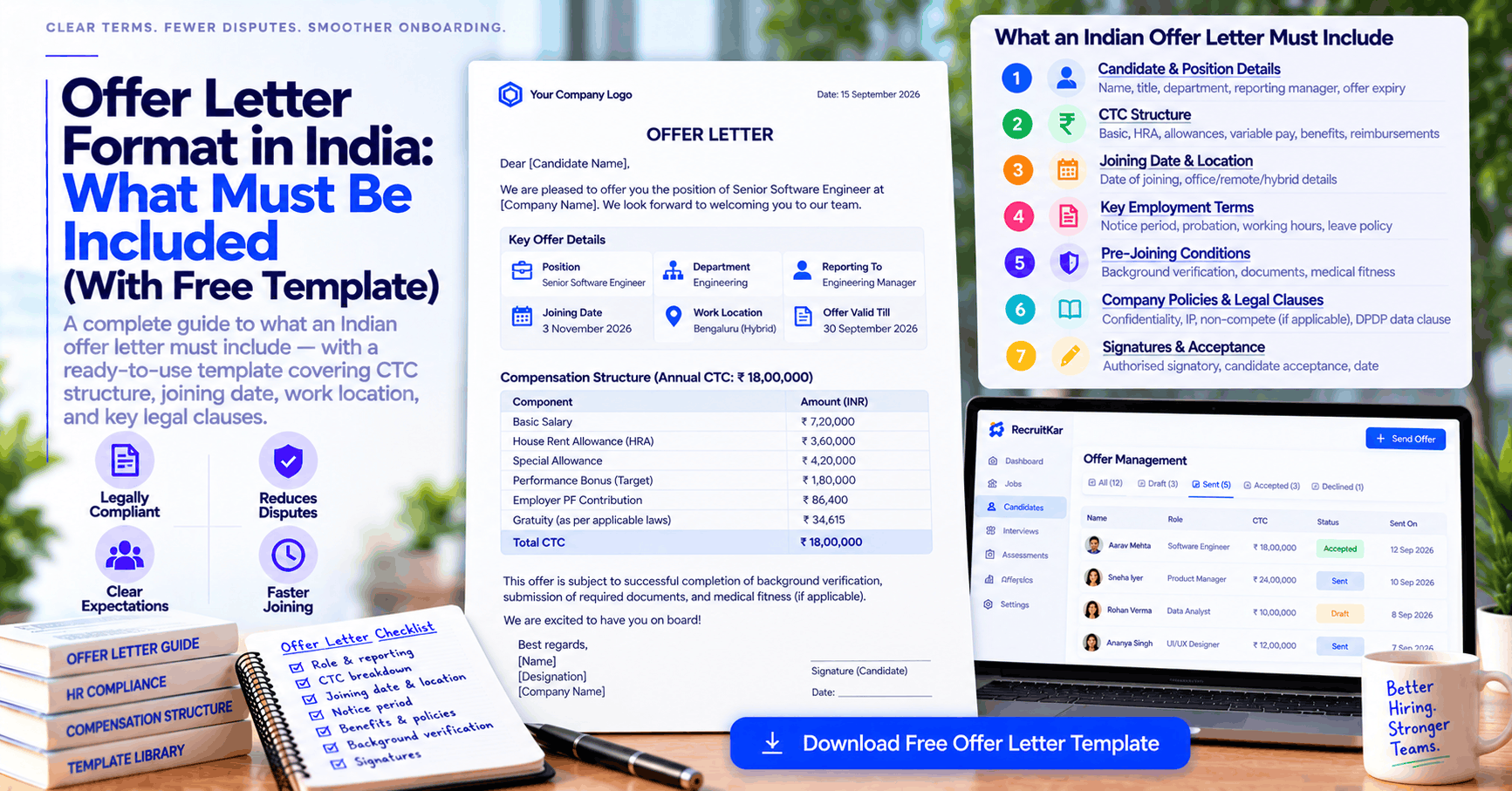
An offer letter in India serves two simultaneous purposes: it confirms a candidate's intention to join, and it creates the first legally referenced document of the employment relationship. A poorly drafted offer letter — one that omits the CTC break-up, leaves the notice period vague, or doesn't specify the work location and mode — creates disputes that are disproportionately expensive to resolve relative to the 20 minutes it takes to get the letter right. RecruitKar's visual ATS pipeline tracks offer status, counter-offers, and joining confirmations in one place — but the offer letter itself needs to be drafted correctly before it goes out. This guide covers every element required, what's commonly missed, and a complete template you can adapt immediately.
Offer letter vs. appointment letter: a distinction Indian HR teams often blur
These two terms are frequently used interchangeably in Indian companies, but they serve different purposes and have different legal weight.
An offer letter is a conditional document — it communicates the company's intention to hire the candidate, subject to conditions (background verification, document submission, medical fitness if applicable). It is not a binding employment contract in most formulations, though this depends on its specific language.
An appointment letter is issued after the candidate has joined, confirmed satisfactory completion of pre-joining conditions, and formally commenced employment. It is the primary employment document that governs the ongoing relationship.
In practice, many Indian companies issue a combined "Offer cum Appointment Letter" that functions as both — particularly for mid-market companies that don't want to issue two separate documents. This is acceptable provided the document is clearly dated (typically effective from the date of joining), clearly distinguishes between conditions that apply pre-joining and those that apply ongoing, and is signed by both parties.
For clarity, this guide covers the offer letter — the pre-joining document. The same elements apply to a combined letter, with the distinction that some clauses (like probation terms) become operative only from the date of joining.
What an Indian offer letter must include
1. Candidate and position identification
Basic but essential — errors here create problems in background verification and formal records:
- Candidate's full legal name (as it appears in Aadhaar/PAN)
- Designation / job title (must match what's used in payroll records and the internal HRMS)
- Department and reporting manager (by designation, not just by name — managers change)
- Date of issue of the offer letter
- Date of offer expiry (how long the candidate has to accept before the offer lapses)
The expiry date is commonly omitted and is worth including — both to create urgency and to give the company a clean way to close the offer if a candidate takes unreasonably long to respond or to accept.
2. CTC structure — broken down, not just stated as a total
"CTC: ₹12 LPA" tells a candidate almost nothing about what they'll actually receive. The offer letter should include:
- Fixed component: Basic salary, HRA (typically 40–50% of basic for metro cities), special allowance, and any other fixed heads
- Variable component: Performance bonus or variable pay — stated as a percentage of fixed or annual CTC, with a clear note on how it's calculated and the performance basis (individual, company, or a combination)
- Benefits: PF contribution (employer's portion — typically 12% of basic), gratuity eligibility, health insurance (sum insured, whether family is covered, group policy details), any other company contributions
- Reimbursements: Phone, internet, fuel, conveyance — stated as monthly limits and the claim process
- One-time payments: Joining bonus if applicable, relocation allowance — with any claw-back condition stated (e.g., joining bonus to be returned if the employee leaves within 12 months)
The distinction between CTC and in-hand (take-home) salary is a perennial source of candidate confusion and post-joining disputes in India. An offer letter that clearly separates what the company pays (CTC) from what the employee receives (gross salary minus statutory deductions) reduces this friction significantly.
Note on TDS: The offer letter itself doesn't need to include TDS calculations, but it should note that the employee's tax liability will be computed based on declared investments and applicable provisions — and that the HR/payroll team will share the TDS working at the start of employment.
3. Joining date and location
- Date of joining: A specific date, not "to be mutually agreed" — the latter creates ambiguity for notice period calculation, payroll start, and background verification timelines
- Work location: City and office address, or "fully remote" — if hybrid, specify the expected office days per week and whether this is mandatory or at team discretion
- Whether the location is subject to transfer: For companies with multiple offices, specifying that employment is subject to transfer to any company location at management discretion is standard and protects the company — but should be explicitly stated rather than assumed
4. Probation period
- Duration: typically 3–6 months in Indian companies; some extend to 12 months for senior roles
- Benefits eligibility (PF, insurance, increments) during probation
- Notice period during probation (typically shorter than the post-confirmation notice period)
- Confirmation terms: Whether confirmation at the end of probation is automatic or requires a positive assessment
5. Notice period (post-confirmation)
India's long notice periods (commonly 60–90 days for professional roles) are the single most negotiated element of an employment letter. Specify:
- Duration of notice period post-confirmation (e.g., 90 days)
- Whether notice period can be bought out — and if so, by either party, and at what calculation (typically per-day basic salary × number of notice days)
- Whether garden leave applies (employee continues to be paid but is not required to work during the notice period)
- Whether the notice requirement is waiveable at company discretion — this is standard and gives HR flexibility to release employees earlier if needed
6. Conditions of employment
This section covers what the offer is conditional upon:
- Satisfactory completion of background verification (reference checks, employment history, education verification, criminal record check if applicable for the role)
- Submission of original educational certificates for verification
- Medical fitness certification if the role requires it
- Non-disclosure of offer terms to existing employer or colleagues (standard confidentiality clause)
- Proof of relieving from previous employer on or before the joining date
The background verification condition is particularly important to state explicitly — without it, the company has limited grounds to revoke an offer if verification reveals a discrepancy after the letter has been issued.
7. Intellectual property and confidentiality
Even at the offer stage, the letter should include or reference:
- That the employee will be required to sign an NDA / confidentiality agreement on or before joining
- That work product created during employment belongs to the company
- That the employee confirms they are not currently bound by a non-compete or non-solicitation agreement that would restrict their joining
For senior roles or roles with access to sensitive IP, these clauses are often detailed directly in the offer letter rather than deferred to a separate agreement.
8. Governing law and dispute resolution
- The jurisdiction under which the offer letter is governed (typically the city where the company's registered office or principal place of business is located)
- The dispute resolution mechanism (usually escalation to HR, then senior management, before any external proceedings — arbitration clauses are less common in standard employment letters but appear in senior and executive contracts)
9. Acceptance mechanism
- A clear instruction for how the candidate accepts the offer: signature (wet or digital), email confirmation, or both
- A deadline for acceptance
- Where to return the signed copy (email address, physical address, or an electronic signature platform)
What's commonly left out — and why it matters
Specific variable pay calculation methodology
Many offer letters state "variable pay: 20% of CTC" without specifying how it's calculated. This becomes a source of dispute when an employee expects ₹2.4 LPA in variable and receives ₹1.2 LPA because the company assessed performance at 50% on an undisclosed rubric. State: the target variable amount, the performance measurement cycle, and what percentage of target variable is paid at what performance rating.
ESOP vesting schedule (for startups)
Startup offer letters frequently mention "ESOP eligible" without any specifics. Candidates who join on the expectation of meaningful equity and discover the vesting cliff, strike price, and dilution provisions only after joining feel misled — and legitimately so. Include the grant size (options or units), vesting schedule, cliff, strike price if known, and the ESOP policy document reference.
Remote/hybrid policy with genuine specificity
"Hybrid work arrangement" without specifying expected in-office days, whether it's mandatory, and whether the policy applies uniformly or varies by team creates misaligned expectations. Candidates who join expecting 2 days in-office and discover the expectation is 4 are among the most common early-attrition cases in post-pandemic Indian hiring.
Claw-back provisions on joining bonuses
If a joining bonus is included, the claw-back condition (return pro-rated joining bonus if the employee leaves within X months) must be clearly stated in the offer letter. A claw-back clause that appears only in the appointment letter — not the offer letter the candidate signed before joining — is legally fragile and practically difficult to enforce.
DPDP Act data processing disclosure
Under India's Digital Personal Data Protection Act 2023, employers who collect and process personal data of employees (which starts at the offer stage — the offer letter itself typically requests Aadhaar, PAN, bank details) should include a disclosure that:
- What data is collected and for what purpose
- Who has access to it
- How long it's retained
- The employee's rights to access and correct their data
This is increasingly expected in offer letters for professional roles in India, particularly for companies with international parent organisations that already maintain GDPR-aligned practices.
A complete offer letter template
Below is a working template. Replace all bracketed fields with your specifics. Have your legal counsel review before using for senior roles or in situations involving complex compensation structures or equity.
An offer letter that clearly separates what the company pays (CTC) from what the employee receives (gross salary minus statutory deductions) reduces friction significantly.
[COMPANY LETTERHEAD]
PRIVATE AND CONFIDENTIAL
Date: [DD/MM/YYYY]
[Candidate Full Name]
[Candidate Address]
Subject: Offer of Employment — [Designation], [Department]
Dear [First Name],
We are pleased to offer you the position of [Designation] in the [Department] at [Company Full Legal Name] ("the Company"), subject to the terms and conditions set out below.
1. Position and Reporting
You will be designated as [Designation], reporting to [Reporting Manager Designation]. Your primary work location will be [City / Remote / Hybrid — X days/week in office at [Address]].
2. Date of Joining
Your employment is expected to commence on [DD/MM/YYYY]. Please note that this offer is contingent upon your joining on the agreed date. Any change to the joining date must be mutually agreed in writing.
3. Compensation
Component | Annual (₹) | Monthly (₹)
Basic Salary | |
HRA | |
Special Allowance | |
Fixed Gross | |
Performance Variable (target, [X]% of fixed gross) | |
Employer PF Contribution (12% of basic) | |
Gratuity Provision | |
Total CTC | |
Variable pay is payable based on individual and company performance, assessed [annually / semi-annually]. The target variable amount assumes 100% performance achievement. Actual payout may be higher or lower based on the applicable performance rating.
4. Additional Benefits
- Group Mediclaim: ₹[X] sum insured, covering [employee only / employee + family]
- [Joining bonus: ₹[X], payable with first salary — to be refunded pro-rata if employment is terminated within [12] months of joining for any reason]
- [Mobile/internet reimbursement: ₹[X]/month on actuals against bills]
5. Probation
You will be on probation for a period of [3/6] months from the date of joining. During this period, the notice period applicable to both parties will be [30] days. Upon satisfactory completion of probation, you will be confirmed in the role.
6. Notice Period (Post-Confirmation)
Post-confirmation, either party may terminate this employment by providing [90] days' written notice, or salary in lieu thereof at ₹[daily basic] per day. The Company reserves the right to waive notice and effect an early separation at its discretion.
7. Conditions of Offer
This offer is conditional upon: (a) Satisfactory completion of background verification (employment history, educational credentials, reference checks) (b) Submission of original documents for verification on or before your date of joining (c) Proof of relieving letter from your current employer on or before [DD/MM/YYYY] (d) Medical fitness certification, if applicable to the role (e) Your confirmation that you are not bound by any non-compete, non-solicitation, or other restrictive covenant that would prevent you from taking up this position
8. Confidentiality and Intellectual Property
You will be required to execute a Confidentiality and Intellectual Property Agreement on or before your joining date, the terms of which will govern your obligations regarding company information and work product during and after your employment.
9. Data Processing
In connection with your employment, the Company will collect and process personal data including identification documents, compensation details, and employment history. This data will be used solely for the purposes of administering your employment relationship, in accordance with the Digital Personal Data Protection Act, 2023. You have the right to access, correct, and request deletion of your personal data — please contact [HR email] to exercise these rights.
10. Acceptance
Please confirm your acceptance of this offer by signing and returning a copy of this letter to [HR email] by [DD/MM/YYYY]. If we do not receive your acceptance by this date, this offer will be deemed withdrawn.
This offer letter does not constitute a binding employment contract. The terms and conditions of your employment will be governed by the Appointment Letter issued to you on or after your date of joining and the Company's HR policies in force from time to time.
We look forward to welcoming you to the team.
Yours sincerely,
[Authorised Signatory Name]
[Designation]
[Company Name]
Acknowledgement and Acceptance
I, [Candidate Name], acknowledge receipt of this offer letter and accept the terms and conditions of employment as stated above.
Signature: ________________________ Date: ________________________
Frequently asked questions
Is an offer letter legally binding in India?
An offer letter is generally considered a conditional document, not a binding employment contract — its binding force depends on its specific language. A letter that says "this offer is subject to satisfactory background verification and your joining on the agreed date" is clearly conditional. A letter that omits conditions and uses unambiguous acceptance language could be argued to create a binding agreement. Indian courts have generally treated offer letters as invitations to enter an employment relationship rather than the relationship itself — but this is jurisdiction and fact-specific. Have your legal counsel review any offer letter template before issuing it for senior roles where disputes are more likely to be litigated.
Can a company revoke an offer letter after it's been signed?
Legally, an offer can be revoked before acceptance, and arguably even after acceptance if the stated conditions are not met (background verification failure, non-submission of documents, misrepresentation by the candidate). Revoking an offer post-acceptance without cause creates legal exposure for wrongful revocation — particularly if the candidate resigned from their previous employment in reliance on the offer. This exposure increases significantly if the candidate joined before revocation. If a background verification reveals a disqualifying issue, consult legal counsel before revoking.
What is the standard notice period in Indian offer letters?
For entry to mid-level roles: 30–60 days. For senior individual contributor and manager roles: 60–90 days. For director and above: 90 days to 6 months in some sectors. Notice periods in India have grown longer over the past decade and are a source of significant friction — both for candidates resigning and for companies hiring. The offer letter's notice period clause should be consistent with industry norms for the role level; an unusually long notice period at a junior level is a red flag for candidates and may reduce offer acceptance rates.
Should variable pay targets be included in the offer letter?
Yes — a variable pay clause that specifies only the percentage of CTC without explaining the assessment basis, cycle, and what happens in the first year (when a new joiner may not have a full performance period) creates the disputes described earlier. Include at minimum: the target variable amount, the performance cycle, and a statement of how first-year variable is calculated for a joiner mid-cycle.
What documents should accompany the offer letter at issuance?
The offer letter should reference but typically not attach: the company's HR policy handbook (or key policies — leave, travel, code of conduct), the ESOP policy if equity is being offered, and the confidentiality and IP agreement the employee will be asked to sign on joining. These are referenced rather than attached to keep the offer letter itself concise and to preserve the ability to update policies without reissuing offer letters.
Track your offer pipeline — who accepted, who's in negotiation, who hasn't responded — directly from RecruitKar's hiring pipeline. Every offer stage, counter-offer, and joining confirmation logged in one place. Visual ATS pipeline — manage your full hiring cycle from sourcing to offer.