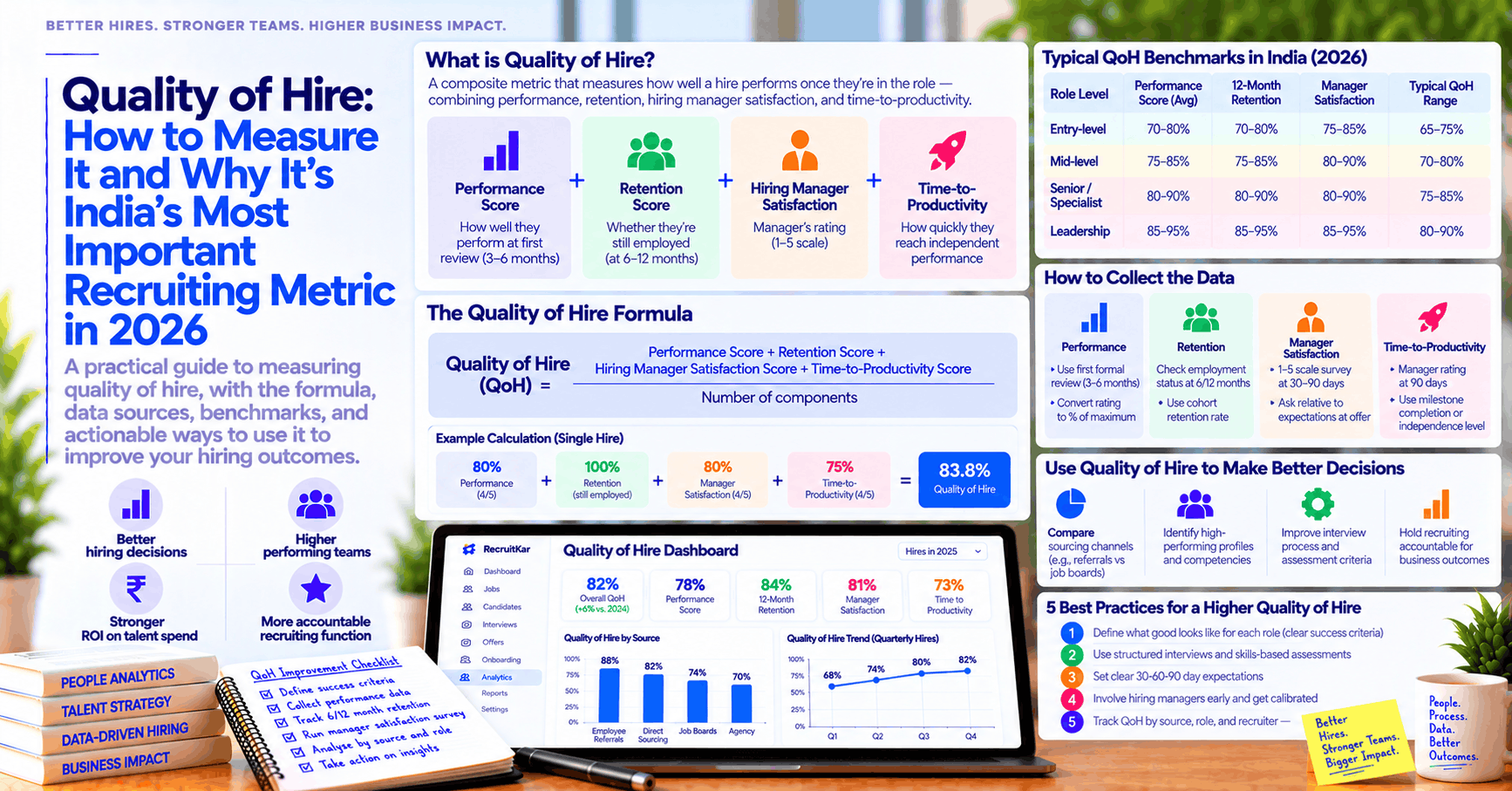
Most Indian HR teams track time-to-hire and cost-per-hire but not quality of hire — which means they can optimise the front end of the funnel with no visibility into whether the back end (actual performance) is improving or degrading. RecruitKar's visual ATS pipeline tracks every hire from sourcing through offer, providing the source and process data that feeds a quality-of-hire calculation — so when you build the metric, the recruiting input data is already there.
Why quality of hire is the metric that should anchor everything else
Consider the problem with optimising only for speed and cost:
A recruiting team that reduces time-to-hire from 45 days to 20 days and reduces cost-per-hire from ₹80,000 to ₹40,000 has produced two impressive metrics. If the hires produced by that faster, cheaper process stay for 18 months instead of 36 and perform in the bottom quartile of their peer group, the company has paid less per hire to build a more expensive talent problem.
Speed and cost matter, but they're inputs. Quality of hire is the output — the measure that determines whether the recruiting investment is producing the talent the business actually needs.
In India's 2026 hiring context specifically, quality of hire is gaining importance for three reasons:
The signal-to-noise problem is getting worse. LinkedIn data for India in 2026 shows applicants per job nearly doubling — which means the screening and selection challenge is intensifying. More applications doesn't mean better applications; it means more work to find the same number of strong candidates, and higher risk that rushed processes produce lower-quality hires.
Early attrition costs are rising. With average salaries increasing across tech, SaaS, and GCC hiring, the cost of a bad hire — recruiting cost, lost productivity, re-hiring — is higher in absolute terms than it was even 3 years ago.
Leadership is asking harder questions about talent ROI. Indian startup and scaleup boards and investors are increasingly focused on talent quality as a strategic differentiator, not just headcount. HR teams that can answer "are our hires performing well?" with data are positioned very differently from those who can only report headcount and time-to-fill.
The quality of hire formula
There is no single universally agreed formula for quality of hire — it's a composite metric, and the right components depend on what data your organisation actually tracks. The most widely used structure:
Quality of Hire (QoH) = (Performance Score + Retention Score + Hiring Manager Satisfaction Score) ÷ Number of components
Component 1: Performance score
The new hire's performance rating at their first formal review (typically 3–6 months post-joining), expressed as a percentage of the maximum possible rating.
Example: If your performance scale is 1–5 and a new hire receives a 4, their performance score = (4 ÷ 5) × 100 = 80%
Component 2: Retention score
Whether the hire is still employed at the measurement point.
Simple version: Binary — 1 (still employed) or 0 (departed) — expressed as 100% or 0%.
More nuanced version: For a cohort of hires, the percentage still employed at the measurement point. If 8 of 10 hires from a cohort are still employed at 12 months, retention score = 80%.
Component 3: Hiring manager satisfaction score
A structured survey question asked to hiring managers at 30–90 days post-joining: "On a scale of 1–5, how satisfied are you with this hire relative to your expectations at the time of offer?" Expressed as a percentage of maximum.
Example: A score of 4 on a 1–5 scale = 80%
Putting it together
For a single hire who scored 80% on performance, is still employed (100%), and whose hiring manager rated them 4/5 (80%):
QoH = (80 + 100 + 80) ÷ 3 = 86.7%
For a cohort of 20 hires measured at the same point, calculate each hire's individual QoH and average across the cohort.
Optional additional components
Depending on what your organisation tracks, you can add:
- Time-to-productivity score: How quickly the hire reached independent performance versus expectation (rated by manager at 90 days on a 1–5 scale)
- Ramp completion score: Whether the hire completed their 30-60-90 day milestones on schedule
- 360 feedback score: Peer and cross-functional ratings at the 6-month mark
Adding more components increases precision but increases data collection burden. Start with three components, add more once the baseline is established.
When to measure
Quality of hire is measured at a defined post-joining milestone — not at the point of hire, not retrospectively whenever convenient. Common measurement points:
- 90 days: Early signal — performance data is limited but can catch obvious mismatches early
- 6 months (probation completion): Best balance of early enough to act on and late enough to have real performance data
- 12 months: Full-year signal — includes the full performance review cycle and real retention data
Most organisations measure at probation completion (6 months in India) for operational utility, and at 12 months for the most comprehensive picture.
Segmenting quality of hire for maximum insight
A single company-wide QoH score is a starting point, not an endpoint. Segmenting it reveals which specific decisions are producing better or worse outcomes.
By sourcing channel
Is the quality of hire from referrals higher than from job boards? From LinkedIn sourcing versus Naukri Resdex? From agency placements versus in-house sourcing?
If referrals consistently produce QoH scores 15 points higher than job board applicants for equivalent roles, that's a clear signal to invest more in referral programs and less in job board spend. If agency placements produce QoH scores lower than in-house sourcing at the same cost or higher, that's a case for building internal sourcing capability.
By hiring manager or interviewer
Are hires from specific hiring managers' teams consistently higher or lower quality? If one business unit's hires consistently show 12-month QoH scores 20 points below the company average, and the issue isn't sourcing (they're drawing from the same channels), the problem may be in how that manager's panel evaluates candidates, what expectations are set during the interview, or how onboarding is handled post-hire.
By role type or department
Engineering hires showing lower QoH than sales hires from the same sourcing channels may indicate that the engineering interview process isn't evaluating the right things — a finding that's invisible if you're only looking at blended company-wide numbers.
By recruiter
With appropriate care (recruiter metrics are heavily influenced by which roles they're assigned), comparing QoH by recruiter can surface whether specific sourcing or screening approaches are producing better outcomes, and which practices are worth codifying across the team.
The data you need, and where to get it
Building quality of hire requires combining data from two systems that most Indian companies have never connected:
From recruiting (ATS): Which channel sourced this hire, which interview process they went through, how long the process took, which recruiters and interviewers were involved, what the offer terms were.
From HR/performance: Performance rating at first review, retention status at measurement point, hiring manager satisfaction survey response.
The connecting data point is the hire's employee ID — linking the ATS record (which has the sourcing and process data) to the HRMS record (which has the performance and retention data).
This connection is exactly what most Indian HR teams are missing — their ATS and HRMS are separate systems that don't share data, so the loop from "how we hired this person" to "how this person is performing" is never closed. Even without a formal integration, a quarterly exercise of manually linking ATS hire data to HRMS performance data for a cohort produces more insight than any number of time-to-hire reports.
What to do with quality of hire data
Use it to evaluate sourcing channels. If one channel consistently produces higher QoH, shift budget toward it. If another produces lower QoH despite being cheaper per hire, the "cheaper" claim is only true if you exclude the cost of lower performance and higher attrition.
Use it to evaluate interview processes. If QoH for roles using structured interviews with defined rubrics is higher than QoH for roles using unstructured interviews, that's evidence to expand structured interviewing. If a specific interview step (a technical assessment, a case study) consistently correlates with higher QoH for hires who passed it strongly, that step is worth preserving and potentially expanding.
Use it to build the business case for recruiting investment. A team that can show leadership "our last 40 hires produced an average QoH of 82%, and hires from our referral program produced 91% versus 74% from job boards" is having a fundamentally different conversation about talent investment than one that reports "we filled 40 roles in an average of 28 days at a cost of ₹65,000 per hire."
Use it to identify onboarding problems. Hires with high performance scores but low hiring manager satisfaction scores often indicate an onboarding mismatch — the hire is capable but was deployed into a context that didn't use their strengths. Hires with low retention but high performance scores indicate a compensation or growth problem, not a quality problem.
Common objections to measuring quality of hire
"Our performance management system isn't rigorous enough to use for this." True in many Indian companies — annual reviews that produce universal "meets expectations" ratings don't produce useful QoH inputs. The fix is to use the hiring manager satisfaction survey and early retention data as the primary QoH inputs, with performance data added when the performance management process matures. An imperfect QoH metric tracked consistently is more useful than no metric at all.
"It takes too long to see the data." At the 90-day measurement point, you have early QoH data for hires made 3 months ago. This is not as far behind as it sounds — a change made in the sourcing or screening process today will show up in QoH data in 3–6 months, which is fast enough to course-correct. The alternative — making sourcing and screening decisions with no outcome data — is much more expensive.
"Our HR and ATS systems don't talk to each other." This is the most common practical blocker. The minimum viable workaround: a quarterly spreadsheet exercise where HR manually links the last 20 hired employees to their ATS sourcing and process records, and calculates basic QoH from performance rating and retention status. It takes 2–3 hours per quarter and produces more insight than any automated report built on metrics that don't include performance outcomes.
Frequently asked questions
What is a good quality of hire score? There's no universal benchmark — a QoH of 75% at a company with a tough performance standard may represent better hiring outcomes than a QoH of 85% at a company where ratings are inflated. What matters more than the absolute number is the trend (is QoH improving or declining?) and the segmentation (which channels, managers, and processes produce the highest QoH?). If forced to a directional benchmark: above 70% is generally acceptable; consistently below 60% warrants a structured root-cause investigation.
How do we get hiring managers to complete QoH surveys consistently? Keep surveys to 2–3 questions maximum, send them at exactly the right moment (probation completion is the natural trigger), make submission easy (a link in the reminder message goes directly to the form with the hire's name pre-filled), and make clear how the data is being used. Managers who understand that their survey responses feed into sourcing channel decisions — not performance reviews of individual employees — tend to participate more readily than those who assume the data will be used against them or their team.
Does quality of hire measure recruiter performance or hiring manager performance? Both, which is why it shouldn't be used as a performance metric for either in isolation. QoH is jointly produced by the recruiting process (sourcing, screening, offer communication) and the onboarding process (role clarity, manager support, development). A low QoH score that traces to a sourcing channel problem is a recruiting issue; one that traces to a consistent onboarding failure under one manager is a management development issue. Using QoH to diagnose rather than to blame produces more useful outcomes.
Should quality of hire be shared externally — with investors or in annual reports? Some Indian companies with mature people analytics functions include quality metrics in investor or board reporting as part of a talent strategy narrative. This is worth doing once the metric is reliably measured and trending well; premature external reporting of a metric that's still being developed creates unnecessary scrutiny and anchors expectations. Build it internally first, make it meaningful, then share selectively when it tells a genuinely compelling story.
What's the relationship between quality of hire and early attrition rate? Early attrition rate (departures within 6 months) is one component of quality of hire — specifically the retention component. A hire who leaves within 6 months will produce a low QoH score regardless of how they performed before leaving. But QoH contains more information than early attrition alone: a hire who stays but consistently underperforms also produces a low QoH score, which attrition rate alone would miss. QoH is the more complete measure; early attrition is the more easily tracked leading indicator.
Connect your hiring process data to your outcomes. RecruitKar's visual ATS pipeline tracks every hire from source to offer — the input data your quality-of-hire calculation needs. Pair it with your HRMS performance data and close the loop from "how we hired" to "how they're performing." Why growing Indian teams choose RecruitKar for hiring operations that connect to business outcomes.