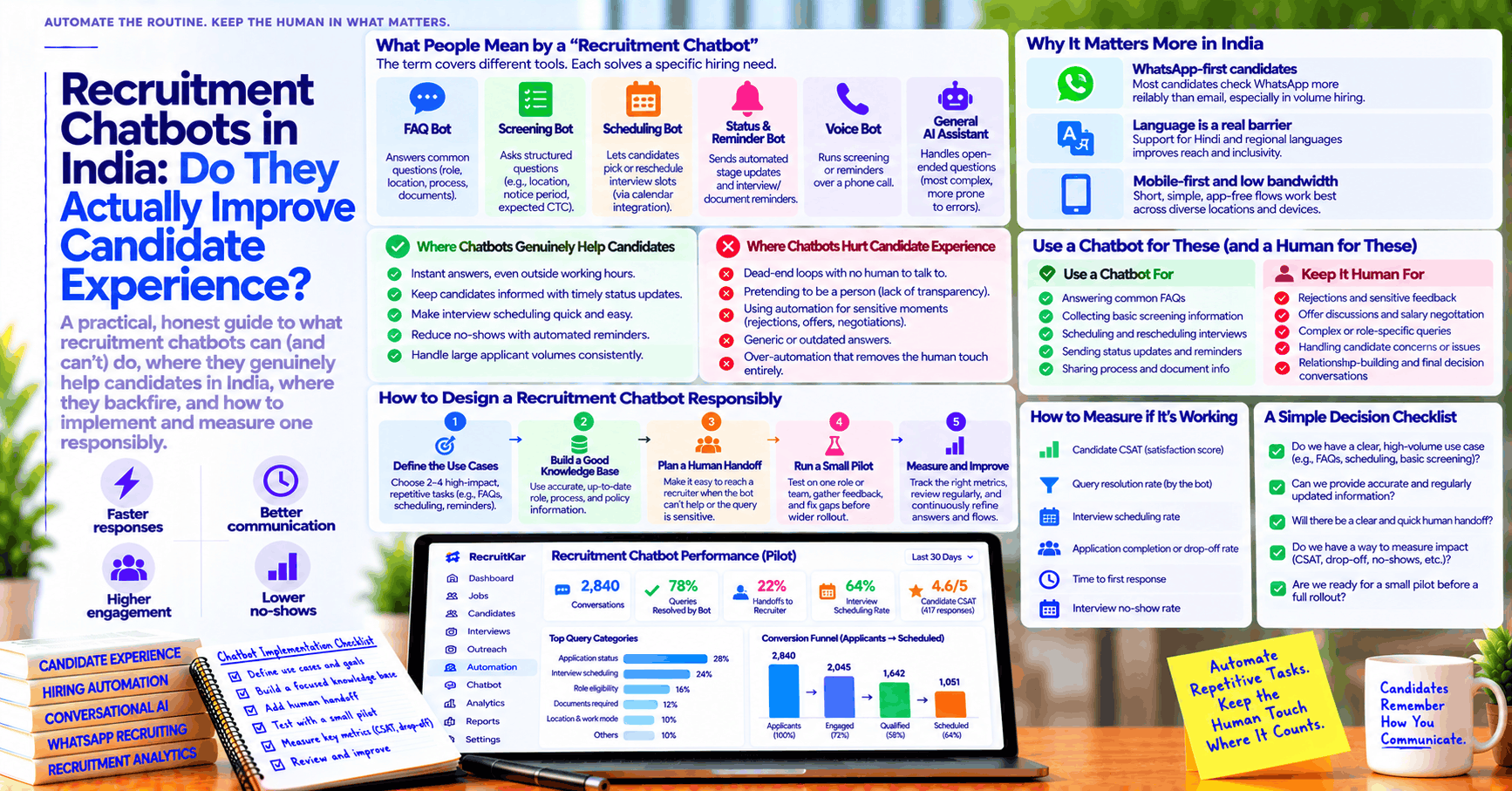
Sometimes. A recruitment chatbot improves candidate experience when it answers repetitive questions instantly, sends timely status updates and reminders, and hands the candidate to a human when the question gets hard. It damages candidate experience when it traps people in loops, pretends to be a person, or is used for moments that need a human, like a rejection or an offer negotiation. Vendor claims about satisfaction and time saved are mostly self-reported, so the honest answer for your company comes from a small pilot you measure yourself. RecruitKar's candidate outreach hub automates the communication tasks people usually buy chatbots for, such as sequenced messages, reminders, and status updates, while keeping every interaction logged against the candidate's record. This guide covers what recruitment chatbots do, when they help, when they hurt, and how to test one without risking your employer brand.
What people mean by "recruitment chatbot"
The term covers several different tools, and mixing them up causes most of the confusion in buying decisions.
FAQ bots answer common candidate questions: location, salary band if shared, process stages, documents needed, joining timelines. They work from a fixed knowledge base.
Screening or qualification bots ask candidates a short set of structured questions (current location, notice period, expected CTC, availability) and record the answers.
Scheduling bots let candidates pick an interview slot or reschedule, usually by integrating with interviewers' calendars.
Status-update and reminder bots send automated messages when a candidate moves stage, and remind them of upcoming interviews or pending documents.
Voice bots do the same screening or reminder job over a phone call rather than text.
General conversational assistants try to handle open-ended questions in natural language. These are the hardest to get right, and the ones most likely to disappoint.
Most of the practical value in recruiting comes from the middle four: narrow, structured, repetitive tasks. The more open-ended the job you give a bot, the more often it fails.
Why this question matters more in India
Three features of the Indian hiring context shape what works.
WhatsApp is where candidates actually are. For many candidates, particularly in volume and frontline hiring, WhatsApp is checked far more reliably than email. A bot or automated sequence that lives on WhatsApp meets candidates where their attention already is. Our guide to WhatsApp recruiting covers consent and message design in more detail.
Language is a real barrier. A bot that only works well in English can quietly exclude candidates more comfortable in Hindi or a regional language. If you serve a multilingual candidate pool, language support is a core requirement, not an optional extra.
Candidates are often on mobile, with variable connectivity. Flows that need app downloads or long forms see drop-off. Short, mobile-first interactions perform better.
Where chatbots genuinely help candidates
Instant answers outside working hours. A candidate who applies at 11pm and wonders whether the role is remote gets an answer immediately instead of waiting until tomorrow afternoon. For routine questions, speed alone improves the experience.
Reducing the silence that causes drop-off. Much candidate frustration is not hostility, it is uncertainty about where they stand. Automated, accurate status updates at each stage keep candidates informed without adding recruiter workload.
Cutting scheduling friction. Letting candidates book from real availability, instead of trading emails, is one of the clearest wins. Calendar-integrated interview scheduling does this without needing a conversational bot at all.
Reducing no-shows with reminders. A reminder the day before and a short nudge shortly before the interview, on the channel the candidate checks, typically does more for attendance than any conversational feature.
Handling volume. When a role attracts hundreds of applicants, a structured first conversation collects the basics from everyone consistently, which a recruiter could not do by hand.
Where chatbots hurt candidate experience
Dead-end loops with no human. The most common complaint. A candidate with a specific question the bot cannot answer, and no way to reach a person, leaves with a worse impression than if there had been no bot.
Pretending to be human. If a candidate discovers partway through that they were talking to software they believed was a recruiter, trust drops. Say upfront that it is automated.
Using automation at emotionally significant moments. Rejections, offer discussions, and negotiation are moments candidates remember. A cold automated message here reads as disrespect. Keep these human, or at least human-reviewed.
Generic or wrong answers. A bot that confidently gives incorrect information about salary, location, or process creates real problems, and the cost lands on the candidate. Keep the knowledge base accurate and narrow.
Poor language handling. A bot that misunderstands accented or regional-language input, or answers in stilted English to a candidate writing in Hindi, signals that the process was not built for them.
Collecting too much data too early. Asking for extensive personal details before a candidate has even been shortlisted raises both experience and data-protection concerns.
Treating the bot as a gatekeeper. Using a chatbot to reject candidates automatically on thin criteria, with no human review, risks excluding good people unfairly and creates the kind of automated-decision issue regulators are paying growing attention to.
A comparison: chatbot, automated sequence, or human?
- Repeated factual questions (location, process, documents): FAQ bot or a clear FAQ page
- Status updates at each stage: Automated message sequence
- Interview reminders: Automated reminders on WhatsApp or email
- Booking and rescheduling: Calendar-integrated scheduling
- Collecting basic qualification data at volume: Structured screening flow or voice screening
- Nuanced, open-ended questions: Human recruiter
- Rejection, offer, negotiation: Human
- Senior or sensitive candidates: Human from the first touch
A useful rule: automate the repetitive and structured, keep the personal and consequential human. Many teams find that well-designed automated sequences deliver most of the benefit of a chatbot with less risk of the open-ended failures above.
Design principles for a bot candidates will tolerate
Disclose that it is automated. Say so in the first message.
Always offer a path to a human. "Type 'agent' to reach a recruiter" or a visible contact option, and then honour it promptly.
Keep the scope narrow. A bot that does four things well beats one that attempts forty.
Match the candidate's language. If your pool is multilingual, support it properly and test with real regional-language input.
Keep messages short and mobile-friendly. A few sentences, one question at a time.
Get consent and honour opt-outs. Candidates should agree to be contacted on a channel and be able to stop.
Collect only what you need. Ask for the minimum at each stage.
Log everything to the candidate record. An automated conversation that is not captured in your pipeline creates blind spots for the recruiter who picks up later.
Keep a human on rejections and offers.
Data protection and consent
Candidate conversations contain personal data, so the obligations that apply to the rest of your hiring process apply here too.
Consent and transparency: tell candidates what is collected, why, and how it will be used.
Data minimisation: do not collect more than the stage requires.
Retention: define how long conversation logs and recordings are kept, and delete them on schedule.
Vendor terms: if a third party hosts the bot, check where data is stored, whether it is used to train their models, and what happens to it when you leave.
Channel rules: WhatsApp Business has its own policies on templates and consent. Use a proper business account rather than a personal number.
Under India's DPDP Act 2023, these practices matter. Have your legal or compliance team review the setup, especially anything that records voice or stores conversation transcripts.
How to pilot a chatbot without risking your employer brand
Do not roll one out across every role at once. Run a contained test.
Step 1: Pick one narrow use case. For example, status updates and interview reminders for one high-volume role, rather than a general assistant for everything.
Step 2: Define what success means before you start. Choose two or three measurable outcomes.
Step 3: Run for four to six weeks against a comparison. Compare against a similar role or earlier period without automation.
Step 4: Read the actual conversations. Review a sample of real transcripts weekly. This is where you find the loops, wrong answers, and awkward phrasing that dashboards miss.
Step 5: Ask candidates. A one-question survey after the interaction ("Was this helpful?") gives direct signal.
Step 6: Decide, expand, or stop. If the numbers and the transcripts both look good, extend to the next use case. If not, fix or drop it.
Metrics worth tracking
Response time to candidate questions, before versus after
Interview no-show rate
Drop-off between stages
Share of conversations escalated to a human (a high rate may mean the bot's scope is wrong)
Candidate satisfaction from a short survey
Recruiter hours saved, measured honestly rather than estimated
Complaints, tracked separately
Be sceptical of any vendor claim that cannot be reproduced in your own pilot with your own candidates.
Where RecruitKar fits
Be clear about what the product does. RecruitKar's outreach tools automate sequenced email and WhatsApp messages, interview reminders, and status communication, and its AI voice screening calls handle structured qualification conversations, with everything logged in the visual ATS pipeline against each candidate's record. Those cover several of the jobs people buy chatbots for.
If what you specifically want is an open-ended conversational assistant that answers free-form candidate questions, confirm what any vendor actually offers rather than assuming a feature exists, and test it against the criteria above.
Frequently asked questions
Do candidates actually like chatbots? It depends on what the bot is doing. Candidates tend to be fine with automation that is fast, accurate, and clearly labelled for simple tasks like answering a routine question or confirming a time. They dislike bots that block access to a person or give wrong answers. Satisfaction is about execution more than the technology, which is why a measured pilot beats relying on general claims.
Should a chatbot tell candidates it is automated? Yes. Disclosure builds trust and avoids the damage of candidates feeling deceived. It also aligns with the direction of data-protection and AI-transparency expectations globally.
Can a chatbot reject candidates? It can deliver a decision a human has made, but automatically rejecting candidates on thin criteria with no human review is risky, both for fairness and for missing good people. Keep human review in the loop for decisions that affect whether someone advances.
Are chatbots worth it for small hiring teams? Often a simpler approach is enough. Automated status messages, interview reminders, and calendar scheduling deliver most of the benefit without a conversational bot, and they are easier to get right. Consider a chatbot only if you have enough volume of repetitive questions to justify the setup and monitoring.
How do we handle candidates who prefer to speak to a person? Offer that path clearly and honour it quickly. For some candidates, particularly senior ones or those in sensitive situations, a human first touch is the better choice from the start. Not every candidate should go through the same channel.
Automate the repetitive parts of candidate communication, and keep the personal moments human. Use RecruitKar's candidate outreach hub for sequenced WhatsApp and email, reminders, and voice screening, all tracked in one pipeline. Pair it with calendar-integrated interview scheduling to remove the back-and-forth.