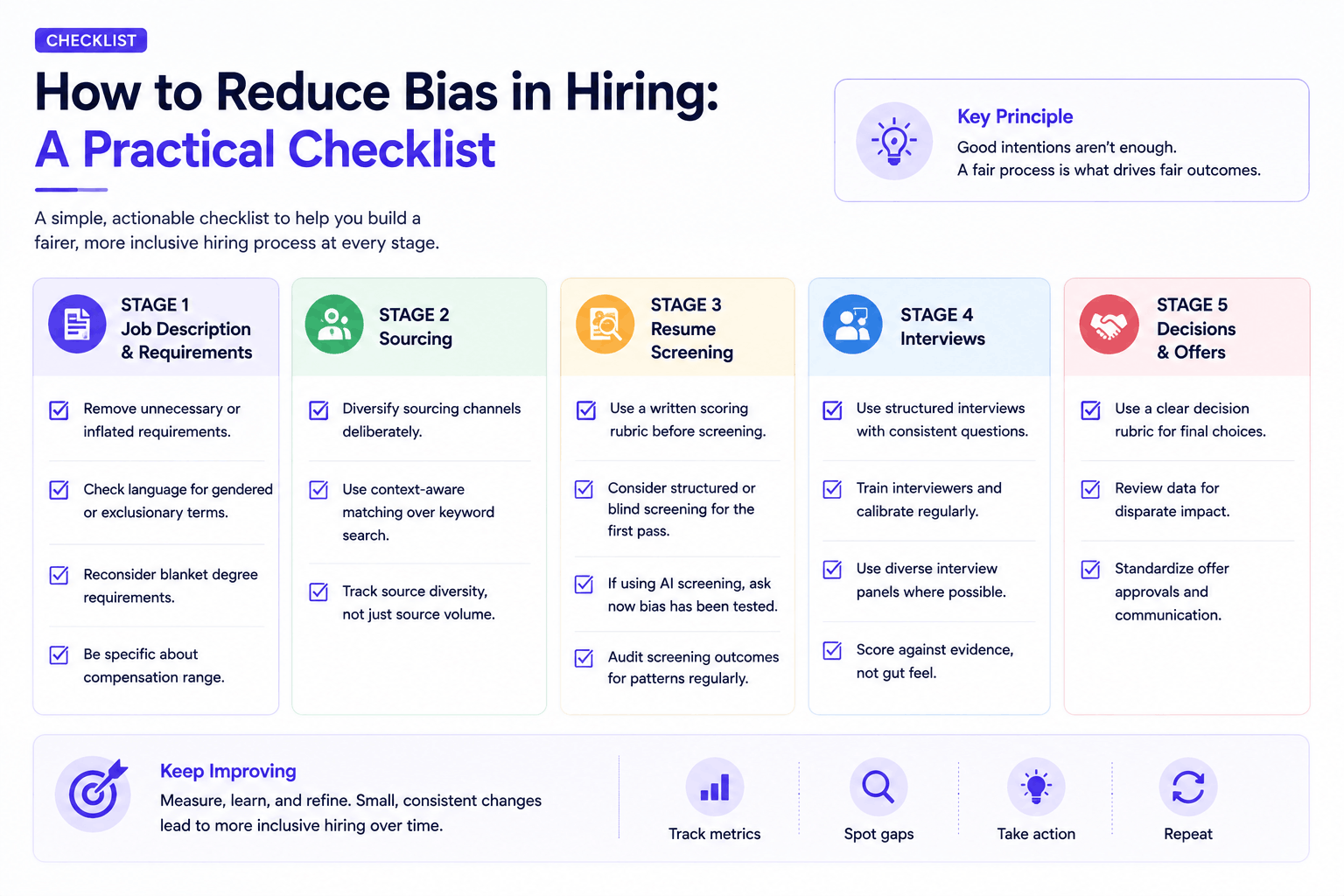
Almost every hiring team believes it evaluates candidates fairly. Almost every hiring team is also, to some degree, wrong about this — not because of deliberate discrimination, but because unconscious bias operates precisely where people aren't looking for it: in split-second reactions to a name, an accent, a resume format, or a candidate's confidence on camera. This isn't a reason for guilt or defensiveness — it's simply how human judgment works under time pressure. That's why a process, not individual good intentions, is what actually reduces bias. This post is a practical, stage-by-stage checklist for building that process.
Why individual awareness alone isn't enough
Unconscious bias training and general awareness are common starting points, but research on their effectiveness has been mixed at best. Awareness alone rarely translates into different behavior under the actual time pressure of a hiring process. What works better is redesigning the process itself so that bias has fewer opportunities to influence decisions, regardless of how self-aware any individual reviewer is in the moment.
Stage 1: Job descriptions and requirements
- Remove unnecessary or inflated requirements. Every extra "must-have" that isn't necessary is a filter that disproportionately discourages some qualified candidates (often women and candidates from non-traditional backgrounds) from applying at all.
- Check language for gendered or exclusionary coding. Words like "aggressive," "dominant," or "ninja/rockstar" have been shown to discourage some qualified candidates from applying.
- Reconsider blanket degree requirements where the underlying skill, not the credential, is what actually matters — a degree requirement can quietly exclude capable candidates who took a different path.
- Be specific about compensation range upfront, since ambiguity disadvantages candidates who are less comfortable negotiating.
Stage 2: Sourcing
- Diversify sourcing channels deliberately, rather than relying solely on referrals or a single network, since referral-heavy sourcing tends to reproduce the existing demographic makeup of your team.
- Use context-aware matching over pure keyword search. Keyword-based sourcing favors candidates who use expected terminology, which correlates with certain backgrounds rather than actual capability.
- Track source diversity, not just source volume. Knowing which channels produce a demographically varied pool — not just a large one — helps identify where to expand.
Stage 3: Resume screening
- Build and use a written scoring rubric before screening begins, rather than relying on ad hoc judgment that can shift from resume to resume.
- Consider structured or blind screening for the first pass — minimizing or removing identifying details (name, photo, sometimes college or dates) particularly for high-volume roles.
- If using AI screening, ask directly how bias has been tested. Automated scoring can encode and scale biases present in historical hiring data. Ask vendors how they test for and mitigate this; vague answers are a warning sign.
- Periodically audit screening outcomes for patterns. Compare shortlist demographics against applicant pool demographics (where appropriate) to check for disproportionate outcomes.
Stage 4: Interviews
- Use structured interviews with pre-defined, consistent questions asked the same way to every candidate. This is one of the most well-evidenced fixes in hiring research — structured interviews outperform unstructured ones on both predictive validity and fairness.
- Use a consistent, defined scoring rubric for evaluation, rather than an open-ended "how did they seem" assessment.
- Involve multiple interviewers, and have them score independently before discussing. Group discussion before independent scoring allows the most vocal or senior person's opinion to anchor others.
- Be deliberate about panel composition where practical — a panel with some diversity can reduce the risk of a single narrow perspective dominating.
- Watch for "culture fit" as an undefined catch-all. It can unconsciously mean "reminds me of people already here." Define specific, observable behavioral competencies instead.
Stage 5: Decision-making and offers
- Document the specific reasoning behind each hiring decision, not just the outcome — this creates accountability and makes patterns easier to audit.
- Check compensation offers for consistency across similar roles and experience levels. Unexplained pay disparities are a measurable and legally significant form of bias.
- Avoid anchoring offers heavily on a candidate's prior salary, as this can perpetuate historical pay disparities into new roles.
Understanding how bias actually shows up, mechanism by mechanism
It helps to name the specific psychological patterns at play, since "unconscious bias" can feel abstract. Affinity bias is the tendency to favor candidates who remind an interviewer of themselves — similar background, style, even hobbies — masquerading as "great culture fit." Confirmation bias shows up when an early impression (often formed in the first few minutes) shapes how later answers are interpreted — a positive first impression leads to more charitable readings of ambiguity, and vice versa. Halo and horn effects occur when one standout trait (a prestigious employer, a confident style) colors judgment of unrelated competencies. Anchoring bias in compensation tethers offers too closely to a candidate's stated prior salary, which can undervalue someone whose previous pay didn't reflect their market value. Naming these mechanisms makes it easier to design targeted safeguards: structured interviews and rubrics address confirmation and halo effects; independent scoring before discussion mitigates affinity bias at the panel level; and not anchoring on prior salary addresses that specific pattern.
A note on measuring progress honestly
It's worth resisting the temptation to declare bias "solved" once a checklist is implemented. Reducing bias is an ongoing practice, not a one-time fix. Teams that build in a regular cadence — a quarterly or semi-annual review of the audit items below — tend to sustain improvements better than those that treat this as a project with an end date.
What genuinely moves the needle, versus what's mostly symbolic
Strong evidence of effectiveness: structured interviews with consistent questions and rubrics; removing unnecessary degree or experience requirements; diversifying sourcing channels; independent scoring before group discussion; blind resume review for high-volume roles.
Mixed or weaker evidence: one-off unconscious bias training sessions without follow-up process change; vague diversity statements in job postings without accompanying process changes; relying solely on interviewer good intentions without structural safeguards.
This isn't to say the "weaker evidence" items are worthless — a diversity statement paired with genuine changes is different from one used as a substitute. The point is to prioritize effort toward what the evidence supports moving outcomes, rather than what feels most visible or easiest.
Where AI tools help, and where they introduce new risk
AI-assisted tools can support several practices above: structured, consistent scoring at scale; context-aware sourcing that widens candidate pools; documented, auditable decision rationale. Recruitkar's approach to resume scoring is built to prioritize candidates for review against defined, role-specific criteria rather than acting as an unreviewed final filter — keeping a human genuinely in the loop on final decisions.
But AI tools aren't automatically less biased than human judgment — a model trained on historical data that already reflects bias can learn and scale that same bias. The safeguard isn't assuming AI removes bias by default; it's demanding transparency about how a tool was built and tested, and keeping meaningful human review in the loop.
A quick note on legal context
Hiring discrimination law varies by jurisdiction, but the general principle — that hiring decisions should be based on job-relevant criteria, applied consistently — is nearly universal. Beyond the ethical case, there's a practical legal one: documented, structured, consistent decision-making is also what makes a process defensible if a decision is ever challenged. A process that relied on undocumented gut instinct is far harder to defend than one with a clear, consistently-applied rubric and recorded reasoning at each stage.
A short audit checklist to run periodically
- Pull your last 20–30 hiring decisions. Is there a documented, specific reason for each one?
- Compare interview scores across interviewers. Is there unusual variance suggesting inconsistent standards?
- Review current job descriptions against the checklist — any inflated requirements or exclusionary language?
- If using AI screening, request documentation on bias testing and review it critically.
- Check compensation offers for the last several hires — are differences explainable by objective factors?
The bottom line
Reducing bias in hiring isn't primarily about individual willpower or good intentions — it's about building a process where consistent, structured, documented decision-making leaves less room for unconscious bias to operate unchecked, from the job description through the final offer. The practices with the strongest evidence — structured interviews, defined rubrics, independent scoring before discussion, deliberate sourcing diversification — aren't complicated or expensive to implement. They just require treating fairness as a process design problem, which is what actually makes it solvable.