A candidate applies, seems engaged through the first conversation, and then goes quiet. No response to the follow-up email. No-show at the scheduled interview. A recruiter who's put real time into that candidate is left wondering what happened — did they take another offer, lose interest, or was it something in the process itself that lost them?
Candidate drop-off is one of the most common and most under-examined problems in recruiting. It's often treated as an unavoidable cost of doing business — "some candidates just ghost, that's how it is" — when a meaningful share of it is actually a direct response to specific, fixable friction in how the process is run. This post looks at where drop-off actually happens, why, and what genuinely helps at each stage.
Why this matters more than it might seem
Every candidate who drops off mid-process represents wasted sourcing and screening effort — time and resources spent getting them into the pipeline that produced nothing. At volume, this compounds: a process that loses 30% of engaged candidates at some point before an offer isn't just individually frustrating, it's a structural inefficiency that means sourcing has to work that much harder to compensate. Drop-off is also, more quietly, a reputation issue — candidates who have a disorganized or unclear experience talk about it, whether directly to peers or through public reviews on sites candidates increasingly check before applying anywhere.
Where drop-off actually happens, and why
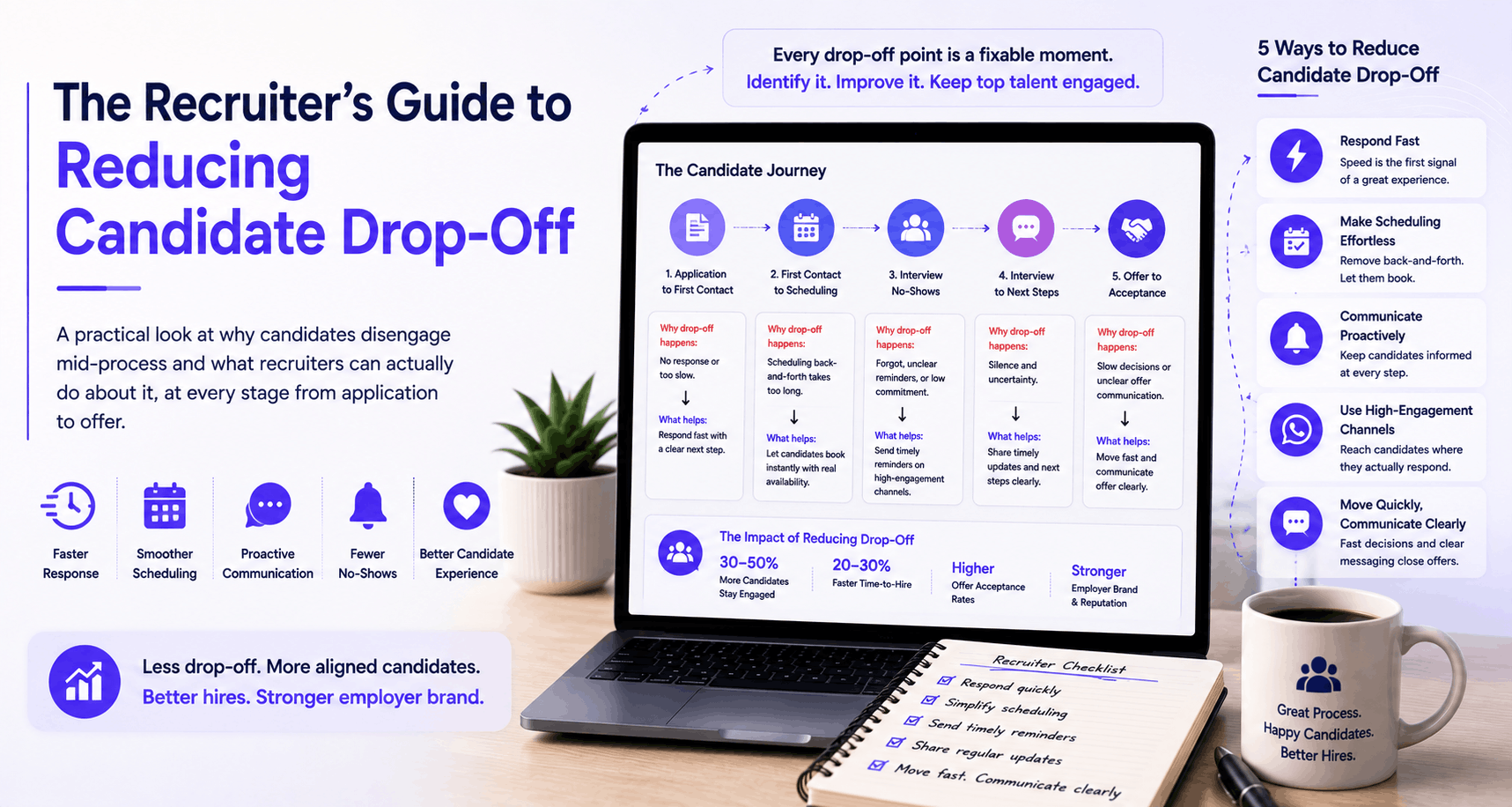
1. Between application and first contact
Why it happens: A candidate applies while motivated and interested, and then waits. If first contact takes too long — days, sometimes weeks — that initial motivation fades, or the candidate accepts a different opportunity that moved faster.
What helps: Speed of first response matters disproportionately here. Even an automated acknowledgment that sets a clear expectation ("we review applications within X days") keeps a candidate engaged rather than assuming they've been ignored. For genuinely interested candidates, moving first contact from "whenever a recruiter gets to it" to a defined, fast turnaround is one of the highest-leverage fixes available.
2. Between first contact and interview scheduling
Why it happens: This is one of the most common drop-off points, and it's almost entirely process friction, not candidate disinterest. Multiple rounds of "does Tuesday work?" over email, waiting on interviewer availability, or a scheduling process that takes several days of back-and-forth gives a candidate time to lose momentum — or accept a competing offer that moved faster.
What helps: Calendar-integrated scheduling that shows real availability and lets a candidate pick a slot directly removes almost all of this friction. Tools like Recruitkar's interview scheduling, which connect directly into Google/Outlook calendars and Meet/Zoom/Teams, exist specifically to collapse what would otherwise be days of email coordination into a single step.
3. Interview no-shows
Why it happens: Sometimes this genuinely reflects lost interest, but often it's simpler — a candidate forgot, didn't get a clear reminder, or the process felt impersonal enough that they didn't feel obligated to follow through or even cancel politely.
What helps: Automated reminders sent close to the scheduled time, through a channel the candidate is actually likely to see, meaningfully reduce no-show rates. In India specifically, a reminder sent via WhatsApp tends to get noticed faster than one buried in an email inbox, simply because of how people actually check the app throughout the day.
4. Between interview and next steps
Why it happens: This is where silence does the most damage. A candidate who interviews well and then hears nothing for a week or two — while the internal team is still deliberating, coordinating feedback, or simply hasn't gotten around to a follow-up — reasonably assumes they're being deprioritized, and starts looking elsewhere.
What helps: Even a brief "we're still reviewing candidates, expect to hear from us by [date]" update, sent proactively rather than only in response to a candidate chasing, keeps candidates engaged through what would otherwise feel like an uncomfortable void. This requires internal feedback collection to move fast enough to actually have something to report — a shared pipeline where interviewer feedback gets logged promptly, rather than scattered across separate emails, makes this kind of timely update realistic rather than aspirational.
5. Between offer and acceptance
Why it happens: By this stage, drop-off is often about competing offers, a slow or unclear offer process, or a mismatch between what was communicated during interviews and what the actual offer reflects.
What helps: Speed matters enormously here — a candidate weighing multiple offers will often lean toward whichever process felt clearer and faster overall, not just whoever offered marginally more. Setting expectations early about compensation range (ideally in the job description itself, so there's no late-stage surprise) reduces the risk of an offer landing meaningfully below what a candidate expected after investing weeks in your process.
The through-line: silence is the biggest driver of drop-off
Looking across every stage above, one pattern shows up repeatedly: candidates don't usually disengage because of a single bad interaction — they disengage because of an absence of communication that leaves them uncertain about where they stand, for long enough that pursuing a different opportunity starts to feel like the safer bet. This reframes the fix: reducing drop-off isn't primarily about making every individual interaction more impressive, it's about closing the gaps of silence between interactions, consistently, at every stage.
Practical fixes that work at any hiring volume
Set expectations explicitly, early. Tell candidates upfront roughly how many stages the process involves and a rough timeline — this doesn't prevent every drop-off, but it meaningfully reduces the anxiety-driven disengagement that comes from genuine uncertainty about what happens next.
Automate status updates, but keep them genuinely informative. A generic "your application is under review" sent once means little; brief, specific updates at each actual stage transition ("moving to interview," "still finalizing decisions, expect an update by Friday") do far more to keep a candidate engaged without requiring a recruiter to personally message every candidate.
Use the channel candidates actually check. Relying solely on email, particularly for candidates who don't check it constantly, means updates and reminders can go unseen for days. Sequencing communication across email, WhatsApp, and voice outreach — rather than picking one channel and hoping it lands — measurably improves response and follow-through rates.
Close the loop on internal feedback fast. A lot of "we haven't heard back from the candidate yet" delay actually traces back to "we haven't finished internal deliberation yet" — tightening how quickly interviewer feedback gets collected and a decision gets made directly reduces the silence candidates experience on the other end.
Don't disappear on rejected candidates either. It's tempting to deprioritize communicating with candidates who won't be moving forward, but leaving them in unexplained limbo damages your reputation with exactly the people most likely to talk about the experience publicly or discourage others from applying. A prompt, even brief, rejection message is a low-cost way to protect your funnel for future roles.
Be honest about timeline and compensation from the start. Surprises late in the process — a compensation offer well below expectations, a timeline that drags far longer than initially indicated — are some of the most damaging drop-off triggers, precisely because they feel like a breach of an implicit agreement made earlier in the conversation.
What NOT to do in the name of reducing drop-off
A few tempting shortcuts that tend to backfire:
- Over-messaging out of anxiety about losing a candidate. Multiple check-ins per day, or messages that feel more like pressure than genuine updates, can push a candidate away faster than silence would have.
- Rushing a decision just to beat a perceived competing offer. Making an offer prematurely, before proper evaluation is complete, risks a worse hiring decision — the goal is closing communication gaps, not skipping steps that genuinely matter.
- Overpromising on timeline or compensation to keep a candidate engaged. If reality doesn't match what was promised to keep someone in the pipeline, that gap becomes its own drop-off trigger later, often at a more costly stage (post-offer) than if expectations had simply been set accurately from the start.
Measuring drop-off properly
To actually improve this, it helps to track drop-off by stage specifically, rather than as one aggregate number. Calculate the percentage of candidates who disengage between each stage transition — application to first contact, first contact to interview, interview to next round, offer to acceptance — over a meaningful sample of recent hires. Whichever stage shows a disproportionately high drop-off rate relative to the others is where to focus first; fixing a stage that isn't actually your biggest leak won't move the overall number much. It's also worth periodically asking candidates directly, through a brief post-process survey (including ones who didn't get an offer), what parts of the experience felt unclear or frustrating — internal metrics alone won't always surface the specific friction candidates actually noticed.
The bottom line
Most candidate drop-off isn't really about candidates losing interest in the role — it's about candidates losing confidence that they know where they stand, for long enough that pursuing something else starts to feel safer than waiting in silence. The fixes that actually move this number aren't usually about making any single interaction more impressive; they're about closing the gaps between interactions consistently, so a candidate never has to wonder whether they've been forgotten. That's a solvable problem at any hiring volume — it just requires treating communication as a deliberate part of the process, not an afterthought squeezed in when there's time.